
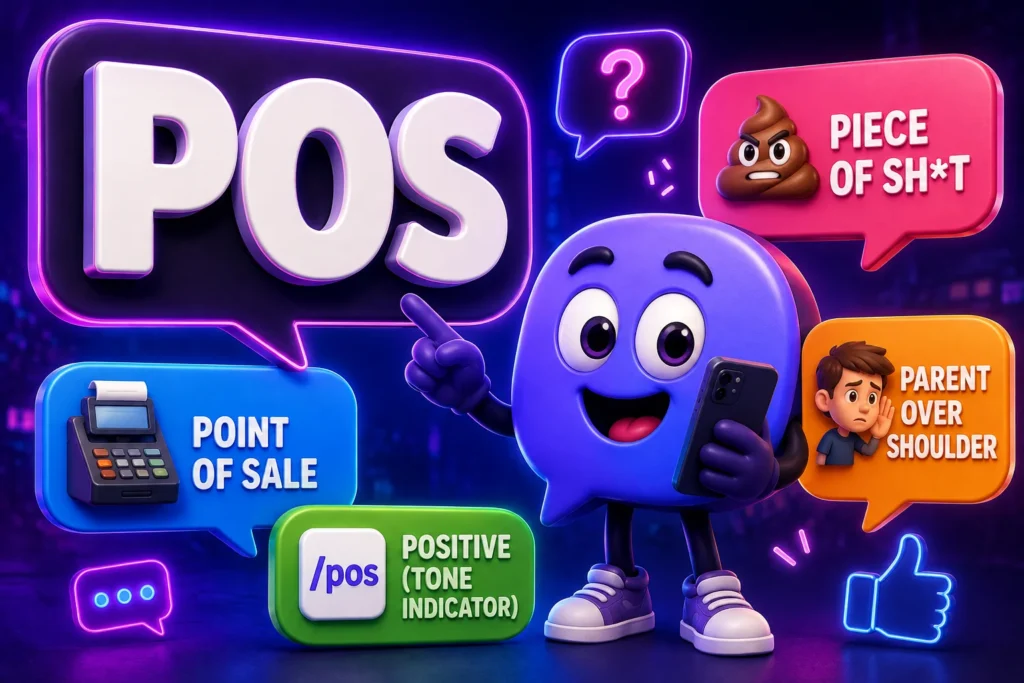
If you’ve seen POS in a text message, TikTok comment, Reddit thread, or group chat, it most commonly means “Piece of Sh*t,” a vulgar slang insult. However, depending on the conversation, POS can also mean “Parent Over Shoulder” in texting or “Point of Sale” in business. The correct meaning depends entirely on the context.
In this guide, you’ll learn every genuine meaning of POS, where it’s actually used, its real origins, how it differs from /pos, and when it’s appropriate—or inappropriate—to use it.
Quick Answer: What Does POS Mean?
| Abbreviation | Meaning | Type | Common? |
|---|---|---|---|
| POS | Piece of Sh*t | Slang acronym | ⭐⭐⭐⭐⭐ Very Common |
| POS | Parent Over Shoulder | Text abbreviation | ⭐⭐⭐ Less Common |
| POS | Point of Sale | Business abbreviation | ⭐⭐⭐⭐⭐ Outside slang |
| /pos | Positive (tone indicator) | Internet tone tag | ⭐⭐⭐ Growing in online communities |
One of the biggest misconceptions online is that POS and /pos mean the same thing. They don’t. The forward slash completely changes the meaning.
Which Category Does POS Belong To?
Depending on how it’s being used, POS fits into several different categories.
- Slang Text Meaning ✅
- Parent-Facing “Decode Your Teen’s Texts” ✅
- Gen Z / Social Media Slang ✅ (used, but not exclusive to Gen Z)
- Brainrot Slang ❌
- Dating/Relationship Slang ❌
- AI/Tech-Related Slang ❌ (although “Point of Sale” is a legitimate business term)
What Does POS Mean in Slang?
The most common meaning of POS is:
POS = Piece of Sh*t
It is an abbreviated form of a vulgar insult used to describe someone or something considered extremely bad, dishonest, unreliable, annoying, or low quality.
Instead of typing the full profanity, many people shorten it to POS, especially in text messages, online forums, social media posts, and gaming chats.
Examples include:
- “That scammer is a POS.”
- “This laptop is a POS.”
- “The customer service was POS.”
- “My old car is such a POS.”
The abbreviation can describe both people and objects, although calling a person a POS is usually much more offensive.
Is POS an Acronym or Slang?
Technically, it’s both.
It is an acronym because each letter represents one word in the phrase “Piece of Sh*t.”
It is also considered internet slang because it is widely used in casual digital communication rather than formal writing.
Today you’ll find POS in:
- Text messages
- Reddit discussions
- Gaming chats
- Discord servers
- X (formerly Twitter)
- TikTok comments
- Instagram comments
- Informal online conversations
All Real Meanings of POS
1. Piece of Sh*t (Most Common Meaning)
This is the meaning you’ll encounter most often online.
People use POS when they’re expressing strong frustration or disappointment.
It can describe:
- A dishonest person
- A broken appliance
- A terrible product
- A scam
- Poor customer service
- A malfunctioning vehicle
- A frustrating game
- An unreliable device
Examples:
“My printer is a POS.”
“Don’t buy that charger. It’s POS.”
“He’s a complete POS.”
“The new update is POS.”
The tone is almost always negative and intentionally harsh.
2. Parent Over Shoulder
A second, much less common meaning is:
POS = Parent Over Shoulder
This abbreviation was especially popular during the early days of instant messaging and SMS texting.
Teenagers used it to warn friends that a parent was nearby or watching the screen.
Example:
Alex: Can you sneak out tonight?
Sam: POS.
Alex: Got it. We’ll talk later.
Although this meaning still appears in lists of texting abbreviations, it is far less common today than the insulting meaning.
3. Point of Sale
Outside internet slang, POS often refers to:
Point of Sale
This is a business abbreviation used in retail and hospitality.
Examples include:
- Cash registers
- Checkout systems
- Credit card terminals
- Retail payment software
Example:
“Our POS system crashed this morning.”
This meaning has nothing to do with slang and is usually obvious from the business context.
4. /pos (Positive Tone Indicator)
This is where many people become confused.
Notice the forward slash.
/pos
means:
Positive
It is one of several tone indicators used online to clarify that a message is intended positively.
Example:
“Your drawing is terrifying /pos”
This means:
“I’m complimenting it.”
Without the slash:
POS
usually means Piece of Sh*t.
That tiny slash completely changes the meaning.
A Common Misunderstanding
Many people see a sentence like:
“Nice work /pos”
and assume they’ve been insulted.
In reality:
- POS = Piece of Sh*t
- /pos = Positive tone indicator
Always check whether the slash is present.
It’s one of the easiest internet abbreviations to misread.
Which Apps Is POS Used On?
Text Messages
Very common.
People use POS when complaining about:
- Broken electronics
- Bad service
- Terrible experiences
- Unpleasant people
Example:
“This phone is POS.”
Reddit is one of the places where POS appears most frequently.
You’ll often see it in discussions about:
- Cars
- Technology
- Gaming
- Politics
- Customer service
- Product reviews
Users frequently abbreviate profanity, making POS a familiar shorthand.
X (Formerly Twitter)
POS is also common on X, especially in replies and opinion posts where users criticize products, companies, celebrities, or public events.
The character limit encourages abbreviations, making POS convenient.
TikTok
POS appears in:
- Comment sections
- Video captions
- Replies
- Reaction videos
It’s usually used when criticizing someone’s behavior or expressing frustration with a product or trend.
You’ll occasionally see POS in comments and direct messages.
It isn’t as widespread as on Reddit or X, but it’s still recognizable.
Snapchat
Snapchat users may use POS to mean either:
- Piece of Sh*t
- Parent Over Shoulder
The surrounding conversation usually makes the intended meaning clear.
WhatsApp doesn’t have any unique meaning for POS.
People use it the same way they do in normal texting, primarily to describe something or someone negatively.
Grammar: How POS Works in a Sentence
POS functions most often as a noun or noun phrase substitute.
Examples:
“He’s a POS.”
“That car is a POS.”
“My laptop turned into a POS.”
It can also function as a complete reply.
Example:
Friend: How’s your printer?
You: POS.
Even though it’s only three letters, the abbreviation communicates a complete opinion.
Where Did POS Come From?
The abbreviation POS developed naturally from the longer English insult “Piece of Sh*t,” which has existed for decades. As online communication shifted toward faster typing in chat rooms, internet forums, SMS messages, and early instant messaging platforms during the late 1990s and early 2000s, people began shortening common phrases into initials. POS became one of many widely recognized internet abbreviations because it saved time while still conveying strong emotion.
The separate meaning Parent Over Shoulder appeared around the same period, particularly among teenagers using instant messaging services. It served as a quick warning that a parent was watching the conversation, signaling friends to change the topic or stop discussing something private. While this usage still exists, it has become much less common than the insulting meaning.
The newer /pos tone indicator has a completely different history. It originated in online communities that use tone tags—such as /j (joking), /srs (serious), and /gen (genuine)—to make written communication easier to interpret. In this context, /pos simply means positive and should never be confused with the older abbreviation POS.
Example Conversations
Funny
Alex: Did your lawn mower finally start?
Ben: Nope.
Alex: Again?
Ben: Biggest POS I’ve ever owned.
Sarcastic
Emma: How was customer support?
Ryan: Incredible.
Emma: Really?
Ryan: Yeah… if POS service is considered incredible.
Playful
Jake: My controller disconnected during the final match.
Chris: Time for a new one.
Jake: This POS somehow keeps surviving.
Serious
Sarah: Why did you stop talking to him?
Emily: He kept manipulating everyone.
Sarah: That’s awful.
Emily: Honestly, he’s a POS.
POS vs Similar Slang Terms
| Term | Meaning | Tone | Popularity | Confusion Risk |
|---|---|---|---|---|
| POS | Piece of Sh*t | Very Harsh | Very High | Medium |
| /pos | Positive tone indicator | Friendly | Medium | Very High |
| L | Failure or loss | Casual | Very High | Low |
| Trash | Low quality | Negative | High | Low |
| Mid | Average or disappointing | Mild | Very High | Low |
| Garbage | Worthless or terrible | Strong | High | Low |
| GOAT (Opposite) | Greatest of All Time | Positive | Very High | Low |
This comparison shows why context matters so much. While terms like mid or trash criticize something, POS is significantly stronger and usually carries a much harsher emotional tone.
More Real-Life POS Conversations
The following conversations show how POS appears naturally across different situations. Notice that the abbreviation doesn’t always refer to a person. In many cases, it’s used to describe a frustrating product, device, or experience.
Friends Texting
Mike: Did your old TV finally stop working?
Josh: Yep.
Mike: Are you getting it repaired?
Josh: Nope. That POS is going straight to the recycling center.
Group Chat
Emma: Who forgot the concert tickets?
Liam: Mark.
Mark: My phone battery died.
Emma: That POS battery has ruined everything again.
Gaming Chat
Player 1: My controller disconnected during the final round.
Player 2: Seriously?
Player 1: Yeah. This POS controller is officially retired.
Family Conversation
Dad: Did the washing machine get fixed?
Son: The repair technician checked it today.
Dad: What did they say?
Son: They said it’s an old POS and replacing it would cost less than repairing it.
Dating Conversation
Taylor: Are you still talking to your ex?
Jordan: Absolutely not.
Taylor: Why not?
Jordan: They treated everyone terribly. Total POS.
Workplace Chat
Coworker: Is the office printer working yet?
You: Barely.
Coworker: Again?
You: Same POS printer we’ve had for years.
Although coworkers sometimes speak this way casually, avoid using POS in professional emails or meetings.
Reddit Discussion
User 1: Is this laptop worth buying?
User 2: Mine lasted only six months.
User 1: That’s disappointing.
User 2: Complete POS. I’d look for another model.
X (Formerly Twitter)
User A: The latest update deleted all my settings.
User B: Same happened to me.
User A: This app has become a POS.
Snapchat
Friend: Why haven’t you replied today?
You: POS.
Friend: Your phone again?
You: Yep. It keeps freezing every few minutes.
Parent Over Shoulder Example
Friend: Can I tell you something about school?
You: POS.
Friend: Got it. I’ll wait.
Here, POS means Parent Over Shoulder, not the insult.
Tone Indicator Example
Friend: Your horror story genuinely scared me. /pos
Writer: Thank you!
Friend: I meant it as a compliment.
Because of the forward slash, /pos means positive, not Piece of Sh*t.
How Should You Reply to POS?
Your response should match the meaning and tone of the conversation.
Funny Replies
If someone is complaining about an object:
- “Sounds like it belongs in a museum.”
- “Time to give it a proper funeral.”
- “Have you tried turning that dinosaur off and on again?”
- “Looks like it’s ready for retirement.”
Serious Replies
- “That sounds really frustrating.”
- “Hopefully you can replace it soon.”
- “Maybe it’s time for an upgrade.”
- “I understand why you’re annoyed.”
Flirty Replies
If someone jokingly complains about an old phone or computer:
- “Maybe I should rescue you with a new one.”
- “I’ll lend you mine if you promise to text me more.”
- “Looks like your phone needs replacing—and maybe we should grab coffee while you’re shopping.”
Avoid flirty replies if POS is referring to a person or a serious situation.
Neutral Replies
- “That makes sense.”
- “I understand.”
- “Hopefully it gets sorted out.”
- “That’s unfortunate.”
Who Uses POS?
Unlike many modern slang expressions, POS isn’t associated with a single generation.
Gen Z
Gen Z commonly uses POS on Reddit, Discord, TikTok, X, gaming platforms, and text messages. However, they also use newer expressions like mid, L, or trash, so POS is just one of several negative slang terms.
Millennials
Millennials are among the most frequent users of POS because the abbreviation became popular during the era of internet forums, MSN Messenger, AIM, and early SMS texting. Many still use it naturally in online conversations today.
Gen X and Older Adults
Older internet users often use POS when describing unreliable cars, electronics, appliances, or poor customer service. They may also encounter it in business contexts where it means Point of Sale, so context is especially important.
Regional Differences
There is no reliable evidence that POS belongs to one English-speaking country. It appears in the United States, Canada, the United Kingdom, Australia, New Zealand, and many other English-speaking communities online. Its meaning remains largely consistent across these regions.
Is POS Rude or Safe?
Yes. In its most common slang sense, POS is considered vulgar because it abbreviates a profanity.
Is It Offensive?
Usually, yes.
Calling someone a POS is a strong insult and is likely to offend most people.
Can It Describe Objects?
Yes.
People frequently use POS to describe:
- Cars
- Phones
- Computers
- Printers
- Household appliances
- Games
- Software
- Low-quality products
Although it’s still informal and mildly vulgar, using POS for an object is generally viewed as less offensive than using it to insult a person.
Is It Appropriate at School?
Generally no.
Many schools treat POS as profanity because everyone understands the phrase it represents.
Is It Appropriate at Work?
Avoid using POS in:
- Business emails
- Meetings
- Presentations
- Customer support
- Workplace messaging with clients
Among close coworkers, you might hear it in casual conversations, but it isn’t appropriate for professional communication.
Why Has POS Stayed Popular?
Many internet abbreviations disappear after a few years, but POS has remained recognizable for decades because it’s short, memorable, and immediately communicates strong frustration. Three letters are enough to express an opinion that would otherwise require a full sentence.
Another reason it has survived is that it softens the appearance of the profanity without hiding the meaning. Most readers instantly understand what POS stands for, yet many people feel more comfortable typing the abbreviation than writing the full phrase. That balance between convenience and emotional impact has helped keep it relevant from early internet forums to today’s social media platforms.
Frequently Asked Questions
Does POS always mean “Piece of Sh*t”?
No. Although that’s by far the most common slang meaning, POS can also mean Parent Over Shoulder in texting or Point of Sale in retail and business. Reading the surrounding conversation is the best way to determine which meaning applies.
Is POS worse than calling someone “trash”?
Generally, yes. POS contains an implied profanity and is considered a much harsher insult than words like trash, bad, or annoying. It communicates stronger anger and disrespect.
Is POS used on TikTok?
Yes. POS appears in TikTok comments, captions, and replies, usually when users criticize someone’s behavior, complain about a product, or react negatively to a situation. It is less common in spoken videos than in written comments.
What’s the difference between POS and /pos?
They have completely different meanings. POS usually means Piece of Sh*t, while /pos is a tone indicator meaning positive. The forward slash is essential and should never be ignored.
Can POS describe broken electronics or cars?
Absolutely. Many people use POS to describe old vehicles, malfunctioning phones, slow computers, broken printers, or unreliable appliances. In these situations, it refers to the object rather than a person.
Should parents know what POS means?
Yes. Parents who monitor text messages should know that POS most often refers to the insulting phrase Piece of Sh*t. However, in some conversations—especially older texting styles—it may simply mean Parent Over Shoulder, so context should always be considered.
Is POS considered hate speech?
No. POS is an insult and a profanity-based abbreviation, but it is not inherently hate speech. Whether it becomes abusive depends on how it is used and who it is directed toward.
Can I use POS in professional writing?
No. Because POS represents a vulgar expression, it is inappropriate for professional emails, reports, presentations, customer communication, or academic writing. If you need to criticize something professionally, use alternatives like poor quality, unreliable, or unsatisfactory instead.
Conclusion
In most online conversations, POS stands for “Piece of Sh*t,” a strong slang abbreviation used to describe someone or something considered terrible, dishonest, unreliable, or extremely low quality. Although it can also mean Parent Over Shoulder in texting and Point of Sale in business, those meanings are much more context-specific.
One of the biggest sources of confusion is /pos, which is not an insult. With the forward slash, it becomes a positive tone indicator used to clarify friendly intent in online conversations.
Whenever you see POS, take a moment to look at the surrounding discussion. If people are talking about a broken phone, a frustrating product, or someone’s behavior, it almost certainly refers to the slang insult. If the conversation is about retail systems, it likely means Point of Sale. And if you see /pos, remember that the slash changes everything.