
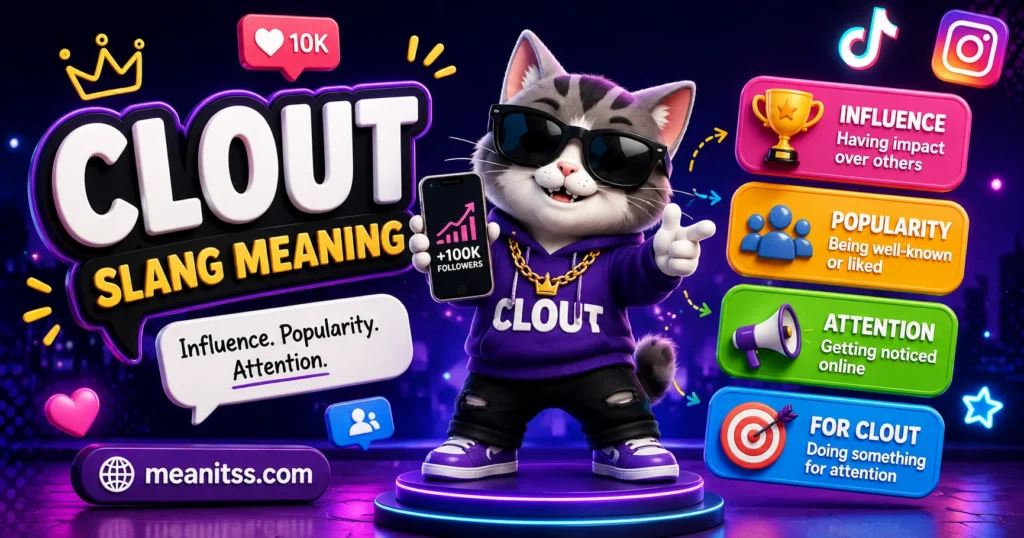
Clout slang meaning is influence, popularity, fame, or social attention, especially online. If someone says a person is “doing it for clout,” they usually mean that person is seeking attention, recognition, or online popularity.
What Does Clout Mean in Slang?
In modern internet slang, clout means social influence, popularity, fame, or the ability to attract attention.
Someone with clout may have a large following, a strong reputation, or enough recognition that other people pay attention to what they say or do.
For example:
“She has serious clout on TikTok.”
This means she has significant influence or recognition on TikTok.
You might also see:
“He only posted that for clout.”
Here, the speaker is suggesting that the person posted it mainly to get attention, views, followers, or publicity.
Merriam-Webster describes the modern slang sense of clout as attention, fame, popularity, and sometimes notoriety, particularly the kind associated with social media.
The important detail is that clout is not exactly the same thing as fame.
Fame means being widely known. Clout goes a step further by suggesting that someone’s recognition gives them influence, social weight, or the ability to attract attention.
That distinction becomes especially useful when someone says:
“She has clout.”
They may not mean she is a celebrity. They may mean that within a particular online community, she carries enough influence for people to notice or follow what she does.
Is Clout Actually Slang?
Yes and no.
Clout is a real English word, not a word invented by Gen Z or social media. Its established dictionary meanings include power or influence, as well as older meanings involving a blow or hit. Cambridge defines the influence sense as power and influence over people or events.
The newer internet-slang sense narrows that broader idea of influence into online popularity, attention, recognition, and social status.
So calling clout “slang” is reasonable when discussing its social-media usage, but the word itself is much older than the internet.
It is also not an acronym or abbreviation. It is an ordinary English word that developed additional informal meanings over time.
Clout vs. Attention: They Are Not Quite the Same
One of the most useful distinctions is between attention and clout.
Attention is simply people noticing you.
Clout suggests that the attention has some kind of social value or influence attached to it.
Imagine someone posts a strange video and gets one million views. That person has received enormous attention.
But if those views turn into followers, recognition, credibility, invitations, opportunities, or influence over an audience, people may describe that person as having clout.
That is why:
Attention = people notice you.
Clout = your recognition or influence carries weight.
The two overlap heavily online, which is why people sometimes use “clout” simply to mean attention. Community discussions about the term show this overlap, with users describing it variously as popularity, attention, influence, or the power that comes from being well known.
What Does “For Clout” Mean?
The phrase “for clout” means doing something primarily to gain attention, popularity, influence, or recognition.
For example:
“He started that argument for clout.”
The speaker believes the argument was partly or entirely motivated by the attention it could generate.
Another example:
“She posted the private conversation for clout.”
This suggests that the person shared something publicly because the resulting reactions, views, or discussion could increase her visibility.
The phrase can be neutral in some situations, but it often carries criticism.
Someone accused of doing something “for clout” is frequently being portrayed as attention-seeking or performative.
What Is a Clout Chaser?
A clout chaser is someone who deliberately tries to gain fame, attention, influence, or social status, particularly through other people’s popularity or controversial situations.
For example:
“He keeps starting drama with famous creators just to become a clout chaser.”
The accusation is not simply that he wants attention. It suggests that he is using people, trends, drama, or controversy as a route to greater visibility.
The phrase clout chasing is therefore more negative than simply “having clout.”
Having clout can be neutral or positive.
Being accused of chasing clout often implies that someone is trying too hard to obtain it.
Merriam-Webster notes that modern clout is often something people seek or chase, and that “clout chasing” is commonly discussed with a negative or dismissive tone.
What Does “No Clout” Mean?
If someone says:
“He has no clout.”
they mean that the person has little influence, recognition, or social importance in the particular context being discussed.
It does not necessarily mean the person is completely unknown.
For example, a person could have no clout in the gaming community but considerable influence in their workplace or local community.
This is one reason clout is better understood as contextual influence rather than simply celebrity status.
Where Is Clout Used Online?
Clout is strongly associated with internet and social-media conversations.
TikTok
TikTok is one of the clearest modern contexts for the term. TikTok’s own newsroom has used “clout” when discussing creators, viral videos, trends, and popularity.
You might see:
“Bro is doing this for clout.”
or:
“She gained so much clout from that video.”
The word is also used in discussions about social-media influence, followers, engagement, creators, and online reputation. Social-media glossaries commonly describe clout in relation to Instagram and other major social platforms.
X
Clout is also common in posts and discussions on X, particularly when people criticize someone for seeking attention through controversy, viral posts, or public arguments. Merriam-Webster’s recent examples include actual social-media usage of “clout,” including examples from X.
Snapchat and WhatsApp
There is no strong reason to treat clout as a Snapchat- or WhatsApp-specific expression. People can certainly use the word in conversations on those services, but clout is a general internet term rather than a platform-specific slang word.
That distinction matters: the word is associated with online culture broadly, not with one particular app.
How Is Clout Used Grammatically?
In its influence/popularity sense, clout is primarily a noun.
It is generally an uncountable noun when referring to influence.
Natural examples include:
“She has a lot of clout.”
“He gained clout after the video went viral.”
“That creator has serious clout.”
“They’re using the controversy to get clout.”
You normally would not say:
“She has three clouts.”
That does not work for the modern influence meaning.
Common phrases with clout
Some established expressions include:
- have clout — possess influence
- gain clout — become more influential
- lose clout — become less influential
- get clout — gain attention or social influence
- for clout — for attention or popularity
- clout chasing — actively seeking attention or influence
- clout chaser — a person who seeks it
The word clout also exists as a verb in other dictionary senses, particularly meaning to hit forcefully, but that is a different meaning from the modern social-media usage.
Where Did the Word Clout Come From?
This is where the word gets surprisingly old.
Clout did not originate on TikTok, Instagram, or in modern internet culture.
Etymonline traces the noun back to Old English clūt, meaning a lump or piece of material, including a patch of cloth. Over time, the word developed other senses, including a blow or strike.
The influence meaning developed much later.
Merriam-Webster explains that by the mid-20th century, clout was being used in American English to mean power or influence, with the idea connected metaphorically to the force of a blow.
Dictionary.com notes that the political-influence sense appeared well before Instagram and later gained new life as social media made popularity and influence easier to observe through followers, likes, and other metrics.
There is some disagreement over the exact earliest appearance of the influence sense. Historical discussion has identified examples from the 19th and 20th centuries, so it would be inaccurate to claim one specific person invented the modern meaning.
The safest history is:
Old English “clūt” → physical/material meanings → “blow” or force → power/influence → modern online influence and popularity.
There is also no reliable evidence that clout originated specifically as AAVE slang. Modern internet usage may overlap with hip-hop and online youth culture, but the word’s documented history is considerably older than those communities. Its influence meaning existed in American English before today’s social-media culture.
4 Short Conversations Using Clout
Funny
Jake: Why did you post 14 pictures of your cat?
Mia: Because he deserves clout.
Jake: He’s literally asleep.
Mia: Exactly. He’s building his brand.
Sarcastic
Ryan: He made another video about that argument.
Ella: Of course.
Ryan: Think he’s still upset?
Ella: No, I think he’s just collecting clout.
Playful
Lena: You got 50,000 views!
Chris: Finally, I have clout.
Lena: Don’t let it change you.
Chris: Too late. I’m famous now.
Serious
Marcus: Why did she post the screenshots publicly?
Nina: She said people needed to know what happened.
Marcus: Do you think that was the only reason?
Nina: Honestly, I think the attention gave her some clout too.
10 More Natural Clout Conversations
Friends
Aiden: Did you see Sam’s new video?
Noah: Yeah, it blew up overnight.
Aiden: He’s got serious clout now.
Noah: His comments are completely packed.
Family
Mom: Why is your cousin suddenly posting every detail online?
Alex: She wants more followers.
Mom: Is that what you call clout?
Alex: Pretty much.
Coworkers
Maya: Why is Daniel posting about the project before it’s finished?
Chris: Probably wants some professional clout.
Maya: That could backfire.
Chris: Definitely.
Dating
Ella: Your ex mentioned you again online.
Ryan: Seriously?
Ella: Yeah.
Ryan: Sounds like she’s trying to get clout from the situation.
Group Chat
Leo: Who posted that screenshot?
Sam: Kevin.
Leo: Why?
Sam: Probably for clout. Everyone’s talking about him now.
TikTok
Nora: Did you see her response video?
Kayla: Yep.
Nora: She turned the whole argument into content.
Kayla: That’s one way to get clout.
X
Ben: That post has 80,000 likes.
Chris: And the replies are fighting nonstop.
Ben: That’s a lot of clout.
Chris: Or a lot of chaos.
Gaming
Tyler: Why did he challenge the top-ranked player?
Max: Probably wanted attention.
Tyler: You think he’s chasing clout?
Max: That’s my guess.
Creator Conversation
Jade: Brands started contacting her after that video.
Mia: That’s what online clout can do.
Jade: Views turned into opportunities.
Mia: Exactly.
School
Ethan: Why is everyone suddenly following Noah?
Liam: His prank video went viral.
Ethan: So he has clout now?
Liam: At school, apparently.
How to Reply When Someone Says “Clout”
Your response depends on whether the speaker is being serious, joking, or accusing someone of chasing attention.
Funny reply
“Congrats on your three seconds of internet fame.”
Serious reply
“I don’t think attention is the same thing as influence.”
Flirty reply
“You don’t need clout. You already have my attention.”
Neutral reply
“Yeah, I can see why that would get attention.”
If someone says:
“He only did it for clout.”
a natural response could be:
“Maybe, but we don’t really know his intention.”
That works particularly well when the accusation is based on speculation.
Clout vs. Similar Terms
| Term | Meaning | Tone | Popularity | Confusion Risk |
|---|---|---|---|---|
| Clout | Influence, recognition, social attention, or online status | Casual | Very high online | Low |
| Influence | Ability to affect people, decisions, or opinions | Neutral | Very high | Medium |
| Fame | Being widely known | Neutral | Very high | Medium |
| Popularity | Being liked or recognized by many people | Neutral/casual | Very high | Medium |
| Credibility | Being considered trustworthy or knowledgeable | Neutral/formal | Very high | High |
| Obscurity | Lack of public recognition or attention | Neutral | Medium | Low |
The biggest distinction is between clout and credibility.
A person can have enormous clout without being an expert.
For example, a popular creator may influence thousands of people while having no professional qualification in the subject they discuss.
Likewise, someone can have strong credibility without much clout.
A respected researcher might have excellent expertise but very few social-media followers.
That is an important difference that short slang definitions often overlook.
Who Uses the Word Clout?
Clout is strongly associated with internet culture, social media, creators, influencers, and younger online communities, but it is not exclusively a Gen Z word.
The word’s influence meaning existed long before Gen Z, and older forms such as “political clout” remain ordinary English.
The modern online meaning became especially visible as social platforms created measurable forms of popularity: followers, views, likes, shares, and viral reach.
There is no strong evidence that the slang meaning belongs exclusively to Americans or to one specific U.S. region.
There are, however, differences in older meanings. In British English, for example, clout can also refer to a hard hit, particularly in informal expressions such as getting “a clout round the ear.” Cambridge and Oxford both document the physical-hit meaning.
So a British speaker using “clout” does not necessarily mean online popularity.
Is Clout Rude or Offensive?
Clout itself is not profanity or a slur.
It is generally safe to use in casual conversation, social media, and informal writing.
The potentially negative part comes from how the word is used.
Saying:
“She has a lot of clout.”
can be neutral or complimentary.
Saying:
“He’s desperate for clout.”
is clearly critical.
Calling someone a clout chaser can also be insulting because it suggests they are attention-seeking or willing to exploit situations for popularity.
For school or professional communication, “clout” may be understood, but influence, reputation, or professional standing is often clearer and more appropriate.
There is also no need to treat the word as inherently offensive because of its association with internet slang. The tone comes from the sentence and the speaker’s intention.
Why Does Clout Work So Well in Online Conversation?
Clout became especially useful because the internet turned influence into something people could see.
Before social media, someone could have influence because they were wealthy, politically connected, respected, famous, or professionally powerful. Online platforms added visible measurements of attention: follower counts, views, likes, shares, comments, and viral reach.
“Clout” compresses all of that into one short word.
It can describe the social value attached to being noticed.
That also explains why “clout” can be both positive and negative. Someone can gain clout because they created something impressive, helped people, became famous, or built genuine expertise. Another person can chase clout by manufacturing drama simply because controversy attracts attention.
The word works because it describes not just being seen, but the perceived social power that can come from being seen.
FAQ About Clout Slang Meaning
What does clout mean in slang?
Clout means influence, popularity, fame, or social attention, especially online. It can describe the recognition a person has within a particular community or audience. The word often suggests that the person’s popularity gives them some degree of social influence.
What does “doing it for clout” mean?
“Doing it for clout” means doing something mainly to gain attention, recognition, followers, views, or popularity. It is often used as a criticism of someone whose behavior seems performative. The speaker is questioning the person’s motivation rather than simply describing their popularity.
What is a clout chaser?
A clout chaser is someone who actively seeks fame, attention, or influence, often by attaching themselves to popular people, trends, controversies, or viral situations. The phrase usually has a negative tone. It suggests that the person cares more about attention than the underlying situation.
Does clout mean fame?
Clout can include fame, but the two words are not identical. Fame means being widely known, while clout emphasizes the influence or social weight that can come with recognition. Someone can be famous without having much meaningful influence in a particular community.
Does clout mean popularity?
Popularity is part of the modern slang meaning of clout, but clout can imply more than simply being liked. A person with clout may have enough recognition or influence to affect conversations, trends, opinions, or opportunities. In online slang, the terms often overlap.
Is clout a Gen Z word?
Clout is strongly associated with modern internet and youth culture, but it is not a Gen Z invention. The word has been used for power and influence in English for much longer, and its documented history reaches back centuries. Social media gave the word a newer meaning centered on online attention and popularity.
Is clout positive or negative?
It can be either. Having clout can simply mean having influence or recognition, which may be positive or neutral. However, phrases such as “clout chasing” and “doing it for clout” usually carry a negative suggestion that someone is seeking attention for the wrong reasons.
Can you use clout in a professional setting?
You can, but context matters. “Political clout” or “professional clout” can sound perfectly natural, while calling a coworker a “clout chaser” is much more informal and potentially insulting. In formal writing, influence, authority, reputation, or professional standing may communicate the idea more precisely.
Conclusion
The simplest clout slang meaning is influence, popularity, fame, or social attention, particularly online.
But clout is more precise than simply saying “attention.” It often describes the social power or recognition that comes from being noticed.
If someone says:
“She has clout.”
they probably mean she has influence or recognition.
If they say:
“He did it for clout.”
they probably mean he wanted attention or popularity.
And if they call someone:
“A clout chaser,”
they are usually criticizing that person’s attempt to gain attention or influence.
The word itself is much older than social media. Its history developed from older meanings connected with material, blows, and force before the influence sense emerged in American English. Modern platforms then gave that influence a new digital form that could be measured through followers, views, likes, and viral reach.
So don’t assume clout automatically means fame, and don’t assume every person with clout is a clout chaser. Having influence and chasing influence are two different things.