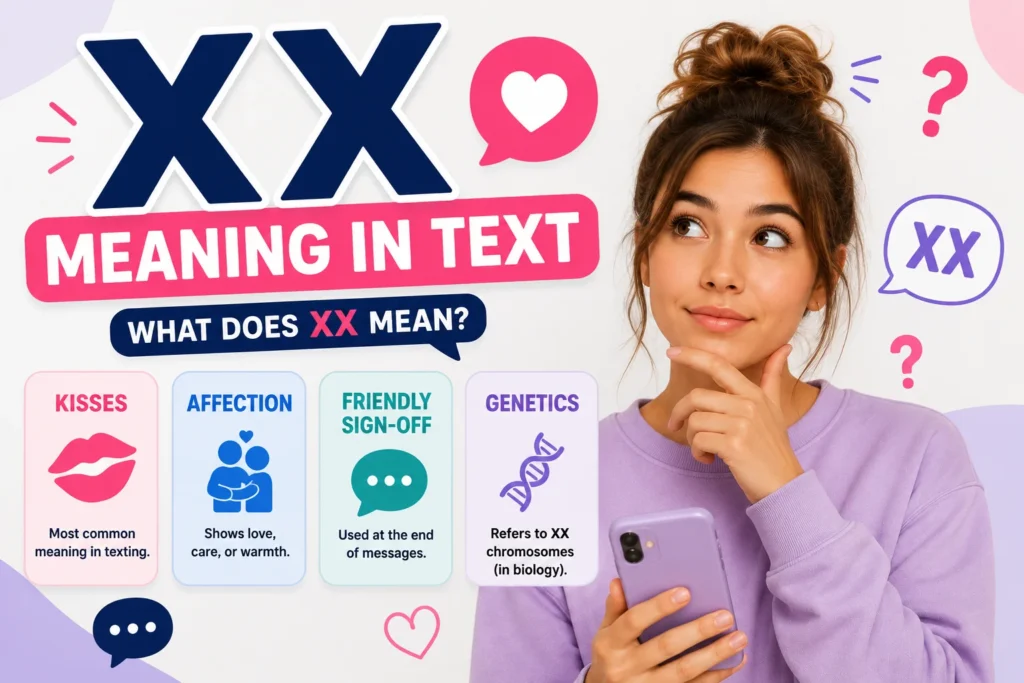
XX means “kisses” when it appears at the end of a text message, used to show affection, warmth, or friendliness toward the person you’re messaging. Each X represents one kiss, so XX signals two.
People search this because “xx” shows up constantly at the end of otherwise ordinary texts, and without knowing the convention, it’s genuinely unclear whether it’s romantic, just friendly, or accidental. This guide breaks down exactly what it means, how intense it is, and how to tell the difference between platonic and romantic use.
Meaning & Explanation
The Primary Meaning: Kisses
In texting, XX overwhelmingly means “kisses,” with each X standing in for one kiss. It’s typically placed at the very end of a message, functioning as a warm, affectionate sign-off rather than part of the main sentence — similar to ending a letter with “love” or “take care,” just condensed into two characters.
A Secondary, Unrelated Meaning: XX Chromosomes
Outside of texting, XX also refers to the XX chromosome pair in genetics, which determines female biological sex in humans. This meaning is entirely unrelated to the texting usage and almost never causes real confusion, since the context — a genetics discussion versus the end of a casual message — makes the intended meaning obvious immediately.
Is It an Acronym, Abbreviation, or Slang Word?
XX is neither a true acronym nor an abbreviation, since the letters don’t stand for other words. It’s better described as a symbolic convention — a repeated character used as a stand-in for a kiss, the same way “O” stands in for a hug in “XOXO.” It functions as informal texting slang, but structurally it behaves more like a small piece of shorthand notation than a compressed phrase.
Platform Breakdown
XX in Texting and SMS
This is the term’s home base — XX is most commonly used at the end of regular text messages between friends, family, or partners, exactly as it has been used in handwritten letters for generations.
XX on WhatsApp
On WhatsApp, XX appears frequently as a casual sign-off in personal chats, especially among users in the UK and Ireland, where the convention is deeply embedded in everyday texting habits.
XX on Instagram
On Instagram, XX shows up in comments and DMs, often added to a supportive or affectionate comment on a friend’s post rather than as a standalone message.
XX on TikTok
On TikTok, XX appears in comment sections, typically as a quick, warm addition to a supportive comment, similar to how someone might add a heart emoji.
XX on Snapchat
On Snapchat, XX is used the same way as in regular texting — a quick, affectionate close to a chat message between friends or partners.
XX is less common on X (formerly Twitter), since public posts on that platform tend to favor a more public, less personal tone than the direct, one-to-one messaging style where XX naturally fits.
Tone & Context Variations
Funny
A: you seriously ate my leftovers didn’t you
B: guilty as charged, sorry xx
A: an apology with a kiss doesn’t fix this
B: it does a little though, right?
Sarcastic
A: thanks for reminding me about the deadline for the third time today
B: just looking out for you xx
A: sure you are
B: someone has to keep you on track
Playful
A: guess who just got tickets to the concert
B: shut up, no way!!
A: way. see you there xx
B: I’m actually so excited now
Serious
A: I know today was really hard, I’m sorry I couldn’t be there
B: it’s okay, I understood. thank you for checking in on me xx
A: always. call me if you need anything tonight
B: I will, thank you, that means a lot
Real Chat Examples
Checking in after a night out
A: made it home safe, night xx
B: glad you're back okay, sleep well xx
A: you too
B: night 💤
Instagram comment on a wedding photo
A: you looked incredible at the wedding
B: stop it, thank you so much xx
A: I mean it, you should wear that color more
B: noted, appreciate you 😊
Quick errand request
A: can you pick up milk on your way home
B: already on it, see you soon xx
A: you're the best
B: I know 😌
Sibling birthday text
A: happy birthday, hope today's a good one
B: thank you so much, love you xx
A: love you too, call me later
B: will do, talk soon
Smoothing over a small argument
A: sorry again about earlier, I overreacted
B: it's really fine, don't worry about it xx
A: you're too nice honestly
B: just being real with you
TikTok comment exchange
A: this video made my whole week, thank you for sharing
B: aw thank you for watching xx
A: of course, following you now
B: welcome to the page 🥹
Checking in on a friend’s family
A: just wanted to check in, how's your mom doing
B: a bit better today, thank you for asking xx
A: sending love to you both
B: it means more than you know
WhatsApp running-late message
A: running 10 minutes late, so sorry
B: no worries at all, see you soon xx
A: you're a lifesaver
B: don't be silly, it's fine
Checking in after a rough day
A: thinking about you today, hope work isn't too rough
B: it's been a lot honestly, but this text helped xx
A: here whenever you need to vent
B: thank you, truly
Snapchat plans for the weekend
A: can't wait to see you this weekend
B: counting down the days xx
A: same, it's been way too long
B: agreed, missed you
Post-interview check-in
A: hope the interview went well today
B: think it went okay, nervous about hearing back xx
A: you'll do great, try not to overthink it
B: trying my best, thanks for checking in
Wrapping up a catch-up call
A: loved catching up with you today
B: me too, let's not wait so long next time xx
A: agreed, same time next month?
B: works for me 😊
Grammar & Language Role
Part of Speech
XX doesn’t fit a standard part-of-speech category — it functions as a symbolic valediction, similar to how “sincerely” or “love” closes a letter, rather than as a noun, verb, or adjective.
Sentence Position
It almost always appears at the very end of a message, either directly after the last word or on its own line, and rarely appears mid-sentence.
Can It Replace a Full Sentence?
Yes — XX can function as a complete, standalone reply on its own, often used as a quick acknowledgment or warm close when no further words are needed.
Formal vs. Informal Register
Strictly informal and personal. It’s appropriate for friends, family, and partners, but it never belongs in professional or formal communication, where it would read as inappropriately intimate.
How to Reply
Funny Reply
“Oh so NOW you’re being sweet to me 😏 xx”
Serious Reply
“Thank you, that really means a lot to me xx”
Flirty Reply
“Only two? I think you owe me a few more xx”
Neutral/Unbothered Reply
“Haha okay, talk soon” (simply not mirroring the XX signals a more casual, low-key tone without being rude).
Comparison Table
| Term | Meaning | Usage Context | Tone | Popularity | Confusion Risk |
|---|---|---|---|---|---|
| XX | Kisses | Ending texts, comments, DMs | Warm/affectionate | Very High | Medium (romantic vs. platonic ambiguity) |
| X | One kiss | Same as XX, slightly lighter | Warm | High | Medium |
| XOXO | Hugs and kisses | Text and social media sign-offs | Warm/playful | Very High | Low |
| XO | Kiss and a hug | Slightly more casual than XOXO | Warm | High | Low |
| :* | Kiss emoticon | Quick affectionate reaction in chat | Playful/warm | Moderate | Low |
| K | Blunt, short acknowledgment (opposite tone) | Terse or cold-sounding reply | Flat/cold | Very High | Low |
Who Uses This Term
Age Group Breakdown
XX is used across nearly all age groups, since it predates digital texting entirely and was already a standard part of handwritten and email correspondence before smartphones existed. It remains common among teens, young adults, and older users alike.
Gen Z vs. Millennials
Millennials and older Gen X users tend to use XX as a direct, sincere sign-off, carried over from earlier texting and email habits. Gen Z is more likely to pair it with emojis or use it more loosely and casually, sometimes as light punctuation rather than a deeply meaningful gesture.
Regional Usage
XX is especially embedded in UK and Irish texting culture, where it’s a near-universal, casual close to messages between friends, family, and partners, reflecting the term’s British handwritten-letter origins. It’s also used in the US, though generally with a bit more emphasis on romantic or close-friend context rather than as a fully default, everyday sign-off.
Platforms
The kisses meaning dominates across texting, WhatsApp, Instagram, TikTok, and Snapchat. The chromosome meaning appears only in scientific, medical, or educational contexts and essentially never in casual messaging.
Origin & Internet Culture
The use of “X” to represent a kiss has a genuinely old, well-documented history. According to the Oxford English Dictionary, the earliest known written use of X in this sense appears in a 1763 letter from British naturalist Gilbert White, though some historians, including Duke University researcher Stephen Goranson, argue White’s X’s more likely represented blessings rather than kisses, given their pairing with religious phrases.
A clearer, unambiguous example appears later, in an 1878 novel by Florence Montgomery, which explicitly describes “a row of kisses” shown as a line of X’s. The broader tradition traces back even further to the Middle Ages, when people who couldn’t write signed documents with an X, which was then kissed as a symbol of sincerity — similar to swearing an oath.
As handwritten letters gave way to email and then SMS texting in the early 2000s, XX carried over almost unchanged, becoming one of the few pieces of “digital slang” that actually predates digital communication by centuries.
Its continued use on TikTok, Instagram, and WhatsApp today isn’t really a case of internet culture inventing something new — it’s closer to a centuries-old convention finding a new home in each successive form of written communication.
Safety & Appropriateness
XX is not offensive, profane, or explicit. It’s a warm, affectionate gesture appropriate for casual conversations with friends, family, or partners. It is, however, too personal and informal for professional or workplace communication, where it can come across as inappropriately intimate, even if unintentionally so. There are no significant cultural sensitivity concerns tied to the term, though its intensity and frequency of use does vary by region — it’s treated as a near-default sign-off in the UK and Ireland, while in some other English-speaking regions it can carry a slightly stronger romantic or close-friend connotation.
Real-World Observation
What makes XX genuinely interesting is that it’s one of the only pieces of everyday texting shorthand that never had to adapt to fit digital communication — it simply moved over unchanged from handwritten letters, first to email, then to SMS, then to every messaging app since.
Most texting slang exists because typing is slower than speaking, but XX isn’t really a shortcut for anything; “kisses” isn’t a long or difficult word to type. Its real function is emotional rather than practical: it lets someone add a small, low-effort signal of warmth to a message without having to spell out a feeling in words, which is exactly why it still gets attached to something as mundane as “running late” or “pick up milk on the way home.” The gap between the simplicity of the symbol and the warmth it can convey in the right relationship is what has kept it in constant, largely unchanged use for well over a century.
FAQ
What does XX mean in a text message?
Quick answer: “Kisses,” added as a warm sign-off. XX means “kisses” and is typically added to the end of a text message to show affection, warmth, or friendliness. It doesn’t have to be romantic — it’s just as commonly used between close friends and family members.
Is XX romantic or just friendly?
Quick answer: Depends entirely on the relationship. It can be either, depending on who’s sending it and the nature of your relationship with them. A parent, sibling, or close friend using XX is almost always platonic, while a romantic partner or someone you’re dating using it typically carries a warmer, more intimate meaning.
Does XX always mean the same thing on every platform?
Quick answer: Yes, the meaning stays consistent. Yes, the “kisses” meaning stays consistent across texting, WhatsApp, Instagram, TikTok, and Snapchat. The only unrelated meaning, the XX chromosome pair, only appears in scientific or medical contexts and is easy to distinguish from casual messaging.
Is it okay to send XX to a coworker?
Quick answer: No, it’s too personal for work messages. No, XX is too informal and personal for professional communication, even with a coworker you’re friendly with. It’s best reserved for personal texts with friends, family, or partners rather than any work-related messaging.
What’s the difference between X and XX?
Quick answer: XX is generally a bit warmer than a single X. A single X represents one kiss and reads as slightly lighter or more casual, while XX (two kisses) is a bit warmer, though the difference in intensity is subtle rather than strict. Some people add even more X’s for extra emphasis, though this is more about personal texting style than any fixed rule.
Where did XX come from as a symbol for a kiss?
Quick answer: A centuries-old British letter-writing tradition. The tradition dates back centuries in British letter writing, with the Oxford English Dictionary tracing the earliest documented use to a 1763 letter, and clearer, unambiguous examples appearing by the late 1800s. It carried over largely unchanged through email and into modern texting.
Should I be worried if someone I just met texts me XX?
Quick answer: Not necessarily — check the overall tone. Not necessarily — in regions like the UK and Ireland, XX is such a common, casual sign-off that it doesn’t always signal romantic interest. Pay attention to the overall tone of the conversation rather than reading too much into the XX alone.
Is XX still commonly used in 2026?
Quick answer: Yes, it remains a widely used sign-off. Yes, XX remains extremely common, particularly in the UK and Ireland, and continues to appear across texting and messaging apps alongside emojis rather than being replaced by them. It has proven to be one of the more durable pieces of everyday digital communication.
Conclusion
XX means “kisses” in texting, used as a warm, affectionate sign-off between friends, family, or partners, with its meaning shaped far more by the relationship it’s used in than by the symbol itself.
Usage tips:
- Use it as a warm close to a message rather than mid-sentence.
- Read the relationship, not just the symbol, to judge romantic versus platonic intent.
- Keep it out of professional or work-related messages entirely.
- Match the other person’s usage rather than escalating with extra X’s if you’re unsure of the tone.
Common mistakes
- Assuming XX is always romantic, when it’s frequently platonic, especially in UK and Irish texting culture.
- Sending it in professional contexts, where it reads as inappropriately personal.
- Overanalyzing a single XX from someone you just met, rather than reading the full conversation.
- Confusing the texting meaning with the unrelated genetics meaning, which almost never actually causes real confusion in context.
When to use it
In casual, warm texts with friends, family, or partners.
When to avoid it
In professional emails, workplace chats, or messages to people you don’t know well enough to gauge their comfort with it.