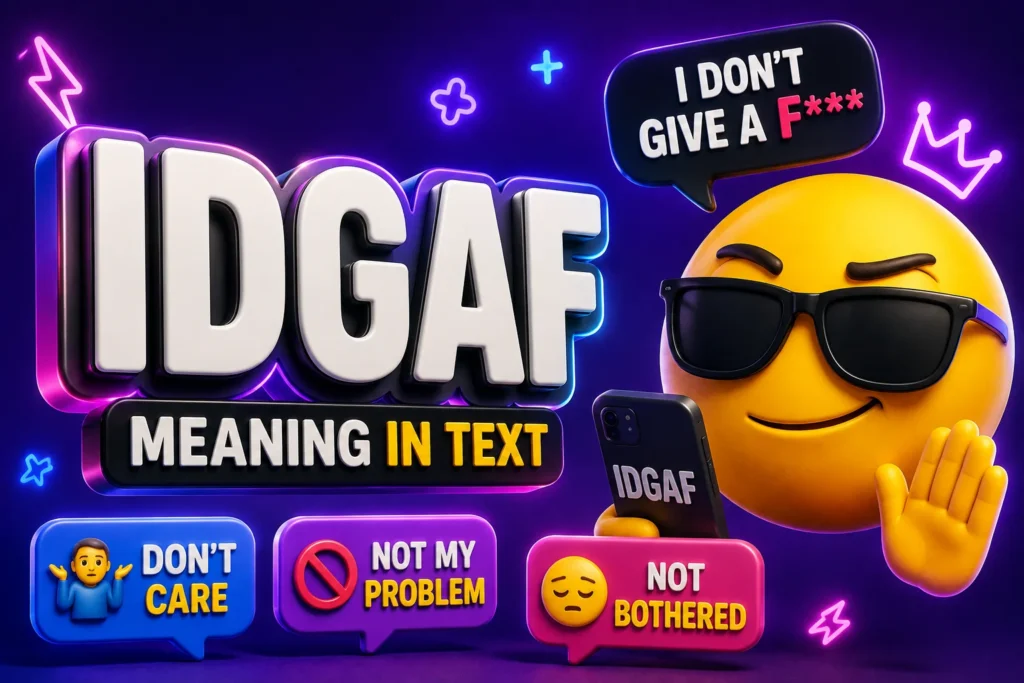
IDGAF means “I Don’t Give a F*.”** It’s a blunt texting acronym used to say you don’t care about something, aren’t interested in someone else’s opinion, or have stopped worrying about a situation. Because it contains profanity, it’s much stronger than simply saying “I don’t care.”
You might see IDGAF in text messages, memes, social media comments, gaming chats, or group conversations where someone wants to express complete indifference or frustration.
Is IDGAF an Acronym or Just Slang?
IDGAF is both:
- An acronym (or more precisely, an initialism) because each letter stands for the first letter of a word:
- I = I
- D = Don’t
- G = Give
- A = A
- F = F***
- Internet slang, because people use it casually in online conversations rather than formal writing.
Unlike words such as “LOL” that have softened over time, IDGAF still carries the force of the profanity it abbreviates.
All Real Meanings of IDGAF
1. I Don’t Give a F*** (The Standard Meaning)
This is by far the most common and widely accepted meaning.
People use it when they want to show:
- They don’t care.
- Someone’s opinion doesn’t matter to them.
- They’ve emotionally checked out.
- They refuse to worry about something.
Examples:
IDGAF what they think.
He can complain all day. IDGAF.
Honestly? IDGAF anymore.
The expression isn’t necessarily aggressive toward the person you’re texting. Sometimes it’s aimed at a situation instead.
Example:
The weather ruined our plans.
IDGAF. We’ll make our own fun.
Does IDGAF Have Other Meanings?
Unlike abbreviations such as “TS” or “HY,” IDGAF has one overwhelmingly dominant meaning online.
Some websites list alternative expansions, but there is no evidence that they’re widely used in texting or social media.
If someone sends “IDGAF,” you should safely assume they mean:
I Don’t Give a F*.**
Common Misunderstanding
One mistake people make is thinking IDGAF simply means:
“I’m not interested.”
That’s only partly true.
Compare these phrases:
IDC
= I don’t care.
IDGAF
= I really, seriously, absolutely don’t care.
The profanity increases the emotional intensity.
Another misunderstanding is believing IDGAF always means someone is angry.
Not necessarily.
Someone can use it:
- jokingly
- sarcastically
- confidently
- rebelliously
- dramatically
Tone depends on the conversation.
How Strong Is IDGAF?
One useful way to understand the phrase is to compare it with similar expressions.
| Expression | Strength |
|---|---|
| I’m not bothered. | Very mild |
| I don’t mind. | Mild |
| I don’t care. | Neutral |
| IDC | Casual |
| DGAF | Strong |
| IDGAF | Very strong |
Because of the profanity, IDGAF sounds much harsher than IDC.
Which Apps Is IDGAF Used On?
IDGAF isn’t tied to one platform. It appears almost everywhere informal conversations happen.
TikTok
Very common.
People use it:
- captions
- comments
- reaction videos
- memes
Examples:
IDGAF era.
He really said IDGAF.
Common in:
- Stories
- Reels
- comments
- DMs
Many users pair it with confidence posts or humorous captions.
Example:
Wearing what I like because IDGAF.
Snapchat
Frequently appears in private chats.
Example:
Friend:
You still worried?
You:
IDGAF anymore 😂
Common among close friends.
Because WhatsApp conversations are usually private, users often write IDGAF more freely than on public platforms.
X (formerly Twitter)
One of the most common places for IDGAF.
Users often use it in:
- opinions
- debates
- sports
- politics
- pop culture discussions
Because X encourages short, opinionated posts, abbreviations like IDGAF fit naturally.
Grammar: How Does IDGAF Work?
Although IDGAF represents an entire sentence, people often use it like a single word.
Complete Reply
Friend:
Want to hear his excuse?
You:
IDGAF.
The abbreviation stands alone.
Inside a Sentence
Examples:
- I honestly IDGAF.
- She IDGAF about rumors.
- We IDGAF what happens next.
Even though it replaces a full phrase, readers understand it immediately.
Can IDGAF Be a One-Word Answer?
Absolutely.
Example:
Friend:
Did you see what they said?
You:
IDGAF.
That’s a complete response.
Unlike abbreviations such as BRB or IMO, IDGAF often ends a conversation because it signals that the speaker has nothing more to say about the topic.
Where Did IDGAF Come From?
The full phrase “I don’t give a f*”** has existed in spoken English for decades.
The abbreviation IDGAF emerged during the early internet era as people shortened common phrases in chat rooms, instant messaging, and SMS texting. The earliest widely documented online definition appeared on Urban Dictionary in 2003, although the full phrase predates the abbreviation.
As texting became more popular, IDGAF spread to:
- MSN Messenger
- AOL Instant Messenger
- online forums
- gaming communities
- Twitter (now X)
- TikTok
Today it’s recognized across virtually every major social platform.
Does IDGAF Come From AAVE?
There is no reliable evidence that IDGAF itself originated in African American Vernacular English (AAVE).
While the full phrase has long been part of informal American English, the abbreviation appears to have developed as general internet shorthand rather than from one specific linguistic community. It’s best not to attribute its origin to AAVE without evidence.
Why Do People Type IDGAF Instead of the Full Phrase?
Most articles stop after explaining the acronym, but understanding why people use it helps explain its popularity.
People choose IDGAF because it:
- saves typing
- softens the appearance slightly compared with writing the full profanity
- is instantly recognizable
- fits character-limited platforms
- creates emphasis without needing a long explanation
Ironically, many readers mentally expand the acronym into the full phrase anyway, so the emotional impact usually remains.
Tone Matters More Than the Letters
IDGAF doesn’t always sound the same.
The surrounding conversation changes its meaning.
Angry
IDGAF what he says.
Strong confrontation.
Confident
I finally wear what I like.
IDGAF what people think.
This expresses self-confidence rather than hostility.
Funny
Diet starts Monday.
IDGAF… pass the pizza.
Used as self-deprecating humor.
Exhausted
I’ve explained it five times.
IDGAF anymore.
Suggests emotional burnout.
Learning the tone is more useful than memorizing the definition.
Four Example Conversations
Funny
Emma: Aren’t you supposed to be eating healthy?
Jake: IDGAF today.
Emma: That explains the giant milkshake.
Jake: Worth it.
Sarcastic
Chris: Someone complained about your playlist.
Sam: IDGAF.
Chris: I figured that would be your answer.
Sam: Good music doesn’t need permission.
Playful
Taylor: You wore matching socks today?
Alex: Nope.
Taylor: Fashion crime.
Alex: IDGAF 😂
Serious
Friend: People are talking behind your back.
You: I know.
Friend: Doesn’t that bother you?
You: IDGAF anymore.
More Realistic Conversations
Friends
Ryan: They’re making fun of my old phone.
Leo: IDGAF. It still works.
Ryan: Exactly.
Group Chat
Mia: Everyone’s changing the plan again.
Sophie: IDGAF as long as we’re eating.
Jake: Priorities. 😄
Dating
Alex: My friends don’t like my outfit.
Taylor: IDGAF what they think.
Alex: Thanks. I needed that.
Gaming
Player 1: They’re trash-talking us.
Player 2: IDGAF. Just win.
Player 1: Fair enough.
Family
Brother: Dad says clean your room.
Sister: IDGAF…
Brother: You will when he gets home.
How to Reply to IDGAF
Because IDGAF (“I don’t give a f***”) is blunt and often emotional, the best reply depends on the tone and your relationship with the sender.
Funny Reply
- “Well… that’s one way to put it. 😂”
- “Zero cares detected.”
- “You woke up and chose chaos today.”
- “Tell me how you really feel.”
Serious Reply
- “I get that you’re frustrated. Want to talk about it?”
- “If it really doesn’t matter to you, that’s your choice.”
- “Let’s focus on what we can control.”
- “I understand where you’re coming from.”
Flirty Reply (When Appropriate)
- “You might not care about that… but do you care about me? 😉”
- “Bold answer. I kind of like the confidence.”
- “Save some attitude for our date.”
- “You say IDGAF, but I bet I’d change your mind.”
Neutral Reply
- “Okay, got it.”
- “Fair enough.”
- “I understand.”
- “No worries.”
Comparison Table
| Term | Meaning | Tone | Popularity | Confusion Risk |
|---|---|---|---|---|
| IDGAF | I don’t give a f*** | Very blunt | Very High | Low |
| IDC | I don’t care | Casual | Very High | Low |
| DGAF | Don’t give a f*** | Aggressive | High | Medium |
| NVM | Never mind | Neutral | Very High | Low |
| SMH | Shaking my head | Disappointed | Very High | Low |
| IMO | In my opinion | Neutral | Very High | Very Low |
| Opposite: I Care | Shows concern or interest | Positive | High | Very Low |
Who Uses IDGAF?
IDGAF is most common among younger internet users but is understood by many age groups.
Gen Z
Gen Z frequently uses IDGAF in memes, reaction videos, captions, gaming chats, and text conversations. Sometimes it’s used humorously rather than literally.
Millennials
Millennials helped popularize IDGAF through internet forums, early social media, and texting in the 2000s and 2010s. Many still use it today, especially in casual conversations.
Older Adults
Older adults generally recognize the abbreviation but tend to use the full phrase less often, especially in professional communication.
Regional Usage
- United States: Extremely common.
- United Kingdom: Common in texting and online discussions.
- Canada & Australia: Frequently understood and used.
- Elsewhere: English-speaking internet communities worldwide generally recognize it.
There is no reliable evidence that IDGAF belongs to one region exclusively.
Is IDGAF Rude or Safe?
Context matters because the abbreviation contains implied profanity.
Is it offensive?
Not necessarily, but it is considered vulgar because it stands for “I don’t give a f***.”
Is it profanity?
Yes. Even though the swear word is abbreviated, most readers understand what it represents.
Is it appropriate at school or work?
Usually no. In professional emails, workplace chats, academic settings, or formal communication, it’s better to avoid IDGAF.
Is it okay with friends?
Among close friends who already use casual language, it’s generally acceptable. However, it can still sound dismissive if someone is discussing something important.
Why IDGAF Remains Popular
IDGAF survives because it’s an efficient way to communicate emotional distance. Instead of writing an entire sentence explaining that something isn’t worth your attention, the acronym instantly signals frustration, indifference, confidence, or even rebellion. Internet culture often rewards short, emotionally charged expressions, making IDGAF memorable in memes, captions, comments, and reaction posts. Its flexibility also helps—it can be serious, humorous, sarcastic, or exaggerated depending on the context.
Frequently Asked Questions
What does IDGAF mean in a text message?
In texting, IDGAF almost always means “I don’t give a f*.”** The sender is saying they don’t care about a situation, opinion, or outcome. Depending on context, it can express confidence, frustration, or emotional detachment.
Is IDGAF the same as IDC?
No. IDC means “I don’t care,” while IDGAF is a much stronger and more vulgar version. If you want to sound less aggressive, IDC is usually the better choice.
Is IDGAF always negative?
Not always. Sometimes people use it humorously or to show confidence, especially in memes or motivational captions. However, it can easily come across as rude if directed at another person.
Can I use IDGAF at work?
It’s best not to. Because it represents profanity, it isn’t appropriate in professional emails, workplace chats, customer communication, or formal settings.
Why do people write IDGAF instead of the full phrase?
The abbreviation is quicker to type and slightly softens the appearance of the profanity while still conveying the intended meaning. It’s also become a widely recognized piece of internet shorthand.
Does IDGAF have any other meanings?
There are occasional niche interpretations in specialized communities, but in everyday texting and social media, it overwhelmingly means “I don’t give a f*.”**
Is IDGAF popular on TikTok?
Yes. It’s frequently used in captions, comments, memes, and videos expressing confidence, indifference, or humor. The exact tone depends on the creator and context.
Can IDGAF be used as a joke?
Absolutely. Many memes use IDGAF in an exaggerated way to make everyday situations seem dramatically unimportant. Even then, remember that the phrase still contains implied profanity.
Conclusion
IDGAF stands for “I don’t give a f*,”** making it one of the strongest expressions of indifference in modern internet slang. It’s widely used in text messages, TikTok, Instagram, Snapchat, X, gaming chats, and memes to show that someone doesn’t care about a person, opinion, or situation.
While the acronym is common and instantly recognizable, it isn’t suitable for every conversation. Because it represents profanity, it’s best reserved for informal chats with friends or humorous online content. In professional, educational, or respectful conversations, alternatives like IDC, I’m not worried about it, or It doesn’t matter to me communicate a similar idea without sounding as harsh.
If you’re ever unsure how someone means IDGAF, look at the surrounding conversation. The same acronym can express genuine frustration, playful confidence, sarcasm, or emotional detachment depending on who is using it and why.