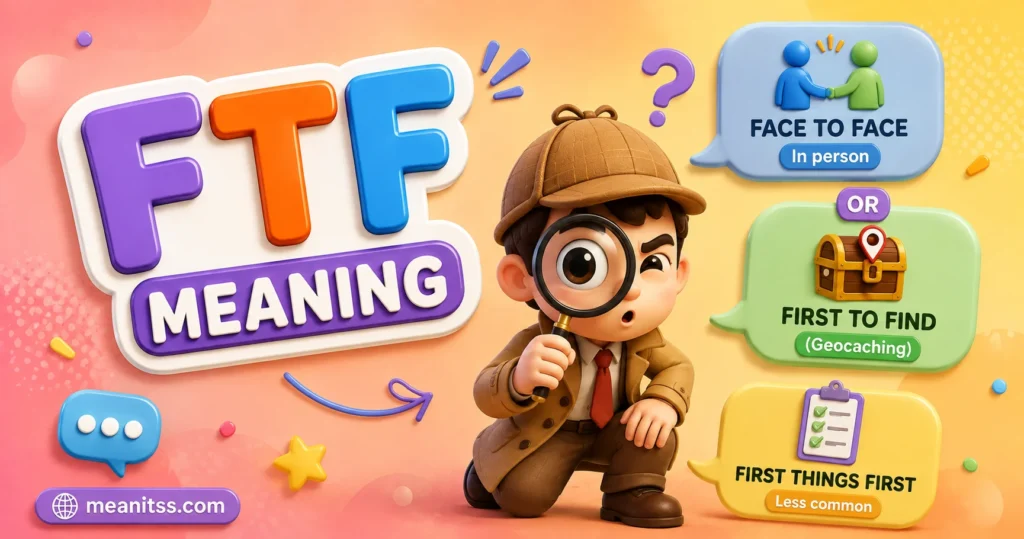
FTF usually means “face to face” in texting and online communication. It refers to talking or meeting with someone in person rather than communicating through texts, calls, or online messages. In some communities, FTF has other meanings, so context matters.
If someone messages, “Can we talk FTF?”, they usually mean, “Can we talk in person?”
What Does FTF Mean?
In everyday texting, FTF = face to face.
It is an abbreviation/initialism, rather than a slang word in the same sense as terms such as “rizz” or “sus.” It shortens the phrase face to face to make digital communication quicker.
For example:
“I’d rather explain it FTF.”
This means:
“I’d rather explain it face to face.”
The abbreviation can describe either an in-person conversation or an in-person meeting:
- “Let’s talk FTF.”
- “Can we meet FTF tomorrow?”
- “This is easier to discuss FTF.”
- “I finally met her FTF.”
Dictionary.com lists FTF as an abbreviation for “face-to-face,” alongside the alternative F2F.
The main meaning at a glance
| FTF | Meaning |
|---|---|
| FTF | Face to face |
| Meaning | In person |
| Type | Abbreviation / initialism |
| Typical context | Texting, chat, email, online communication |
| Tone | Usually neutral or casual |
| Opposite concept | Online/remote communication |
Other Real Meanings of FTF
FTF is not limited to “face to face.” The abbreviation has several documented meanings, although most are context-specific rather than everyday texting slang.
1. Face to face
This is the most relevant meaning when you encounter FTF in an ordinary message, email, or online conversation.
“Let’s discuss it FTF” means the person wants to discuss it in person.
2. First to Find
FTF = First to Find is a recognized term in geocaching.
In geocaching, participants search for hidden caches. Someone who becomes the first person to locate a newly published cache may record FTF in the cache log. This meaning is especially associated with the geocaching community rather than ordinary social texting.
So:
“FTF on the new cache!”
does not mean “face to face.” It means the person was first to find it.
3. First Things First
Some abbreviation databases also record FTF as “First Things First” in chat or internet-related contexts.
However, this is much less useful as a default interpretation. If somebody writes:
“FTF, we need to finish the report.”
you would need the surrounding conversation to determine whether they mean “First Things First.”
4. Specialized meanings
FTF has numerous meanings in professional, technical, organizational, gaming, and other specialized contexts. Abbreviations.com, for example, lists dozens of possible expansions.
That does not mean all of these meanings are relevant to slang or texting. When someone asks about FTF meaning in text, “face to face” is generally the interpretation worth checking first.
A Common Misunderstanding About FTF
One common mistake is assuming that FTF is always a slang term with one fixed definition.
It isn’t.
FTF is an abbreviation used by different communities, so context determines the meaning. A friend saying “Let’s talk FTF” is almost certainly talking about an in-person conversation. A geocacher posting “FTF!” after finding a newly published cache is using the specialized “First to Find” meaning.
There is also a useful distinction between FTF and F2F. Both can mean “face to face,” although some internet-language references recommend F2F specifically for that meaning.
Which Apps Is FTF Used On?
FTF is associated with online chat, texting, email, and social communication, but there is not strong evidence that it belongs exclusively to one particular social-media platform.
FTF can naturally appear in WhatsApp messages when someone wants to move a conversation from chat to an in-person discussion.
“Can we talk FTF tomorrow?”
The abbreviation is especially understandable when the conversation already contrasts texting with meeting.
FTF can occur in Instagram DMs when people are discussing plans or deciding to continue a conversation offline.
“This is getting complicated 😂 let’s talk FTF.”
Snapchat
FTF may appear in Snapchat conversations in the same basic sense: face to face.
However, it would be misleading to describe FTF as a Snapchat-exclusive slang term. It is a broader internet and messaging abbreviation.
TikTok
FTF can occur in TikTok-related comments or messages, but the available evidence is not strong enough to claim that it is a distinctive TikTok slang term. Some slang-reference sites list TikTok alongside other platforms, but those claims are not the same as evidence of platform-specific popularity.
X
FTF can also be understood in posts or replies on X when someone uses it to mean “face to face,” although it is not specifically an X-only abbreviation.
Bottom line on platforms
FTF is better understood as a general internet/texting abbreviation than as TikTok, Snapchat, or Instagram-specific slang. That distinction matters because seeing it on one of these apps does not automatically give it a different meaning.
Grammar: How Is FTF Used in a Sentence?
FTF normally functions as an abbreviation for the phrase “face to face.”
It most often appears where the full phrase would naturally appear.
After a verb
“Let’s talk FTF.”
After a preference
“I’d rather discuss it FTF.”
Describing a meeting
“We finally met FTF.”
Modifying a noun
“We need an FTF meeting.”
The capitalization varies:
- FTF
- ftf
- Ftf
All can communicate the same basic meaning in informal contexts.
Can “FTF” be a complete reply?
Yes, depending on the conversation.
Someone might ask:
“Should we discuss this over text or in person?”
You could reply:
“FTF.”
That effectively means “Face to face.”
However, simply replying “FTF” can sound abrupt. A more natural response might be:
“FTF works for me.”
Where Did FTF Come From?
The phrase “face to face” is much older than the internet. It has long been used in English to describe people being physically present with one another.
The abbreviation developed as part of the broader tradition of online and electronic communication shorthand. FTF appears in collections and research concerning internet abbreviations, alongside other familiar forms such as AFK, BTW, CYA, FAQ, and IRL. A reference discussing online communication lists FTF as “face to face” among abbreviations used in the 1990s internet environment.
An online slang entry for FTF meaning “face to face” dates to 2005, while other references document its use in internet communication more broadly.
The exact moment when someone first typed FTF cannot be established confidently from the available evidence. So it is safer to say that FTF emerged as part of internet and digital communication shorthand, rather than claiming a specific person invented it.
There is also no credible evidence that FTF originated in AAVE. It is better understood as general English-language digital shorthand.
Four Short Conversations Showing Different Tones
Funny
Friend: You wrote me a three-page explanation.
Me: I panicked.
Friend: Just tell me FTF next time 😂
Me: Fine. But you’re buying coffee.
Here, FTF means face to face.
Sarcastic
Friend: Can we talk FTF?
Me: Oh great. That sounds terrifying.
Friend: It’s not that serious.
Me: That’s exactly what people say before serious conversations.
Playful
Person A: You keep dodging my questions.
Person B: Maybe I’m better FTF 😌
Person A: Convenient excuse.
Person B: Meet me and find out.
Serious
Person A: I don’t want to discuss this through messages.
Person B: Okay.
Person A: Let’s talk FTF tomorrow.
Person B: Sure. We can talk calmly then.
Realistic FTF Conversations
1. Friends
Maya: Are you actually mad at me?
Sara: I don’t want to explain everything over text.
Maya: Should we talk FTF?
Sara: Yeah, probably better.
2. Dating
Alex: Can we talk about what happened last night?
Jordan: Sure.
Alex: FTF though, not over text.
Jordan: Okay, let’s meet after work.
3. Family
Mom: What’s wrong?
Son: Nothing I can explain properly in messages.
Mom: Call me?
Son: I’d rather tell you FTF when I get home.
4. Coworkers
Manager: I have some feedback about the project.
Employee: Can you send it here?
Manager: I’d prefer an FTF conversation.
Employee: No problem.
5. Group chat
Liam: Who’s free tomorrow?
Noah: Depends why 😂
Liam: We need to settle the trip plans FTF.
Emma: I’m free after 6.
6. Instagram DM
A: This story is too complicated for DMs lol.
B: Seriously 😂
A: Let’s talk FTF.
B: Deal.
7. Snapchat
Friend: You seem upset.
You: Kind of.
Friend: Wanna talk?
You: Yeah, FTF would be better.
8. Planning a meetup
A: Are you still coming Saturday?
B: Definitely.
A: Good, we can finally catch up FTF.
B: It’s been forever!
9. Workplace scheduling
A: Are you available Thursday?
B: For a call?
A: I’d prefer FTF if you’re in the office.
B: Thursday afternoon works.
10. Relationship disagreement
A: We’re just going in circles here.
B: I know.
A: Let’s stop texting about it and talk FTF.
B: Okay. That’s probably healthier.
11. Online friendship
A: We’ve been talking for months.
B: I know 😭
A: We should actually meet FTF sometime.
B: I’d like that.
12. Geocaching
A: Did anyone find the new cache?
B: Yep!
A: Already?
B: FTF 😎
In this last conversation, FTF means “First to Find,” not “face to face.” That is why context matters.
How to Reply When Someone Says FTF
Your response depends on whether they’re proposing an in-person conversation.
Funny reply
“FTF? Should I bring snacks or a lawyer? 😂”
Serious reply
“Sure. Let me know when you’re available.”
Flirty reply
If the conversation is already romantic:
“FTF sounds good. I think you’ll like me better in person 😉”
Neutral reply
“Sure, FTF works for me.”
If you’re unsure what the abbreviation means, simply ask:
“Do you mean face to face?”
That is better than guessing.
FTF vs Similar Terms
| Term | Meaning | Tone | Popularity | Confusion Risk |
|---|---|---|---|---|
| FTF | Face to face | Casual/neutral | Common | Medium |
| F2F | Face to face | Casual/neutral | Common | Low |
| IRL | In real life | Casual/internet | Very common | Low |
| In person | Physically present | Neutral | Very common | Very low |
| Online | Through the internet | Neutral | Very common | Low |
| First to Find | First person to find something | Community-specific | Niche | High |
| Remote | Done from a distance | Neutral/professional | Common | Medium |
FTF vs F2F
These are the closest equivalents.
F2F makes the “two faces” idea more visually obvious, while FTF uses the first letters of “face to face.” Both are documented abbreviations for in-person communication.
FTF vs IRL
IRL means “in real life.”
It can refer to meeting someone physically, but it is broader than FTF.
“We met IRL.”
means you met offline rather than only online.
“Let’s talk FTF.”
specifically emphasizes communicating face to face.
Who Uses FTF?
There is not enough reliable evidence to assign FTF exclusively to one age group.
It appears in internet, texting, email, and online-chat contexts, and references describe its use among both adults and younger internet users.
Gen Z vs. Millennials
It would be an overstatement to say that Gen Z “owns” FTF. The abbreviation predates today’s Gen Z internet culture and has been documented in online communication for decades.
Younger users may encounter it alongside newer abbreviations, while older internet users may recognize it from earlier forms of online communication.
Regional differences
There is no strong evidence that FTF has a substantially different slang meaning in the US versus the UK. Its basic “face to face” usage is broadly understandable in English-language digital communication.
Is FTF Rude or Safe?
FTF is generally safe and non-offensive when it means “face to face.”
It is not profanity, and there is no inherently rude meaning attached to the ordinary abbreviation.
You can use it casually with friends, but it may be better to write “face to face” in formal documents if your audience may not know the abbreviation.
One important exception
Because FTF has other meanings, including some vulgar or highly context-specific expansions listed in slang databases, you should avoid assuming every use means “face to face.”
Context is particularly important if you encounter FTF in an unfamiliar online community.
A Useful Insight: Why Does FTF Work So Well?
FTF survives because digital communication creates a simple distinction people constantly need to express: online versus physically present. A three-letter abbreviation quickly tells someone that a conversation, meeting, or explanation should happen in person. It is especially useful when texting itself is becoming inconvenient, emotional, or too easy to misunderstand. In that sense, FTF is less about sounding trendy and more about efficiently marking a change in communication mode.
When FTF Can Sound More Serious Than Expected
The abbreviation itself is neutral, but the sentence around it can change the emotional impression.
Compare:
“Let’s catch up FTF sometime!”
with:
“We need to discuss this FTF.”
The first sounds friendly. The second can sound serious because the subject matter creates that impression.
So if someone sends:
“We need to talk FTF.”
don’t automatically assume something bad is happening. The abbreviation only means face to face; the seriousness comes from the surrounding message.
When Should You Use FTF Instead of “Face to Face”?
Use FTF when:
- You’re texting friends.
- You’re chatting casually.
- The other person already uses abbreviations.
- You’re arranging an in-person meeting.
- You want a short message.
Use face to face when:
- Writing formally.
- Speaking to someone unfamiliar with internet abbreviations.
- Writing an important professional message.
- Clarity matters more than brevity.
For example, a professional email is usually clearer as:
“I’d like to discuss this face to face.”
rather than:
“I’d like to discuss this FTF.”
FAQ
What does FTF mean in text?
FTF most commonly means “face to face.” It indicates that someone wants to communicate or meet in person rather than continue through messages or another remote method. The abbreviation is used in texting, chat, and other digital communication.
What does FTF mean on Snapchat?
On Snapchat, FTF can mean “face to face” when someone is suggesting an in-person conversation or meeting. However, FTF is not a Snapchat-exclusive term. The same abbreviation can be used across different forms of online communication.
Is FTF the same as F2F?
Yes, when both are being used to mean “face to face.” F2F is another established abbreviation for the phrase, and some internet-language references use it specifically for this purpose.
Does FTF mean “first to find”?
It can. First to Find is a recognized FTF meaning in geocaching, where it identifies the person who was first to locate a newly published cache. If you see FTF in a geocaching discussion, that meaning is much more likely than “face to face.”
Is FTF a slang word?
FTF is better described as an abbreviation or initialism than as a traditional slang word. It is commonly used in informal digital communication, which is why people often search for it as “text slang.” Its most common conversational meaning is “face to face.”
Does FTF mean “in person”?
Usually, yes. When FTF means “face to face,” it indicates that people will communicate while physically present with one another. It is essentially a short way to distinguish an in-person interaction from online or remote communication.
Is FTF rude?
No. The ordinary “face to face” meaning is neutral and not offensive. The tone depends on the surrounding message—for example, “Let’s catch up FTF” sounds friendly, while “We need to discuss this FTF” may sound more serious.
Should I use FTF at work?
You can use it if your workplace commonly uses abbreviations and everyone understands it. In formal emails, reports, or communication with unfamiliar audiences, “face to face” or “in person” is clearer. The full phrase avoids unnecessary ambiguity.
Conclusion
FTF usually means “face to face” in text and online communication. It is an abbreviation used when someone wants to talk, meet, or discuss something in person.
The key is context. In ordinary texting, “Let’s talk FTF” almost certainly means “Let’s talk face to face.” In geocaching, however, FTF can mean “First to Find.” Other specialized meanings also exist, so treating FTF as having only one possible definition can lead to mistakes.
For casual messages, FTF is perfectly understandable. For formal communication, face to face or in person is usually the safer choice.