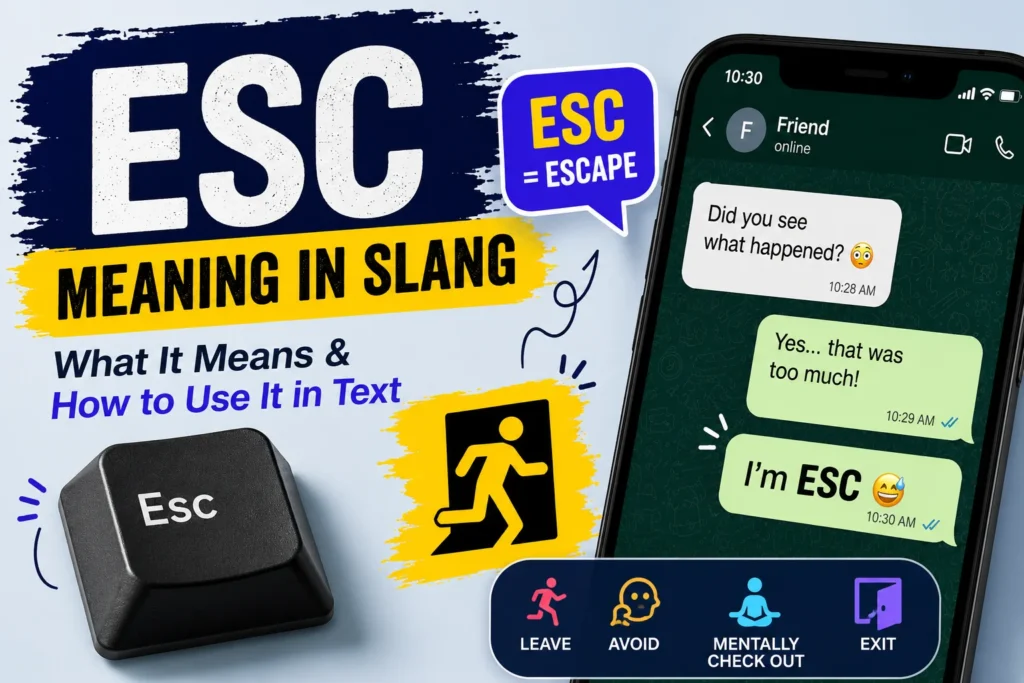
“ESC” in slang usually means “escape”—it’s used when someone wants to leave a situation, avoid something, or mentally check out. Sometimes, it can also imply distancing from drama or ending a conversation quickly.
In casual texting, it’s often used humorously or dramatically.
Example: “I’m ESC from this convo 😭”
ESC Meaning in Text
In everyday texting, ESC stands for “escape.”
It comes from the keyboard “Escape” key, which people associate with exiting or backing out of something. Over time, it became slang for:
- Leaving a situation (physically or mentally)
- Avoiding awkward moments
- Ending conversations quickly
People use it when they feel overwhelmed, bored, or just want out.
“ESC” functions as an abbreviation, not a true acronym — it’s a direct shortening of “escape” rather than an initialism built from multiple words.
Examples:
- “This group chat is too much, I’m ESC 💀”
- “When the teacher starts asking questions… ESC mode activated”
- “Nah, I’m ESC from that drama”
Other Common Meanings of ESC
While “escape” is the most common meaning in casual texting, “ESC” has other well-established meanings depending on context. In Europe, ESC very often refers to the Eurovision Song Contest, especially in social media conversations around the annual event — if you see “ESC” trending or used with country names/song titles, this is almost always the meaning.
In automotive contexts, ESC stands for Electronic Stability Control, a safety system found in most modern cars, and it shows up regularly in car-review and driving content.
There’s also a niche EU meaning, the European Solidarity Corps, a youth volunteering program, occasionally seen in application-related posts. None of these relate to the “escape” slang meaning — the surrounding topic makes clear which one applies.
Real Chat Examples (Relatable Conversations)
1. Group Chat Overload
Friend: Why is everyone arguing here? You: Idk but I’m ESC 😭
2. Awkward Situation
Friend: She just waved at you, go talk to her You: Nope. ESC immediately 😂
3. School Stress
Friend: Did you finish the assignment? You: Bro I haven’t even started… ESC from reality
4. Social Media Drama
Friend: Did you see what happened on Instagram? You: Yeah and I’m ESC from all that mess
5. Work Slack
Coworker: This meeting could’ve been an email… You: ESC 😅 Coworker: Same, I’m muting and doing actual work
6. Family Group Chat
Mom: Grandma’s asking everyone to share vacation photos again You: ESC, I already sent mine three times
7. Gaming Discord
Teammate: You dying already? we just started You: Bro this lobby is toxic, ESC
8. Dating App
Match: He just sent a paragraph about his ex unprompted You: ESC immediately, that’s a red flag
9. Reddit-Style Comment Thread
Commenter 1: This thread turned into a whole argument Commenter 2: Yeah I’m ESC from this one
10. Class Group Project Chat
Classmate: Can someone else present tomorrow? You: ESC, I did it last time, your turn
Emotional Meaning & Tone
“ESC” isn’t just about leaving—it also carries emotion and attitude.
Common tones:
- Funny / Dramatic: “I’m ESC 😂” (not serious)
- Overwhelmed: “ESC from life rn”
- Avoidant: “I’m ESC from this topic”
When it can feel different:
- Friendly: Used jokingly with friends
- Neutral: Just means stepping away
- Slightly rude: If used to shut someone down abruptly
It really depends on context and how well you know the person.
ESC Meaning from a Girl / Guy
Note: this is a general pattern some users notice in casual observation, not a confirmed rule — usage varies far more by individual and relationship than by gender.
From a Girl:
When a girl uses “ESC,” it’s often:
- Playful or sarcastic
- Used to avoid awkwardness
- A light way to say “I’m done with this”
Example: “This is getting weird… ESC 😂”
From a Guy:
When a guy uses it, it’s usually:
- Casual and humorous
- Used in gaming-style language
- A way to dodge situations
Example: “Nope, I’m ESC from that conversation”
Overall, both use it similarly—tone matters more than gender.
Origin & History of ESC
“ESC” as slang draws directly from the physical Escape key on computer keyboards, first standardized decades ago as a way to cancel or exit a running command — a concept that predates modern texting entirely. As keyboards and computing became part of everyday life, “hitting escape” became a familiar cultural metaphor for backing out of something, which slang usage later extended to real-life situations: leaving an awkward conversation is framed the same way as exiting a stuck program.
How to Reply to ESC
If someone says “ESC,” here are natural ways to respond:
Casual Replies:
- “Same honestly 😭”
- “Can I join you?”
- “Mood lol”
Friendly Replies:
- “Haha where you going?”
- “Don’t leave me here alone 😂”
- “Okay but come back later”
Funny Replies:
- “ESC denied. You’re staying”
- “No exit button here 😈”
- “Too late, you’re trapped”
Short Responses:
- “Same”
- “Lol”
- “Mood”
Is ESC Rude or Safe to Use?
ESC is generally safe and not rude.
However, context matters:
✅ Safe when:
- Used jokingly
- Talking with friends
- Expressing stress or humor
⚠️ Can feel rude when:
- You abruptly end a serious conversation
- You ignore someone’s message after saying it
- You use it in formal or professional chats
Think of it as informal slang—great for casual use, not for serious discussions.
Where You’ll See ESC
You’ll commonly spot “ESC” across different platforms:
- Texting: Casual chats with friends
- Snapchat: Quick reactions or streak messages
- TikTok: Comments like “I’m ESC from this video 💀”
- Instagram: Replies to drama or awkward posts
- WhatsApp: Less common than on TikTok or Snapchat, but appears in group chats when someone wants to bail on a plan or conversation without a long explanation
- X (formerly Twitter): Shows up in reply threads to disengage from an argument or pile-on, often as a one-word exit line
It’s especially popular in meme culture and Gen Z conversations.
Similar Slang Comparison
| Slang | Meaning | Usage |
|---|---|---|
| GTG | Got to go | Leaving politely |
| BRB | Be right back | Temporary exit |
| I’m out | Leaving | Direct and casual |
| Ghosting | Disappearing | Ignoring someone |
| Dip | Leave quickly | Informal exit |
| Bounce | Leave | Chill slang |
| Avoid | Stay away | More serious |
| Yeet | To leave abruptly or throw something | Chaotic, high-energy exit |
| Stay | Opposite of ESC | Remaining present |
Key Insight: “ESC” feels more playful and expressive than other exit slang—it’s less formal than “GTG” and more dramatic than “I’m out.”
Variations / Types of ESC
Here are common variations you might see:
ESC mode
– Fully checked out mentally
ESC rn
– Leaving right now
ESC from life
– Feeling overwhelmed
ESC this convo
– Ending a chat
Hard ESC
– Strong reaction to leave
ESC energy
– Avoiding vibes
ESC button
– Reference to keyboard humor
ESC pls
– Wanting to escape badly
ESC vibes
– Feeling like leaving
ESC activated
– Dramatic or funny exit
Common Mistakes & Misunderstandings
1. Thinking It’s Always Serious
Sometimes it’s just a joke—not actual avoidance.
2. Using It in Formal Chats
Avoid using “ESC” in emails or professional messages.
3. Misreading Tone
“ESC” can sound rude if used at the wrong time.
4. Overusing It
Using it too often can make you seem disengaged.
5. Assuming ESC Always Means “Escape”
In car-related, tech, or Eurovision-adjacent conversations, ESC likely refers to Electronic Stability Control or the Eurovision Song Contest instead — always check the topic before assuming the slang meaning applies.
FAQ
What does ESC mean in Snapchat?
It means “escape”—usually used when reacting to something awkward, funny, or overwhelming.
What does ESC mean from a girl?
It typically means she wants to avoid or exit a situation, often in a playful or humorous way.
Is ESC rude?
No, but it can feel rude if used to ignore someone or end serious conversations abruptly.
Does ESC mean leaving the chat?
Yes, it can mean mentally or literally leaving a conversation.
Is ESC popular slang?
Yes, especially among younger users and meme culture online.
Can ESC be used in texting?
Yes, it’s commonly used in casual texting and social media chats.
What does ESC mean in slang texting?
ESC means “escape” in slang texting. It’s used when someone wants to leave a conversation, avoid something, or react to an awkward moment.
What does ESC stand for in chat?
In chat, ESC stands for “escape,” inspired by the keyboard key used to exit or cancel actions.
Is ESC a rude slang term?
No, ESC is not rude by default. However, it can seem dismissive if used to abruptly end serious conversations.
How do you use ESC in a sentence?
You can use ESC when reacting to something uncomfortable or funny. Example: “This is getting awkward… ESC 😭”
Why do people say ESC online?
People say ESC to express the feeling of wanting to “exit” a situation—especially during awkward, stressful, or funny moments.
Does ESC mean leaving the conversation?
Yes, it can mean mentally or literally leaving a conversation, depending on context.
What is the full form of ESC in slang?
There is no formal “full form”—it directly refers to the “Escape” key and its meaning.
Is ESC commonly used in Gen Z slang?
Yes, ESC is popular among Gen Z, especially in memes, texting, and social media reactions.
What are alternatives to ESC in texting?
Common alternatives include:
- “I’m out”
- “GTG”
- “BRB”
- “I’m done”
Does ESC always mean “escape” online?
No — while “escape” is the most common meaning in casual texting and social captions, ESC has other well-known meanings depending on context. In Europe especially, it frequently refers to the Eurovision Song Contest, and in automotive or tech content, it usually means Electronic Stability Control. The surrounding conversation almost always makes the intended meaning clear.
What does ESC mean on TikTok specifically?
On TikTok, ESC is used two very different ways depending on the video’s topic. In reaction comments and relatable content, it means “escape,” as in wanting to leave an awkward or overwhelming situation. In car-content or automotive-review videos, the same letters refer to Electronic Stability Control, a real vehicle safety feature — so the video’s subject matter is the best clue to which meaning applies.
Conclusion
“ESC” is a simple but expressive slang term that captures a feeling we all have—wanting out of a situation quickly.
Whether you’re joking with friends, reacting to awkward moments, or just overwhelmed, it’s an easy and relatable way to say “I’m out.” Just keep in mind that outside of casual texting, the same letters can mean something completely different — from Eurovision to car safety systems — so context is everything.
Use it casually, keep the tone light, and you’ll sound completely natural in modern digital conversations.