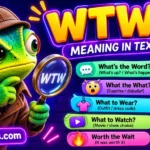
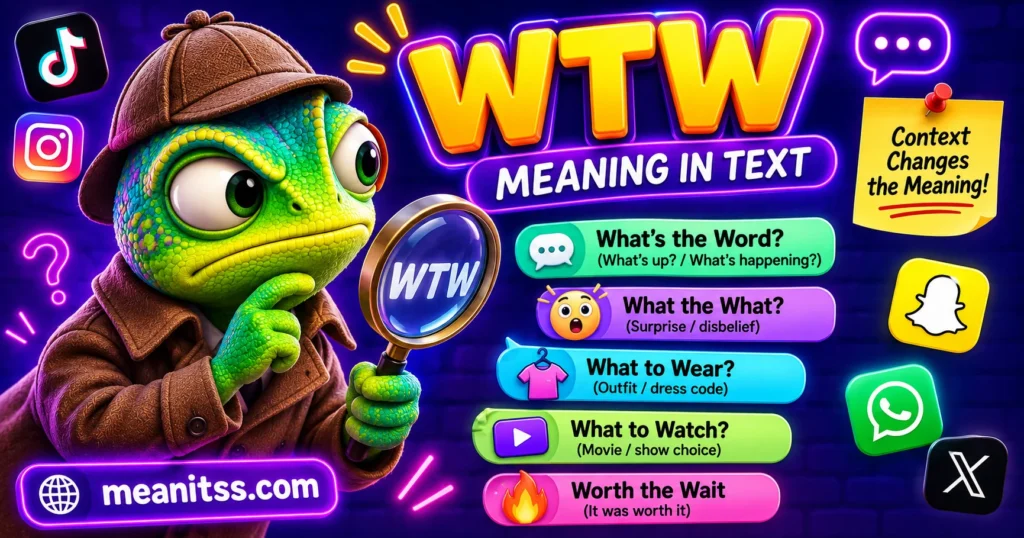
WTW most commonly means “What’s the Word?” in texting and online slang. It is a casual way to ask “What’s up?”, “What’s happening?”, “What are the plans?”, or “What’s going on?”
If someone sends you “WTW?” with no other context, the safest interpretation is usually “What’s the word?” rather than one of the less-common expansions.
What Does WTW Mean?
WTW is an informal texting abbreviation or initialism for “What’s the Word?”
In everyday conversation, “What’s the word?” does not normally ask you to provide one particular word. Instead, it is a compact way of asking for an update, checking what someone is doing, finding out what is happening, or asking about plans. Slang references consistently describe this as the dominant meaning of WTW in texting, chat, and social media.
Depending on context, these can all be reasonable translations:
- WTW? → “What’s up?”
- WTW tonight? → “What are the plans tonight?”
- WTW with you? → “What’s going on with you?”
- WTW for the weekend? → “What are we doing this weekend?”
- WTW on that situation? → “What’s the latest on that?”
The important point is that WTW is usually an open-ended question. The sender may want information, conversation, or an opportunity to make plans.
Is WTW an Acronym or Abbreviation?
People commonly call WTW an acronym, but more precisely it functions as an initialism/abbreviation, because the letters are normally read individually: W-T-W.
The letters represent:
W = What’s
T = The
W = Word
It belongs to the broader category of texting shorthand, alongside expressions such as WYD (“what you doing?”), WYA (“where you at?”), WBU (“what about you?”), and WSP (“what’s up?”).
Other Real Meanings of WTW
The meaning “What’s the Word?” is clearly the main one in casual texting, but WTW has other documented interpretations. These should not automatically be treated as equally common.
1. What’s the Word?
This is the default texting meaning.
Example:
“WTW tonight?”
The person is probably asking what the plan is or whether anything is happening.
2. What the What?
WTW can also mean “What the What?”, a clean expression of surprise, confusion, or disbelief. Slang references document this interpretation, although it is much less common than “What’s the Word?”
For example:
“She just bought a house at 19.”
“WTW?!”
Here, WTW is reacting to surprising information rather than asking about plans.
Punctuation can help. “WTW?” is more naturally read as a question, while “WTW?!” or “WTW!” can suggest surprise when the surrounding conversation supports it.
3. What to Wear?
In a fashion, party, wedding, or date-planning conversation, WTW can mean “What to Wear?” This is a context-specific interpretation, not the normal meaning of a standalone message.
For example:
“WTW for the wedding? I know the dress code is formal.”
Here, the subject makes the intended meaning obvious.
4. What to Watch?
Some slang references also document “What to Watch?”, particularly when people are discussing movies, shows, or streaming choices. This is another context-dependent expansion rather than the default meaning of WTW in personal messages.
For example:
“WTW on Netflix tonight?”
In a streaming conversation, the intended meaning could be “What should we watch?”
5. Worth the Wait
“Worth the Wait” is another documented expansion, although it is considerably less common as everyday texting slang than “What’s the Word?”
For example:
“That game took forever to release, but WTW.”
Here, the letters mean that the result was worth the wait.
The lesson is simple: context outranks the letters themselves. If someone sends only “WTW?”, assume “What’s the Word?” unless the surrounding conversation clearly points elsewhere.
A Common Misunderstanding About WTW
One common mistake is assuming that WTW always has one fixed translation such as “What are you doing?”
That is close, but not quite precise.
WTW is broader than WYD. WYD specifically asks what someone is doing, usually right now. WTW can ask what someone is doing, but it can also ask about plans, news, a situation, or what is happening generally.
Compare:
WYD? → What are you doing right now?
WTW? → What’s going on? What are the plans? What’s up?
That difference becomes particularly useful when you’re trying to understand the sender’s intention.
Where Is WTW Used?
Search results consistently associate WTW with texting, social media, online chat, group conversations, and casual messaging. Snapchat has especially clear documentation for the “What’s the Word?” interpretation.
Evidence for individual platforms is less uniform, so it is better not to claim that WTW is exclusive to any one app.
Snapchat
WTW is well documented in Snapchat conversations, where it generally means “What’s the Word?” and functions as a casual check-in or question about plans.
Example:
“wtw?”
“Just chilling. You?”
WTW also appears in Instagram-related slang references, especially in DMs and casual interactions. The usual interpretation remains “What’s the Word?” rather than a special Instagram-only meaning.
WTW is documented as a texting/chat abbreviation and can appear in informal WhatsApp conversations. The core meaning does not automatically change because the message is on WhatsApp.
TikTok
Some sources associate WTW with TikTok and other social platforms, but claims about a special TikTok-specific expansion such as “What’s the Wave” are less consistently supported than the standard “What’s the Word?” interpretation. Therefore, it is safer to read WTW on TikTok as “What’s the Word?” unless the surrounding content clearly indicates another meaning.
X
WTW can appear in informal social-media conversations, but there is no strong evidence that X gives it a separate standard meaning. Treat it as ordinary internet shorthand and use the surrounding conversation to determine the intended expansion.
Grammar: How Does WTW Work in a Sentence?
WTW behaves more like a questioning expression or conversational initialism than a conventional noun or verb.
It commonly appears:
By itself:
“WTW?”
Before a time reference:
“WTW tonight?”
With a person or situation:
“WTW with the party?”
Inside a longer question:
“WTW for Saturday?”
It can absolutely stand alone as a complete reply or message.
For example:
“WTW?”
That three-letter message can function grammatically as an entire conversational question because the abbreviated phrase carries the intended meaning.
Capitalization is flexible. You may see:
- WTW
- wtw
- Wtw
Lowercase wtw is particularly natural in fast, casual texting.
Where Did WTW Come From?
There is no reliable evidence identifying a single person, post, app, or year as the creator of WTW.
What can be established more confidently is that “What’s the word?” existed as a spoken informal expression before the modern internet. It has been used as a way to ask about news, information, or what is happening.
The abbreviation WTW is best understood as a shortened written form of that existing expression. Texting and instant messaging made abbreviations useful because people wanted quick ways to communicate, and later social platforms continued that habit.
User-submitted slang records show WTW being used for “What’s the word?” by at least the 2010s, including entries from 2016 and 2017. Those records demonstrate that the abbreviation was in circulation by then, but they do not prove that this is when it was invented.
There is also no strong evidence that WTW itself originated specifically on TikTok or Snapchat. Claims that it was “invented by Gen Z” or “created on TikTok” should therefore be treated cautiously.
4 Short Conversations: Different Tones
Funny
Friend 1: WTW?
Friend 2: Trying to become productive.
Friend 1: And how’s that going?
Friend 2: I opened my laptop and immediately ordered fries.
Sarcastic
Friend 1: WTW tonight?
Friend 2: Nothing. Living my glamorous life.
Friend 1: So, sitting at home?
Friend 2: Correct. Please respect my celebrity status.
Playful
Friend 1: WTW 👀
Friend 2: Depends. Why?
Friend 1: I may have found us somewhere fun to go.
Friend 2: Okay, now you have my attention.
Serious
Coworker: WTW with the project deadline?
Coworker 2: The client moved it to Friday.
Coworker: Good to know. Do we need to change the schedule?
Coworker 2: Yes, I’ll update the team.
12 More Natural WTW Conversations
1. Best Friends
A: Yo, wtw?
B: Just got home. You?
A: Same. Wanna game?
B: Give me ten minutes.
2. Group Chat
A: WTW for Saturday?
B: I’m free after 6.
C: Same here.
D: Movie night?
3. Dating
A: Hey, wtw tonight?
B: Nothing planned yet.
A: Want to grab coffee?
B: Yeah, I’d like that.
4. Family
Sister: WTW with Mom’s birthday?
Brother: Dinner Saturday.
Sister: At her favorite place?
Brother: Yep, reservation is already done.
5. Coworkers
Coworker A: WTW on the meeting?
Coworker B: Still happening at three.
Coworker A: In person or Zoom?
Coworker B: Zoom.
6. Snapchat
A: wtw 👀
B: Heading downtown.
A: With who?
B: A couple friends. Come through.
7. Instagram DM
A: WTW this weekend?
B: Probably brunch Sunday.
A: Invite me next time 😂
B: You’re officially invited.
8. After School
A: WTW after class?
B: Library for an hour.
A: Then food?
B: Absolutely.
9. Dating App
A: WTW?
B: Just looking for someone interesting to talk to.
A: Conveniently, I’m here.
B: Strong opening. 😂
10. Event Planning
A: WTW for the party dress code?
B: Semi-formal.
A: Perfect, thanks.
B: No problem!
11. Group Chat After News
A: Did you hear what happened?
B: Yeah, absolutely wild.
C: WTW?!
B: I know. I still can’t believe it.
Here, the punctuation and context make the surprised “What the What?” interpretation more plausible.
12. Movie Night
A: WTW tonight?
B: We need a movie.
A: Horror or comedy?
B: Comedy. I need something easy.
In this situation, the intended meaning could be understood as “What to watch?” because the conversation has already established the movie context.
How to Reply to WTW
Your best response depends on what the sender appears to be asking.
Funny Reply
“Currently fighting for my life against my alarm clock.”
Serious Reply
“Not much is happening. I’m dealing with the project deadline right now.”
Flirty Reply
If the conversation is already romantic or suggestive:
“Depends… are you asking because you want to make plans with me? 👀”
WTW itself is not inherently flirty. The romantic tone comes from the relationship and surrounding conversation, not from the abbreviation.
Neutral Reply
“Not much, just relaxing. WTW with you?”
This is probably the safest all-purpose answer.
WTW Compared With Similar Texting Terms
| Term | Meaning | Tone | Popularity | Confusion Risk |
|---|---|---|---|---|
| WTW | What’s the Word? / What’s happening? | Casual | High in informal chat | Medium |
| WYD | What you doing? | Casual | Very high | Low |
| WYA | Where you at? | Casual | High | Low |
| WSP | What’s up? | Casual | High | Low |
| WBU | What about you? | Neutral/casual | High | Low |
| WTM | What’s the matter? / context-dependent | Casual | Moderate | Medium |
The most useful distinction is between WTW and WYD. If somebody says “WYD?”, they’re normally asking about your current activity. “WTW?” gives them more room to ask about your plans, news, or general situation.
Who Uses WTW?
WTW is most naturally associated with informal digital communication, including texting, social media, DMs, group chats, and casual online conversations. Sources commonly describe teenagers, young adults, and general casual internet users as audiences for the term.
However, there is not enough reliable evidence to assign WTW to a precise age range or claim that Gen Z uses it while Millennials do not. Those kinds of hard age divisions are often overstated in slang articles.
Likewise, there is no strong evidence supporting a precise US-versus-UK regional usage rule for WTW. The underlying phrase “What’s the word?” has broader English usage, while the abbreviation is particularly associated with informal digital communication.
Some online sources attach the phrase to particular American communities or cities, but isolated user-generated examples are not enough to establish a broad regional rule.
So the safest conclusion is:
WTW is informal internet/texting shorthand used by people who are familiar with the abbreviation, rather than a slang term that can be reliably assigned to one age group, gender, or region.
Is WTW Rude or Safe?
WTW is generally safe, neutral, and non-profane.
It is not inherently offensive and does not contain a swear word. Even the alternate “What the What?” interpretation is generally a softened expression of surprise rather than profanity.
It is fine for:
- Friends
- Family
- Casual DMs
- Group chats
- Informal social media conversations
It is usually better to avoid it in:
- Formal emails
- School assignments
- Job applications
- Professional reports
- Messages to clients
- Formal communication with managers
The issue is register, not offensiveness. A manager may understand “WTW,” but that does not make it appropriate for a formal workplace message.
Why Does WTW Work So Well in Conversation?
WTW works because it is short but deliberately open-ended. Instead of forcing the sender to decide whether they are asking “How are you?”, “What are you doing?”, or “What are the plans?”, three letters leave the recipient room to choose the relevant answer. That flexibility is useful in fast-moving chats: a friend can turn WTW into a catch-up, a plan-making question, or a request for an update without rewriting the question every time. It also explains why the abbreviation can survive across different apps without needing a completely different definition on each platform.
WTW and the “Parent Decoder” Question
If a parent sees “WTW?” in a teen’s message, the most likely interpretation in an ordinary conversation is simply:
“What’s the word?” → “What’s happening?” / “What are the plans?”
It is not automatically a secret code or something inappropriate.
Context still matters. For example:
“WTW tonight?”
probably concerns plans.
But:
“WTW?!”
after shocking news could mean “What the What?”
And:
“WTW for the wedding?”
could mean “What to Wear?”
Reading the surrounding messages is much more reliable than treating every three-letter abbreviation as having one permanent meaning.
Frequently Asked Questions
What does WTW mean in texting?
WTW most commonly means “What’s the Word?” It is a casual way to ask what is happening, what someone is doing, or what the plans are. In many conversations, it is roughly equivalent to “What’s up?” or “What’s going on?”
What does WTW mean from a guy or girl?
WTW does not have a different standard meaning based on whether a guy or girl sends it. Usually, it simply means “What’s the Word?” and is asking what is happening or whether you have plans. If the conversation is romantic, it can become a way to start talking or make plans, but the letters themselves are not inherently flirty.
Does WTW mean “What’s the Wave”?
Some sources and users use “What’s the Wave?” as an interpretation of WTW, especially when asking what is happening socially or where people are going. However, evidence for it is less consistent than for “What’s the Word?” If you receive a standalone “WTW?”, “What’s the Word?” remains the safer interpretation.
What does WTW mean on Snapchat?
On Snapchat, WTW is commonly explained as “What’s the Word?”—a casual question about what’s happening, what someone is doing, or what the plans are. Snapchat does not automatically give WTW a completely different meaning.
Is WTW the same as WYD?
No, although they can overlap. WYD specifically means “What you doing?” and usually focuses on someone’s current activity. WTW is broader and can ask about plans, news, or what is generally happening.
Can WTW mean “What the What?”
Yes. “What the What?” is a documented alternative meaning used to express surprise, confusion, or disbelief. It is much less likely than “What’s the Word?” when WTW appears by itself, so look at the surrounding message and punctuation before choosing this interpretation.
Can I use WTW at work?
You can, but it is generally better not to in formal workplace communication. WTW is informal texting shorthand, so phrases such as “What’s the latest?” or “Do we have an update?” are clearer and more professional. Save WTW for casual conversations unless you already know the workplace culture is extremely informal.
Is WTW a Gen Z word?
WTW is commonly described online as modern texting or social-media slang, and it is certainly used by younger internet users. However, there is not strong evidence that it belongs exclusively to Gen Z. It is more accurate to call it informal digital slang used by people familiar with texting shorthand.
Which Category Does WTW Belong To?
For a slang glossary or SEO site, WTW fits best in these categories:
- Slang Text Meaning — Yes. This is the strongest category because its main use is as a texting abbreviation.
- Brainrot slang — No. WTW is ordinary conversational shorthand, not a brainrot term.
- AI/tech-related slang — No. Its primary slang meaning is unrelated to AI or technology.
- Dating/relationship slang — Sometimes, but not primarily. Someone may use WTW while talking to a crush or dating partner, but the abbreviation itself is not specifically dating slang.
- Gen Z / TikTok slang — Partly. It appears in contemporary social-media communication, but there is not enough evidence to say it originated on TikTok or belongs exclusively to Gen Z.
- Parent-facing “decode your teen’s texts” — Yes. It is useful in this category because parents may encounter the abbreviation in casual messages and need to understand whether it is a question about plans or another context.
Best primary category: Slang Text Meaning.
Conclusion
If you receive “WTW?” in a casual text, the most likely meaning is “What’s the Word?”—essentially “What’s up?”, “What’s happening?”, or “What are the plans?”
The other documented meanings, such as “What the What?”, “What to Wear?”, “What to Watch?”, and “Worth the Wait,” are much more dependent on context. Don’t assume that every WTW has the same expansion.
The easiest way to decode it is to examine what surrounds the abbreviation:
- “WTW?” → probably “What’s the Word?”
- “WTW tonight?” → probably asking about plans.
- “WTW?!” after surprising news → possibly “What the What?”
- “WTW for the wedding?” → possibly “What to Wear?”
- “WTW on Netflix?” → possibly “What to Watch?”
And if you want to reply, you usually don’t need anything complicated. A simple “Not much, you?” or “Just chilling—WTW with you?” keeps the conversation natural.