
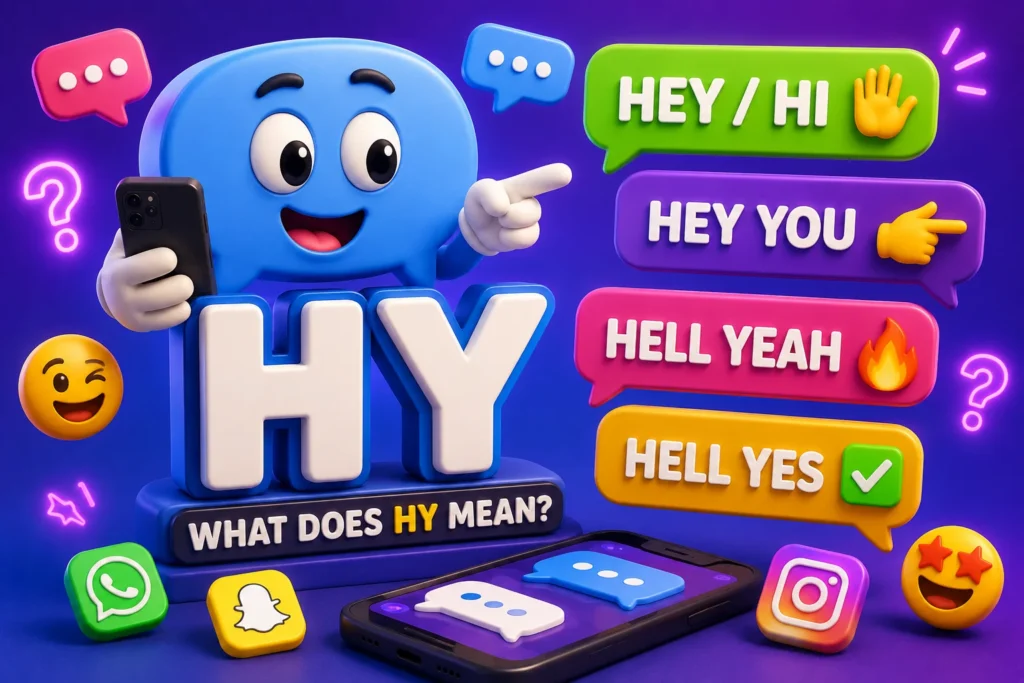
HY usually means “Hey,” “Hi,” or “Hey You” in text messages. In some conversations it can also mean “Hell Yeah” or “Hell Yes” as an excited reply. The correct meaning depends entirely on where it appears in the conversation and the tone of the message.
Unlike abbreviations such as LOL or BRB that have one widely accepted definition, HY is more context-dependent. If someone simply sends “HY,” they’re almost always greeting you. If they reply “HY!” after you ask a question, they’re probably expressing enthusiastic agreement (“Hell Yeah!”).
This guide explains every real meaning, where it came from, how people actually use it today, and how to tell which definition someone intends.
Is HY an Acronym or Just Slang?
HY falls into two categories depending on how it’s used.
- As a greeting (“Hey,” “Hi,” or “Hey You”) it is simply an informal texting abbreviation.
- As “Hell Yeah” or “Hell Yes,” it functions as an acronym formed from the first letters of each word.
It isn’t an official English abbreviation, and there is no universal dictionary definition that applies in every situation. Internet users interpret it through context.
All Real Meanings of HY
1. HY = Hey (Most Common)
This is the meaning most people encounter.
Instead of typing “Hey,” many users simply write:
HY
or
hy
Lowercase is especially common because most messaging apps automatically encourage casual writing.
Examples
- HY, what’s up?
- Hy, are you free later?
- HY! Long time no see.
In these cases, HY simply starts a conversation.
2. HY = Hi
Some people type HY instead of HI.
This is especially common among people who type quickly or whose first language isn’t English. In many online communities, “hy” has become an accepted informal greeting even though “hi” remains the standard English spelling.
Example:
Friend: HY
You: Hey! How are you?
Nothing more complicated than that.
3. HY = Hey You
Occasionally HY is interpreted as “Hey You.”
You’ll usually recognize this meaning because it’s used to grab someone’s attention.
Examples:
- HY 😊
- HY, I wanted to ask something.
- HY! Guess what happened.
This version often feels slightly warmer or more personal than simply saying “Hey.” Evidence for this meaning exists, but it is less consistently used than “Hey” itself.
4. HY = Hell Yeah / Hell Yes
Another genuine meaning is Hell Yeah or Hell Yes.
Unlike the greeting meaning, this version appears as a response, not as the opening message.
Example:
A: Want pizza tonight?
B: HY!
Meaning:
Absolutely!
or
Definitely!
Some users prefer “HY” because it is shorter than typing the full phrase. Older slang references also record HY as meaning “Heck Yeah,” a censored variation of “Hell Yeah.”
Meanings That Are Sometimes Claimed But Aren’t Widely Accepted
You’ll occasionally find websites listing dozens of definitions such as:
- Hold Yourself
- Hope You
- Happy Year
- Have You
These are not established internet slang meanings.
Could someone invent them inside one conversation?
Yes.
Are they common enough to assume?
No.
Unless the surrounding sentence clearly indicates otherwise, readers usually interpret HY as a greeting or an enthusiastic “Hell Yeah.”
The Biggest Misunderstanding
One of the most common mistakes is assuming HY always means “Hell Yeah.”
Imagine someone sends:
HY 😊
That almost certainly isn’t excitement.
They’re simply saying hello.
Likewise:
Movie tonight?
HY!!
Now it obviously means:
Hell yeah!
The position inside the conversation is the biggest clue.
How Context Changes the Meaning
Instead of memorizing multiple definitions, ask three simple questions.
Is HY the First Message?
If yes, it almost always means:
- Hey
- Hi
- Hey You
Example:
HY
How’s your day?
Is HY Answering a Question?
If yes, it probably means:
- Hell Yeah
- Hell Yes
Example:
Want ice cream?
HY!
Does It Include Emojis?
Greeting emojis:
👋 😊 ❤️
Usually suggest “Hey.”
Excited emojis:
🔥 🎉 🤩 😄
Often point toward “Hell Yeah.”
Which Apps Actually Use HY?
Unlike platform-specific slang, HY appears almost anywhere people exchange short messages.
Very common.
People often begin chats with:
- HY
- Hy
- hy
before continuing with their message.
Snapchat
Common in private conversations.
Because Snapchat encourages quick replies, short greetings like HY fit naturally.
Seen in:
- DMs
- Story replies
- Casual conversations
People frequently write:
HY 😊
before starting a conversation.
TikTok
Evidence for HY on TikTok is weaker than on messaging apps. While you may occasionally see it in comments or direct messages, it is not a defining part of TikTok culture or trends.
X (formerly Twitter)
Possible, but uncommon.
Most users simply type:
Hey
instead of HY.
Because X encourages public conversation rather than private messaging, abbreviations like HY appear less frequently.
Grammar: How Does HY Work?
HY behaves differently depending on its meaning.
As a Greeting
Part of speech:
Interjection.
Examples:
HY!
HY everyone!
HY, what’s happening?
It can stand completely alone.
As “Hell Yeah”
Part of speech:
Interjection.
Examples:
HY!
HY, that’s awesome.
HY 😂
Again, it works perfectly as a one-word reply.
Unlike nouns or verbs, HY doesn’t change tense or grammar.
Can HY Be a Complete Reply?
Yes.
That’s one reason it survives.
Imagine these conversations.
Friend:
Finished your assignment?
You:
HY.
Complete conversation.
Or:
Friend:
HY
You:
Hey!
Again, no additional words are required.
Where Did HY Come From?
There isn’t one single documented origin.
Instead, HY seems to have developed naturally during the rise of instant messaging, SMS texting, chat rooms, and later social media, where people shortened common words to type faster.
The greeting version likely evolved from shortening “Hey” or informally spelling “Hi.”
The enthusiastic version comes from abbreviating “Hell Yeah” or “Heck Yeah,” both long-established English expressions of excitement.
Unlike slang terms that can be traced to one community or creator, there is no well-documented evidence identifying a single inventor of HY. The exact origin remains unclear, and multiple meanings appear to have evolved independently through online messaging.
Does HY Come From AAVE?
There is no reliable evidence that HY itself originated in African American Vernacular English (AAVE).
While “Hell yeah” has long existed in informal American English, the abbreviation “HY” appears to have emerged mainly through internet shorthand rather than from one specific dialect or cultural community. Current evidence doesn’t support attributing HY to AAVE.
Four Example Conversations
Funny
Alex: HY 😂
Ben: Why are you laughing already?
Alex: I haven’t even told you what happened.
Ben: Now I’m curious.
Playful
Taylor: HY 👋
Jordan: Finally! I thought you disappeared.
Taylor: I was taking a nap.
Jordan: Best excuse ever.
Serious
Manager: HY. Do you have five minutes?
Employee: Sure.
Manager: I’d like to discuss tomorrow’s presentation.
Employee: Sounds good.
Sarcastic
Chris: We have another meeting.
Sam: HY… exactly what I wanted today.
Chris: I somehow knew you’d say that.
Sam: My excitement is impossible to hide.
More Real-World HY Conversations
Here are additional examples showing how HY naturally appears in different relationships and messaging situations.
Friends (WhatsApp)
Emma: HY! Are you still coming tonight?
Liam: Yep, I’ll be there around 8.
Emma: Awesome, see you then.
Snapchat
Mia: HY 👋
Noah: Hey! Just saw your snap.
Mia: Thought you’d like that sunset.
Noah: It looked amazing.
Dating
Alex: HY 😊
Taylor: Hey! I was hoping you’d text.
Alex: Want to grab coffee this weekend?
Taylor: I’d love to.
Family Chat
Mom: HY. Did you get home safely?
Daughter: Yes, just got in.
Mom: Great. Call me when you’re free.
Coworkers
Rachel: HY, could you review the report?
Mark: Sure. I’ll check it after lunch.
Rachel: Thanks, I appreciate it.
Group Chat
Jake: HY everyone!
Olivia: Morning!
Chris: Ready for the game tonight?
Everyone: Absolutely!
Gaming Friends
Player 1: HY, squad online?
Player 2: Loading in now.
Player 3: Give me two minutes.
College Friends
Sara: HY! Did class get canceled?
Ben: Yeah, professor’s sick.
Sara: Nice, extra study time… or maybe not.
Excited Reply
Friend: We got concert tickets!
You: HY!! 🎉
Friend: I knew you’d be excited.
Weekend Plans
Friend: Beach tomorrow?
You: HY! I’ve been waiting all week.
Friend: Don’t forget sunscreen.
Helping Someone
Friend: Can you help me move Saturday?
You: HY, no problem.
Friend: You’re the best.
Casual Check-In
Jordan: HY, how’ve you been?
Casey: Pretty good. Busy with work lately.
Jordan: Same here. We should catch up soon.
How to Reply to HY
The best reply depends on how the sender is using it.
If HY Means “Hey”
Funny
Finally! I thought you forgot I existed. 😂
Serious
Hey! What’s up?
Flirty
Hey 😊 I was hoping you’d text.
Neutral
Hi! How are you?
If HY Means “Hell Yeah”
Funny
That’s the energy I wanted!
Serious
Great, let’s do it.
Flirty
Love the enthusiasm 😄
Neutral
Awesome! I’ll make the plans.
HY Compared With Similar Texting Terms
| Term | Meaning | Tone | Popularity | Confusion Risk |
|---|---|---|---|---|
| HY | Hey, Hi, Hey You, Hell Yeah | Casual | High | Medium |
| HMU | Hit Me Up | Friendly | High | Low |
| HBU | How About You? | Casual | High | Low |
| SUP | What’s Up? | Informal | High | Low |
| YO | Greeting | Casual | Medium | Low |
| YH | Yeah | Casual | Very High | High |
| NAH (opposite response) | No / Not Interested | Casual | High | Very Low |
HY vs HI vs HEY
One detail many articles overlook is that HY isn’t simply a misspelling of “Hi.”
These three greetings have slightly different feels:
- Hi is the most standard and neutral.
- Hey is a little warmer and more casual.
- HY is a texting shortcut that usually represents one of those greetings rather than replacing them in formal writing.
If you’re emailing a teacher, employer, or client, write Hi or Hello instead of HY.
Why Context Matters More Than the Letters
Because HY has multiple accepted meanings, reading only the abbreviation can be misleading.
For example:
HY
Could mean:
- Hey
- Hi
- Hey You
But:
HY!!
after “We won!”
almost certainly means:
Hell Yeah!
Looking at the previous message is often enough to identify the correct interpretation.
Who Uses HY?
HY is most common among:
- Teenagers
- Gen Z
- Younger Millennials
- Frequent texters
- People who use messaging apps daily
Older adults generally type the full word “Hi” or “Hey” more often, although some also use HY after adopting texting shortcuts from family or friends.
Regional Differences
HY isn’t tied to one English-speaking country.
You’ll find it in conversations involving users from the:
- United States
- Canada
- United Kingdom
- Australia
- New Zealand
It also appears among many non-native English speakers because short abbreviations are common in international messaging. There is no reliable evidence that one region uses HY significantly more than another.
Is HY Rude or Safe?
HY is generally considered safe and friendly.
Profanity
The greeting meanings contain no profanity.
However, if HY stands for “Hell Yeah,” it indirectly references a mild swear word. Many people still consider it casual rather than offensive.
School
Using HY with classmates or friends is perfectly acceptable.
In assignments or formal writing, use “Hi” or “Hello.”
Workplace
HY may be appropriate in casual internal chats between coworkers who already communicate informally.
For professional emails, client messages, or formal business communication, avoid it.
Cultural Notes
HY carries very little cultural baggage. Unlike some internet slang terms, it is not associated with a particular online community, identity, or dialect.
Why HY Keeps Surviving
HY succeeds because it balances speed and friendliness. A single two-letter message can start a conversation without sounding cold, while the same abbreviation can also express enthusiastic agreement when used as a reply. That flexibility makes it useful across texting apps, even as internet slang constantly changes. Rather than replacing traditional greetings, HY offers a faster alternative for casual conversations where brevity matters.
Frequently Asked Questions
What does HY usually mean in text?
Most commonly, HY means “Hey” or “Hi.” It’s often used as a quick greeting at the beginning of a conversation. In some contexts, especially as a reply, it can also mean “Hell Yeah.”
Is HY the same as HI?
Not exactly. HI is the standard English greeting, while HY is an informal texting abbreviation that many people use to mean “Hi” or “Hey.” HY should generally be avoided in formal writing.
Does HY always mean “Hell Yeah”?
No. In fact, the greeting meaning is more common when HY appears as the first message in a conversation. “Hell Yeah” is usually obvious because it’s responding to a question or exciting news.
Is HY used on Snapchat?
Yes. HY appears regularly in Snapchat chats because the app encourages short, fast conversations. It functions just like it does in WhatsApp or Instagram DMs.
Is HY considered Gen Z slang?
It’s commonly used by Gen Z, but it isn’t exclusive to them. Millennials and other frequent texters also use HY, especially in informal conversations.
Should I reply with HY too?
You can, but you don’t have to. Most people simply respond with “Hey,” “Hi,” or continue the conversation naturally. Matching the other person’s tone usually feels the most natural.
Is HY an official English abbreviation?
No. It’s internet shorthand rather than a formal English abbreviation. Dictionaries generally treat it as texting slang rather than standard written English.
Conclusion
HY is a short, flexible texting abbreviation that most often means “Hey,” “Hi,” or “Hey You.” In other contexts—especially when replying enthusiastically—it can also mean “Hell Yeah.” The easiest way to interpret it is by looking at where it appears in the conversation. If it starts a chat, it’s probably a greeting. If it answers a question, it’s likely an excited “yes.” While HY is perfectly fine for casual texting on apps like WhatsApp, Snapchat, and Instagram, it’s best to avoid it in formal emails or professional communication.