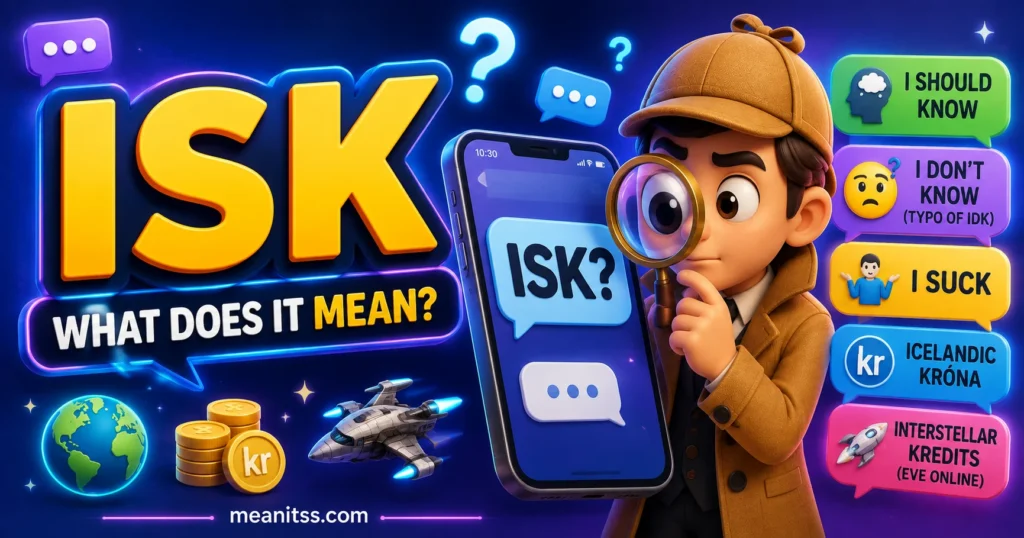
If you see ISK in a text, it can mean “I Should Know,” but it may also be a typo or deliberate variation of “IDK” (“I Don’t Know”). Context matters because ISK is not a universally standardized texting abbreviation.
What Does ISK Mean in Text?
The most commonly reported slang expansion of ISK is “I Should Know.” It is used when someone feels they ought to know an answer, fact, detail, or situation but cannot immediately remember it.
For example:
“What time does the movie start?”
“ISK, I forgot to check.”
Here, ISK carries the idea of “I should know this, but I don’t right now.”
However, current online references also document ISK as a typo or playful substitute for IDK, meaning “I Don’t Know.” The two letters are adjacent on a QWERTY keyboard, which makes the typo plausible, although there is no strong evidence establishing one definitive origin for this usage.
So if someone sends you “isk”, don’t automatically assume it means “I Should Know.” Read the surrounding sentence first.
Is ISK an Acronym, Abbreviation, or Slang?
In texting, ISK is best described as an informal abbreviation or initialism, rather than a standard English word.
When interpreted as “I Should Know,” each letter represents part of the phrase:
- I = I
- S = Should
- K = Know
It is normally written as ISK or isk. Capitalization does not usually change its meaning in a casual conversation.
Unlike established abbreviations such as LOL, BRB, or IDK, ISK is relatively uncommon. Several current slang references specifically note that its meaning depends heavily on context, and some sources give competing interpretations.
That uncertainty is important. If someone uses ISK and you don’t understand it, asking what they meant is more reliable than assuming everyone uses the abbreviation in exactly the same way.
The Main Meanings of ISK
1. ISK = “I Should Know”
This is the clearest slang meaning repeatedly reported in current texting references.
Someone might write ISK when they realize they should already have an answer.
For example:
“Do you know where Sarah went?”
“ISK, she told me earlier but I forgot.”
The phrase can communicate mild embarrassment, self-awareness, or frustration with one’s own memory.
It doesn’t necessarily mean the person actually knows the answer at that moment. In many examples, the important idea is “I ought to know this.”
2. ISK = A Typo or Variation of “IDK”
Another documented interpretation is that isk is sometimes used instead of idk, meaning “I Don’t Know.”
Some sources describe it as an accidental typo because S and D are neighboring keys on a QWERTY keyboard. Others describe people intentionally leaving the typo in place as a joke or informal spelling.
For example:
“Who is coming tonight?”
“isk”
In this situation, the sender may simply mean “I don’t know.”
This is why the surrounding conversation matters so much.
3. ISK = “I Suck”
A smaller number of slang references also record ISK as shorthand for “I Suck.” This interpretation is much less reliable and much less widespread than “I Should Know” or the IDK-typo interpretation.
It might appear after someone makes a mistake:
“I forgot your birthday again. isk 😭”
But because this meaning is not consistently documented across major references, it should not be assumed without supporting context.
A Common Misunderstanding: ISK vs. IDK
The biggest practical source of confusion is ISK vs. IDK.
IDK is well established and means “I Don’t Know.”
ISK is much less standardized. It may mean “I Should Know,” or it may simply be a typo or playful version of IDK.
Compare these:
IDK:
“IDK where my keys are.”
Meaning: I don’t know where my keys are.
ISK:
“ISK where my keys are. I put them somewhere this morning.”
Meaning: I should know where they are, but I’ve forgotten.
The second sentence carries an extra sense of self-awareness.
That distinction is useful when interpreting a message.
How Context Changes the Meaning
One of the easiest ways to decode ISK is to look at what comes immediately before it.
If somebody asks:
“Who won the game?”
and the response is:
“ISK.”
the sender could mean “I don’t know.”
But if someone says:
“I was supposed to remember the meeting time. ISK.”
the intended meaning is much more naturally “I should know.”
A useful rule is:
If the message expresses responsibility for knowing something, “I Should Know” is more likely. If it simply answers an unknown question, it may be an IDK typo.
This is not a universal rule, but it is a practical way to interpret ambiguous messages.
Where Is ISK Used?
Evidence for specific social platforms is limited because ISK is not a standardized platform-specific slang term.
Snapchat
There is documented discussion of ISK being used in Snapchat conversations, including examples where it expresses uncertainty or “I should know” sentiment.
Because Snapchat messages are short and informal, abbreviations can appear naturally there.
TikTok
Some current slang references list ISK in TikTok comments and messages, generally with the same interpretations found elsewhere. However, there is not strong evidence that TikTok created or standardized the term.
ISK can appear in casual online communication, but evidence does not establish it as an Instagram-specific expression. It is better understood as general internet shorthand than as an Instagram-exclusive term.
The same applies to WhatsApp. ISK may appear in informal chats, but there is no evidence that WhatsApp gives it a special meaning.
X
There is insufficient evidence to treat ISK as a distinctive X/Twitter slang term. If you see it there, interpret it from the surrounding conversation rather than assuming a platform-specific definition.
Grammar: How Is ISK Used in a Sentence?
ISK functions as a standalone conversational abbreviation, rather than a conventional noun or verb.
It can appear at the beginning:
“ISK, but I can’t remember.”
It can appear after a statement:
“I was there yesterday, isk.”
It can also appear by itself:
“Who told you?”
“ISK.”
The punctuation and surrounding words help reveal the intended tone.
A person might write:
“ISK 😭”
to sound embarrassed or amused, while:
“ISK.”
could sound more blunt or dismissive.
Because ISK is informal shorthand, it does not follow the same grammatical rules as a normal English word.
Where Did ISK Come From?
There is no well-established, authoritative origin story for the texting slang ISK.
Some slang websites claim that it developed through fast internet messaging or from the accidental substitution of S for D when typing IDK. The keyboard explanation is plausible and is repeated by multiple sources, but that does not establish a documented historical origin.
It is therefore safer to say that the origin of the slang usage is unclear.
The broader practice of shortening phrases in online communication is much older and well documented, but that does not prove exactly when or where ISK itself began.
There are also established non-slang meanings of ISK that are completely separate from texting.
ISK Can Also Mean Icelandic Króna
In financial contexts, ISK is the international currency code for the Icelandic króna.
So if you see:
“The price is 20,000 ISK.”
the person is almost certainly talking about money, not texting slang.
This is an important distinction because ISK has a legitimate financial meaning outside internet slang.
ISK in EVE Online
Gamers may recognize ISK for another reason.
In EVE Online, ISK stands for InterStellar Kredits, the game’s primary currency. The official EVE Online documentation describes ISK as the main currency used for transactions throughout the game’s universe.
So:
“I have 50 million ISK.”
could be completely unrelated to texting slang.
In a gaming chat, always consider whether the conversation is about EVE Online before interpreting ISK as “I Should Know.”
Four Tone-Based Conversations
Funny
Mia: Did you seriously forget the Wi-Fi password again?
Jake: ISK 😭
Mia: You literally changed it yesterday.
Jake: My brain has resigned.
Here, ISK means “I should know,” with a humorous self-aware tone.
Sarcastic
Alex: You were the one who made the schedule, right?
Sam: ISK.
Alex: And yet you’re asking me what time we’re meeting?
Sam: Apparently I enjoy creating mysteries.
The abbreviation highlights the irony of knowing that the person should have the information.
Playful
Lena: Who ate the last cookie?
Noah: ISK 👀
Lena: You were standing next to the empty box.
Noah: Allegedly.
Here, the abbreviation can be used jokingly rather than as a literal admission.
Serious
Manager: Do you know why the report wasn’t submitted?
Employee: ISK. I should have checked the deadline.
Manager: Please check it now and let me know what happened.
Employee: I will.
In a serious exchange, the abbreviation can sound too casual, so the full phrase is clearer.
10 More Realistic ISK Conversations
1. Friends
Friend A: What time are we leaving?
Friend B: ISK, you planned it.
Friend A: Oh right. 7:30.
Friend B: Knew you knew.
2. Family
Sister: Mom’s birthday is Friday, right?
Brother: ISK, but I need to check the calendar.
Sister: It’s Friday. Don’t forget this time.
Brother: That’s exactly why I’m checking.
3. Coworkers
Coworker A: Did the client approve the design?
Coworker B: ISK. I wasn’t copied on the last email.
Coworker A: I’ll check with them.
Coworker B: Thanks.
4. Dating
Person A: You said you’d remember my favorite restaurant.
Person B: ISK 😭
Person A: So you forgot?
Person B: I forgot the name, not the food.
5. Group Chat
A: Who’s bringing drinks?
B: ISK.
C: Nobody knows anything in this group.
D: Beautiful teamwork.
6. School
Student A: When is the history assignment due?
Student B: ISK, I think Friday.
Student A: Let me check the class page.
Student B: Please do because now I’m worried.
7. Gaming
Player A: What level do we need for that mission?
Player B: ISK. Check the quest details.
Player A: It says 30.
Player B: Then we’re good.
8. Snapchat
A: Did you hear what happened after the party?
B: ISK, I left early.
A: I’ll tell you later.
B: Please do.
9. Dating App
A: Have you seen that movie?
B: ISK, the title sounds familiar.
A: We can watch it together sometime.
B: I’m in.
10. Parent and Teen
Parent: What time does practice end?
Teen: ISK, around six?
Parent: Please check before I come get you.
Teen: Checking now.
How to Reply to ISK
Your response depends on what the sender appears to mean.
Funny Reply
“Then your brain needs a software update 😂”
Serious Reply
“No worries. Let’s check and find out.”
Flirty Reply
If the conversation is already romantic or playful:
“You should know one thing: I’m definitely thinking about you 😉”
Don’t force a flirty interpretation onto an ordinary message. ISK itself is not inherently romantic.
Neutral Reply
“No problem. We can check.”
If you’re unsure whether the sender meant “I Should Know” or “I Don’t Know,” simply ask:
“Do you mean ‘I should know’ or ‘I don’t know’?”
That is often the clearest solution.
ISK vs. Similar Text Terms
| Term | Meaning | Tone | Popularity | Confusion Risk |
|---|---|---|---|---|
| ISK | I Should Know; sometimes IDK typo | Casual/self-aware | Low–Medium | High |
| IDK | I Don’t Know | Neutral/casual | Very high | Low |
| IKR | I Know, Right? | Agreeing/enthusiastic | High | Medium |
| IDC | I Don’t Care | Indifferent | High | Medium |
| IDEK | I Don’t Even Know | Confused/emphatic | Medium | Low |
| OFC | Of Course | Confident/affirming | Medium–High | Low |
| I Know | Directly indicates knowledge | Neutral | Very high | Very low |
The most important comparison is ISK vs. IDK. If the sender is simply saying they have no idea, IDK is the established abbreviation. If they are acknowledging that they ought to know something, ISK can fit better.
Who Uses ISK?
There is not enough reliable evidence to assign ISK to one particular age group, generation, gender, or region.
Some websites describe it as internet slang associated with younger users, but the available evidence does not justify saying that Gen Z exclusively uses it or that it has a distinct US, UK, or regional identity.
The safest description is that ISK is informal internet shorthand with relatively limited and inconsistent usage.
That also explains why one person may immediately understand it while another person has never seen it before.
Is ISK Rude or Offensive?
Generally, ISK is not profanity or inherently offensive.
Its tone depends on how it is used.
A casual:
“ISK 😭”
can sound harmless and self-deprecating.
A short:
“ISK.”
could sound dismissive if the surrounding conversation is already tense.
There is no known cultural reason to treat the abbreviation itself as offensive. The main issue is clarity, especially in school or professional communication.
For an email, report, assignment, workplace message, or formal request, write “I should know” or “I don’t know” instead.
When ISK Can Cause Trouble
The unusual thing about ISK is not its offensiveness. It is its ambiguity.
Imagine someone asks:
“Do you know where the documents are?”
and receives:
“ISK.”
Does that mean:
- “I should know where they are,”
- “I don’t know where they are,”
- or simply “I typed IDK incorrectly”?
The sender may know exactly what they intended, but the receiver does not have enough information.
That makes ISK a good example of a broader rule in digital communication: shorter does not always mean clearer.
Why Does ISK Work in Conversation?
ISK works because it compresses a small but recognizable social reaction into three letters: “I really ought to know this, but somehow I don’t.” That is different from the completely neutral IDK because it can acknowledge responsibility, forgetfulness, or mild embarrassment at the same time. Its usefulness comes less from widespread popularity and more from that specific conversational nuance. At the same time, because the abbreviation is uncommon and can resemble a typo, context is essential.
ISK: Slang Category
For your category system, ISK fits best under:
Primary category: Slang Text Meaning
Secondary category: Parent-facing “decode your teen’s texts”
Possible but weaker category: Gen Z / TikTok slang
It does not have strong evidence supporting classification as:
- Brainrot slang
- AI/tech-related slang
- Dating/relationship slang
It can appear in dating or social conversations, but that does not make it dating slang.
Common Mistakes With ISK
Mistake 1: Assuming ISK Always Means “I Should Know”
It doesn’t always. Some sources specifically document it as a typo or intentional variation of IDK, so context should determine the interpretation.
Mistake 2: Treating It Like a Widely Standardized Acronym
ISK is much less standardized than IDK, LOL, BRB, or FYI.
If the recipient doesn’t understand it, that does not necessarily mean they are unfamiliar with internet slang. ISK itself is relatively uncommon.
Mistake 3: Assuming Every “ISK” Is Text Slang
A financial message may use ISK for the Icelandic króna, while a gaming message may refer to InterStellar Kredits in EVE Online.
Mistake 4: Inventing a Fixed Origin
There are explanations involving keyboard errors and internet shorthand, but there is no strong historical record establishing one definitive origin for the texting usage.
It’s better to call the origin unclear than to turn a plausible explanation into a proven fact.
FAQ About ISK
What does ISK mean in texting?
ISK most commonly appears in current slang references as “I Should Know.” It can express that someone feels they ought to know an answer or piece of information. However, ISK is also documented as a typo or playful variation of IDK, meaning “I Don’t Know.”
Does ISK mean “I Don’t Know”?
Sometimes, but this interpretation is less straightforward because IDK is the established abbreviation for “I Don’t Know.” Some references document ISK as a typo or intentional variation of IDK. Look at the surrounding conversation before deciding what the sender meant.
Is ISK the same as IDK?
No, not necessarily. IDK clearly means “I Don’t Know,” while ISK is ambiguous and can mean “I Should Know” or function as a typo of IDK. If the distinction matters, ask the sender.
What does ISK mean on Snapchat?
On Snapchat, ISK has been documented as informal shorthand that can express uncertainty or the idea that someone should know something. It does not appear to have a special Snapchat-only definition. Context still determines the intended meaning.
Is ISK a Gen Z word?
There is not enough evidence to say that ISK belongs exclusively to Gen Z. It is better described as informal internet or texting shorthand. Some current sources associate it with social-media communication, but that does not establish a specific generational ownership.
Is ISK rude?
No, ISK is not inherently rude or offensive. A blunt “ISK.” can sound dismissive depending on the conversation, but the abbreviation itself is harmless. In formal communication, however, it is better to use the full phrase.
What does ISK mean in gaming?
In EVE Online, ISK means InterStellar Kredits, the game’s primary currency. This is completely different from the texting slang meaning.
What does ISK mean in money?
ISK is the currency code for the Icelandic króna. If you see ISK next to a price, exchange rate, or financial amount, the financial meaning is probably intended rather than the texting abbreviation.
Final Takeaway
ISK usually means “I Should Know” when it is being used as texting slang, but it is not a standardized abbreviation. It can also appear as a typo or playful version of IDK (“I Don’t Know”), and a smaller number of sources record “I Suck” as another slang interpretation.
The safest way to decode it is to examine the sentence around it.
If the person is admitting they ought to know something, “I Should Know” is the strongest fit. If they’re simply saying they don’t know, it may be an IDK typo.
And remember that context can completely change the answer: ISK can also mean Icelandic króna in financial contexts or InterStellar Kredits in EVE Online.
For casual chats, ISK can work when both people understand the shorthand. For school, work, or anything where clarity matters, writing the full phrase is the safer choice.