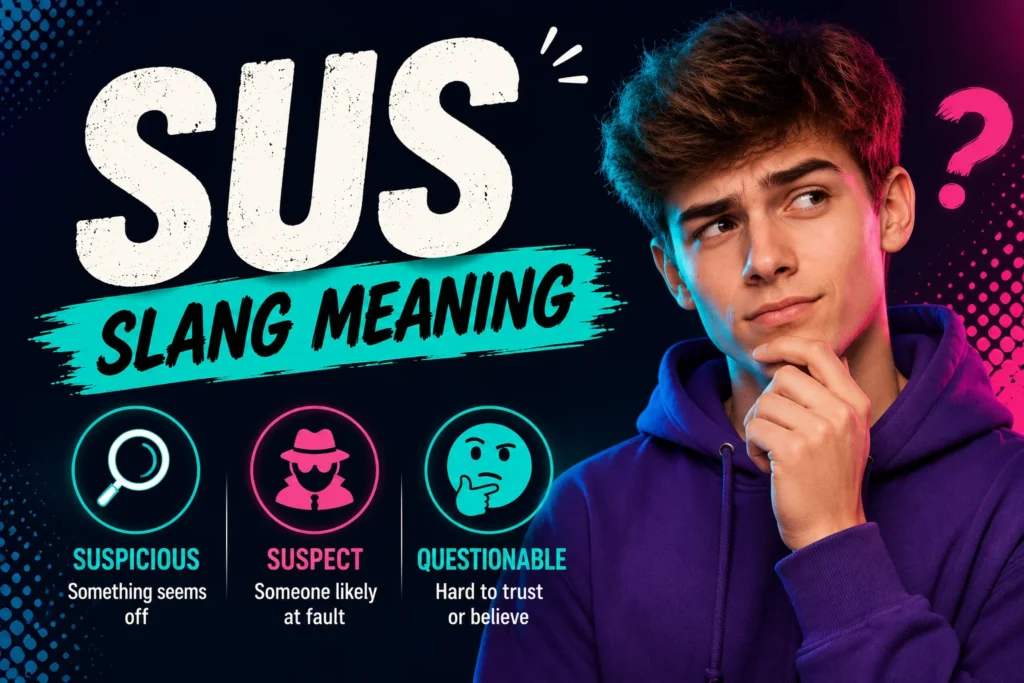
Sus slang meaning most commonly refers to “suspicious” or “suspect.” It is internet slang used to describe someone or something that seems shady, dishonest, or unusual. People often search for it after seeing “sus” on TikTok, in gaming chats, or on social media and wondering what it really means.
What Does “Sus” Mean in Slang?
The primary slang meaning of sus is suspicious. It is a shortened form of the word and is used when someone appears untrustworthy, acts strangely, or seems likely to be hiding something.
Unlike an acronym, sus is simply a shortened slang word (clipping) derived from “suspicious.”
Examples:
- “That excuse sounds sus.”
- “He’s acting kinda sus today.”
- “Why are you deleting messages? That’s sus.”
Although the word existed in spoken English long before social media, it exploded in popularity after the online multiplayer game Among Us, where players constantly accused each other of being “sus.”
Possible Meanings of “Sus”
Suspicious (Most Common)
This is by far the most common meaning.
People use sus when someone:
- Seems dishonest
- Acts unusually
- Gives a questionable explanation
- Looks guilty
- Behaves differently than expected
Example:
“You suddenly became quiet when I mentioned the surprise party. That’s sus.”
Suspect
Sometimes sus can also mean someone who is the likely culprit or person under suspicion.
Example:
“He’s the main sus.”
In gaming communities, this usually means:
“He’s probably the one responsible.”
Joking or Playful Teasing
Among friends, sus is often used humorously rather than seriously.
Example:
Friend eating the last slice of pizza:
“Looking pretty sus right now.”
No one actually believes they committed a serious wrongdoing—it’s just playful teasing.
Is “Sus” an Acronym?
No.
Unlike slang such as LOL, BRB, or SMH, sus is not an acronym.
Instead, it’s a shortened version of the adjective suspicious.
How “Sus” Is Used on Different Platforms
TikTok
TikTok is one of the biggest reasons sus became mainstream.
You’ll commonly see:
- “Bro is sus.”
- “That’s kinda sus.”
- POV videos about suspicious behavior
- Meme edits
- Comedy skits
Many creators also use it ironically for harmless situations.
On Instagram, sus appears in:
- Reels
- Comments
- Memes
- Story replies
- DMs
Example:
“That caption is sus 😂”
Snapchat
Snapchat users often send:
- “Why’d you leave me on opened? Sus.”
or
- “You’re acting sus.”
It usually refers to unusual texting behavior.
Friends use sus during everyday conversations.
Example:
“You disappeared for six hours… kinda sus.”
It’s especially common in group chats.
X (Formerly Twitter)
On X, sus frequently appears in reactions to:
- Viral videos
- Celebrity news
- Sports moments
- Politics
- Memes
Example:
“That apology feels sus.”
It usually expresses doubt rather than certainty.
Tone & Context Variations
Funny
A: Who finished the cookies?
B: Not me.
A: You’re covered in chocolate.
B: Okay… that’s kinda sus.
Sarcastic
A: I definitely studied all weekend.
B: Sure…
A: You don’t believe me?
B: That’s the most sus thing I’ve heard today.
Playful
A: Why are you smiling at your phone?
B: No reason.
A: Sus.
B: Mind your business.
Serious
A: The numbers don’t match the report.
B: That sounds sus.
A: We should double-check everything.
B: Agreed.
Real Chat Examples
Example 1 – Friends Texting
A: You said you were asleep, but you were posting on Instagram.
B: I couldn’t sleep.
A: Hmm… that’s sus.
B: Fine, you caught me.
Example 2 – Gaming (Among Us)
A: Red was standing near Electrical.
B: I saw that too.
A: Red is sus.
B: Let’s vote and see.
Example 3 – TikTok Comments
A: He says he found $5,000 on the sidewalk.
B: That’s pretty sus.
A: Exactly what I was thinking.
B: The story doesn’t add up.
Example 4 – School Friends
A: You finished the homework in five minutes?
B: Yeah.
A: That’s sus.
B: I actually started yesterday.
Example 5 – WhatsApp Group
A: Who changed the group icon?
B: Not me.
A: Everyone’s saying it was you.
B: Why am I always the sus one?
Example 6 – Instagram DM
A: You liked my photo from 2019.
B: I was scrolling.
A: Sounds sus.
B: Totally accidental.
Example 7 – College Project
A: The file disappeared right before submission.
B: Nobody touched it.
A: That’s really sus.
B: Let’s check the edit history.
Example 8 – Family Chat
A: Who finished the ice cream?
B: No idea.
A: You’re the only one home.
B: Okay… that does look sus.
Example 9 – X (Formerly Twitter)
A: That “leaked” screenshot seems fake.
B: Yeah, it’s sus.
A: I’m waiting for better sources.
B: Same here.
Example 10 – Discord Server
A: Why did you leave the voice chat so quickly?
B: Internet problems.
A: Kinda sus.
B: My Wi-Fi actually crashed.
Example 11 – Sports Group Chat
A: He suddenly supports the winning team.
B: That’s sus behavior.
A: Biggest bandwagon fan ever.
B: Facts.
Grammar & Language Role
Part of Speech
In modern slang, sus is most commonly used as an adjective.
Examples:
- “That’s sus.”
- “He’s acting sus.”
- “This looks sus.”
Occasionally, especially in gaming, it can function as a noun.
Example:
- “Blue is the sus.”
Sentence Position
“Sus” naturally appears:
At the end of a sentence
- “That sounds sus.”
After linking verbs
- “He’s sus.”
- “This is sus.”
As a short response
- “Sus.”
Can It Replace a Full Sentence?
Yes.
A single reply of “Sus.” often means:
- “That seems suspicious.”
- “I don’t believe you.”
- “Something feels off.”
Formal vs. Informal Register
| Situation | Appropriate? |
|---|---|
| Friends | ✔ Yes |
| Text Messages | ✔ Yes |
| Gaming | ✔ Yes |
| Social Media | ✔ Yes |
| Workplace Emails | ✘ No |
| Academic Writing | ✘ No |
| Professional Reports | ✘ No |
“Sus” is highly informal and should stay in casual conversations.
How to Reply When Someone Says “Sus”
Funny Reply
“Guess I’m the main character today.”
or
“No evidence, Your Honor.”
Serious Reply
“I understand why it looks that way.”
or
“Let me explain what happened.”
Flirty Reply
(Only if the conversation is playful.)
“Maybe I’m only suspicious because I like talking to you.”
or
“You’ll have to investigate me over coffee.”
Neutral Reply
“Fair enough.”
“Maybe.”
“I can see why you’d think that.”
“Okay.”
Comparison Table
| Term | Meaning | Usage Context | Tone | Popularity | Confusion Risk |
|---|---|---|---|---|---|
| Sus | Suspicious, questionable | Gaming, texting, social media | Casual | Very High | Low |
| Sketchy | Looks unsafe or suspicious | Everyday conversation | Casual | High | Low |
| Fishy | Doesn’t seem truthful | Conversation | Casual | High | Medium |
| Shady | Secretive or dishonest | Social media, texting | Informal | High | Medium |
| Cap | Lie or false statement | TikTok, texting | Casual | Very High | Medium |
| Legit (Opposite) | Genuine, trustworthy | Everyday speech | Casual | High | Low |
Who Uses This Term?
Age Group Breakdown
Ages 13–17
Teenagers are the most frequent users of sus, especially after its popularity exploded through Among Us, TikTok, YouTube, and Discord.
Ages 18–29
Young adults commonly use it in texting, memes, gaming, and casual conversations. Many use it both seriously and ironically.
Ages 30+
Many adults recognize the term because of social media and gaming culture, although they generally use it less frequently.
Gen Z vs. Millennials
Gen Z
Gen Z often says sus for anything even slightly unusual. It is frequently used jokingly rather than as a serious accusation.
Millennials
Millennials understand the slang but are more likely to alternate between words like “sketchy,” “fishy,” or “shady.”
Regional Usage
United States
The slang is extremely common in the U.S. and has become part of everyday internet language.
United Kingdom
British users also understand and use sus, largely because of gaming communities, TikTok, Twitch, and YouTube.
Global
English-speaking users worldwide recognize the term thanks to memes, gaming, and short-form video platforms.
Platform Breakdown
| Platform | Common Usage |
|---|---|
| TikTok | Meme videos, POVs, comments |
| Reels, DMs, comments | |
| Snapchat | Casual conversations |
| Friend group chats | |
| X | Reactions, memes, viral posts |
| Discord | Gaming discussions and voice chats |
Origin & Internet Culture
Where Did “Sus” Come From?
The word sus has existed in spoken English for decades as a shortened form of suspicious. It was commonly used in everyday speech long before social media.
Internet Popularity
Although the slang wasn’t new, it became globally recognizable in 2020 because of the multiplayer game Among Us. During each match, players accused one another by saying things like:
- “Red is sus.”
- “Blue looks sus.”
Millions of gameplay videos, Twitch streams, YouTube clips, and TikTok memes turned the word into one of the biggest internet slang terms of the decade.
Meme Culture
After Among Us, “sus” evolved beyond gaming. People began using it for:
- Strange behavior
- Odd excuses
- Funny situations
- Obviously fake stories
- Everyday jokes
Today, someone can call a sandwich, a cat, or even the weather “sus” purely for comedic effect.
Cultural Context
Unlike some internet slang terms, sus is not rooted in AAVE. Its popularity is primarily linked to gaming culture and meme communities rather than a specific dialect or cultural tradition.
Safety & Appropriateness
Is “Sus” Offensive?
Generally, no.
It is a lighthearted slang word used to describe something that seems suspicious.
Does It Contain Profanity?
No.
There is no profanity or explicit language in the word.
School and Workplace Appropriateness
Using sus among classmates or friends is completely acceptable. However, professional emails, business meetings, and academic writing should use words like suspicious, questionable, or concerning instead.
Cultural Sensitivity
Calling someone sus as a joke is usually harmless among friends, but repeatedly labeling someone suspicious without evidence can create misunderstandings. Context matters.
Real-World Observation
One reason sus has remained popular long after the Among Us craze is its flexibility. People no longer use it only to accuse someone of hiding a secret—they use it whenever something feels odd, unexpected, or amusingly questionable. That adaptability has allowed the word to move from gaming jargon into everyday internet conversations, making it one of the most recognizable slang terms of the 2020s.
Frequently Asked Questions
What does “sus” mean in slang?
In slang, sus means suspicious or questionable. It describes a person, action, or situation that seems dishonest, unusual, or untrustworthy. The meaning depends on context but almost always implies doubt.
Why do people say “sus”?
People use sus because it is a quick, informal way to say something seems suspicious. It works well in texting, gaming, and social media where short responses are common. It can be serious or completely playful.
Is “sus” from Among Us?
No. The word existed long before the game as a shortened form of suspicious. However, Among Us made it famous worldwide in 2020 and introduced it to millions of new users.
What does “sus” mean on TikTok?
On TikTok, sus usually describes strange behavior, unbelievable stories, or funny situations. It often appears in memes, skits, reaction videos, and comment sections.
Is “sus” rude?
Not usually. Among friends, it is often playful and humorous. If you seriously accuse someone of wrongdoing by calling them “sus,” though, it may come across as rude depending on the situation.
Can adults use “sus”?
Yes. While the term is especially popular with Gen Z, many adults understand and use it casually. Its widespread popularity means it is recognized across multiple age groups.
What’s the difference between “sus” and “cap”?
Sus means something appears suspicious or questionable. Cap means someone is lying or making a false claim. Something can seem sus without being proven to be cap.
Is “sus” still popular?
Yes. Although it peaked during the Among Us boom, sus remains a common slang word across TikTok, Instagram, Snapchat, WhatsApp, Discord, and X.
What does “sus” mean in texting?
In text messages, sus usually means someone thinks your behavior, explanation, or story seems suspicious. It is often used jokingly between friends but can also express genuine doubt.
Is “sus” only a gaming word?
No. While gaming made it famous, sus is now used across social media, texting, memes, and everyday conversations. Many people who have never played Among Us still use the word regularly.
Conclusion
The sus slang meaning is straightforward: it usually means suspicious, questionable, or likely hiding something. Although the word existed for years as a shortened form of “suspicious,” its popularity skyrocketed through Among Us and quickly spread across TikTok, Instagram, Snapchat, WhatsApp, X, and other online communities.
Today, sus is one of the most recognizable internet slang terms, used both seriously and humorously whenever something doesn’t seem quite right.
Usage Tips
- Use sus to describe suspicious or unusual behavior.
- Keep it for casual conversations, gaming, and social media.
- Pay attention to context—many people use it jokingly.
- Remember it is a shortened word, not an acronym.
Common Mistakes
- Thinking “sus” was invented by Among Us.
- Assuming every use is a serious accusation.
- Using it in formal business or academic writing.
- Confusing it with slang like cap, which specifically refers to lying.
When to Use / When to Avoid
Use it when:
- Chatting with friends.
- Commenting on TikTok or Instagram.
- Playing online games.
- Reacting to something that seems questionable.
Avoid it when:
- Writing professional emails.
- Preparing academic assignments.
- Speaking in formal workplace settings.
- Making unsupported accusations in serious situations.
Meta Title
Sus Slang Meaning: What Does “Sus” Mean in Text?
Meta Description
Learn the real sus slang meaning, its origin, and how it’s used on TikTok, Snapchat, Instagram, WhatsApp, and X with examples and chat conversations.