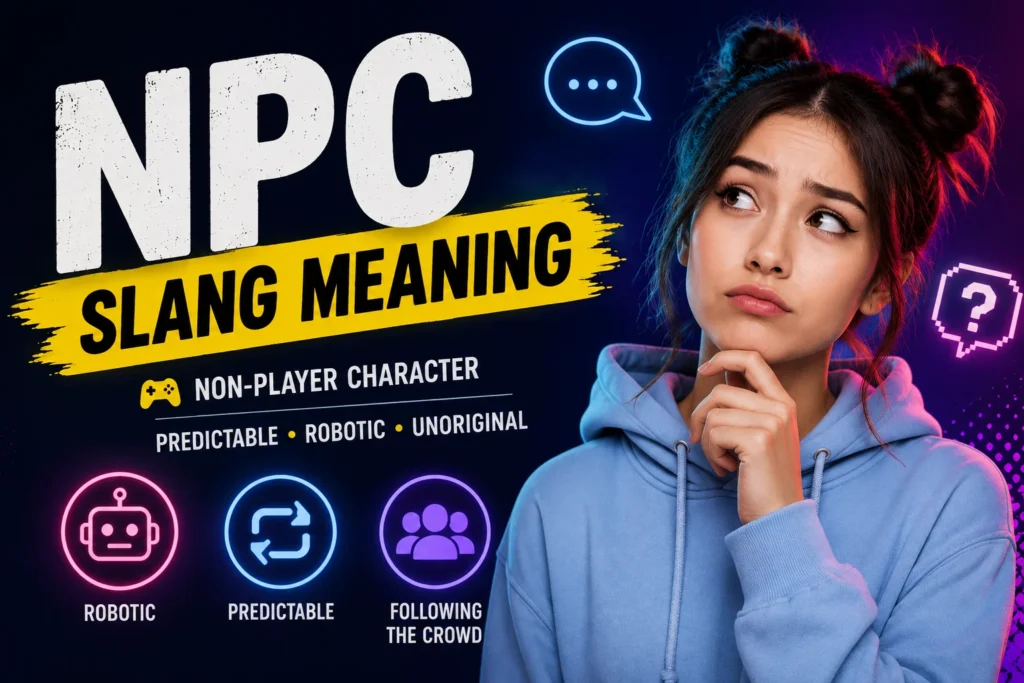
NPC slang meaning most commonly refers to “Non-Player Character,” a gaming term that evolved into internet slang describing someone perceived as predictable, unoriginal, or acting without independent thought. People search for it after seeing “NPC” on TikTok, gaming forums, or social media and wondering whether it’s an insult or simply a meme.
What Does NPC Mean in Slang?
Originally, NPC stood for Non-Player Character in video games. An NPC is a character controlled by the game’s programming rather than by a real player.
In internet slang, however, calling someone an NPC usually means they:
- Repeat popular opinions without thinking independently.
- Behave in a predictable or robotic way.
- Follow trends without questioning them.
- React with the same phrases everyone else uses.
The slang meaning is usually figurative, not literal. It suggests someone appears to be “running on autopilot,” similar to background characters in video games.
Is NPC an Acronym, Abbreviation, or Slang?
NPC is an acronym.
It stands for:
NPC = Non-Player Character
While the acronym comes from gaming, its modern internet usage is considered slang because the meaning has expanded beyond games into everyday online conversations.
Possible Meanings of NPC
Non-Player Character (Primary Meaning)
This is the original and still most common meaning.
In video games, NPCs:
- Are controlled by the game’s software.
- Usually repeat the same dialogue.
- Cannot make independent decisions.
- Help build the game’s world.
Examples include:
- Shopkeepers
- Quest givers
- Guards
- Villagers
Example:
“Talk to the NPC to start the mission.”
Internet Slang
The slang meaning compares a person to a game NPC.
Example:
“He repeats every viral opinion. He’s such an NPC.”
The speaker is suggesting the person lacks originality—not literally calling them a video game character.
Meme Character
Sometimes “NPC” simply refers to the exaggerated internet stereotype itself.
Example:
“That video is making fun of NPC behavior.”
Here, the focus is the meme rather than a specific individual.
How NPC Is Used on Different Platforms
TikTok
TikTok played a major role in popularizing NPC slang.
Common content includes:
- NPC livestreams
- Repetitive catchphrases
- Satirical role-playing
- Trend commentary
- Meme edits
Creators sometimes intentionally act like game characters by repeating identical phrases and movements.
On Instagram, NPC appears in:
- Meme pages
- Reels
- Comments
- Pop-culture discussions
Example:
“The comments are full of NPC replies.”
Snapchat
Snapchat users occasionally call a friend an NPC when someone sends repetitive snaps or responds with the same messages every day.
Example:
“Bro sends the exact same selfie every morning. NPC behavior.”
Among friends, NPC is used jokingly.
Example:
“You always order the same meal.”
“You’re actually an NPC.”
X (Formerly Twitter)
NPC appears frequently in:
- Political discussions
- Meme culture
- Gaming conversations
- Commentary on trending topics
Users often describe repetitive online arguments as “NPC responses.”
Tone & Context Variations
Funny
A: You ordered chicken nuggets again?
B: They’re good.
A: NPC food choice.
B: Leave my comfort food alone.
Sarcastic
A: I copied everyone’s opinion.
B: Really?
A: Saves time.
B: Maximum NPC mode.
Playful
A: You always say “It is what it is.”
B: It’s my favorite phrase.
A: NPC dialogue unlocked.
B: New voice line acquired.
Serious
A: People keep calling me an NPC online.
B: They’re probably criticizing how repetitive your comments sound.
A: I didn’t realize that.
B: Context matters before taking it personally.
Real Chat Examples
Example 1 – Gaming Lobby
A: Why is Blue standing in the same place?
B: Probably AFK.
A: Total NPC behavior.
B: Yeah, they’re not doing anything.
Example 2 – TikTok Comments
A: Every comment says the exact same thing.
B: NPC comment section.
A: Nobody has an original opinion.
B: That’s the internet sometimes.
Example 3 – Friends Texting
A: You order pepperoni pizza every Friday.
B: It’s my favorite.
A: You’re literally an NPC.
B: Consistency isn’t a crime.
Example 4 – College Friends
A: Why did everyone suddenly buy the same water bottle?
B: TikTok made it popular.
A: NPC trend.
B: It definitely went viral.
Example 5 – Discord Server
A: He copies every streamer.
B: I’ve noticed that too.
A: NPC personality.
B: He needs his own style.
Example 6 – Instagram Reel
A: That influencer uses the exact same script in every video.
B: NPC dialogue.
A: Word for word.
B: Every single time.
Example 7 – Office Friends
A: John says “Happy Monday” every Monday.
B: That’s just being friendly.
A: NPC greeting unlocked.
B: I’ll allow it.
Example 8 – WhatsApp Group
A: Sarah keeps replying with “LOL.”
B: Nothing else?
A: Just LOL every time.
B: NPC responses.
Example 9 – X Discussion
A: Every reply repeats the same talking point.
B: NPC replies everywhere.
A: Nobody is reading the article.
B: Just reacting to headlines.
Example 10 – Family Conversation
A: Dad tells the same joke every barbecue.
B: That’s tradition.
A: Classic NPC dialogue.
B: We all laugh anyway.
Example 11 – Online Shopping
A: Why did everyone suddenly buy the same sneakers?
B: A celebrity wore them.
A: NPC shopping decisions.
B: Trends spread fast.
Grammar & Language Role
Part of Speech
In internet slang, NPC most commonly functions as:
- Noun – “He’s an NPC.”
- Adjective (informal modifier) – “That’s NPC behavior.”
Sentence Position
NPC naturally appears:
After a linking verb
- “You’re an NPC.”
Before another noun
- “NPC behavior.”
- “NPC dialogue.”
As a short reply
- “NPC.”
Can It Replace a Full Sentence?
Yes.
A single reply of “NPC.” often communicates:
- “You’re acting predictably.”
- “That behavior seems robotic.”
- “You’re copying everyone else.”
The exact meaning depends on context.
Formal vs. Informal Register
| Situation | Appropriate? |
|---|---|
| Gaming | ✔ Yes |
| Friends | ✔ Yes |
| Social Media | ✔ Yes |
| Text Messages | ✔ Yes |
| Workplace Email | ✘ No |
| Academic Writing | ✘ No |
| Professional Meetings | ✘ No |
NPC is informal internet slang and should generally stay in casual conversations.
How to Reply When Someone Calls You an NPC
Funny Reply
“Guess I forgot to install the main character update.”
or
“Please complete my side quest first.”
Serious Reply
“I actually have my own opinion.”
or
“I’m just keeping things simple.”
Flirty Reply
(Only when the conversation is playful.)
“Maybe I’m an NPC until you start the conversation.”
or
“Looks like you found your favorite character.”
Neutral Reply
“Okay.”
“If you say so.”
“That’s your opinion.”
“Fair enough.”
Comparison Table
| Term | Meaning | Usage Context | Tone | Popularity | Confusion Risk |
|---|---|---|---|---|---|
| NPC | Predictable or robotic person | Gaming, memes, texting | Humorous | Very High | Low |
| Bot | Automated or fake account/person | Gaming, social media | Casual | Very High | Medium |
| Sus | Suspicious or questionable | Gaming, texting | Casual | Very High | Low |
| Sheep | Someone who blindly follows others | Internet debates | Critical | High | Medium |
| Main Character | Someone acting like the story centers on them | TikTok, memes | Playful | High | Medium |
| Original Thinker (Opposite) | Independent, creative person | General conversation | Positive | Medium | Low |
Who Uses This Term?
Age Group Breakdown
Ages 13–17
Teenagers use NPC frequently in gaming, TikTok comments, Discord servers, and memes. Many discovered the term through livestreams and viral videos.
Ages 18–29
Young adults use NPC both seriously and humorously to describe repetitive online behavior or predictable trends. It’s common in gaming communities and social media discussions.
Ages 30+
Many adults recognize NPC because of gaming culture and viral TikTok content, though they generally use it less often than younger users.
Gen Z vs. Millennials
Gen Z
Gen Z often uses NPC ironically and as part of meme culture. It can describe repetitive dialogue, trend-following, or exaggerated online behavior.
Millennials
Millennials usually associate NPC with video games first. When they use it as slang, it’s often tied to gaming or internet humor rather than everyday conversation.
Regional Usage
United States
NPC is widely recognized in gaming and internet culture.
United Kingdom
The slang is commonly understood among gamers and younger social media users.
Global
Because gaming is international, English-speaking users worldwide recognize NPC and its slang meaning.
Platform Breakdown
| Platform | Common Usage |
|---|---|
| TikTok | NPC livestreams, memes, comments |
| Reels, meme pages, comments | |
| Snapchat | Casual jokes among friends |
| Group chats and memes | |
| X | Gaming discussions, internet commentary, memes |
Origin & Internet Culture
Original Meaning
NPC stands for Non-Player Character, a long-established gaming term. Since the early days of role-playing games, NPCs have referred to characters controlled by the game’s programming rather than by human players. These characters typically repeat scripted dialogue, provide quests, sell items, or help move the story forward.
Evolution Into Slang
As gaming culture became mainstream, people began using NPC metaphorically. Instead of referring to game characters, it described individuals who appeared to repeat the same opinions, routines, or behaviors without much originality.
TikTok and Meme Culture
NPC slang gained significant popularity on TikTok through creators who intentionally acted like video game characters. During NPC livestreams, streamers repeated the same phrases, facial expressions, and movements whenever viewers sent virtual gifts. This performance style introduced the term to audiences beyond gaming and turned NPC into a widely recognized meme.
Cultural Context
NPC is not rooted in AAVE. Its slang meaning developed from gaming terminology and later spread through online meme communities, livestreaming, and social media.
Safety & Appropriateness
Is NPC Offensive?
Not inherently. However, calling someone an NPC can be insulting because it implies they lack originality or independent thought.
Does It Contain Profanity?
No. The term contains no profanity or explicit language.
School and Workplace Appropriateness
NPC is generally acceptable in casual conversations with friends, but it is inappropriate for professional communication or formal academic writing because it can sound dismissive or disrespectful.
Cultural Sensitivity
Using NPC as a lighthearted joke among friends is common, but repeatedly labeling people as NPCs in serious discussions may discourage respectful conversation. Consider the context and relationship before using the term.
Real-World Observation
NPC has become one of the few gaming terms to enter mainstream internet language. Many people now use it without ever playing video games, applying it to repetitive trends, scripted social media content, or predictable behavior. Its popularity shows how gaming vocabulary increasingly shapes everyday online conversations.
Frequently Asked Questions
What does NPC mean in slang?
In slang, NPC means someone who seems predictable, robotic, or lacking independent thought. The comparison comes from non-player characters in video games that follow scripted actions. Most people use it humorously, though it can also be critical.
Is calling someone an NPC an insult?
Sometimes. Friends often use it jokingly, but in arguments it can imply that someone simply repeats popular opinions without thinking independently. Whether it’s offensive depends on the tone and relationship.
What does NPC mean on TikTok?
On TikTok, NPC often refers to creators performing robotic, repetitive actions or catchphrases during livestreams. It also appears in comments describing repetitive behavior or trend-following.
What is an NPC in video games?
An NPC, or Non-Player Character, is any character controlled by the game’s programming instead of another player. These characters may give quests, sell items, or interact with players through scripted dialogue.
Why did NPC become so popular?
NPC became mainstream because gaming culture expanded into social media, and TikTok livestreams introduced the concept to millions of viewers. Meme culture helped transform a technical gaming term into everyday slang.
Is NPC only used by gamers?
No. Although it started in gaming, NPC is now common across TikTok, Instagram, X, Snapchat, WhatsApp, Discord, and general internet culture. Many users know the slang without actively playing games.
Can NPC be used positively?
Usually, no. The slang generally carries a teasing or mildly negative meaning. However, friends sometimes use it affectionately as an inside joke rather than a genuine criticism.
Is NPC still popular?
Yes. While its peak popularity coincided with viral TikTok NPC livestreams, the term remains common in gaming communities, memes, and online discussions.
What does NPC mean in texting?
In texting, NPC usually means someone is acting in a repetitive, predictable, or scripted way. Friends often use it jokingly when someone repeats the same habits or phrases.
Is NPC a gaming term or internet slang?
It’s both. NPC began as a gaming acronym meaning Non-Player Character, then evolved into internet slang describing predictable or unoriginal behavior.
Conclusion
The NPC slang meaning comes from the gaming term Non-Player Character, but today’s internet users mostly use it to describe someone acting predictably, following trends without much originality, or repeating familiar phrases. While it’s often meant as a joke, it can also be interpreted as criticism depending on the context.
Understanding both the gaming definition and the modern slang meaning helps you recognize how NPC is used across TikTok, Instagram, Snapchat, WhatsApp, X, and gaming communities.
Usage Tips
- Use NPC in casual conversations, memes, and gaming discussions.
- Consider your audience since some people may find the term insulting.
- Remember that it originated in video games before becoming slang.
- Use it humorously rather than as a personal attack.
Common Mistakes
- Assuming NPC only exists as internet slang.
- Thinking it always means someone is unintelligent.
- Using it in formal workplace or academic settings.
- Confusing NPC with bot, which often refers to automated accounts.
When to Use / When to Avoid
Use it when:
- Talking about gaming.
- Sharing memes with friends.
- Discussing repetitive online behavior.
- Making lighthearted jokes in casual chats.
Avoid it when:
- Writing professional emails.
- Speaking in formal settings.
- Criticizing someone in a serious discussion.
- Communicating where the joke may be misunderstood.