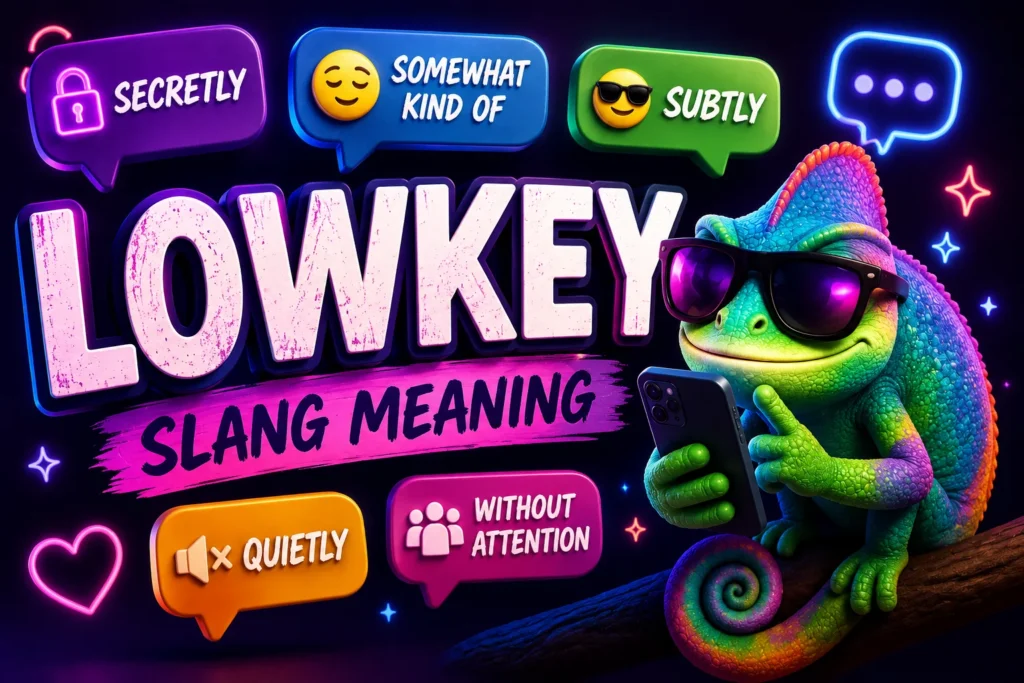
If someone says they’re “lowkey excited” or “lowkey obsessed,” they usually mean they’re secretly, quietly, or somewhat feeling that way without making a big deal about it. In modern slang, lowkey softens a statement or suggests that someone doesn’t want to express their feelings too strongly.
Unlike many internet terms, lowkey is not an acronym or abbreviation. It’s simply a slang word that evolved from the standard English expression low-key and became especially popular through African American Vernacular English (AAVE), hip-hop culture, and social media.
In this guide, you’ll learn every real meaning of lowkey, where it came from, how people use it on different platforms, and how to understand it in everyday conversations.
What Does “Lowkey” Mean in Slang?
The most common slang meaning of lowkey is:
Secretly, quietly, somewhat, or without drawing much attention.
It often softens opinions, emotions, or preferences.
Examples:
- “I lowkey want pizza.”
- “She’s lowkey funny.”
- “I’m lowkey nervous.”
- “We lowkey won.”
In these examples, the speaker isn’t completely hiding their feelings—they’re simply expressing them in a more understated way.
Is “Lowkey” an Acronym?
No.
Lowkey is not an acronym or abbreviation.
It comes from the English phrase low-key, which originally described something restrained, subtle, or not flashy. Online, it evolved into slang with slightly different meanings depending on the sentence.
All Real Meanings of “Lowkey”
Although people often use lowkey casually, it can express several slightly different ideas.
1. Secretly (Most Common)
One of the most common meanings is secretly.
Examples:
- “I lowkey hope it rains.”
- “He’s lowkey jealous.”
- “I lowkey miss school.”
The speaker admits a feeling that they may not openly express.
2. Somewhat or Kind Of
Sometimes lowkey means:
- a little
- kind of
- somewhat
Examples:
- “I’m lowkey tired.”
- “That movie was lowkey amazing.”
- “She’s lowkey right.”
Rather than making a dramatic statement, the speaker intentionally softens it.
3. Quietly or Without Attention
Sometimes people use lowkey to mean doing something discreetly.
Examples:
- “Let’s keep it lowkey.”
- “We had a lowkey birthday dinner.”
- “It was a lowkey weekend.”
Here the meaning is close to:
- relaxed
- simple
- not flashy
- private
This usage is closer to the original English meaning of low-key.
4. Understated Praise
People also use lowkey before compliments.
Examples:
- “That’s lowkey the best pizza I’ve had.”
- “You’re lowkey talented.”
- “This song is lowkey addictive.”
Adding lowkey makes the compliment sound more conversational and less dramatic.
A Common Misunderstanding
Many people think lowkey always means secretly.
That’s only partly true.
Depending on the sentence, it may instead mean:
- somewhat
- kind of
- quietly
- subtly
- without making a big deal
For example:
“I’m lowkey hungry.”
doesn’t necessarily mean you’re hiding your hunger.
It often simply means:
“I’m kind of hungry.”
Understanding the context is the key to interpreting the word correctly.
Which Apps Use “Lowkey”?
The slang appears across nearly every major social platform.
TikTok
TikTok is one of the biggest reasons lowkey became mainstream.
You’ll often hear:
- “Lowkey obsessed.”
- “Lowkey iconic.”
- “Lowkey embarrassing.”
Creators use it in:
- storytime videos
- comedy skits
- fashion content
- reviews
- reaction videos
Instagram users frequently write lowkey in:
- captions
- comments
- Stories
- Reels
Examples:
- “Lowkey my favorite picture.”
- “This outfit is lowkey perfect.”
- “I’m lowkey proud of this.”
Snapchat
Snapchat conversations commonly include:
- “I’m lowkey bored.”
- “Lowkey miss you.”
- “I’m lowkey hungry.”
Because Snapchat emphasizes casual messaging, the word feels natural there.
X (Formerly Twitter)
On X, people often use lowkey while sharing opinions.
Examples:
- “This album is lowkey underrated.”
- “I’m lowkey excited.”
- “That was lowkey hilarious.”
It also appears frequently in memes and trending discussions.
Friends and family naturally use lowkey in WhatsApp chats.
Examples:
- “I’m lowkey tired today.”
- “Lowkey don’t want to go.”
Unlike platform-specific slang, lowkey fits ordinary conversation very well.
Grammar: How Is “Lowkey” Used?
In internet slang, lowkey most commonly functions as an adverb.
It modifies:
- verbs
- adjectives
- entire opinions
Examples:
- “I lowkey agree.”
- “She’s lowkey funny.”
- “We’re lowkey excited.”
Sentence Position
It usually appears:
Before verbs:
- “I lowkey forgot.”
Before adjectives:
- “That’s lowkey weird.”
Before opinions:
- “Lowkey, I liked it.”
Can It Be a Whole Reply?
Sometimes.
Example:
A: “Did you enjoy it?”
B: “Lowkey.”
That one-word reply usually means:
- “Yes, kind of.”
- “Quietly, yes.”
- “I liked it more than I expected.”
The exact meaning depends on the conversation.
Where Did “Lowkey” Come From?
The word low-key has existed in English since the 1800s. Originally, it described something restrained, subdued, or not overly intense. For example, a “low-key event” meant a quiet or informal gathering rather than a large, flashy celebration.
The modern slang use of lowkey developed later and is widely associated with African American Vernacular English (AAVE). Within AAVE, lowkey came to express ideas such as secretly, quietly, or to a certain extent, often softening an opinion or emotion.
From there, the word spread through:
- hip-hop lyrics
- Black popular culture
- Twitter (now X)
- Tumblr
- Vine
- YouTube
- TikTok
By the late 2010s and early 2020s, lowkey had become one of the most common slang words used by English speakers online.
Today, it is recognized far beyond its original communities and appears regularly in everyday conversations, social media captions, memes, and text messages.
Four Example Conversations
Funny
A: Did you eat the last slice of pizza?
B: Lowkey…
A: I knew it!
B: It was calling my name.
Sarcastic
A: So you only spent five hours gaming?
B: Lowkey.
A: Sure you did.
B: Okay… maybe six.
Playful
A: What do you think of my new haircut?
B: Lowkey love it.
A: Really?
B: It suits you.
Serious
A: Are you nervous about tomorrow?
B: Lowkey.
A: That’s understandable.
B: I’m trying not to overthink it.
More Realistic Chat Examples
1. Friends (TikTok)
Emma: Have you heard the new song?
Lily: Just did.
Emma: Thoughts?
Lily: Lowkey my favorite this year.
2. Dating
Chris: Did you miss me?
Taylor: Lowkey.
Chris: Only lowkey?
Taylor: Maybe high-key.
3. College Friends
Alex: Want to skip class?
Jordan: Lowkey tempted.
Alex: I knew it.
Jordan: Don’t convince me.
4. Family Chat
Mom: Did you enjoy dinner?
Son: Lowkey, yes.
Mom: I’ll make it again.
Son: Please do.
5. Instagram Comments
Olivia: Almost didn’t post this picture.
Friend: Why?
Olivia: I wasn’t sure about it.
Friend: Lowkey one of your best photos.
6. Snapchat Friends
Olivia: Are you coming tonight?
Maya: Lowkey thinking about staying home.
Olivia: Long day?
Maya: Yeah, I’m exhausted.
7. Siblings
Brother: Did you actually like my cooking?
Sister: Lowkey, yes.
Brother: I’ll take that as a win.
Sister: You should.
8. Group Chat
Alex: Who wants to watch the new movie?
Jordan: I’m lowkey interested.
Taylor: Let’s go this weekend.
Jordan: Sounds good.
9. Coworkers
Rachel: How was the presentation?
Megan: Lowkey better than I expected.
Rachel: That’s great!
Megan: I’m relieved.
10. Dating
Chris: Did you miss me?
Taylor: Lowkey.
Chris: I missed you too.
Taylor: I figured.
11. X (Formerly Twitter)
User 1: That sequel was surprisingly good.
User 2: Lowkey one of the best this year.
User 1: I wasn’t expecting that.
User 2: Same here.
How to Reply to “Lowkey”
How you respond depends on whether someone is sharing a feeling, giving an opinion, or making a subtle confession.
Funny Reply
- “Only lowkey? I expected high-key!”
- “Go ahead and admit it.”
- “You don’t have to whisper your opinion.”
- “I’ll pretend I didn’t hear that.”
Serious Reply
- “I understand.”
- “That’s completely fair.”
- “Thanks for being honest.”
- “I appreciate you telling me.”
Flirty Reply
If the conversation is clearly romantic:
- “Only lowkey? I was hoping for high-key.”
- “I’ll take that as a compliment.”
- “You’re cute when you’re honest.”
- “Now tell me how you really feel.”
Neutral Reply
- “Same.”
- “I get that.”
- “Fair enough.”
- “Makes sense.”
Comparison Table
| Term | Meaning | Tone | Popularity | Confusion Risk |
|---|---|---|---|---|
| Lowkey | Secretly, somewhat, quietly | Casual | Very High | Low |
| High-key | Openly, strongly, without hiding it | Casual | High | Low |
| Honestly | Truthfully or sincerely | Neutral | Very High | Medium |
| Kind of | To some extent | Neutral | Very High | Low |
| Low-profile | Private or avoiding attention | Neutral | Medium | Medium |
| Subtly | In a quiet or indirect way | Neutral | High | Medium |
| High-key (Opposite) | Openly and enthusiastically | Casual | High | Low |
Although lowkey and high-key are opposites in many situations, lowkey often softens a statement, while high-key emphasizes it.
Who Uses “Lowkey”?
Gen Z
Gen Z uses lowkey constantly in text messages, memes, TikTok videos, and comments. It has become one of the most recognizable conversational slang words because it naturally softens opinions without making them sound too serious.
Millennials
Many Millennials also use lowkey, especially in online conversations and social media. The word became mainstream during the 2010s and remains common in everyday texting.
Regional Differences
The slang is most strongly associated with American English, but because of social media, it’s now widely understood in other English-speaking countries, including the UK, Canada, Australia, and New Zealand.
There is no reliable evidence that lowkey has a significantly different slang meaning in those regions. The usage is generally consistent across English-speaking communities.
Is “Lowkey” Rude or Safe?
In almost every situation, lowkey is completely safe to use.
Is It Offensive?
No.
The word itself is not insulting, offensive, or disrespectful.
Is It Profanity?
No.
There is no profanity or explicit language involved.
School and Workplace
While lowkey is acceptable in casual conversations, it may sound overly informal in professional writing or business emails.
For example:
Casual:
- “I’m lowkey excited about the project.”
Professional:
- “I’m looking forward to the project.”
Choosing the more formal wording is usually better in workplace communication.
Cultural Notes
The modern slang use of lowkey is widely associated with African American Vernacular English (AAVE) before spreading into mainstream English through hip-hop, online culture, and social media. Recognizing those origins provides important cultural context while acknowledging that the word is now widely used across many communities.
Why Does “Lowkey” Continue to Be Popular?
Unlike many slang words that disappear after a few years, lowkey fills a useful gap in everyday conversation. People often want to express opinions without sounding overly dramatic or completely committed. Saying “I’m lowkey excited” feels softer and more natural than saying “I’m extremely excited,” while also being more expressive than simply saying “I’m excited.” That flexibility allows the word to fit many situations, from jokes and memes to sincere conversations. Its ability to soften statements without changing their meaning is one of the biggest reasons it has remained popular.
Frequently Asked Questions
What does “lowkey” mean in slang?
In slang, lowkey usually means secretly, somewhat, kind of, or without making a big deal about it. It often softens an opinion or emotion rather than expressing it strongly.
Is “lowkey” an acronym?
No. Lowkey is not an acronym or abbreviation. It evolved from the English expression low-key, which originally described something restrained or understated.
What’s the difference between “lowkey” and “high-key”?
Lowkey suggests something subtle, quiet, or understated, while high-key means something is expressed openly or strongly. For example, “I’m lowkey excited” sounds more reserved than “I’m high-key excited.”
Why do people say “lowkey” on TikTok?
TikTok users often use lowkey because it makes opinions sound casual and relatable. It’s common in storytelling, reactions, comedy videos, and trend discussions.
Can “lowkey” mean “kind of”?
Yes. In many conversations, lowkey works almost like kind of or somewhat. For example, “I’m lowkey tired” usually means “I’m somewhat tired.”
Is “lowkey” rude?
No. The word is generally considered polite and informal. It doesn’t contain profanity or offensive language.
Where did “lowkey” come from?
The original expression low-key dates back to the 19th century in standard English. The modern slang use developed within African American Vernacular English (AAVE) before becoming widely used through music, internet culture, and social media.
Is “lowkey” still popular in 2026?
Yes. Lowkey remains one of the most commonly used slang words in online conversations, especially on TikTok, Instagram, Snapchat, X, and in text messages.
Conclusion
The slang word lowkey has become a staple of online communication because it lets people express feelings, opinions, and preferences in a subtle way. Whether it means secretly, kind of, somewhat, or quietly, the word helps soften statements without changing their core meaning.
Usage Tips
- Use lowkey to express opinions without sounding overly dramatic.
- It’s common on TikTok, Instagram, Snapchat, WhatsApp, and X.
- Remember that the exact meaning depends on context—it can mean secretly, kind of, or quietly.
- Keep it for casual conversations rather than formal writing.
Common Mistakes
- Mistake: Thinking lowkey always means secretly.
Correct: It can also mean somewhat, kind of, or subtly, depending on the sentence. - Mistake: Assuming it’s an acronym.
Correct: It’s simply a slang word derived from low-key. - Mistake: Using it in formal reports or business emails.
Correct: It’s better suited to casual speech and social media. - Mistake: Confusing it with high-key.
Correct: High-key usually expresses something openly or enthusiastically, while lowkey tones it down.
When to Use It
Use lowkey when you want to express a thought or feeling in a relaxed, understated way. Avoid it in formal or academic writing where standard English is more appropriate.