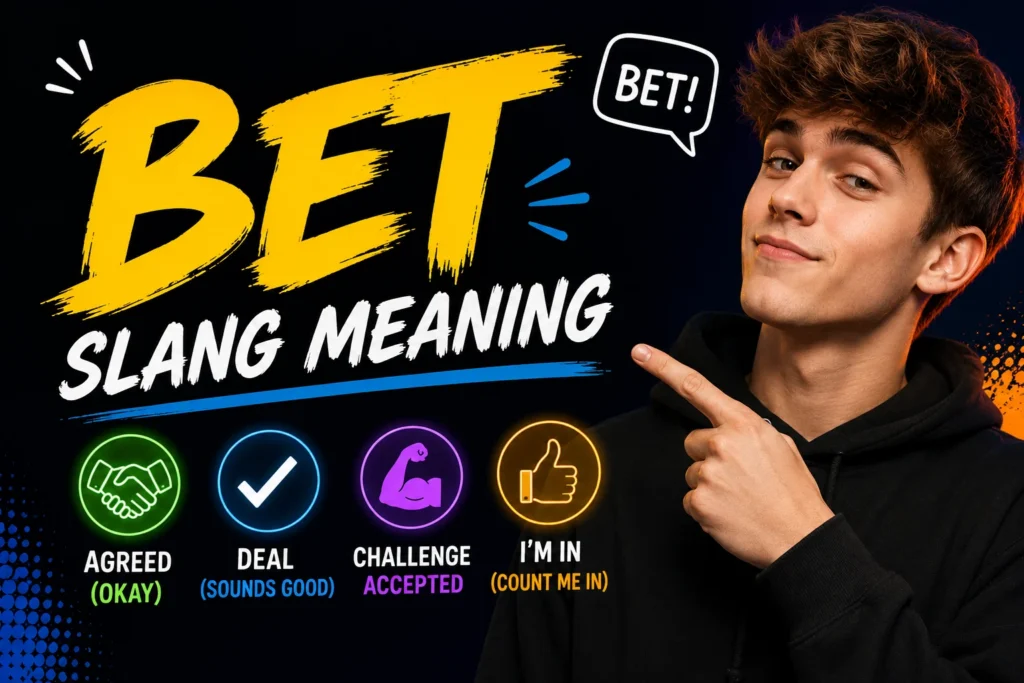
Bet is modern internet slang that usually means “okay,” “deal,” “agreed,” or “I’m in.” While “bet” is also an ordinary English word related to gambling, its slang meaning has become extremely popular in texting, TikTok, Snapchat, Instagram, and everyday conversations. Many people search for “bet slang meaning” because the same word has both a traditional dictionary definition and a newer internet slang meaning.
What Does Bet Mean in Slang?
The most common slang meaning of bet is:
- Okay
- Sounds good
- I agree
- Deal
- Challenge accepted
- I’ll do it
It is not an acronym or abbreviation. Instead, bet is a slang word that evolved from the standard English word “bet,” where agreeing to something was like accepting a wager. Over time, the gambling connection became less important, and today most people use bet simply to show agreement or confidence.
Simple Examples
- “Meet me at 8.”
- “Bet.”
Meaning:
“Okay, I’ll be there.”
Another example:
- “Think you can beat me?”
- “Bet.”
Meaning:
“Challenge accepted.”
The exact meaning depends on the conversation, but it almost always communicates agreement, confidence, or willingness.
Is Bet an Acronym?
No.
Unlike slang such as LOL, BRB, or IMO, bet is not an acronym.
It is a regular English word that developed a new slang meaning through everyday speech and internet culture.
Different Meanings of Bet
1. Agreement (Most Common)
This is by far the meaning you’ll see most often online.
Examples:
- Bet.
- Bet, I’ll be there.
- Bet, sounds good.
- Bet, see you later.
Here it simply means:
- Okay
- Sure
- I agree
2. Challenge Accepted
Sometimes someone says bet after hearing a challenge.
Example:
Friend:
You won’t finish that spicy burger.
You:
Bet.
Meaning:
Watch me.
Here the word expresses confidence.
3. Confirmation
Sometimes it simply confirms information.
Example:
A:
Practice starts at six.
B:
Bet.
Meaning:
Thanks, I understand.
4. Excitement or Enthusiasm
People also use it when they’re excited.
Example:
A:
Free pizza tonight.
B:
Bet!
Meaning:
Awesome!
Count me in!
How Bet Is Used on Different Platforms
Bet on TikTok
TikTok users frequently comment:
- Bet.
- Say less, bet.
- Bet 😂
- Bet, I’m trying this.
The word usually means:
- I’m doing it.
- I agree.
- Good idea.
- Challenge accepted.
Creators often reply “bet” when accepting dares, trends, or suggestions from viewers.
Bet on Snapchat
On Snapchat, conversations are usually short, making bet extremely common.
Example:
Friend:
Pick you up at 7?
You:
Bet.
It works almost like saying “OK.”
Bet on Instagram
Instagram users write bet in:
- comments
- DMs
- story replies
- reels
Example:
“Movie tomorrow?”
“Bet.”
Bet on WhatsApp
WhatsApp conversations often use bet instead of:
- okay
- sure
- sounds good
It keeps replies short while sounding casual.
Bet on X (formerly Twitter)
On X, people use bet to react to opinions, sports discussions, gaming, memes, or breaking news.
Examples:
- Bet.
- Bet we’ll see.
- Bet they lose.
Sometimes it expresses confidence or prediction instead of simple agreement.
Tone & Context Variations
Funny
A: I accidentally ordered enough fries for six people.
B: Bet. I’m already on my way.
A: I knew you’d volunteer.
B: Never waste fries.
Sarcastic
A: The Wi-Fi died five minutes before the deadline.
B: Bet. Of course it did.
A: Perfect timing.
B: Couldn’t have happened earlier.
Playful
A: Race you to the park.
B: Bet!
A: Don’t complain when I win.
B: We’ll see about that.
Serious
A: Can you help me move tomorrow?
B: Bet. I’ll bring my truck.
A: Thanks, I appreciate it.
B: No problem.
Real Chat Examples
Example 1 – Friends Making Plans
A: Basketball at 5?
B: Bet.
A: See you then.
B: Don’t be late.
Example 2 – TikTok Comments
A: Someone should actually try this challenge.
B: Bet.
A: Post the results.
B: I definitely will.
Example 3 – Snapchat
A: Call me after class.
B: Bet.
A: Around 3?
B: Works for me.
Example 4 – Gaming
A: One more match?
B: Bet.
A: Winner stays.
B: You’re going down.
Example 5 – Siblings
A: Mom said dinner’s ready.
B: Bet. I’m starving.
A: Hurry before it’s cold.
B: Already coming.
Example 6 – Study Group
A: Let’s meet in the library.
B: Bet.
A: Bring your notes.
B: I already packed them.
Example 7 – WhatsApp Group
A: BBQ at my place Saturday?
B: Bet.
A: Bring drinks if you can.
B: Already added them to my shopping list.
Example 8 – Instagram DM
A: Want to check out that new café?
B: Bet. I’ve wanted to go for weeks.
A: Saturday morning?
B: Sounds perfect.
Example 9 – X (Formerly Twitter)
A: My team is winning tonight.
B: Bet.
A: You’re that confident?
B: Absolutely.
Example 10 – College Friends
A: Let’s finish the project after class.
B: Bet.
A: Meet in the library?
B: I’ll be there.
Example 11 – Cousins
A: Think you can beat me at Mario Kart?
B: Bet.
A: No excuses afterward.
B: You’re the one making excuses already.
Grammar & Language Role
Part of Speech
Although bet is traditionally a verb and noun in standard English, its slang usage most often functions as an interjection or discourse marker expressing agreement, acceptance, or confidence.
Examples:
- “Bet.”
- “Bet, I’ll come.”
- “Bet, see you later.”
Sentence Position
Slang bet usually appears:
As a complete response
- “Want to hang out?”
- “Bet.”
At the beginning of a sentence
- “Bet, I’ll bring snacks.”
At the end of a sentence
- “We’ll meet at seven, bet.”
The first two uses are much more common.
Can It Replace a Full Sentence?
Yes.
One reason bet became so popular is that it can replace an entire response.
Instead of saying:
“Okay, I agree.”
People simply say:
“Bet.”
Formal vs. Informal Register
| Usage | Appropriate? |
|---|---|
| Texting | ✔ Yes |
| Friends | ✔ Yes |
| Social Media | ✔ Yes |
| Gaming | ✔ Yes |
| Workplace Emails | ✘ No |
| Academic Writing | ✘ No |
| Professional Reports | ✘ No |
“Bet” is considered informal slang and is best suited for casual conversations.
How to Reply When Someone Says “Bet”
Funny Reply
“You’d better not back out now.”
or
“I’ll remember you agreed.”
Serious Reply
“Great, see you then.”
or
“Thanks, I’ll send the details.”
Flirty Reply
If someone says “Bet” after you ask them out:
“Looks like it’s a date.”
or
“I’ll hold you to that.”
Neutral Reply
“Sounds good.”
“Perfect.”
“See you soon.”
“Thanks.”
Comparison Table
| Term | Meaning | Usage Context | Tone | Popularity | Confusion Risk |
|---|---|---|---|---|---|
| Bet | Okay, agreed, challenge accepted | Texting, social media | Casual | Very High | Low |
| Say Less | I understand, no need to explain | TikTok, texting | Casual | High | Medium |
| Facts | That’s true | Social media | Confident | High | Low |
| Word | I agree | Conversation, texting | Casual | High | Medium |
| Deal | Agreement accepted | Everyday conversation | Neutral | High | Low |
| Nah (Opposite meaning) | No, I disagree, I’m not interested | Texting | Casual | Very High | Low |
Who Uses This Term?
Age Group Breakdown
Ages 13–17
Teenagers are among the most frequent users of bet, especially on TikTok, Snapchat, gaming platforms, and school group chats.
Ages 18–29
Young adults use bet naturally in texting, social media comments, Discord servers, and everyday speech. This age group has helped popularize the slang both online and offline.
Ages 30+
Many adults recognize the slang, especially through younger family members, coworkers, or social media. While some use it regularly, others still associate “bet” primarily with gambling.
Gen Z vs. Millennials
Gen Z
Gen Z often uses bet as a one-word reply to show agreement or excitement. It has become part of everyday digital communication.
Millennials
Millennials also use bet, though many alternate between it and phrases like “sounds good,” “okay,” or “deal.” Those active on social media are generally familiar with its slang meaning.
Regional Usage
United States
The slang meaning of bet is most common in the United States, where it has become a regular part of casual speech and online conversations.
United Kingdom
The term is understood by many younger users through TikTok, YouTube, and American pop culture, although it is used less frequently than in the U.S.
Global
Because of social media, gaming communities, streaming platforms, and music culture, bet is increasingly recognized by English-speaking users around the world.
Platforms Where It Appears
| Platform | Common Usage |
|---|---|
| TikTok | Challenges, comments, replies |
| DMs, comments, Reels | |
| Snapchat | Everyday texting |
| Casual conversations | |
| X | Predictions, memes, reactions |
| Discord | Gaming and community chats |
Origin & Internet Culture
Where Did the Slang “Bet” Come From?
The slang use of bet has existed in African American Vernacular English (AAVE) for decades, where it developed as a conversational expression meaning “okay,” “for sure,” or “you can count on it.” Over time, it spread into mainstream American English through everyday conversation, music, sports culture, and entertainment.
AAVE and Cultural Roots
It is important to recognize that the modern slang meaning of bet has roots in AAVE. As with many popular internet expressions, it gained widespread attention after being adopted by broader online communities. Acknowledging its origins helps provide accurate cultural context.
Growth Through Hip-Hop and Social Media
Hip-hop artists, athletes, YouTubers, and streamers helped popularize bet among younger audiences. As short-form content grew on TikTok and Instagram Reels, the word became even more common because it is quick, versatile, and easy to understand.
Why It Became So Popular
“Bet” succeeds because it can express several ideas with one word:
- Agreement
- Confidence
- Excitement
- Acceptance
- Commitment
Its simplicity makes it ideal for fast-paced online conversations.
Safety & Appropriateness
Is “Bet” Offensive?
No.
The slang meaning of bet is generally considered harmless and non-offensive.
Does It Contain Profanity?
No.
It contains no profanity or explicit language.
School and Workplace Appropriateness
Using bet with classmates or friends is perfectly acceptable. However, in professional emails, academic papers, or formal workplace communication, it is better to use alternatives such as “okay,” “agreed,” or “confirmed.”
Cultural Sensitivity
Because the slang meaning originated in AAVE, it is helpful to understand and acknowledge its cultural background rather than treating it as a brand-new internet invention.
Real-World Observation
Unlike many internet slang terms that fade quickly, bet has become part of everyday speech because it fills a practical role. It replaces longer responses such as “okay,” “sounds good,” and “I agree” without changing the meaning. Its flexibility allows it to fit naturally into conversations between friends, classmates, teammates, and online communities, making it one of the most durable pieces of modern slang.
Frequently Asked Questions
What does “bet” mean in slang?
In slang, bet usually means “okay,” “I agree,” “sounds good,” or “challenge accepted.” It is commonly used as a quick response in text messages and social media conversations. The exact meaning depends on the context, but it almost always signals agreement or confidence.
Why do people reply with “bet”?
People reply with bet because it is a short, casual way to confirm plans or accept a suggestion. Instead of typing a full sentence like “Okay, I’ll do that,” they simply write “bet.” This makes conversations faster and more natural.
Is “bet” a Gen Z slang word?
While bet is strongly associated with Gen Z today, the expression existed long before social media. It became especially popular among younger users through TikTok, hip-hop culture, streaming platforms, and online gaming.
What does “bet” mean on TikTok?
On TikTok, bet usually means “I’m in,” “I’ll try it,” or “challenge accepted.” Users often comment “bet” under challenge videos or reply with it when agreeing to participate in a trend.
Is “bet” rude?
No. In most situations, bet is friendly and informal. It is appropriate for casual conversations but should generally be avoided in formal business or academic communication.
Is “bet” the same as “okay”?
Often, yes. In many conversations, bet and okay have the same meaning. However, bet can also express confidence or excitement in addition to agreement.
Can adults use “bet”?
Absolutely. While younger people use it more frequently, many adults understand and use bet in casual conversations. The main consideration is whether the setting is informal enough for slang.
What is the opposite of “bet”?
There is no perfect opposite, but responses such as “nah,” “no,” “not really,” or “I’d rather not” communicate disagreement or refusal, making them practical opposites in conversation.
What does “bet” mean in texting?
In texting, bet is usually another way of saying “okay,” “sure,” or “sounds good.” It confirms that someone agrees with a plan or accepts a request. Because it is only one word, it has become one of the fastest and most common texting responses.
Is “bet” used only in America?
No. Although the slang meaning originated in the United States, it is now recognized in many English-speaking countries thanks to social media, music, gaming, and online communities. Usage is still most common in American English.
Conclusion
The bet slang meaning is simple but versatile. Most commonly, it means “okay,” “I agree,” “sounds good,” or “challenge accepted.” While the word originally referred to gambling, its modern slang meaning has become a staple of texting and social media conversations.
Whether you see bet on TikTok, Snapchat, Instagram, WhatsApp, X, or in everyday chats, the surrounding context will tell you whether someone is agreeing with a plan, accepting a challenge, or expressing confidence.
Usage Tips
- Use bet as a casual way to agree with someone.
- It’s perfect for texting, gaming, and social media conversations.
- Read the context to understand whether it means agreement or confidence.
- Replace it with “okay” or “deal” in formal situations.
Common Mistakes
- Assuming it always refers to gambling.
- Using it in professional emails or academic writing.
- Misinterpreting it as an acronym.
- Forgetting that it is informal slang.
When to Use / When to Avoid
Use it when:
- Texting friends or family.
- Replying on TikTok, Instagram, Snapchat, or X.
- Accepting plans, invitations, or challenges.
- Participating in casual online conversations.
Avoid it when:
- Writing formal emails.
- Preparing academic or business documents.
- Communicating in situations where slang may seem unprofessional.