
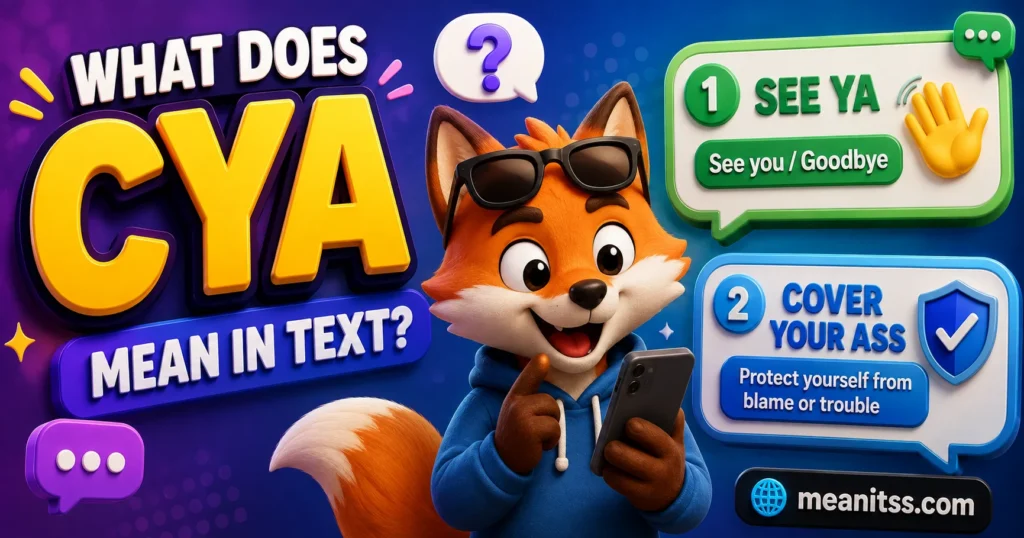
CYA usually means “see ya” or “see you” in text messages, a casual way to say goodbye. In workplace or business contexts, however, CYA can mean “cover your ass,” meaning to protect yourself from blame or trouble.
If someone simply texts “cya!” after a conversation, they almost certainly mean “see ya.” But if you see “CYA” in an office discussion about documentation, mistakes, responsibility, or risk, the meaning can be completely different.
What Does CYA Mean in Text?
CYA has two established meanings:
- CYA = “See ya” / “See you” — an informal farewell used in texting, online chats, emails, and social communication.
- CYA = “Cover your ass” — an informal expression meaning to take precautions to protect yourself from blame, criticism, legal trouble, or other consequences.
Dictionaries recognize both meanings. Collins specifically identifies “see you” as a messaging and social-media abbreviation, while its American English entry also gives “cover your ass” as a slang expression.
For the exact search “what does CYA mean in text?”, the first meaning is normally the one you want.
Quick examples
“I gotta go study. CYA!”
Meaning: See ya!
“Send yourself a copy of that email to CYA.”
Meaning: Cover your ass; protect yourself by keeping documentation.
The surrounding conversation usually makes the intended meaning obvious.
Is CYA Slang, an Abbreviation, or an Acronym?
When CYA means “see ya,” it is best understood as an informal abbreviation or phonetic shorthand. The letters represent the sounds in “see ya,” rather than each letter standing for a separate word.
When CYA means “cover your ass,” it functions as an initialism, because the letters come from the initial letters of the words.
This distinction matters because the two versions can even be pronounced differently. The farewell version can be read aloud as “see ya,” while the workplace expression is commonly read as the individual letters “C-Y-A.”
The Two Real Meanings of CYA
1. CYA = “See Ya”
This is the meaning most relevant to casual texting.
“See ya” is an informal version of “see you,” and CYA simply compresses it into three letters. It can mean goodbye, see you later, or a casual indication that the conversation is ending.
Examples:
- “Gotta run, cya!”
- “Cya tomorrow.”
- “Okay, cya later!”
- “Thanks for hanging out. CYA!”
- “I’m logging off, cya everyone.”
It doesn’t necessarily promise a specific meeting. Someone might say “cya” even when they simply mean “bye” or “talk to you later.”
Collins and other dictionary sources specifically associate this version with text messages, email, messaging, and social media.
2. CYA = “Cover Your Ass”
The second meaning is very different.
“Cover your ass” means taking action to protect yourself against possible blame, criticism, punishment, legal consequences, or responsibility later.
For example:
“Keep a copy of the approval email, just to CYA.”
Here, the speaker isn’t saying goodbye. They’re recommending that the person keep evidence showing they received approval.
The expression is particularly associated with workplace, business, bureaucratic, and other situations involving responsibility or risk. Collins describes this use in a business context, while Dictionary.com labels it slang and sometimes vulgar.
A less vulgar alternative might be:
- “cover your back”
- “protect yourself”
- “cover your bases”
- “protect yourself from liability”
A Common Misunderstanding About CYA
The biggest misunderstanding is assuming that CYA always means “see ya.”
That’s usually reasonable in a casual text:
“Okay, I have to go. CYA!”
But it would be wrong in:
“Make sure everything is documented for CYA.”
The second sentence clearly concerns self-protection, not saying goodbye.
A useful rule is:
Farewell + casual conversation → “see ya.”
Work + documentation + blame/risk → “cover your ass.”
That context-based distinction is also reflected in dictionary definitions.
Which Apps Is CYA Used On?
CYA isn’t tied to one particular social-media platform. Dictionary sources describe it broadly as a messaging and social-media abbreviation, while usage references show it in online chats and text communication.
Text messages and private chats
This is one of the clearest contexts for CYA = “see ya.”
“Dinner was fun! cya soon”
CYA can appear in casual DMs or comments when someone is saying goodbye. However, there is no evidence that Instagram has a special platform-specific meaning for CYA.
Snapchat
The same casual “see ya” interpretation can occur in Snapchat conversations. The meaning comes from ordinary internet/text slang rather than a Snapchat-specific definition.
TikTok
CYA can appear in comments or messages, but it isn’t a distinctive TikTok slang term. Treat it as general online shorthand rather than TikTok-exclusive slang.
CYA can naturally appear in casual WhatsApp conversations, especially when someone is ending a chat.
X
CYA can also be understood in casual posts or direct messages on X, but it isn’t an X-specific abbreviation.
Important: The strongest dictionary evidence supports CYA as a general messaging/social-media abbreviation rather than proving that it has a unique meaning on each of these platforms. So it is better not to describe CYA as “TikTok slang” or “Snapchat slang” specifically.
Grammar: How Is CYA Used in a Sentence?
When CYA means “see ya,” it functions much like an interjection or farewell expression.
It commonly appears:
- At the end of a message
- As a standalone reply
- Before “later”
- Before a time or future meeting
Examples:
“CYA!”
“CYA later!”
“CYA tomorrow.”
“Alright, cya!”
It can stand completely on its own.
Person A: “I gotta head out.”
Person B: “CYA!”
When CYA means “cover your ass,” it behaves differently because it refers to a precaution or strategy.
“We should document everything to CYA.”
In this use, it can function as a verb-like abbreviation within informal workplace language.
Where Did CYA Come From?
There isn’t a single documented origin story that establishes exactly when every use of CYA began.
The underlying phrase “see ya” existed in spoken informal English before the internet. CYA developed as a written shorthand for that expression, and texting and internet communication helped make it recognizable as an abbreviation. Collins dates the dictionary entry to the 20th century, while texting references document CYA among established messaging abbreviations.
The “cover your ass” expression is older than modern texting. Historical references describe the phrase as circulating in American slang before the internet era, with the abbreviation becoming associated with workplace and political/bureaucratic contexts. The exact first use of the abbreviation is less certain, so it would be misleading to claim a precise inventor or single starting date.
One useful historical clue is that an early Urban Dictionary entry for “cya” meaning “see you” dates to 2002, showing that the abbreviation was already established in online usage by the early 2000s.
CYA in Different Tones
Funny
Alex: I have to go before I eat this entire pizza.
Sam: Too late. There are only two slices left.
Alex: Those are emergency slices.
Sam: 😂 CYA, pizza criminal.
Here, CYA simply means goodbye.
Sarcastic
Mia: You really submitted the assignment without checking it?
Jake: Confidence is important.
Mia: So is punctuation.
Jake: CYA when the professor emails me. 😭
Again, CYA means “see ya,” but the surrounding sarcasm gives the farewell a humorous edge.
Playful
Lena: Movie starts in ten minutes!
Noah: I’m still looking for my shoes.
Lena: You have five minutes.
Noah: CYA at the theater 😂
Serious
Manager: Please save the approval email in the project folder.
Employee: Do we really need another copy?
Manager: Yes. If questions come up later, the record protects everyone.
Employee: Understood. Good CYA practice.
Here, CYA means cover your ass, not “see ya.”
12 More Realistic CYA Conversations
1. Friends — Text Message
Emma: I’m heading home now.
Sofia: Same, I’m exhausted.
Emma: Same time tomorrow?
Sofia: Probably. Cya!
Meaning: See ya.
2. Siblings — WhatsApp
Brother: Mom said dinner is at 8.
Sister: I know, but I’m still outside.
Brother: Better hurry.
Sister: Okayyy, cya 😂
Meaning: See you / goodbye.
3. Dating — Instagram DM
Alex: I had fun tonight.
Jordan: Me too 🙂
Alex: Text me when you get home.
Jordan: Definitely. Cya soon ❤️
Meaning: See you soon.
4. Group Chat
Ryan: Anyone still playing?
Chris: I’m done for tonight.
Taylor: Same.
Ryan: Alright, cya tomorrow.
Meaning: See you tomorrow.
5. Gaming Chat
Player 1: I have class early tomorrow.
Player 2: Same, I should probably sleep.
Player 1: One more match?
Player 2: Nope 😂 cya next time.
Meaning: Goodbye / see you next time.
6. Family Conversation
Dad: Are you coming home this weekend?
Son: Probably Saturday afternoon.
Dad: Let me know when you’re leaving.
Son: Will do. Cya then.
Meaning: See you then.
7. Coworkers — Workplace Chat
Maya: Did you send the client the revised figures?
Chris: Yes, and I saved the final version.
Maya: Good. Keep the approval email too.
Chris: Yep, just to CYA.
Meaning: Cover your ass / protect yourself with documentation.
8. Manager and Employee
Manager: Why did you put the request in writing?
Employee: I wanted a record of what was approved.
Manager: Fair enough.
Employee: Just CYA in case someone asks later.
Meaning: Protect yourself from future blame or dispute.
9. Office Email Discussion
Nina: Should we send a confirmation after the meeting?
Mark: Definitely.
Nina: Even though everyone agreed verbally?
Mark: Yes. CYA.
Meaning: Create documentation for protection.
10. Friend Giving Advice
Sam: I’m sending the landlord those photos.
Lee: Keep copies of everything you send.
Sam: Even the old messages?
Lee: Especially those. CYA.
Meaning: Protect yourself by keeping evidence.
11. Casual Social Media Message
Ava: I have to disappear for a bit.
Mia: No worries!
Ava: I’ll message you later.
Mia: Cya 👋
Meaning: See ya.
12. Group Project
Student 1: Can you upload the final presentation?
Student 2: Already uploaded it.
Student 1: Great.
Student 2: And I saved the submission receipt. CYA.
Meaning: Protect yourself by keeping proof.
How Should You Reply to “CYA”?
Your response depends on which meaning the person intended.
If CYA means “See Ya”
Funny:
“Cya, don’t get lost 😂”
Serious:
“See you tomorrow.”
Flirty:
“Cya soon 😉”
Neutral:
“See you!”
If CYA means “Cover Your Ass”
A natural response could be:
“Good idea. I’ll keep a copy.”
Or:
“Agreed. I’ll document it.”
If you’re unsure which meaning was intended, look at the surrounding sentence rather than guessing from the abbreviation alone.
CYA vs Similar Texting Terms
| Term | Meaning | Tone | Popularity | Confusion Risk |
|---|---|---|---|---|
| CYA | See ya / see you | Casual; sometimes professional slang | Common | High because it has two meanings |
| CU | See you | Casual | Moderate | Low |
| TTYL | Talk to you later | Casual | Common | Low |
| BRB | Be right back | Casual | Common | Low |
| GTG / G2G | Got to go | Casual | Common | Low |
| Bye | Goodbye | Neutral | Very high | Very low |
| Hello / Hi | Greeting | Neutral/friendly | Very high | Very low |
One particularly useful comparison is CYA vs TTYL. Both can close a conversation, but TTYL explicitly means “talk to you later,” whereas CYA literally evokes “see ya.” Neither necessarily guarantees a specific future meeting.
Who Uses CYA?
CYA is not reliably limited to one generation.
Texting abbreviations such as CYA have been used across internet and mobile communication, and dictionary sources recognize the expression as established messaging language.
It is therefore safer to describe CYA as general informal internet/text language rather than claiming that only Gen Z uses it.
There is also no strong evidence that the basic “see ya” meaning belongs specifically to one country or region. The phrase “see ya” itself is informal English, while the abbreviation has appeared in online communication more broadly.
Is CYA Rude or Safe?
“CYA” meaning “see ya”
Usually, no—it isn’t rude or offensive.
It is simply an informal goodbye.
It is appropriate for:
- Friends
- Family
- Casual chats
- Gaming conversations
- Informal DMs
For formal communication, however, “See you soon” or “Talk to you later” is usually clearer and more professional.
“CYA” meaning “cover your ass”
This version is different.
The phrase contains “ass,” which dictionary sources classify as slang and sometimes vulgar.
You might hear it in informal workplace conversations, but it isn’t ideal for formal writing, customer communication, academic work, or professional documents.
Safer alternatives include:
- “protect yourself”
- “cover your bases”
- “protect your position”
- “keep a record”
- “document everything”
A Useful Insight: Why Does CYA Work So Well?
CYA is interesting because the same three letters can perform two completely different conversational jobs. In one context, it is a lightweight farewell that mirrors the sound of everyday speech: “see ya.” In another, it is a compact workplace expression about risk and responsibility. The surrounding words do most of the interpretive work. This is a good example of how abbreviations don’t always have fixed meanings; their meaning can depend heavily on the setting, relationship, and topic.
That ambiguity is exactly why someone unfamiliar with CYA can misread a message.
Frequently Asked Questions
Is CYA a bad word?
Not when it means “see ya.” In that context, it is simply a casual abbreviation for saying goodbye. When CYA means “cover your ass,” it contains a vulgar slang expression, so it is less appropriate in formal settings.
Does CYA mean “see you later”?
Yes, in casual texting CYA can mean “see ya,” “see you,” or informally “see you later.” It usually signals that someone is ending the conversation. It doesn’t necessarily specify exactly when the people will meet again.
What does CYA mean from a coworker?
Context matters. If your coworker writes something like “Keep the email for CYA,” they probably mean “cover your ass”—protect yourself by keeping documentation. If they write “CYA tomorrow!”, they mean “see ya.”
Is CYA appropriate for work?
It depends on the meaning. “CYA” as “see ya” is informal and may be fine in a casual workplace chat, but it isn’t ideal for formal business writing. The “cover your ass” meaning is also informal and somewhat vulgar, so professional alternatives such as “protect yourself” or “document this” are safer.
Does CYA mean “cover your assets”?
Sometimes people use cleaner substitutions such as “cover your assets” or “cover your actions” to avoid the vulgarity of “cover your ass.” However, the established slang expression listed by major dictionaries is “cover your ass.”
What is the difference between CYA and TTYL?
CYA commonly means “see ya” and works as a casual farewell. TTYL means “talk to you later” and specifically suggests another conversation later. Both are informal ways of ending a digital conversation.
Can CYA be used by itself?
Yes. When it means “see ya,” it can easily stand alone:
“I gotta go.”
“CYA!”
It functions like a short farewell. The “cover your ass” meaning normally needs surrounding context because it refers to a protective action or strategy.
Is CYA still used?
Yes. CYA remains a recognized abbreviation in current dictionary and texting references. It isn’t as mysterious or platform-specific as some newer internet slang; it is an established shorthand that has persisted across messaging and online communication.
Conclusion
So, what does CYA mean in text?
Most of the time, especially in a casual message, CYA means “see ya” or “see you.” It’s a quick, informal goodbye.
But there is another established meaning: “cover your ass.” In workplace, business, or risk-related conversations, CYA can mean taking steps to protect yourself from blame, criticism, or future problems.
The easiest way to tell them apart is to check the context:
“I have to go, cya!” → See ya.
“Save that email to CYA.” → Cover your ass.
If you’re writing formally, spell out “see you” instead of CYA. And if you’re using the second meaning professionally, consider a cleaner phrase such as “protect yourself” or “keep a record.”