
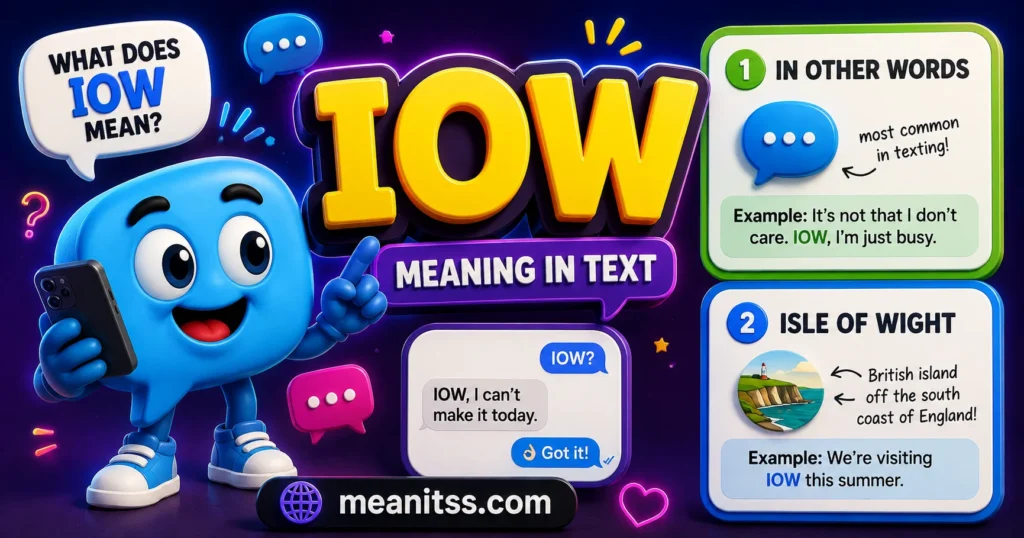
IOW usually means “in other words” in texting and online communication. It is a written abbreviation used when someone wants to rephrase, simplify, clarify, or summarize something they have just said.
If you saw “IOW” in a message, comment, forum post, or social-media conversation, the intended meaning is usually “in other words.” However, IOW also commonly represents “Isle of Wight,” especially in British geographical contexts.
What Does IOW Mean?
The most common meaning of IOW in text is “in other words.”
It tells the reader that the person is about to explain the same idea differently, usually in a simpler, shorter, or more direct way.
For example:
“The restaurant was expensive and the portions were tiny. IOW, not worth it.”
Here, IOW = in other words, and the writer uses it to summarize the point.
Cambridge defines IOW as a written or internet abbreviation for “in other words,” specifically noting that it can introduce an explanation that is simpler than what came before.
Quick meaning
| Term | Meaning | Type |
|---|---|---|
| IOW | In other words | Written abbreviation / initialism |
| IOW | Isle of Wight | Place abbreviation |
So if someone writes “IOW, you need to start over,” they are not introducing a place. They are saying, “In other words, you need to start over.”
Is IOW Slang or an Acronym?
IOW is better described as an internet/text abbreviation or initialism, rather than traditional slang.
It is formed from the first letters of:
In
Other
Words
Because the letters are normally pronounced individually—“I-O-W”—it is technically an initialism, although many websites and everyday users loosely call it an acronym.
Cambridge categorizes it as a written abbreviation/internet abbreviation, while online reference sources classify it among internet acronyms and text-message shorthand.
This distinction matters because IOW does not have the same cultural function as slang such as “rizz,” “sus,” or “cap.” It is primarily shorthand that makes written communication quicker.
The Other Major Meaning: Isle of Wight
There is another established meaning of IOW: Isle of Wight.
The Isle of Wight is an island off the southern coast of England. In British writing, travel discussions, news, tourism, and geographical contexts, IOW can be used as an abbreviation for the island. Collins lists both meanings: “Isle of Wight” and, in messaging and social media, “in other words.”
For example:
“We’re going to the IOW this weekend.”
This almost certainly means:
“We’re going to the Isle of Wight this weekend.”
Context makes the distinction straightforward.
How to tell which meaning is intended
Look at the words surrounding IOW.
Texting context:
“IOW, you’re saying I was right?”
= In other words
Travel context:
“Have you ever visited IOW?”
= Isle of Wight
Dictionary.com and Reverso also recognize these two established meanings.
A Common Misunderstanding About IOW
One common mistake is assuming that IOW is always a texting acronym.
It isn’t.
If you encounter IOW in a conversation about British travel, ferries, holidays, geography, or the island itself, “Isle of Wight” may be the intended meaning.
Likewise, someone who sees IOW in a text message might wonder whether it refers to the island. Usually, the surrounding sentence resolves the question.
Another mistake is treating IOW as a modern Gen Z slang invention. Evidence instead shows that IOW belongs to the broader tradition of internet, email, newsgroup, and messaging shorthand. It was already documented in online acronym lists and newsgroup culture decades ago.
Where Is IOW Used?
IOW is associated with texting, online chat, instant messaging, email, blogs, forums, and social media. NetLingo specifically lists it as online jargon used across these forms of communication.
It is also listed by Collins under messaging and social media.
What about TikTok, Instagram, Snapchat, WhatsApp, and X?
There is an important distinction here.
IOW can naturally be used in written online communication, but the available reliable references do not establish a strong platform-specific pattern showing that it belongs particularly to TikTok, Instagram, Snapchat, WhatsApp, or X.
So it would be misleading to say something like “IOW is a TikTok slang term.”
A better description is:
IOW is an older internet and messaging abbreviation that can appear in many forms of online writing.
Some online lists also include IOW among WhatsApp/SMS shorthand, but that does not make it exclusive to WhatsApp.
How IOW Works in a Sentence
IOW functions as a discourse marker. It signals that the writer is about to restate or simplify the preceding idea.
It commonly appears:
- At the beginning of a sentence
- Before a clarification
- Before a summary
- After a complicated explanation
- Before a blunt conclusion
For example:
“The deadline can’t be moved because the client already approved the schedule. IOW, we’re stuck with Friday.”
It can also appear in a shorter form:
“IOW, no changes.”
Can IOW be used by itself?
Usually, IOW works best with the explanation that follows it.
For example:
“IOW?”
can theoretically ask someone to rephrase what they said, but this is much less common than:
“IOW, what are you saying?”
or simply:
“In other words?”
The abbreviation itself is generally a transition into another explanation rather than a complete message.
Where Did IOW Come From?
The exact person or moment that first coined IOW = “in other words” is not clearly documented.
That is important: there is no reliable evidence establishing a single inventor or exact birth date for the internet abbreviation.
What can be established is its place in the history of online shorthand.
Older internet and newsgroup communities used large numbers of abbreviations to make electronic conversations faster and easier. Historical acronym lists from the late 1990s already recorded IOW as “In Other Words.” A 1999 acronym FAQ, for example, lists IOW alongside abbreviations such as AFAIK, IMHO, IIRC, and IMO.
A 1995 publication discussing online communication also lists IOW – In Other Words among electronic communication abbreviations.
This suggests that IOW was part of established online shorthand by the mid-to-late 1990s.
So the safest conclusion is:
The exact origin is unclear, but IOW was already established in online communication by the 1990s and belongs to the broader history of internet and computer-mediated shorthand.
It did not originate from AAVE, and there is no credible evidence that it is specifically rooted in a particular youth subculture.
IOW Example Conversations by Tone
1. Funny
Friend 1: I ate the entire pizza because I didn’t want it to go to waste.
Friend 2: That’s your excuse?
Friend 1: IOW, I was hungry.
Friend 2: Finally, some honesty.
2. Sarcastic
Friend 1: The meeting was only three hours long.
Friend 2: “Only”?
Friend 1: IOW, it felt like a full workday.
Friend 2: Now we’re speaking the truth.
3. Playful
Person 1: You keep stealing my fries.
Person 2: I’m just helping you eat healthier.
Person 1: IOW, you’re hungry.
Person 2: Exactly. Teamwork.
4. Serious
Person 1: The budget doesn’t allow us to add another employee this month.
Person 2: So what happens to the workload?
Person 1: IOW, we’ll need to redistribute the tasks temporarily.
Person 2: Understood.
12 More Realistic IOW Conversations
1. Friends
A: I don’t think that movie was terrible. It just wasn’t interesting.
B: So you didn’t hate it?
A: IOW, I wouldn’t watch it again.
B: Fair enough.
2. Family
Mom: Your room needs to be cleaned before your cousins arrive.
Son: Can I do it later?
Mom: IOW, no, please do it now.
Son: Got it.
3. Coworkers
A: The client wants the presentation shortened by half.
B: That’s a lot to remove.
A: IOW, we need to focus only on the key numbers.
B: I’ll revise the slides.
4. Dating
A: You said you were “busy,” but you posted three times today.
B: Okay, that’s fair.
A: IOW, you didn’t really want to meet.
B: I should’ve just been honest.
5. Group Chat
A: Nobody has confirmed the restaurant yet.
B: So are we actually going out tonight?
C: IOW, we’re still completely unorganized.
A: Accurate.
6. Online Discussion
A: The update improves performance but removes several customization options.
B: So it’s faster but less flexible?
A: IOW, yes.
B: That’s much clearer.
7. School
Student: The teacher said we can submit it tomorrow, but there will be a late penalty.
Friend: How much?
Student: IOW, technically tomorrow is allowed, but today is better.
Friend: I’m submitting it tonight.
8. Workplace Chat
Manager: We can’t approve overtime without additional authorization.
Employee: Does that mean I should stop working on it tonight?
Manager: IOW, yes. Pick it up tomorrow.
Employee: Understood.
9. Dating Text
A: You said you wanted something serious, but you never make plans.
B: I see your point.
A: IOW, I’m not sure we’re looking for the same thing.
B: Let’s talk about it honestly.
10. Social Media
A: Everyone keeps saying the update is amazing.
B: Do you agree?
A: Not really. IOW, I think it’s okay but overhyped.
B: That’s probably closer to how I feel too.
11. Gaming
Player 1: The new system gives stronger players better rewards.
Player 2: So beginners are at a disadvantage?
Player 1: IOW, pretty much.
Player 2: That’s going to be annoying.
12. Quick Text
A: Are you coming tonight?
B: I have work early tomorrow.
A: IOW, that’s a no?
B: Sadly, yes.
How to Reply When Someone Uses IOW
Because IOW simply introduces a restatement, you normally respond to the actual statement rather than to the abbreviation itself.
Funny reply
“Translation received 😂”
Serious reply
“Yes, I understand what you’re saying now.”
Flirty reply
If the conversation is romantic:
“IOW, you just wanted an excuse to keep talking to me?”
Neutral reply
“Got it. That makes more sense.”
IOW vs Similar Abbreviations
| Term | Meaning | Tone | Popularity | Confusion Risk |
|---|---|---|---|---|
| IOW | In other words | Neutral/explanatory | Moderate to low | Low |
| IE / i.e. | That is; in other words | Formal | High in writing | Medium |
| EG / e.g. | For example | Informational | High | Medium |
| IMO | In my opinion | Conversational | High online | Low |
| TL;DR | Too long; didn’t read / summary | Casual | High online | Low |
| IDK | I don’t know | Casual | High | Low |
| OTOH | On the other hand | Conversational | Lower | Medium |
One particularly useful distinction is between IOW and i.e.
They can sometimes appear in similar situations, but they aren’t identical in style.
IOW sounds like:
“Let me say that another way.”
i.e. is more formal and means approximately:
“That is to say.”
For casual texting, IOW is much more naturally associated with internet shorthand.
Who Uses IOW?
There is no reliable evidence that IOW belongs exclusively to Gen Z, teenagers, men, women, or a particular regional group.
In fact, its history points in the opposite direction: IOW predates today’s Gen Z slang culture by decades.
Historical internet acronym lists from the 1990s already included it, and modern dictionaries continue to recognize it as an internet or messaging abbreviation.
Some current slang-reference sources describe it as relatively uncommon, which is useful context. It is recognized, but it is not necessarily among the most frequently typed abbreviations today.
There is also a British connection to the Isle of Wight meaning, but that is a geographic usage rather than evidence that British texters use IOW differently as internet slang.
Is IOW Rude or Safe?
IOW is generally completely safe and neutral.
It is:
- Not profanity
- Not inherently offensive
- Not a slur
- Not sexually explicit
- Not associated with a particular cultural insult
You can use it in casual conversations without worrying that the abbreviation itself is rude.
Is it okay for school or work?
Generally, the phrase “in other words” is perfectly appropriate in school and professional writing.
The abbreviation IOW, however, is more informal.
For a school essay, report, formal email, or business document, writing “in other words” or “that is” is usually clearer.
In a casual team chat, IOW may be perfectly understandable.
When IOW Can Sound Unnatural
Here’s a useful point that many basic definition pages don’t emphasize: being understood doesn’t necessarily mean sounding natural.
IOW can feel slightly old-fashioned or forum-like in some modern conversations.
For example:
“IOW, you need to fix it.”
is understandable, but:
“Basically, you need to fix it.”
may sound more natural in a casual conversation.
Similarly:
“IOW, I don’t agree.”
could simply become:
“Basically, I don’t agree.”
This doesn’t make IOW incorrect. It means the abbreviation has a particular internet-shorthand flavor that isn’t equally common in every online community.
IOW vs “Basically”
These two expressions often perform a similar conversational job, but they’re not interchangeable in every sentence.
IOW explicitly signals a rephrasing.
“The event was canceled because of severe weather. IOW, we’re not going.”
Basically can summarize an idea without necessarily restating the previous sentence.
“Basically, we’re not going.”
That distinction helps explain why IOW remains useful: it tells the reader “I’m about to translate what I just said into simpler terms.”
Why Does IOW Work in Conversation?
IOW survives because it performs a very practical job: it announces a translation of an idea without requiring the writer to repeat “in other words” every time. Its history also shows how online communities developed compact shorthand to make typed communication more efficient. The interesting part is that IOW is less about sounding trendy and more about controlling clarity: the writer first gives an explanation, then signals that a simpler version is coming.
FAQ
What does IOW mean in texting?
In texting, IOW usually means “in other words.” It is used when someone wants to restate an idea more simply or directly. Cambridge specifically identifies it as an internet/written abbreviation with this meaning.
Is IOW an acronym or abbreviation?
IOW is best described as a written abbreviation or initialism for “in other words.” Technically, because the individual letters are pronounced separately, “initialism” is more precise than “acronym.” In everyday online discussions, however, people often use “acronym” as a broad term for this kind of shorthand.
What does IOW mean on social media?
On social media, IOW generally means “in other words.” It introduces a rephrasing or simplified explanation of something already mentioned. Collins specifically lists this meaning under messaging and social media.
Does IOW mean Isle of Wight?
Yes. IOW is also an established abbreviation for the Isle of Wight, particularly in British geographical and travel contexts. If the surrounding conversation involves holidays, ferries, tourism, or southern England, this meaning may be intended.
Is IOW still commonly used?
IOW is still recognized and used, but it is not necessarily one of the most common modern texting abbreviations. Some online reference sources describe it as relatively uncommon.
Is IOW rude?
No. IOW itself is neutral and not offensive. It simply means “in other words” when used as an internet abbreviation.
Can I use IOW in a formal email?
You can, but “in other words” is usually a better choice in formal writing. IOW is more strongly associated with informal digital communication, even though the underlying phrase is completely appropriate in professional English.
What’s the difference between IOW and IMO?
IOW means “in other words,” while IMO means “in my opinion.” IOW introduces a rephrasing; IMO introduces a personal viewpoint. They serve completely different purposes even though both are common internet abbreviations.
Conclusion
IOW means “in other words” when used in texting, online chat, and social-media communication. It is a written abbreviation/initialism used to rephrase, clarify, or simplify something that was just said.
There is also a genuine second meaning: Isle of Wight, especially in British geographical and travel contexts.
The abbreviation has a longer internet history than today’s Gen Z slang. Evidence from online acronym references shows IOW was already established in electronic communication by the 1990s, although its exact inventor or first use is unclear.
If someone texts:
“IOW, you don’t want to go?”
read it as:
“In other words, you don’t want to go?”
But if someone says:
“We’re visiting IOW this summer,”
they are probably talking about the Isle of Wight.
The key is context—and with IOW, context usually makes the intended meaning easy to spot.