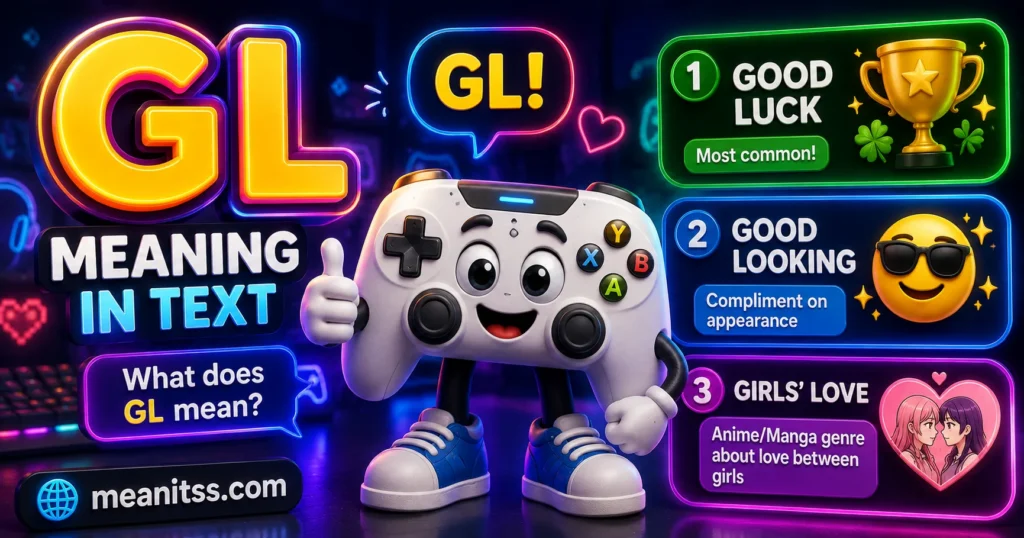
If you see “GL” in a text, it most commonly means “Good Luck.” It is a short internet and texting abbreviation used to wish someone success before an exam, game, interview, competition, or difficult situation.
But context matters. GL can have other meanings, including “Good Looking” and “Girls’ Love,” so the surrounding conversation is what tells you which meaning applies.
What Does GL Mean in Text?
The most common meaning of GL in texting is:
GL = Good Luck
It is an initialism/abbreviation, rather than a conventional slang word. The letters come from the first letters of good and luck. Wiktionary specifically records lowercase gl as a texting initialism for “good luck.”
People typically send GL when someone is about to face something where the outcome matters:
- “GL on your exam!”
- “GL with the interview.”
- “GL in the tournament.”
- “GL tonight!”
- “I’m going to ask my boss tomorrow. GL me 😭”
The basic message is essentially “I hope things go well for you.”
Is GL slang or an abbreviation?
It is more accurate to call GL an internet/texting abbreviation or initialism rather than traditional slang.
It behaves like other digital shortcuts such as:
- BRB = Be Right Back
- IDK = I Don’t Know
- TY = Thank You
- GG = Good Game
- GLHF = Good Luck, Have Fun
GL became especially recognizable in online gaming, where short messages are useful immediately before a match. Dictionary.com lists GLHF as “good luck, have fun” and notes that it can be further shortened to GL or HF.
The Main Meanings of GL
Although “Good Luck” is the default interpretation in ordinary texting, GL has several legitimate meanings in other contexts.
1. GL = Good Luck
This is by far the most useful meaning to know when you encounter GL in a casual message.
Someone might write:
“My driving test is at 9. 😭”
You might receive:
“GL!!”
They’re wishing you success.
It doesn’t necessarily mean they think you’re going to fail. Quite the opposite: it’s normally a supportive expression.
2. GL = Good Looking
GL can also mean “Good Looking” in some internet-slang and texting contexts. This use is much more dependent on the conversation and is less universal than “Good Luck.”
For example:
“Who was that guy in your photo?”
“My cousin.”
“Oh, he’s GL.”
Here, the speaker may mean good looking.
Because this interpretation can be complimentary or potentially flirtatious, don’t automatically assume it when someone simply writes “GL.”
The surrounding words are important.
3. GL = Girls’ Love
In anime, manga, and fandom discussions, GL can mean “Girls’ Love.” It refers to media or stories involving romantic relationships or attraction between female characters. It is closely associated with the term yuri.
For example:
“Is this manga GL?”
That has nothing to do with wishing someone good luck.
The context makes the distinction fairly obvious because the conversation is about manga, anime, characters, or genres.
4. Other Specialized Meanings
Outside ordinary texting, GL can represent many technical or professional terms.
Examples include:
- General Ledger — accounting
- Graphics Library — technology/programming
- Glycemic Load — nutrition/health terminology
- Guideline — occasionally used as professional shorthand
- Greenland — GL is the ISO country-code abbreviation in several contexts
- Galician — gl is the ISO 639-1 language code for Galician
These aren’t normally what someone means when they send you “GL!” in a casual text.
How Can You Tell Which Meaning Someone Means?
This is where GL gets interesting.
The letters themselves don’t tell you the answer. The surrounding words do.
Consider these three messages:
“My final starts in 10 minutes. GL!”
Clearly Good Luck.
Now:
“That actor is GL.”
Probably Good Looking, depending on the speaker and conversation.
And:
“I found a new GL manga.”
Almost certainly Girls’ Love.
A useful rule is:
Look at the subject of the conversation before expanding the abbreviation.
If you’re talking about a test, interview, game, competition, or challenge → Good Luck.
If you’re talking about someone’s appearance → Good Looking may fit.
If you’re discussing anime, manga, or fictional relationships → Girls’ Love may fit.
A Common Misunderstanding About GL
One common mistake is assuming every GL means “Good Luck.”
That is usually a safe first guess in ordinary texting, but it isn’t universally correct.
For example:
“I love GL manga.”
It would make no sense to interpret that as “I love good luck manga.”
Likewise:
“She’s so GL.”
The context could point toward “good looking,” not “good luck.”
Another mistake is assuming GL is always gaming slang. Gaming helped establish and popularize related expressions such as GLHF, but GL is also used outside gaming.
Which Apps Is GL Used On?
There is good evidence for GL as general internet and texting shorthand, particularly in online chats and gaming. However, claims that it is uniquely associated with one specific social-media platform are harder to substantiate.
Text messages
This is one of the clearest environments for the Good Luck meaning.
“Interview tomorrow.”
“GL!!”
Gaming chats
Gaming is an especially established context.
GL can appear before a match, while GLHF means “Good Luck, Have Fun.” Gaming sources document GLHF as a customary pre-match greeting, and Dictionary.com specifically describes GLHF as being used especially in online video-game chat.
Instagram, Snapchat, WhatsApp, TikTok and X
GL can appear in casual messages, comments, replies, and conversations on social platforms, but the evidence doesn’t justify claiming that it has a unique or official meaning on any one of these services.
So if you see:
“GL 😭”
on a social platform, interpret it from the surrounding conversation rather than assuming the platform changes the definition.
Can “GL” Be a Complete Reply?
Yes.
“GL!” can stand alone as a complete message.
For example:
Person A:
“I’ve got my interview in five minutes.”
Person B:
“GL!”
The recipient understands that Person B is wishing them good luck.
It can also be attached to a sentence:
“GL with everything tomorrow.”
Or:
“GL on your presentation!”
Grammatically, GL behaves like a standalone interjection or discourse expression in this use. It isn’t functioning like a normal noun or verb.
How GL Changes With Punctuation and Tone
The same abbreviation can feel slightly different depending on how it’s written.
“GL”
Neutral and casual.
“GL on your test.”
“GL!”
More enthusiastic.
“GL!”
“GL!!”
Stronger enthusiasm or excitement.
“gl”
Very casual and often associated with quick online communication.
“GL 😭”
The emoji can dramatically change the emotional feel.
For example:
“My interview starts in 2 minutes 😭”
“gl 😭”
This can communicate sympathetic encouragement rather than a formal-sounding “good luck.”
“glhf”
Gaming-specific shorthand is more likely.
“glhf everyone”
means:
Good Luck, Have Fun.
Where Did GL Come From?
There is no securely documented single moment when someone invented GL as a texting abbreviation.
That distinction matters because many websites claim a specific origin in a particular year, chatroom, or gaming community without providing strong historical evidence.
What can be established is that GL is part of the broader tradition of internet shorthand, and its association with online gaming is particularly well documented through the related expression GLHF. Dictionary.com dates the first recorded use of GLHF to 2005–10, while gaming documentation and digital folklore sources show GLHF being used as a pre-match greeting.
So the safest conclusion is:
The exact origin of GL itself is unclear, but its use as shorthand for “Good Luck” fits the longstanding abbreviation practices of online chat and gaming.
There is no need to invent a specific person, website, or date as its “birth.”
4 Short Conversations: Different Tones
Funny
A: “I have to present my terrible PowerPoint in 10 minutes.”
B: “GL 😂”
A: “That doesn’t sound very confident.”
B: “I’m supporting you emotionally from a safe distance.”
Sarcastic
A: “I told my boss the deadline was impossible.”
B: “GL.”
A: “That’s it? Just GL?”
B: “What else can I do? Fight the boss?”
Playful
A: “Tournament starts in five!”
B: “GL 😎”
A: “You too!”
B: “May the better button-masher win.”
Serious
A: “My interview is tomorrow morning. I’m nervous.”
B: “GL. You’ve prepared for this.”
A: “Thanks, I really needed that.”
B: “You’ve got this.”
12 More Realistic GL Conversations
1. Friends — Exam
A: “Final exam starts at 8.”
B: “GL!”
A: “I’m going to need it.”
B: “You studied all week. You’ll be fine.”
2. Gaming — Match
A: “Everyone ready?”
B: “glhf”
A: “GL!”
B: “Let’s go.”
3. Coworkers — Interview
A: “I’m interviewing for the promotion today.”
B: “GL!”
A: “Thanks!”
B: “Hope it goes your way.”
4. Dating — First Date
A: “Heading to my first date with him.”
B: “GL 😂”
A: “Why are you laughing?”
B: “Because you said you were going to be chill.”
5. Family
A: “I’m taking my driving test.”
B: “GL sweetheart ❤️”
A: “Thank you!”
B: “Call me afterward.”
6. Group Chat
A: “Who wants to present first?”
B: “Not me.”
C: “GL to whoever volunteers 😂”
D: “Absolutely not.”
7. Gaming Rival
A: “Queueing now.”
B: “GL.”
A: “You too.”
B: “No mercy though.”
8. Social Media Comment
A: “Trying out for the team tomorrow!”
B: “GL!!”
A: “Thank you 🥹”
9. Friend Moving Away
A: “First day at my new job tomorrow.”
B: “GL!”
A: “I’m terrified.”
B: “You’ll settle in quickly.”
10. Dating Context
A: “I’m finally going to ask her out.”
B: “GL bro 😭”
A: “Don’t curse me.”
B: “I’m rooting for you!”
11. School Group Chat
A: “Presentation uploaded.”
B: “GL everyone.”
C: “We survived.”
D: “Barely.”
12. Casual Challenge
A: “I’m going to try making this recipe.”
B: “GL 😂”
A: “Why do you sound concerned?”
B: “Because you burned toast yesterday.”
How to Reply to “GL”
If someone sends GL meaning “Good Luck,” your response can be very simple.
Neutral reply
“Thanks!”
Friendly reply
“Thanks! I appreciate it.”
Funny reply
“I desperately need it 😂”
Playful reply
“Thanks 😎 I got this.”
Return the encouragement
“Thanks! GL to you too!”
If you’re unsure what they mean
Simply ask:
“GL as in good luck?”
There’s nothing awkward about clarifying an abbreviation.
GL vs Similar Text Abbreviations
| Term | Meaning | Tone | Popularity | Confusion Risk |
|---|---|---|---|---|
| GL | Good Luck | Friendly, supportive | High | Medium |
| GLHF | Good Luck, Have Fun | Friendly, gaming-focused | High in gaming | Low |
| GG | Good Game | Competitive/casual | High in gaming | Medium |
| GJ | Good Job | Positive | Moderate | Low |
| HF | Have Fun | Friendly | Moderate | Medium |
| TY | Thank You | Friendly/neutral | High | Low |
| Get lost | Go away | Rude/dismissive | Low as “GL” | High |
The important distinction is between GL and GLHF.
GL is simply “Good Luck.”
GLHF adds a second idea: “Have Fun.” Dictionary.com specifically notes that GLHF may be shortened to GL or HF.
Who Uses GL?
GL is not limited to one age group.
It appears in online communication among teenagers, young adults, gamers, and other internet users. The abbreviation is old enough that it should not be treated as exclusively Gen Z slang.
In fact, its strong connection with gaming and older internet-chat culture means that Millennials and older online communities may also recognize it easily.
There isn’t strong evidence for a meaningful US-versus-UK regional distinction in the “Good Luck” texting meaning. It is better understood as internet shorthand rather than a regional dialect term.
Is GL Rude or Safe?
GL is generally safe and non-offensive when it means “Good Luck.”
It isn’t profanity, and the ordinary “Good Luck” meaning is appropriate for casual conversations.
You can generally use it with:
- Friends
- Classmates
- Gaming teammates
- Family
- Casual online acquaintances
What about school or work?
The abbreviation is understandable in informal digital communication, but “Good luck” is better for formal writing.
For example, in a professional email:
“Good luck with your presentation.”
is more polished than:
“GL with your presentation.”
The difference isn’t that GL is rude. It’s simply that it belongs more naturally to informal communication.
Does GL Mean Something Flirty?
Usually, no.
If someone sends:
“GL!”
before your exam, interview, game, or competition, there’s no reason to interpret it romantically.
However, “Good Looking” is a documented alternative meaning, and that interpretation can occur in conversations about someone’s appearance.
So context matters:
“GL with your interview” → Good Luck
“That guy is GL” → potentially Good Looking
Don’t turn an ordinary supportive “GL” into a flirtatious message without evidence from the conversation.
One Useful Trick: Read the Words Around the Abbreviation
When decoding texting abbreviations, don’t focus only on the letters.
Look at:
- What happened immediately before GL?
- What topic are they discussing?
- Is someone about to do something?
- Are they discussing a person or appearance?
- Are they talking about anime or manga?
- Are they in a gaming conversation?
For example:
“Ranked starts in five. GL!”
That’s almost certainly Good Luck.
But:
“This series is GL.”
is likely referring to Girls’ Love.
This context-first approach is much more reliable than memorizing dozens of possible expansions for every abbreviation.
Why Does GL Work So Well in Conversation?
GL works because it delivers a complete social gesture with only two letters.
When someone says “good luck,” they’re not simply giving information—they’re acknowledging that another person is about to face something uncertain or important. GL preserves that supportive function while removing the extra typing.
That’s particularly useful in gaming, fast group chats, and situations where the sender wants to respond quickly. The related GLHF expression demonstrates how these short forms also became part of online gaming etiquette rather than merely being typing shortcuts.
GL vs GLHF: A Small Difference That Matters
These two are closely related but aren’t identical.
GL
= Good Luck
GLHF
= Good Luck, Have Fun
If someone sends:
“GL!”
they’re wishing you success.
If someone sends:
“GLHF!”
they’re usually wishing you both success and an enjoyable game or match.
The second expression is especially associated with online multiplayer gaming.
FAQ About GL Meaning in Text
What does GL mean in a text message?
GL most commonly means “Good Luck.” It is a short internet abbreviation used to wish someone success. You’ll often see it before exams, interviews, games, competitions, or other challenges.
Does GL mean good luck or good looking?
It can mean either, but “Good Luck” is the standard interpretation in ordinary texting. “Good Looking” is a less common slang meaning and normally requires a conversation about someone’s appearance. Context is the best way to distinguish them.
What does GL mean in gaming?
In gaming, GL generally means “Good Luck.” It is often associated with GLHF, meaning “Good Luck, Have Fun,” which is commonly used before an online match.
What does GL mean in anime?
In anime and manga discussions, GL commonly means “Girls’ Love.” It describes a genre or category involving romantic relationships or attraction between female characters. It is closely related to the term yuri.
Is GL the same as GLHF?
No. GL means “Good Luck,” while GLHF means “Good Luck, Have Fun.” GLHF is particularly associated with multiplayer gaming and sportsmanlike pre-match greetings.
Is GL a slang word?
GL is better described as an internet/texting abbreviation or initialism. It functions as a shorthand expression rather than behaving like a conventional slang word. Wiktionary specifically labels “gl” as a texting initialism for “good luck.”
Can I reply “GL” to someone?
Yes, if you mean “Good Luck.” It works well in casual texts, chats, gaming conversations, and other informal communication. In a formal email or professional document, writing “Good luck” is generally more appropriate.
Is GL rude?
Not when it means “Good Luck.” It is normally friendly and supportive, although tone can change depending on context—for example, someone could theoretically use a short “GL” sarcastically. If the conversation is tense, look at the surrounding messages before deciding how sincere it is.
Which Category Does GL Belong To?
For your site’s categories, GL primarily belongs to:
✅ Slang Text Meaning
It can also fit:
✅ Parent-facing “decode your teen’s texts”
because parents may encounter “GL” in messages and want to understand the abbreviation.
It can sometimes fit:
✅ Gen Z / TikTok slang
but it is important not to label GL as exclusively Gen Z slang. It predates current TikTok culture and has longstanding roots in internet communication and gaming.
It does not primarily belong to:
- ❌ Brainrot slang
- ❌ AI/tech-related slang
- ❌ Dating/relationship slang
The “Good Looking” interpretation can appear in appearance or dating-related conversations, but that does not make dating its primary category.
Conclusion
When someone sends “GL” in an ordinary text, the safest first interpretation is “Good Luck.” It’s a concise way to wish someone success before an exam, interview, game, competition, or difficult task.
However, GL isn’t limited to one meaning. In the right context, it can refer to Good Looking or Girls’ Love, while professional and technical fields use GL for completely different terms.
The easiest way to decode it is to look at the conversation around it:
- Challenge or upcoming event → Good Luck
- Appearance → potentially Good Looking
- Anime/manga or female-female romance → Girls’ Love
- Multiplayer game → usually Good Luck, sometimes part of GLHF
And if you’re sending it yourself, remember that “GL” is casual shorthand. It’s perfectly natural in texts and online chats, but “Good luck” is the better choice for formal or professional communication.