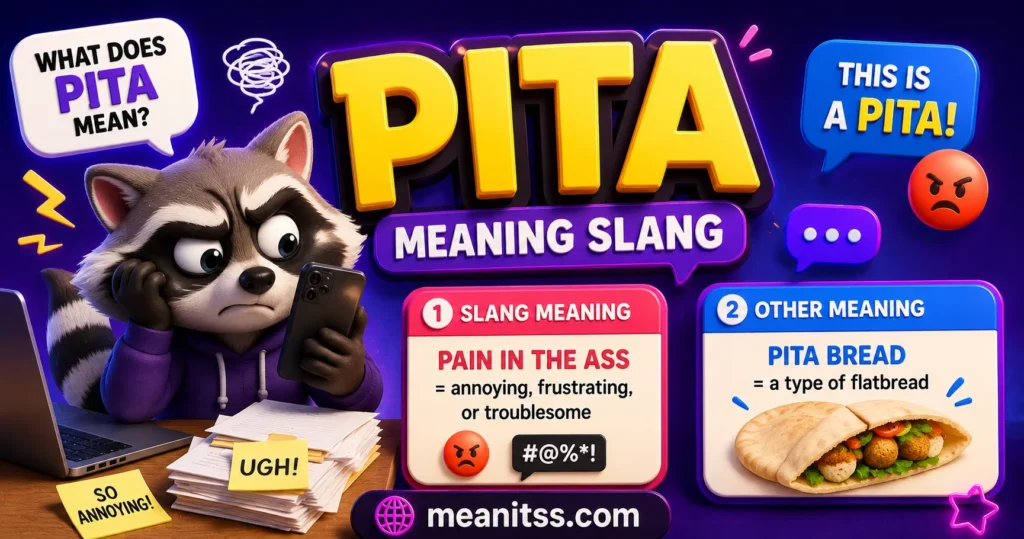
PITA usually means “pain in the ass” in texting and online slang. It describes a person, task, situation, or problem that is annoying, troublesome, inconvenient, or frustrating. It is an informal acronym, not a separate slang word.
What Does PITA Mean in Slang?
In informal messages, PITA = “pain in the ass.”
Someone might write:
“This paperwork is such a PITA.”
They mean the paperwork is really annoying or difficult to deal with.
It can describe:
- A frustrating person: “My neighbor is a PITA.”
- An annoying task: “Filing these forms is a PITA.”
- A troublesome situation: “Getting this fixed has been a PITA.”
- An inconvenient process: “Changing the reservation was a PITA.”
Cambridge specifically labels this meaning very informal and notes that PITA is used in social media and text messages to refer to someone or something annoying.
PITA is generally treated as an acronym/abbreviation formed from the initial letters of “pain in the ass.” Some dictionary sources describe it as an initialism, while others simply call it an abbreviation or acronym.
The Other Meaning of “Pita”
There is an important distinction between PITA and pita.
Lowercase pita can simply mean the familiar type of flatbread. Dictionary sources list pita as a round, hollow or pocket-style bread commonly used for sandwiches and other foods.
So context matters:
- “I ordered pita with hummus.” → the food
- “This website is a PITA.” → “pain in the ass”
- “My coworker is such a PITA.” → an annoying person
Capitalization can make the distinction clearer, but people do not always capitalize texting abbreviations. Therefore, the surrounding sentence is usually the best clue.
A Common Misunderstanding: Is PITA Always About Food?
No.
If you see PITA in a complaint, text conversation, email, forum, or online discussion, it may have nothing to do with bread.
For example:
“Updating all these files manually is a PITA.”
The person isn’t talking about lunch. They are saying the task is frustrating.
At the same time, “pita” really can mean bread, so you shouldn’t automatically interpret every occurrence as slang. Dictionary.com lists both the food meaning and the informal “pain in the ass” abbreviation.
What the PITA References Consistently Cover
The dictionary and slang references I checked consistently agree on the central meaning: PITA is shorthand for “pain in the ass” and refers to something or someone troublesome or annoying. They also commonly mention texting, online communication, frustration, and the separate bread meaning.
What is less consistently explained is how strong the expression is, when it refers to a person versus a task, how its tone changes with context, and why someone might choose PITA instead of a milder phrase such as “pain in the neck.” Those distinctions are useful when you’re actually trying to understand a message rather than simply decode the letters.
Which Apps Is PITA Used On?
Reliable dictionary evidence supports PITA as an abbreviation used in text messages and social media, but there isn’t strong enough evidence to claim that it is uniquely associated with one particular platform.
Text Messages and Chat
This is one of the clearest contexts.
“That whole process was a PITA.”
The sender is simply expressing frustration.
PITA can appear in captions, comments, DMs, or discussions where people are using informal language. However, there is no reliable evidence that Instagram has a special PITA-specific meaning.
Snapchat
The same general “pain in the ass” interpretation can apply in informal Snapchat messages when the context is complaining about a person or situation.
PITA can function as ordinary conversational shorthand in WhatsApp chats. Again, context determines whether it means the acronym or pita bread.
X
On X, PITA can be used in informal posts or replies to describe an annoying situation, person, process, or problem.
Important: I would not describe PITA as a specifically TikTok-created term or claim that TikTok is its primary home. The evidence supports broader internet and text-message use rather than a platform-specific origin.
Grammar: How Is PITA Used in a Sentence?
PITA normally functions as a noun phrase, even though it is written as an abbreviation.
It can refer to either a person or a thing.
Referring to a person
“He’s a PITA.”
Meaning: He’s a pain in the ass.
Referring to a thing or task
“This installation process is a PITA.”
Meaning: This process is extremely annoying or troublesome.
After “such a” or “a real”
“That was such a PITA.”
“Getting a refund was a real PITA.”
Can PITA stand alone?
Yes, especially in informal conversation.
Person 1: “How was dealing with customer support?”
Person 2: “PITA.”
The one-word response effectively means:
“It was a pain in the ass.”
That usage relies heavily on context.
Where Did PITA Come From?
The phrase “pain in the ass” is considerably older than the abbreviation PITA.
The exact origin of the full phrase is not completely settled. One linguistic discussion citing the Oxford English Dictionary reports a metaphorical “pain” construction from the early 20th century and gives 1972 as a recorded date for “pain in the ass”.
The expression belongs to a broader family of phrases describing annoying people or situations as a physical “pain,” including the older and milder “pain in the neck.”
The abbreviation itself does not have a securely documented single inventor or creation date in the sources I found. A 2004 University of Iowa linguistic resource, however, records PITA as an acronym meaning “pain in the ass,” showing that the abbreviated form was already established in informal usage by then.
There are also online dictionary entries dating PITA examples to the early 2000s, but those user-submitted dates should be treated as evidence of recorded online usage rather than proof of the term’s original invention.
So the responsible answer is: the phrase has an older history, while the exact origin date and inventor of the abbreviation PITA are unclear.
4 PITA Conversations in Different Tones
Funny
Alex: “How’s your new printer?”
Sam: “It has jammed three times today.”
Alex: “So…?”
Sam: “Absolute PITA.”
Here, PITA makes the complaint sound humorous rather than extremely angry.
Sarcastic
Mia: “The website says checkout takes two minutes.”
Jen: “It took you twenty?”
Mia: “Yep. Very efficient.”
Jen: “Sounds like a PITA.”
The sarcasm comes from contrasting the promised simplicity with the actual frustration.
Playful
Ryan: “You forgot your keys again.”
Leo: “I know.”
Ryan: “You are such a PITA.”
Leo: “And yet you keep inviting me over.”
The insult is softened because the friends clearly understand it playfully.
Serious
Manager: “Why hasn’t the report been submitted?”
Employee: “The system keeps rejecting the file.”
Manager: “Can you resolve it today?”
Employee: “I’m working on it. The upload process has been a PITA.”
Here, PITA communicates genuine frustration about a technical problem.
12 More Realistic PITA Examples
1. Friends texting
Nora: “Did you book the tickets?”
Ella: “Tried to. The site kept crashing.”
Nora: “Again?”
Ella: “Yep. Total PITA.”
2. Family chat
Brother: “Did Mom finally fix the Wi-Fi?”
Sister: “Nope, she called the provider again.”
Brother: “Oof.”
Sister: “This router has been a PITA all week.”
3. Dating
A: “How was your date?”
B: “Fine until parking.”
A: “Bad?”
B: “Spent 30 minutes looking for a spot. Total PITA.”
4. Coworkers
Jordan: “Did you finish the spreadsheet?”
Chris: “Finally.”
Jordan: “What happened?”
Chris: “The formulas kept breaking. Such a PITA.”
5. Group chat
Sam: “Who changed the shared document?”
Liam: “Not me.”
Ava: “Also not me.”
Sam: “Okay, this is becoming a PITA.”
6. Gaming chat
Player 1: “Why can’t we join the server?”
Player 2: “Update error.”
Player 1: “Again?”
Player 2: “Yep. PITA.”
7. Instagram DM
Maya: “Did your order arrive?”
Tara: “No, they sent it to the wrong address.”
Maya: “Seriously?”
Tara: “Yep. Such a PITA.”
8. Snapchat
A: “Why are you still awake?”
B: “Trying to finish this assignment.”
A: “Almost done?”
B: “No. It’s a PITA.”
9. Parent and adult child
Dad: “Did you manage to renew your license?”
Son: “Eventually.”
Dad: “Was it difficult?”
Son: “The website was a PITA.”
10. Roommates
Roommate 1: “The sink is clogged again.”
Roommate 2: “You’re kidding.”
Roommate 1: “Wish I were.”
Roommate 2: “That sink is such a PITA.”
11. Customer-service conversation
Friend: “Did they refund you?”
You: “Eventually.”
Friend: “How long?”
You: “Three calls. Total PITA.”
12. Casual workplace chat
Coworker: “How’s the new software?”
You: “Powerful, but confusing.”
Coworker: “Worth switching?”
You: “Maybe. Setup is a PITA, though.”
How to Reply to “PITA”
Your response depends on whether the person is joking or genuinely frustrated.
Funny reply
“Sounds like you need snacks and a five-minute disappearance.”
Serious reply
“What happened? Maybe I can help.”
Flirty reply
If you’re already joking or flirting with someone:
“Sounds like you need someone to make your day less annoying 😏”
This only works when the existing conversation is clearly flirtatious.
Neutral reply
“What made it such a PITA?”
That keeps the conversation going without assuming how serious the complaint is.
PITA vs Similar Terms
| Term | Meaning | Tone | Popularity | Confusion Risk |
|---|---|---|---|---|
| PITA | Pain in the ass; annoying person or thing | Informal, blunt | Moderate | Low–Medium |
| Pain in the neck | Annoying or troublesome person/thing | Informal, milder | High | Low |
| Pain in the butt | Softer version of “pain in the ass” | Casual | High | Low |
| PITA bread | A type of flatbread | Neutral | High | High when written as “pita” |
| Annoying | Causing irritation or frustration | Neutral | Very high | Low |
| Breeze | Something easy or effortless | Positive/neutral | High | Low |
One useful contrast is “a breeze.” PITA describes something troublesome; “a breeze” describes something easy.
Is PITA Rude or Safe?
PITA is not profanity itself, but it abbreviates a phrase containing the vulgar word “ass.”
That makes it more acceptable than spelling out the full expression in some casual settings, but it is still informal and mildly vulgar.
With friends
Usually fine if that is normal language within the friendship.
In texting
Generally understandable in casual conversation.
At school
It depends on the setting and teacher. Avoid it in formal assignments.
At work
Use caution. A casual private conversation with a colleague is different from putting “PITA” in a formal email to a manager or client.
For professional writing, alternatives such as “frustrating,” “troublesome,” “inconvenient,” or “difficult to deal with” are safer.
Who Uses PITA?
There isn’t strong evidence supporting a precise age demographic, such as “Gen Z uses PITA more than Millennials.” The sources establish it as an informal abbreviation used in texting, online communication, and social media, but they don’t provide reliable demographic data.
It is therefore better to describe PITA as general informal internet and written slang, rather than labeling it exclusively as Gen Z slang.
There is also no solid evidence that PITA belongs specifically to one US region or that it has a special regional meaning in the United States or United Kingdom.
In British English, the underlying phrase can instead be “pain in the arse,” while American English commonly uses “pain in the ass.”
Why Does PITA Work So Well in Conversation?
PITA compresses a fairly expressive complaint into four letters. Instead of writing “this is such a pain in the ass,” a person can type “PITA” and let the reader reconstruct the phrase from context.
That makes it especially useful in informal written communication where speed, shared knowledge, and humor matter.
It also has an amusing secondary effect: the acronym looks harmless at first glance even though the phrase behind it is mildly vulgar.
PITA vs “Pain in the Ass”: Does It Mean Exactly the Same Thing?
Yes, when PITA is being used as the abbreviation.
Compare:
“This paperwork is a pain in the ass.”
and:
“This paperwork is a PITA.”
The basic meaning is the same.
The difference is mostly format and tone. PITA is shorter and feels more like shorthand, while spelling out the phrase makes the complaint more explicit.
Can PITA Describe a Person?
Yes.
For example:
“He’s being a PITA.”
That means the person is being annoying, difficult, troublesome, or frustrating.
However, calling someone a PITA is more directly insulting than calling a task a PITA. If you’re speaking to the person you’re describing, the phrase can sound confrontational unless the relationship is clearly playful.
Can You Say “A PITA”?
Yes.
Examples include:
“That was a PITA.”
“He’s a PITA.”
“This process is a real PITA.”
The article “a” is normal because PITA is functioning as a countable noun when it refers to a particular person, thing, or situation.
Does PITA Have a Positive Meaning?
Not in its standard slang use.
The “pain in the ass” meaning is negative: it communicates annoyance, inconvenience, frustration, or difficulty.
A person could use it affectionately or jokingly, but that changes the tone, not the basic dictionary meaning.
For example:
“You’re such a PITA 😂”
between close friends may be affectionate teasing.
The same words during an argument could be genuinely insulting.
FAQ
What does PITA stand for in texting?
PITA stands for “pain in the ass.” It is used to describe someone or something that is annoying, frustrating, troublesome, or inconvenient. It is an informal abbreviation commonly associated with text and online communication.
Is PITA a bad word?
PITA is mildly vulgar because the phrase it abbreviates contains “ass.” However, the abbreviation itself is not generally treated like a severe swear word. It is still better avoided in formal school or professional writing.
Does PITA mean bread?
It can. Lowercase pita commonly refers to flatbread. But uppercase PITA in a complaint often means “pain in the ass.” Context tells you which meaning is intended.
Is PITA an acronym or abbreviation?
It is commonly described as an acronym or abbreviation for “pain in the ass.” Some references specifically call it an initialism because the letters come from the individual words.
Is PITA a Gen Z slang word?
Not specifically. PITA predates current Gen Z internet culture and has been documented in informal written usage for years. It is more accurately described as general informal slang and texting shorthand.
Can PITA describe a person?
Yes. “He’s a PITA” means that the person is difficult, annoying, or troublesome. Whether it sounds humorous or insulting depends heavily on the relationship and tone.
What is a polite alternative to PITA?
Try “pain in the neck,” “annoying,” “frustrating,” “troublesome,” or “inconvenient.” “Pain in the neck” is particularly useful when you want the same basic idea without the vulgarity of “ass.” The broader family of “pain” expressions has a long history in English.
Is PITA used only online?
No. The abbreviation is particularly useful in written communication, but people can also discuss or pronounce it in informal speech. Dictionary sources specifically document its use in social media and text messages.
Conclusion
When someone writes PITA in a text, comment, DM, or casual online conversation, the most likely meaning is “pain in the ass.” It describes someone or something that is annoying, frustrating, inconvenient, or difficult to deal with.
The biggest trap is the ordinary word pita, meaning flatbread. If the sentence involves food, it probably means bread; if someone is complaining about a task, person, website, or situation, PITA probably means “pain in the ass.”
Use it casually with people who are comfortable with informal language. Avoid it in formal writing, especially when a neutral word like “frustrating” will communicate the same idea without the mild vulgarity.
Most importantly, don’t treat PITA as a newly invented TikTok or brainrot expression. Its underlying phrase has a much longer history, while the exact origin of the abbreviation itself remains unclear.