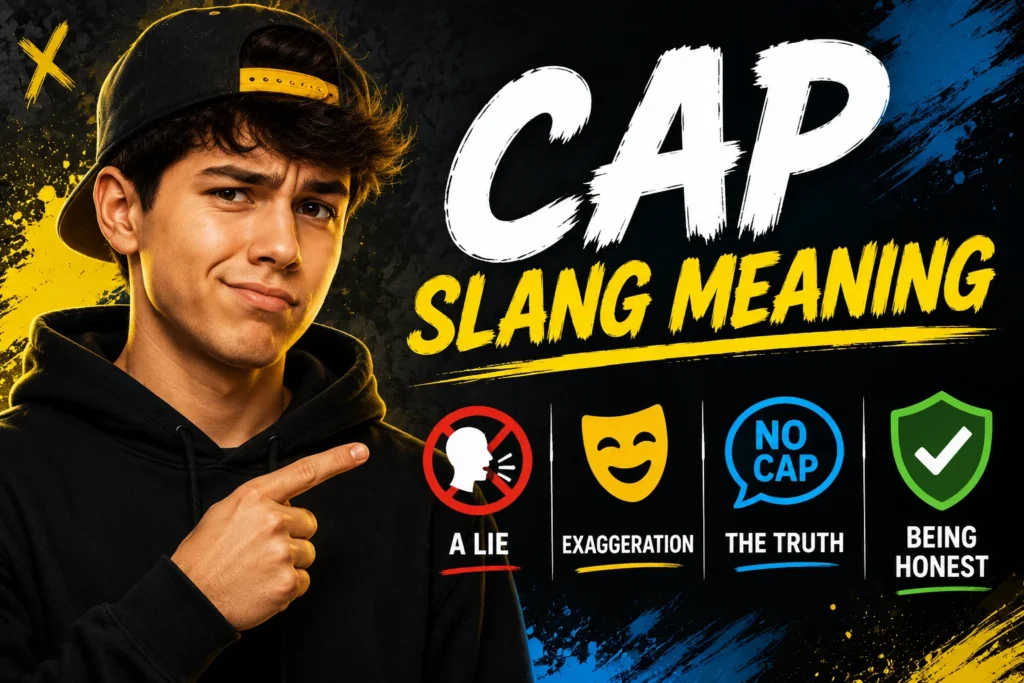
In modern slang, “cap” means a lie, exaggeration, or false statement. “No cap” means someone is being truthful. Cap is a slang word—not an acronym—and is widely used on TikTok, Instagram, Snapchat, WhatsApp, X, and in everyday texting.
If you’ve seen comments like “That’s cap,” “No cap,” or “Stop capping,” you may wonder whether people are talking about hats or something entirely different. In today’s internet slang, cap almost always refers to honesty, making it one of the most recognizable Gen Z expressions online.
What Does Cap Mean in Slang?
The most common meaning of cap is a lie, exaggeration, or something that isn’t true.
When someone says:
“That’s cap.”
they mean:
- “That’s a lie.”
- “I don’t believe you.”
- “You’re exaggerating.”
- “That isn’t true.”
Example
A: I finished the whole project in ten minutes.
B: That’s cap.
Here, B believes A is exaggerating or lying.
Unlike many internet slang words, cap has become common in both online conversations and everyday spoken English among younger generations.
Is Cap an Acronym, Abbreviation, or Slang?
Cap is:
- ❌ Not an acronym
- ❌ Not a texting abbreviation
- ✅ A slang word
The opposite phrase is:
No cap
which means:
- I’m serious.
- I’m telling the truth.
- Honestly.
- No exaggeration.
Examples:
“That movie was amazing, no cap.”
“No cap, that’s the best pizza I’ve ever had.”
The Real Meanings of Cap
1. A Lie or False Statement (Most Common Meaning)
This is by far the most common usage.
If someone says:
“That’s cap.”
they’re accusing another person of saying something false.
Examples:
- “You scored 200 points? Cap.”
- “He says he knows the celebrity. That’s cap.”
- “You’re definitely capping.”
2. Exaggerating a Story
Sometimes a person isn’t completely lying—they’re simply stretching the truth.
Example:
“Bro said he never studies but gets perfect grades.”
Reply:
“Cap.”
Here, listeners believe the story is exaggerated.
3. Calling Someone Out
Rather than directly saying “You’re lying,” people often use cap because it’s shorter and more playful.
Examples:
- “Stop the cap.”
- “Quit capping.”
- “Big cap.”
These phrases question someone’s honesty without sounding overly formal.
4. No Cap = Honest Truth
The phrase no cap has become almost as popular as cap itself.
Examples:
- “No cap, that concert changed my life.”
- “She’s one of the nicest people I’ve met, no cap.”
- “No cap, I forgot my homework.”
Adding no cap emphasizes sincerity.
Related Slang Expressions
You’ll often see these expressions alongside cap:
- No cap – I’m telling the truth.
- Stop capping – Stop lying.
- Big cap – An obvious lie.
- Cap detector – Someone jokingly claiming they can spot lies.
- Capping – The act of lying or exaggerating.
These expressions are common across social media and texting.
Cap on Different Social Media Platforms
Although the meaning stays consistent, each platform uses it slightly differently.
Cap on TikTok
TikTok helped introduce cap to millions of users.
You’ll commonly find it in:
- storytime videos
- reaction videos
- comedy skits
- sports debates
- celebrity discussions
Typical comments include:
- “Cap.”
- “Big cap.”
- “No cap.”
- “Stop capping.”
Cap on Instagram
Instagram users often write:
- “No cap.”
- “That’s cap.”
- “Big cap.”
under:
- Reels
- memes
- celebrity posts
- fitness videos
- lifestyle content
Cap on Snapchat
Snapchat users commonly use:
- “Cap?”
- “No cap.”
- “You’re capping.”
during casual conversations between friends.
Because Snapchat messages are conversational, the slang fits naturally.
Cap on WhatsApp
Although WhatsApp isn’t known for creating slang, younger users frequently bring cap into private chats.
Example:
A: I can beat everyone at FIFA.
B: Cap.
Cap on X (Formerly Twitter)
On X, cap frequently appears in:
- sports arguments
- political discussions
- entertainment news
- viral memes
The phrase is often used to disagree quickly without writing a long explanation.
Why Has Cap Become So Popular?
Several factors helped make cap one of the internet’s biggest slang words.
Short and Easy
Instead of writing:
“I don’t believe you.”
people simply write:
“Cap.”
It’s quick, memorable, and easy to understand.
Meme Culture
Reaction memes often include:
- “Cap.”
- “Big cap.”
- “No cap.”
Because they’re short, these comments spread rapidly across platforms.
Celebrity Influence
Athletes, musicians, streamers, and influencers regularly use cap and no cap, exposing millions of followers to the slang.
Everyday Conversations
Unlike some internet expressions that stay online, cap has become common in face-to-face conversations among teenagers and young adults.
Grammar and Language Role
Part of Speech
Cap most commonly functions as a noun.
Examples:
- “That’s cap.”
- “Big cap.”
It can also function as a verb.
Examples:
- “Don’t cap.”
- “He’s capping again.”
The adjective-like phrase no cap functions as an adverbial expression meaning honestly or truthfully.
Sentence Position
Cap naturally appears:
At the end of a sentence
- “That’s cap.”
As a standalone response
- “Cap.”
As a verb
- “Stop capping.”
As an emphasis
- “No cap.”
Can Cap Replace a Full Sentence?
Yes.
Among friends, simply replying:
“Cap.”
communicates:
“I don’t believe you.”
Likewise,
“No cap.”
can stand alone to emphasize honesty.
Formal vs Informal Register
| Register | Appropriate? | Notes |
|---|---|---|
| Casual texting | ✅ Yes | Extremely common. |
| TikTok comments | ✅ Yes | One of the most recognizable slang terms. |
| Snapchat | ✅ Yes | Frequently used between friends. |
| Workplace emails | ❌ No | Too informal. |
| Academic writing | ❌ No | Suitable only when discussing slang. |
Tone and Context Variations
Funny
A: I can eat ten burgers.
B: That’s cap.
A: Maybe eight.
B: Still cap.
Sarcastic
A: I never lose at video games.
B: Biggest cap I’ve heard today.
A: You don’t believe me?
B: Not even a little.
Playful
A: I baked these cookies myself.
B: Cap.
A: Okay… my mom helped.
B: I knew it.
Serious
A: What does “cap” mean in slang?
B: It means someone thinks a statement isn’t true or is exaggerated.
A: So it’s basically calling something a lie?
B: Exactly.
Real Chat Examples
Example 1 – TikTok Comments
A: I met my favorite singer yesterday.
B: Cap.
A: I actually did!
B: Show the picture.
Example 2 – Friends
A: I finished the homework before dinner.
B: No way.
A: Seriously.
B: No cap?
Example 3 – Instagram Reels
A: Best burger in the city.
B: No cap.
A: I’m going back tomorrow.
B: Same.
Example 4 – Snapchat
A: I stayed awake for 40 hours.
B: That’s cap.
A: Okay… maybe 24.
B: Sounds more believable.
Example 5 – Gaming Chat
A: I won every match today.
B: Stop capping.
A: Check the leaderboard.
B: Alright, maybe you’re telling the truth.
Example 6 – Family Group Chat
A: Dad says he never used GPS.
B: Cap.
A: He admitted it later.
B: Knew it.
Example 7 – School Friends
A: I got 100% without studying.
B: That’s cap.
A: Fine… I studied for an hour.
B: That sounds more realistic.
Example 8 – WhatsApp Chat
A: I ran five miles before breakfast.
B: No cap?
A: No cap.
B: Respect.
Example 9 – X (Formerly Twitter)
A: This is the greatest game ever made.
B: Big cap.
A: It’s my opinion!
B: Fair enough.
Example 10 – Basketball Group Chat
A: I could beat our coach one-on-one.
B: Stop capping.
A: Maybe if he let me win.
B: Now you’re being honest.
Example 11 – Coffee Break
A: I only need four hours of sleep every night.
B: Cap.
A: Most nights, anyway.
B: That’s a different story.
How to Reply When Someone Says “Cap”
Your response depends on whether the other person is joking, genuinely skeptical, or challenging your claim.
Funny Reply
“The receipts are loading.”
or
“Give me a minute—I brought proof.”
Serious Reply
“I’m serious. I can show you.”
or
“It’s actually true.”
Flirty Reply
“Come see for yourself.”
(Only use this if the conversation is clearly playful and appropriate.)
Neutral/Unbothered Reply
“Believe what you want.”
or
“Fair enough.”
Comparison Table
| Term | Meaning | Usage Context | Tone | Popularity | Confusion Risk |
|---|---|---|---|---|---|
| Cap | A lie or exaggeration | Texting, TikTok, memes | Playful | Very High | Low |
| No Cap | Honest, truthful | Casual conversations | Positive | Very High | Low |
| Capping | Lying or exaggerating | Social media, texting | Informal | High | Low |
| Facts | I completely agree | Texting, comments | Positive | High | Low |
| BS | Nonsense or something untrue | Informal conversations | Strong | High | Medium |
| Truth (Opposite) | A genuine statement | Everyday English | Neutral | Very High | Very Low |
Who Uses This Term?
Age Group Breakdown
Teenagers (13–19)
Teenagers are the biggest users of cap and no cap. The terms appear daily in texting, TikTok comments, Snapchat conversations, gaming chats, and school discussions.
Young Adults (20–35)
Young adults also use the phrase regularly, especially those active on social media or familiar with internet culture. Many use it naturally in spoken conversations.
Adults Over 35
Older adults may recognize the expression from younger family members, music, sports interviews, or viral videos, but they generally use it less often.
Gen Z vs Millennials
Gen Z
For Gen Z, cap is an everyday slang word. It’s often used as a quick reaction instead of saying, “I don’t believe you.”
Millennials
Millennials usually understand the term but may prefer phrases like “Seriously?” or “You’re joking.” Those active on TikTok or gaming platforms are more likely to use cap themselves.
Regional Usage
United States
The slang is extremely common across schools, colleges, sports communities, and social media. It has become part of mainstream youth vocabulary.
United Kingdom
UK users also recognize cap, particularly through TikTok, YouTube, rap music, and online gaming communities.
Global
Because of TikTok, YouTube, streaming culture, and music, cap is now understood in many English-speaking communities around the world.
Platforms Where It Appears
| Platform | Common Usage |
|---|---|
| TikTok | Storytimes, debates, memes, reaction videos |
| Reels, comments, memes | |
| Snapchat | Private chats between friends |
| Casual conversations | |
| X | Sports, celebrity discussions, trending topics |
| Discord | Gaming and community chats |
Origin and Internet Culture
Where Did Cap Come From?
The slang cap has roots in African American Vernacular English (AAVE), where “capping” has long been used to describe lying, exaggerating, or boasting. Linguists and language historians have documented its use in spoken English decades before it became mainstream online.
The phrase gained wider recognition through Southern hip-hop culture during the 1990s and 2000s. Rappers frequently used cap and no cap in lyrics to distinguish between truth and exaggeration.
How Cap Became Popular Online
Its popularity exploded in the late 2010s when musicians, athletes, influencers, and streamers began using it on social media. TikTok, Instagram, YouTube Shorts, Snapchat, and X introduced the expression to millions of users worldwide.
Today, cap, no cap, and stop capping are among the most recognizable pieces of internet slang. Although they are now used by many different communities, it’s important to recognize that the expression originated in AAVE before entering mainstream internet culture.
Safety & Appropriateness
Is Cap Offensive?
No. Cap is generally harmless slang used to suggest that a statement is false or exaggerated. It is not considered offensive on its own.
Does It Contain Profanity?
No. The word contains no profanity or explicit language.
Is It Appropriate for School or Work?
Using cap with friends or classmates is usually acceptable. However, because it is informal internet slang, it isn’t appropriate for business emails, professional meetings, or academic writing unless you’re discussing slang itself.
Cultural Sensitivity
Since cap originated in African American Vernacular English (AAVE), it’s good practice to acknowledge its linguistic and cultural origins rather than treating it as a random internet invention.
Real-World Observation
In everyday online conversations, cap works because it’s incredibly efficient. Instead of typing an entire sentence like “I don’t think that’s true,” users simply reply with “Cap.” Likewise, “No cap” instantly signals sincerity. The expressions are short, memorable, and flexible enough to fit texting, gaming, sports debates, and social media discussions, which explains why they have remained popular even as many other slang terms have faded.
Frequently Asked Questions
What does cap mean in slang?
In slang, cap means a lie, exaggeration, or false statement. When someone says “That’s cap,” they’re saying they don’t believe what was said. It’s one of the most widely recognized internet slang terms used by Gen Z and young adults.
What does no cap mean?
No cap means “I’m telling the truth” or “I’m being completely honest.” People often use it to emphasize sincerity or to assure others that they are not exaggerating.
What does stop capping mean?
Stop capping means “Stop lying” or “Stop exaggerating.” Friends commonly use it during playful conversations, although it can also be used seriously when questioning someone’s honesty.
Is cap an acronym?
No. Cap is not an acronym or abbreviation. It is a slang word that originated in African American Vernacular English (AAVE) before becoming popular through music and social media.
Why do people say “big cap”?
Big cap is simply a stronger way of calling something a lie or exaggeration. It’s commonly used when a claim seems especially unbelievable.
Where did cap slang come from?
The expression originated in AAVE and later spread through Southern hip-hop, rap music, streaming culture, and social media platforms like TikTok and YouTube.
Is cap used on TikTok?
Yes. TikTok is one of the most popular places where cap, no cap, and stop capping appear. They are frequently used in comments, reaction videos, storytimes, and comedy content.
What’s the difference between cap and no cap?
Cap means something is false or exaggerated, while no cap means someone is being truthful or sincere. They are opposite expressions that are often used together in casual conversations.
What does cap mean in texting?
In texting, cap means that the sender believes a statement is false or exaggerated. Instead of typing a longer response, many people simply reply with “Cap” to express disbelief.
Is cap still popular in 2026?
Yes. Cap remains one of the most commonly used slang words in texting and social media. While new expressions continue to emerge, cap and no cap are still widely recognized across TikTok, Instagram, Snapchat, WhatsApp, X, and gaming communities.
Conclusion
The cap slang meaning is straightforward: it refers to a lie, exaggeration, or statement that someone doesn’t believe. Its opposite, no cap, signals honesty and sincerity. Thanks to its origins in African American Vernacular English (AAVE) and its spread through hip-hop, streaming culture, and social media, cap has become one of the defining slang words of modern internet communication.
Understanding the context is essential because cap can be playful, humorous, or genuinely skeptical. Knowing when and how to use it will help you communicate naturally in texts, comments, and casual conversations.
Usage Tips
- Use cap to question statements you believe are false or exaggerated.
- Use no cap when emphasizing honesty or sincerity.
- Keep it for casual conversations and social media.
- Pay attention to the tone of the conversation before using it.
Common Mistakes
- Thinking cap refers to a hat in internet slang.
- Assuming cap is an acronym.
- Using it in professional or academic writing.
- Forgetting that no cap means the opposite of cap.
When to Use / When to Avoid
Use it when:
- Texting friends.
- Commenting on TikTok, Instagram, or X.
- Chatting in gaming communities.
- Joining casual online conversations.
Avoid it when:
- Writing business emails.
- Preparing academic assignments.
- Giving formal presentations.
- Communicating with people unfamiliar with modern internet slang.