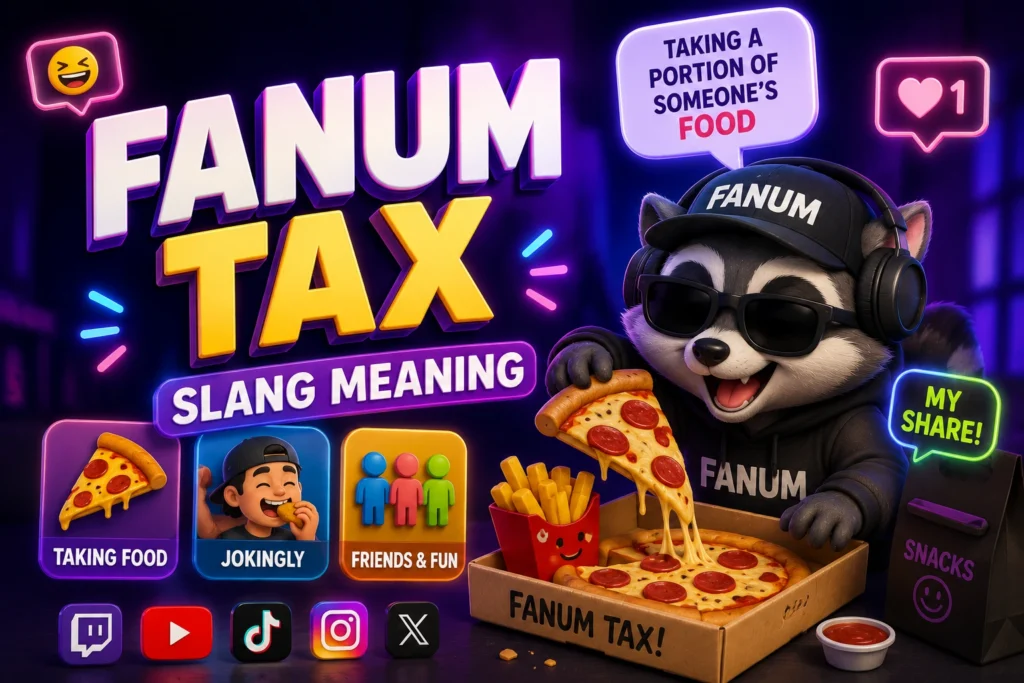
If you’ve heard someone jokingly say “Fanum tax!” while grabbing a fry or taking a bite of someone else’s pizza, they’re using one of the internet’s most recognizable Gen Z and Gen Alpha slang phrases. Fanum tax means playfully taking someone else’s food without permission—or pretending you’re entitled to a small share of it.
Unlike many online abbreviations, Fanum tax is not an acronym. It’s a slang expression inspired by Twitch streamer Fanum, who became famous for humorously stealing food from his friends during livestreams. Since then, the phrase has exploded across TikTok, YouTube, Instagram, X, and meme culture.
In this guide, you’ll learn the real meaning of Fanum tax, where it came from, how people use it online, and why it became one of the biggest slang terms of the 2020s.
What Does “Fanum Tax” Mean in Slang?
The most common meaning of Fanum tax is:
Playfully taking a portion of someone else’s food as if you’re collecting a “tax.”
It’s usually meant as a joke between friends or family.
Examples:
- “Fanum tax!”
- “I’m taking one fry. Fanum tax.”
- “You owe me the Fanum tax.”
Nobody is talking about real taxes.
Instead, the phrase humorously suggests that because someone has food nearby, they’re obligated to share a little.
Is “Fanum Tax” an Acronym?
No.
Fanum tax is not an acronym or abbreviation.
The phrase combines:
- Fanum — the online name of Twitch streamer Roberto “Fanum” Escanio
- Tax — used jokingly to mean taking a small portion of something
Together, they create a humorous slang phrase that has become widely recognized across social media.
All Real Meanings of “Fanum Tax”
Although the core meaning stays the same, Fanum tax appears in several slightly different ways depending on the conversation.
1. Taking Someone’s Food (Most Common)
This is the original and most common meaning.
Someone takes:
- one French fry
- a slice of pizza
- a chicken nugget
- candy
- chips
- dessert
Then they jokingly announce:
“Fanum tax.”
Example:
A: That’s my burger!
B: Fanum tax.
Nobody expects an argument because everyone understands it’s meant humorously.
2. Pretending You’re Owed Something
The phrase can also mean joking that you’re entitled to a small portion of anything—not just food.
Examples:
- “You got paid today? Fanum tax.”
- “New headphones? Fanum tax.”
- “Bought cookies? Fanum tax.”
In these cases, no real payment is expected.
It’s simply playful teasing.
3. Meme Slang
Today, Fanum tax is often used even when no food is involved.
People comment:
- “Fanum tax incoming.”
- “Collecting the Fanum tax.”
- “IRS wishes it worked like this.”
These jokes exaggerate the idea that someone always deserves a share.
4. Brain Rot Humor
Among Gen Alpha and younger Gen Z users, Fanum tax frequently appears alongside other viral slang such as:
- rizz
- gyatt
- sigma
- skibidi
- looksmaxxing
- mewing
In these memes, the phrase often has no literal meaning at all.
Instead, it’s used because people recognize it as part of modern internet humor.
A Common Misunderstanding
Many people think Fanum tax means stealing.
Not exactly.
The phrase almost always refers to lighthearted joking between friends or family.
If someone genuinely steals food or property without permission, people wouldn’t normally call that a Fanum tax in a serious sense.
Another misunderstanding is that Fanum tax is an actual tax or internet challenge.
It isn’t.
It’s simply a meme and slang expression inspired by Fanum’s entertaining livestream moments.
Which Apps Use “Fanum Tax”?
TikTok
TikTok helped turn Fanum tax into a viral trend.
You’ll see:
- comedy skits
- food-sharing videos
- prank clips
- meme compilations
- reaction videos
Popular captions include:
- “Fanum tax activated.”
- “He wasn’t watching.”
- “Collected the Fanum tax.”
YouTube
YouTube contains:
- AMP highlights
- Fanum compilations
- meme edits
- gaming videos
- reaction content
Many creators also explain where the phrase came from.
Instagram users often include the slang in:
- Reels
- food videos
- friend group memes
- story captions
Example:
“Nobody escapes the Fanum tax.”
X (Formerly Twitter)
On X, the phrase usually appears as:
- jokes
- memes
- reaction posts
- viral replies
Example:
“You leave your fries unattended for two seconds and suddenly it’s Fanum tax.”
Snapchat
Among friends, Snapchat users commonly joke:
- “Fanum tax 😂”
- “One bite only.”
- “Tax collected.”
The slang works well because it matches Snapchat’s casual style.
The phrase occasionally appears in private chats between friends or family, especially when talking about meals, snacks, or funny moments. It’s much less common in professional or formal conversations.
Grammar: How Is “Fanum Tax” Used?
The phrase works mainly as a noun phrase, but it can also function as a humorous exclamation.
As a Noun
Examples:
- “That’s the Fanum tax.”
- “Nobody escapes the Fanum tax.”
As an Exclamation
Examples:
- “Fanum tax!”
- “Fanum tax, sorry!”
This is probably the most common usage online.
Sentence Position
It often appears:
At the beginning:
- “Fanum tax!”
At the end:
- “I’m taking one fry… Fanum tax.”
Inside a sentence:
- “He called it the Fanum tax.”
Can It Be a Whole Reply?
Absolutely.
Example:
A: Why did you take my fries?
B: Fanum tax.
No additional explanation is usually needed because the meme is widely recognized online.
Where Did “Fanum Tax” Come From?
The phrase Fanum tax originated from Roberto “Fanum” Escanio, a popular Twitch streamer and content creator who is a member of the AMP (Any Means Possible) group. During livestreams and videos, Fanum became known for jokingly taking bites of his friends’ food or helping himself to their snacks. These moments became a recurring joke among viewers, who started calling it the “Fanum tax.”
As clips spread across YouTube, TikTok, and other social media platforms, the phrase quickly evolved into a meme. Fans began using it whenever someone jokingly took food from another person, even if Fanum wasn’t involved.
By 2023 and 2024, the term had become part of broader Gen Z and Gen Alpha internet slang. It also gained even more visibility after being referenced in viral “brain rot” memes and songs, where it appeared alongside terms like rizz, gyatt, sigma, and skibidi. Today, many people use Fanum tax without even knowing who Fanum is, showing how deeply the phrase has entered online culture.
Four Example Conversations
Funny
A: Did you just take my last chicken nugget?
B: Fanum tax.
A: That’s not how taxes work!
B: It does in my house.
Sarcastic
A: Nice. You stole my pizza.
B: Borrowed.
A: Really?
B: Fanum tax.
Playful
A: Want some fries?
B: Already took one.
A: Without asking?
B: Fanum tax.
Serious
A: Can you ask before taking my food next time?
B: You’re right.
A: Thanks.
B: No more Fanum tax without permission.
More Realistic Chat Examples
1. Friends (TikTok)
Emma: Where did my cookie go?
Olivia: Fanum tax.
Emma: I should’ve known.
Olivia: It was worth it.
2. Family Dinner
Brother: Why is my pizza slice smaller?
Sister: Fanum tax.
Brother: Again?
Sister: House rules.
3. Gaming Friends
Alex: BRB, grabbing snacks.
Jordan: Hide them.
Alex: Why?
Jordan: Fanum tax is inevitable.
4. Dating
Chris: Did you seriously steal my fries?
Taylor: Just one.
Chris: That’s suspicious.
Taylor: Fanum tax.
5. Instagram Comments
Liam: That burger looks amazing.
Friend: It was.
Liam: Was?
Friend: My brother collected the Fanum tax.
6. Snapchat Friends
Jake: Why is my milkshake half empty?
Ryan: Fanum tax.
Jake: That’s a huge tax.
Ryan: Inflation.
7. College Friends
Emma: I just bought these chips.
Sophia: Mind if I take one?
Emma: Go ahead.
Sophia: Fanum tax approved.
8. Group Chat
Alex: Who ate the cookies?
Jordan: No clue.
Taylor: Sounds like Fanum tax to me.
Alex: Mystery solved.
9. Coworkers
Rachel: Did someone take one of my donuts?
Megan: Guilty.
Rachel: Really?
Megan: Consider it the Fanum tax.
10. Siblings
Brother: That’s my ice cream!
Sister: Only one spoonful.
Brother: Every single time.
Sister: Fanum tax never sleeps.
11. X (Formerly Twitter)
User 1: Left my fries on the table for ten seconds.
User 2: Rookie mistake.
User 1: My friend ate half of them.
User 2: Fanum tax collected.
How to Reply to “Fanum Tax”
Your reply depends on whether the person is joking, teasing, or actually asking for food.
Funny Reply
- “That’s the highest tax rate I’ve ever seen.”
- “I’m calling the Snack Protection Agency.”
- “Tax refund, please.”
- “One bite? That was half my meal!”
Serious Reply
- “Next time, just ask first.”
- “I’m happy to share if you ask.”
- “Let’s split it fairly.”
- “No problem, but give me a heads-up.”
Flirty Reply
If you’re talking with someone you’re dating or flirting with:
- “Only because it’s you.”
- “You owe me dessert now.”
- “I’ll allow the Fanum tax this time.”
- “That’s an expensive bite.”
Neutral Reply
- “Sure, go ahead.”
- “Just take one.”
- “That’s fine.”
- “Save me some.”
Comparison Table
| Term | Meaning | Tone | Popularity | Confusion Risk |
|---|---|---|---|---|
| Fanum Tax | Playfully taking someone else’s food | Funny | Very High | Low |
| Rizz | Charm or flirting ability | Playful | Very High | Low |
| Gyatt | Exclamation about someone’s appearance | Humorous | Very High | Medium |
| Mewing | Tongue posture trend and meme | Casual | Very High | Low |
| Looksmaxxing | Improving physical appearance | Motivational | High | Medium |
| Sharing (Related) | Willingly giving someone part of your food | Friendly | High | Low |
| Keeping It All (Opposite) | Refusing to share food | Serious | Medium | Low |
Although Fanum tax often appears alongside terms like rizz, gyatt, and mewing, it has a completely different meaning. It specifically refers to the playful act of taking someone else’s food, not attractiveness or confidence.
Who Uses “Fanum Tax”?
Gen Alpha
Gen Alpha helped make Fanum tax one of the defining internet slang terms of the early 2020s. The phrase appears frequently in memes, gaming videos, and short-form content.
Gen Z
Gen Z widely adopted the term through TikTok, Twitch, YouTube, and AMP content. Many use it casually with friends, even if they never watched Fanum’s original streams.
Millennials
Some Millennials recognize the phrase through viral videos or younger family members. However, it’s generally less common in everyday Millennial conversations.
Regional Differences
The slang originated in the United States, but social media quickly spread it across the UK, Canada, Australia, New Zealand, and many other English-speaking communities.
There is no reliable evidence that Fanum tax has different meanings in different countries. The joke remains essentially the same everywhere.
Is “Fanum Tax” Rude or Safe?
The phrase itself is not offensive.
Is It Profanity?
No.
There are no swear words or offensive expressions involved.
Is It Rude?
Usually not.
When friends jokingly say “Fanum tax,” they’re referring to a playful social media meme.
However, actually taking someone’s food without permission may still be considered rude in real life. The humor depends on the relationship and whether everyone involved is comfortable with the joke.
School and Workplace
The phrase is generally safe for casual conversations at school or with friends. In professional workplaces, though, many people may not recognize the meme, so it could cause confusion.
Cultural Note
The phrase comes from a specific internet creator and livestream culture. Using it doesn’t imply anything about taxes or government—it simply references a well-known running joke.
Why Does “Fanum Tax” Keep Going Viral?
Fanum tax works because nearly everyone can relate to someone “borrowing” a fry, a chip, or a bite of pizza. The phrase turns an everyday situation into a shared joke with a recognizable punchline. It also has a memorable name tied to a real internet personality, which helped it spread beyond Twitch into mainstream meme culture. Even people who have never watched Fanum now understand the joke, proving how internet slang often takes on a life of its own once it becomes part of everyday online conversation.
Frequently Asked Questions
What does “Fanum tax” mean in slang?
Fanum tax means jokingly taking some of another person’s food or pretending you’re entitled to a small share. It’s almost always used humorously among friends or family.
Is “Fanum tax” an acronym?
No. Fanum tax is not an acronym or abbreviation. It combines the online name Fanum with the word tax to create a humorous slang expression.
Who is Fanum?
Fanum is the online name of Roberto Escanio, an American Twitch streamer and content creator who is a member of AMP (Any Means Possible). The slang originated from his habit of playfully taking food from friends during livestreams.
Why is it called “Fanum tax”?
Fans started joking that whenever Fanum took a bite of someone else’s food, he was collecting a “tax.” The phrase caught on and eventually became a meme used by millions of people online.
Is Fanum tax only about food?
Mostly, yes. However, people sometimes use it jokingly for other things, such as taking a small portion of snacks, drinks, or even pretending they’re owed a share of something valuable. The food-related meaning remains the most common.
Is Fanum tax rude?
The phrase itself isn’t rude. Whether it’s funny or annoying depends on the situation. If everyone is joking, it’s usually harmless. If someone genuinely doesn’t want to share, respecting that is the better choice.
Is Fanum tax still popular in 2026?
Yes. Although the peak of the trend has passed, Fanum tax remains a widely recognized internet slang term and still appears in memes, TikTok videos, gaming communities, and Gen Z conversations.
Is Fanum tax part of “brain rot” slang?
Yes. Today, Fanum tax is commonly grouped with other viral Gen Alpha and Gen Z expressions such as rizz, gyatt, skibidi, sigma, and mewing. In many memes, these words are intentionally combined for humorous effect.
Conclusion
Fanum tax has grown from a simple inside joke on Twitch into one of the internet’s most recognizable slang expressions. Originally inspired by content creator Fanum playfully taking food from friends, the phrase now represents any lighthearted moment where someone jokingly claims a bite of another person’s snack.
Usage Tips
- Use Fanum tax in casual conversations with friends or family.
- Remember that it’s meant as a joke, not a justification for taking someone’s food without permission.
- Recognize that many people use the phrase as a meme, even outside food-related situations.
- If you’re unsure whether someone knows the slang, a quick explanation can prevent confusion.
Common Mistakes
- Mistake: Thinking Fanum tax is a real tax.
Correct: It’s simply internet slang inspired by a streamer. - Mistake: Assuming it’s acceptable to take someone’s food without asking.
Correct: The humor works only when everyone understands it’s playful. - Mistake: Believing it’s an acronym.
Correct: It’s a slang phrase based on the name Fanum. - Mistake: Using it in formal situations.
Correct: The phrase is best reserved for casual conversations and online humor.
When to Use It
Use Fanum tax when joking with friends about sharing food, reacting to memes, or referencing internet culture. Avoid using it in professional settings or as an excuse to ignore someone’s boundaries, since the joke only works when everyone is in on it.