
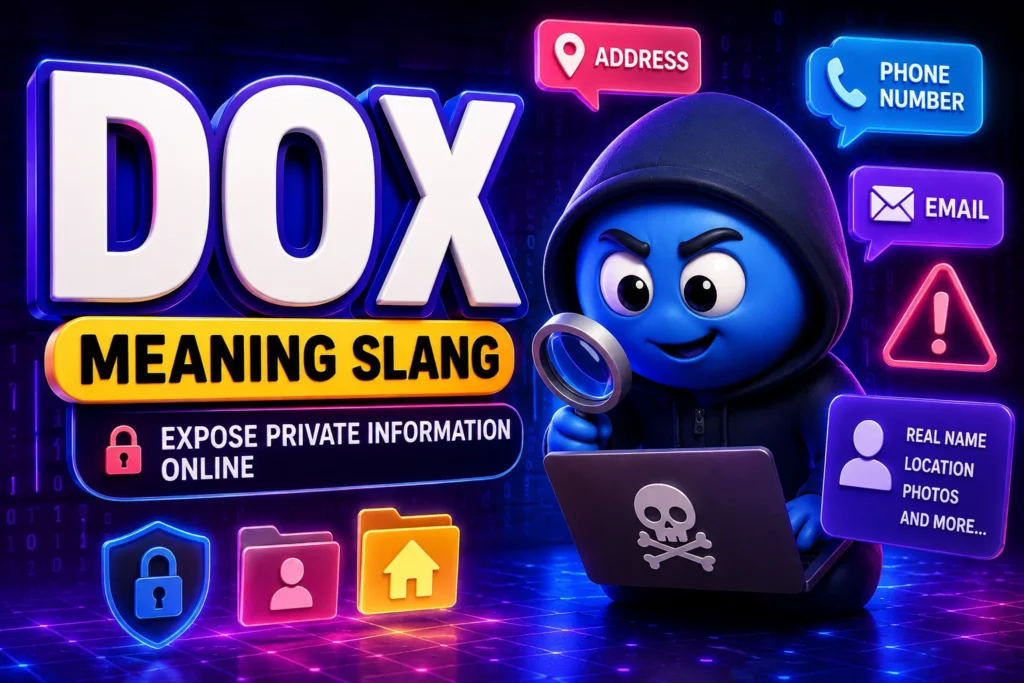
If you’re wondering what “dox” means in slang, it means to publicly reveal or publish someone’s private or identifying information online without their permission, often to harass, intimidate, punish, or expose them.
You may also see it written as “doxx,” “doxed,” “doxxed,” “doxing,” or “doxxing.” The word is internet slang rather than an acronym, and its history is closely connected to the older expression “dropping dox,” with dox coming from docs, short for documents.
What Does “Dox” Mean in Slang?
The most common modern meaning of dox is to expose someone’s private or personally identifying information online without their consent.
That information can include things such as:
- A private home address
- A personal phone number
- A private email address
- A person’s real identity behind an anonymous account
- Workplace or school information
- Information about family members
- Other identifying details that could put someone at risk
The important part is not simply that information exists somewhere online. Doxxing involves exposing or distributing identifying information in a way that violates the person’s privacy, especially when the disclosure is intended to cause harm or enable harassment. Cambridge defines dox as publishing private information online without permission, while Merriam-Webster emphasizes public identification or publication of private information, particularly as punishment or revenge.
For example:
“Someone threatened to dox me after the argument.”
This means the person threatened to expose the speaker’s private or identifying information.
Another example:
“He got doxxed after the online dispute.”
That means someone published his private information online.
Is “Dox” Slang, an Acronym, or an Abbreviation?
Dox is internet slang and an informal abbreviation/shortened form, not an acronym.
It developed from “docs,” a shortened form of documents. The expression “dropping dox” referred to releasing documents or information about someone. Over time, dox became a verb meaning to expose that information publicly.
So:
Dox = internet slang derived from “docs”/“documents.”
It isn’t formed from the first letters of a phrase, so calling it an acronym like “LOL” or “BRB” would be incorrect.
A Second Meaning: “Dox” Can Mean Documents
There is a genuine secondary meaning worth knowing.
In some older internet and technical contexts, dox can simply refer to documents. Collins lists dox as an informal plural noun meaning “documents,” while other dictionaries also record the noun sense.
For example:
“Send me the project dox.”
Here, dox could simply mean documents.
However, if you encounter “dox” in a social-media argument, gaming dispute, privacy discussion, or warning, the more likely meaning is the modern verb to expose someone’s personal information.
There is also a noun use in which “dox” refers to the personal information itself, especially information gathered for the purpose of exposing someone. Dictionary.com records this sense as well.
A Common Misunderstanding About “Dox”
A common misunderstanding is that doxxing always means hacking someone’s computer or account.
It doesn’t.
Someone can potentially collect information from publicly available sources and combine it in a way that exposes a person’s identity or location. Doxxing can also involve information obtained through unauthorized access or other means. The defining issue is the exposure of personal information without consent and the surrounding context—not necessarily whether the person was hacked.
That distinction matters because someone can be doxxed even when the person doing it never directly breaks into an account.
Where Is “Dox” Used Online?
“Dox” is associated with internet communities, social media, gaming spaces, forums, and online arguments rather than one particular app.
TikTok
The term is used in discussions involving privacy, creators, online conflicts, and personal information. TikTok also has policies addressing content involving personal information that can create risks such as stalking, violence, fraud, or identity theft.
“Dox” can appear when people discuss online harassment, creator disputes, privacy problems, or the exposure of someone’s personal details. More broadly, university safety guidance identifies Instagram among the social networks where information involved in doxxing may be gathered or shared.
X
X has a particularly well-documented connection to discussions about doxxing. Its rules have addressed the sharing of private information, including information that could threaten a person’s physical safety.
Snapchat and WhatsApp
The word can certainly be understood in private chats and messaging conversations, but there is less useful authoritative evidence for claiming that Snapchat or WhatsApp are uniquely associated with “dox.” It is better to describe those as possible messaging contexts rather than claiming they are major doxxing-specific platforms.
How Do You Use “Dox” in a Sentence?
“Dox” is primarily used as a transitive verb.
Present tense
“Don’t dox her.”
Past tense
“Someone doxed him.”
Both doxed and doxxed are accepted spellings. Merriam-Webster lists both forms.
Present participle
“They’re threatening to dox me.”
Passive form
“She was doxxed.”
You can also use doxxing/doxing as a noun:
“Doxxing can put someone’s safety at risk.”
So the word can fit naturally into ordinary sentence structures, but its meaning remains connected to privacy and information exposure.
Where Did the Word “Dox” Come From?
The origin is unusually well documented, although sources differ slightly about the exact date of its earliest use.
The strongest common thread is that dox developed from “docs,” short for “documents,” and the phrase “dropping dox.” Earlier internet and hacker culture used the expression for releasing information or documents about someone.
Academic research also describes “dropping dox” as an older revenge tactic associated with hacker culture in the 1990s.
Merriam-Webster gives 2009 as the first known use of “dox” in its modern dictionary sense, while other sources document earlier forms such as docs and dropping dox.
So the safest historical explanation is:
documents → docs/dox → “dropping dox” → dox/doxxing
The exact first-ever use is difficult to pin down, but its connection to early internet and hacker culture is well supported.
Funny, Sarcastic, Playful, and Serious Examples
The following examples show how the word can appear naturally without treating actual privacy violations as a joke.
Funny
Friend 1: Why did you delete that selfie?
Friend 2: It showed my house number 😭
Friend 1: Oh, yeah, don’t accidentally dox yourself.
Friend 2: Imagine getting exposed by my own selfie.
Sarcastic
Person 1: I’m posting your entire profile.
Person 2: Wow, terrifying.
Person 1: Prepare to be doxxed.
Person 2: My public username has been discovered. How will I survive?
Playful
Friend 1: I found your old gaming account.
Friend 2: Don’t dox me 😂
Friend 1: I only found your username.
Friend 2: That’s enough internet detective work for today.
Serious
Person 1: Someone posted my private number.
Person 2: Did you know who posted it?
Person 1: Not yet.
Person 2: Save the evidence and report the post.
12 More Realistic Conversations Using “Dox”
1. Gaming Friends
A: The argument in the server got really bad.
B: What happened?
A: Someone threatened to dox another player.
B: That’s way beyond normal trash talk.
2. Group Chat
A: Delete that screenshot.
B: Why?
A: It has someone’s private number in it.
B: Good catch. I don’t want to accidentally expose them.
3. Dating
A: I don’t give strangers my exact address online.
B: That’s smart.
A: Too much personal information can spread quickly.
B: Yeah, especially if someone gets angry later.
4. Coworkers
A: Did you see what happened on the company forum?
B: No.
A: Someone posted an employee’s private details.
B: That’s a serious privacy issue.
5. Friends on Social Media
A: Someone figured out my real name from my old posts.
B: Are they sharing it?
A: Not yet.
B: Then tighten your privacy settings and don’t engage with them.
6. Parent and Teen
Parent: What does “don’t dox me” mean?
Teen: It means don’t expose someone’s private information online.
Parent: So it’s more serious than ordinary teasing?
Teen: Yeah, definitely.
7. Online Argument
A: I’m blocking him.
B: Good idea.
A: He said he’d dox me if I kept responding.
B: Don’t give him more information.
8. Creator Community
A: Why did the creator remove that post?
B: It accidentally showed private information.
A: So people were worried she’d be doxxed?
B: Exactly.
9. School Group
A: Someone posted a student’s personal details.
B: Did the school see it?
A: The moderators removed it.
B: Good. That shouldn’t be shared.
10. Forum
A: This discussion is getting ugly.
B: Yeah, people are starting to threaten each other.
A: Someone even mentioned doxxing.
B: Time to report it and leave the thread.
11. Family Chat
A: Don’t send Grandma’s phone number to the whole group.
B: Why not?
A: Not everyone needs it.
B: Fair point. I’ll message her privately.
12. Online Safety
A: Why are you removing your location posts?
B: I don’t want strangers piecing together where I live.
A: That’s reasonable.
B: I’d rather not make it easy for someone to target me.
How Should You Reply When Someone Says “Dox”?
Your response depends on what they mean.
Funny reply
“Relax, detective. Nobody needs your secret Wi-Fi password 😂”
Use humor only when the conversation is clearly harmless and among people who understand the joke.
Serious reply
“Don’t share anyone’s private information without permission.”
This is appropriate when someone is genuinely discussing exposing another person’s details.
Flirty reply
There isn’t a naturally flirty meaning of dox, so forcing a romantic interpretation would be confusing. If someone says “don’t dox me” jokingly in a dating conversation, respond to the privacy concern rather than treating dox as a romantic slang term.
Neutral reply
“Yeah, protecting people’s private information is important.”
This works when you don’t want to escalate the conversation.
Dox vs Similar Terms
| Term | Meaning | Tone | Popularity | Confusion Risk |
|---|---|---|---|---|
| Dox | Expose someone’s private information online | Serious | High online | Low |
| Doxx | Alternate spelling of dox | Serious | High online | Low |
| Doxxing | The act of exposing private information | Serious | High | Low |
| Data leak | Private information becomes exposed, often accidentally or through a security failure | Technical/serious | High | Medium |
| Identity theft | Using another person’s identity or personal information fraudulently | Serious/legal | High | Medium |
| Swatting | Making a false emergency report intended to trigger a police response against someone | Extremely serious | Moderate online | High |
| Protect privacy | Taking steps to keep personal information from being exposed | Neutral/positive | Common | Low |
One important distinction is doxxing vs data leaking. A data leak can happen accidentally or because a system is compromised, while doxxing generally describes the intentional exposure or publication of someone’s personal information.
Dox vs Swatting: Why People Mention Them Together
You may see doxxing and swatting discussed together because both can turn online harassment into a real-world safety concern.
Doxxing involves exposing personal information. Swatting involves making a false report designed to provoke a law-enforcement response to someone’s location. Merriam-Webster specifically discusses the two as related forms of harmful online harassment.
They are not the same thing, however.
Dox = exposing personal information.
Swatting = falsely triggering a dangerous emergency response.
Understanding the difference helps when reading online safety discussions.
Does Public Information Count as Doxxing?
This is where the subject becomes more complicated.
Not every mention of someone’s name or publicly available information is automatically doxxing. Context matters, including whether the information was private, whether it was published without permission, how it was presented, and whether the disclosure creates a meaningful privacy or safety risk.
Cambridge and eSafety focus on unauthorized exposure of private or identifying information, while research on doxxing notes that definitions vary over whether information must have been genuinely secret or simply difficult to obtain and newly assembled into a revealing profile.
That means “I found it online” does not automatically make every use of someone’s information harmless, especially when separate pieces of information are deliberately assembled to identify or target a person.
Why “Dox” Works So Well as Internet Slang
The word survives because it compresses a complicated online behavior into four letters.
Instead of saying, “Someone is threatening to publicly release my identifying information without my permission,” a person can simply say:
“They’re threatening to dox me.”
That makes the term useful in fast-moving online conversations.
It also carries more information than simply saying “they leaked something.” Dox immediately suggests a person, identifying information, exposure, and a potential privacy or safety problem. Its short form makes it especially effective in chats, gaming communities, social media discussions, and online reporting.
Who Uses the Word “Dox”?
There is no reliable evidence that dox belongs exclusively to Gen Z or to a particular gender or region.
It emerged from older internet and hacker communities and later spread into broader online culture. Today, dictionaries recognize it as established informal English, and it appears in discussions involving social media, gaming, online harassment, privacy, and internet safety.
Younger internet users may encounter it frequently because of social media and gaming communities, but it is not accurate to label it exclusively as Gen Z slang.
Regional differences are also not central to its meaning. The basic definition remains broadly understandable in English-speaking online contexts.
Is “Dox” Rude or Offensive?
The word itself is not profanity and isn’t inherently a slur or offensive expression.
However, the behavior it describes can be extremely serious.
Doxxing can expose people to harassment, stalking, threats, identity-related risks, reputational damage, and physical-safety concerns. The Australian eSafety Commissioner describes doxing as an intentional exposure of identity or personal information without consent with the intent to cause harm.
So the word is acceptable when discussing privacy, online safety, moderation, or reporting harmful behavior.
It is not appropriate to use it as a genuine threat.
For school or workplace communication, clearer language such as “private information was exposed without permission” may be preferable if the audience isn’t familiar with internet slang.
Category: Where Does “Dox” Belong?
For a slang website, dox fits these categories:
- ✅ Slang Text Meaning
- ❌ Brainrot slang
- ❌ AI/tech-related slang — although it is strongly connected to internet and cybersecurity culture, it isn’t AI-specific slang.
- ❌ Dating/relationship slang
- ✅ Gen Z / TikTok slang — it appears in modern social-media culture, but it is not exclusively Gen Z.
- ✅ Parent-facing “decode your teen’s texts” — useful because parents may encounter “dox,” “doxxed,” or “don’t dox me” and misunderstand what it means.
Is Dox the Same as “Doxxed”?
Almost.
Dox is generally the base verb:
“They might dox him.”
Doxxed/doxed describes someone who has already been targeted:
“He got doxxed.”
Doxxing/doxing describes the activity:
“Doxxing can create serious safety risks.”
Both single-X and double-X spellings are recognized in modern English usage.
FAQ
What does “dox” mean in slang?
“Dox” means to publicly reveal or publish someone’s private or identifying information online without their permission. It is usually associated with harassment, intimidation, punishment, or exposing someone’s identity. The word is internet slang derived from “docs,” short for documents.
Is dox a bad word?
Dox is not a swear word or profanity. However, the behavior it describes can be harmful and threatening because it involves exposing someone’s private information. Using the term to discuss online safety is completely different from threatening to dox someone.
What does “don’t dox me” mean?
“Don’t dox me” means “Don’t expose or publish my private or identifying information online.” Depending on the conversation, someone might say it seriously or jokingly. If the person is genuinely worried about their privacy, the statement should be taken seriously.
What does “I got doxxed” mean?
“I got doxxed” means someone exposed or published the person’s private or identifying information online. The information may reveal their identity, location, contact details, or other personal information. The exact information involved depends on the situation.
Is “dox” the same as “doxx”?
Yes. Dox and doxx are spelling variants of the same modern internet term. The same variation appears in forms such as doxed/doxxed and doxing/doxxing.
Is doxxing illegal?
There is no single worldwide rule that makes every instance of doxxing automatically illegal. Legal consequences depend on the country or jurisdiction, what information was exposed, how it was obtained or used, and whether additional conduct such as threats, stalking, harassment, or fraud was involved. It is therefore better not to assume that every case has the same legal status.
Does dox mean documents?
It can. In older or technical internet usage, dox can be an informal term for documents. In current social-media slang, however, the more common meaning is the verb referring to exposing someone’s private information.
What is the difference between doxing and leaking information?
A leak can happen accidentally or through a security failure, while doxxing generally refers to intentionally exposing personal or identifying information about a person. The two concepts can overlap, but they are not interchangeable.
Conclusion
Dox is internet slang meaning to expose or publish someone’s private or identifying information online without permission. It is not an acronym; the term developed from docs/documents and the older expression dropping dox.
The most important distinction is context. If someone says “don’t dox me,” they are usually talking about privacy. If someone says “he got doxxed,” they mean his personal information was exposed. And if you see “doxxing,” it refers to the act itself.
Use the word when discussing online privacy, harassment, or internet culture, but don’t treat an actual threat to expose someone’s personal information as harmless slang.