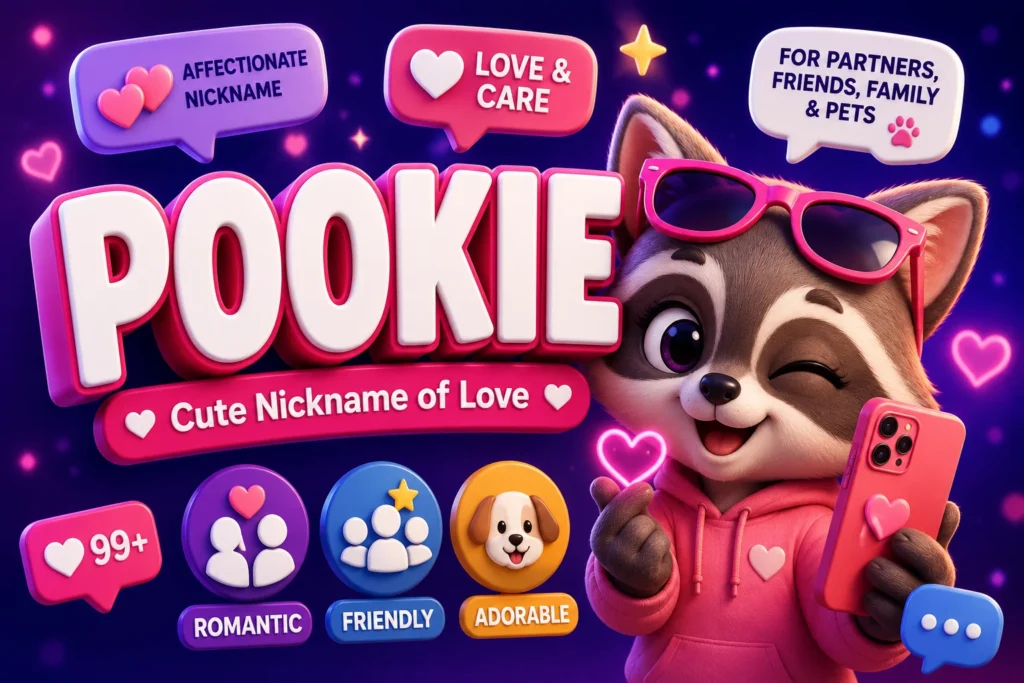
If someone calls you “Pookie,” they’re almost always using it as an affectionate nickname. In modern slang, pookie is a cute pet name for someone you love, care about, or find adorable—similar to baby, babe, sweetheart, or honey.
Unlike many internet terms, pookie is not an acronym or abbreviation. It’s simply a slang nickname that has existed for decades but became hugely popular on TikTok and other social media platforms during the 2020s.
This guide explains the real meaning of pookie, where it came from, how people use it online, and when it’s appropriate to call someone by this nickname.
What Does “Pookie” Mean in Slang?
The primary slang meaning of pookie is:
A cute, affectionate nickname for someone you love, care about, or feel close to.
People often use it for:
- Romantic partners
- Husbands or wives
- Boyfriends or girlfriends
- Close friends
- Children
- Pets
Examples include:
- “Good morning, Pookie.”
- “Love you, Pookie.”
- “Come here, Pookie.”
Unlike insults or ironic internet slang, pookie is usually positive and expresses affection.
Is “Pookie” an Acronym?
No.
Pookie is not an acronym or abbreviation.
It is simply a slang nickname and term of endearment.
There is no evidence that each letter stands for separate words.
All Real Meanings of “Pookie”
Although “cute nickname” is the meaning most people search for today, pookie has a few legitimate meanings depending on context.
1. Affectionate Nickname (Most Common)
This is by far the most common meaning online.
Calling someone pookie means they’re special to you.
Examples:
- “You’re my pookie.”
- “Sleep well, Pookie.”
- “Miss you, Pookie.”
It’s similar to saying:
- babe
- sweetheart
- honey
- darling
- love
2. Cute Way to Address a Friend
Many friends use pookie jokingly.
For example:
- “What’s up, Pookie?”
- “Let’s go, Pookie.”
- “You made it!”
In these situations, there isn’t necessarily any romantic meaning.
Instead, it’s playful and affectionate.
3. Internet Meme Character
During the 2020s, pookie became a meme.
People began calling:
- celebrities
- fictional characters
- athletes
- internet personalities
“Pookie” as a humorous way of showing affection.
Examples include:
- “That’s my pookie.”
- “Pookie can do no wrong.”
- “Protect Pookie.”
These are usually exaggerated jokes rather than serious nicknames.
4. Traditional Pet Name
Long before TikTok existed, Pookie was already used as:
- a family nickname
- a pet’s name
- a childhood nickname
You’ll also find characters named Pookie in books, television, and comics, showing that the nickname has been around for many years.
A Common Misunderstanding
A common misunderstanding is that pookie always means boyfriend or girlfriend.
It doesn’t.
Someone may call:
- their spouse
- best friend
- sibling
- child
- pet
“Pookie.”
The exact meaning depends entirely on the relationship.
Another misconception is that pookie is a brand-new TikTok word.
In reality, TikTok made the nickname more visible, but the word itself has existed in American English for decades.
Which Apps Use “Pookie”?
The nickname appears on several social media platforms, although each community uses it a little differently.
TikTok
TikTok helped make pookie extremely popular.
You’ll often find:
- relationship videos
- wholesome memes
- funny couple clips
- pet videos
- trending audio
Comments commonly include:
- “Pookie is so cute.”
- “Protect Pookie.”
- “Pookie deserves better.”
The viral phrase:
“Pookie is looking absolutely fire today.”
also helped introduce the nickname to many users.
Instagram users often use pookie in:
- captions
- comments
- Stories
- couple posts
Examples:
- “My favorite Pookie ❤️”
- “Love you, Pookie.”
Many influencers also use it humorously with their audiences.
Snapchat
Snapchat naturally fits affectionate nicknames.
Examples include:
- “Morning, Pookie.”
- “Where are you, Pookie?”
- “Miss you.”
Because Snapchat focuses on personal conversations, the nickname feels natural there.
X (Formerly Twitter)
On X, pookie frequently appears in memes and fandom communities.
People jokingly write:
- “That’s my pookie.”
- “Leave Pookie alone.”
- “Pookie deserves an award.”
Many of these posts are intentionally dramatic for comedic effect.
Friends, couples, and family members also use pookie in WhatsApp conversations.
Examples:
- “Goodnight, Pookie.”
- “Call me later.”
Since WhatsApp is mainly used for private messaging, the nickname is common among people who already know each other well.
Grammar: How Is “Pookie” Used?
In slang, pookie most often functions as a noun, specifically a nickname.
Examples:
- “You’re my pookie.”
- “Hi, Pookie.”
- “Thanks, Pookie.”
Sentence Position
It often appears:
After greetings:
- “Hey, Pookie.”
At the end of sentences:
- “I missed you, Pookie.”
After possessive words:
- “My Pookie.”
Can It Be a Whole Reply?
Yes.
Example:
A: “Good morning.”
B: “Morning, Pookie ❤️”
Or simply:
Pookie 🥹
The nickname alone communicates affection.
Where Did “Pookie” Come From?
Unlike many modern internet slang words, pookie did not originate on TikTok.
The nickname has been used in American English for decades as an affectionate pet name. It also appears in older books, television shows, comic strips, and family nicknames, showing that it predates today’s social media culture.
However, its exact origin is unclear. There is no verified record identifying the first person who created the nickname or precisely when it first entered everyday speech.
What is well documented is how the word became popular again online.
During the early 2020s, TikTok creators, meme pages, and couples began using pookie in wholesome, humorous, and romantic content. Viral videos and catchphrases—especially “Pookie is looking absolutely fire today”—introduced the nickname to millions of new users.
As a result, pookie shifted from being an old-fashioned pet name to one of the internet’s favorite affectionate nicknames.
Four Example Conversations
Funny
A: Why are you smiling at your phone?
B: Pookie finally texted me back.
A: That’s all it took?
B: Absolutely.
Sarcastic
A: Forgot my birthday again?
B: Sorry, Pookie.
A: Nice try.
B: Worth a shot.
Playful
A: Are you coming over?
B: Give me ten minutes.
A: Hurry up, Pookie.
B: I’m already on my way.
Serious
A: Thanks for checking on me today.
B: Of course, Pookie.
A: It meant a lot.
B: Anytime.
More Realistic Chat Examples
1. Friends (TikTok)
Emma: Did you see my latest video?
Lily: Yes!
Emma: Be honest.
Lily: You look adorable, Pookie.
2. Dating
Chris: Made it home safely.
Taylor: Good.
Chris: Miss you already.
Taylor: Miss you too, Pookie.
3. Family Chat
Mom: Dinner’s ready.
Daughter: Coming!
Mom: Hurry, Pookie.
Daughter: Be there in a minute.
4. College Roommates
Mia: Can you save me some pizza?
Grace: Of course.
Mia: You’re the best.
Grace: Anything for my Pookie.
5. Instagram Comments
Olivia: Finally posted our vacation photos.
Friend: You two are adorable.
Olivia: Thanks!
Friend: Pookie looks so happy.
6. Snapchat Friends
Noah: Just woke up.
Emma: Morning, Pookie.
Noah: That’s the nicest way to wake up.
Emma: Good. 😊
7. Siblings
Brother: Can you grab my charger?
Sister: Only if you ask nicely.
Brother: Please, Pookie.
Sister: That’s better.
8. Group Chat
Alex: Who’s bringing snacks tonight?
Jordan: I will.
Taylor: Thanks, Pookie.
Jordan: You’re welcome.
9. Coworkers (Close Friends)
Rachel: I finally finished the presentation.
Megan: Nice work!
Rachel: It took forever.
Megan: Proud of you, Pookie.
10. Long-Distance Relationship
Chris: Wish you were here.
Taylor: Me too.
Chris: Counting the days.
Taylor: Love you, Pookie.
11. X (Formerly Twitter)
User 1: My favorite actor won another award.
User 2: That’s my Pookie!
User 1: They deserved it.
User 2: Absolutely.
How to Reply to “Pookie”
The right response depends on who is calling you Pookie and your relationship with them.
Funny Reply
- “I’m accepting this promotion.”
- “Only you get to call me that.”
- “Pookie reporting for duty.”
- “I knew I was the favorite.”
Serious Reply
- “Thank you, that means a lot.”
- “You’re sweet.”
- “I appreciate you.”
- “That’s really kind.”
Flirty Reply
If you’re talking to a romantic partner or someone you’re flirting with:
- “Only if you’re my Pookie too.”
- “Come here and tell me that in person.”
- “Now you’re making me smile.”
- “I was hoping you’d say that.”
Neutral Reply
- “Thanks!”
- “😊”
- “Aww.”
- “You’re too kind.”
These responses work well in casual conversations and social media comments.
Comparison Table
| Term | Meaning | Tone | Popularity | Confusion Risk |
|---|---|---|---|---|
| Pookie | Affectionate nickname for someone you love or care about | Warm, affectionate | Very High | Low |
| Babe | Romantic pet name | Affectionate | Very High | Low |
| Baby | Common nickname for a loved one | Affectionate | Very High | Low |
| Sweetheart | Caring, gentle nickname | Warm | High | Low |
| Honey | Friendly or romantic term of endearment | Warm | High | Low |
| Bestie | Close friend | Friendly | Very High | Medium |
| Enemy (Opposite) | Someone you dislike or oppose | Negative | Very High | Low |
Although these words overlap, Pookie usually feels cuter and more playful than terms like babe or honey. It often carries a lighthearted, affectionate tone.
Who Uses “Pookie”?
Gen Z
Gen Z helped make Pookie trend again through:
- TikTok
- Instagram Reels
- Snapchat
- X memes
- Couple videos
Many younger users also use it ironically with close friends or favorite celebrities.
Millennials
Many Millennials were already familiar with Pookie as an older pet name before it became a TikTok trend. Today, some use it sincerely with partners or children, while others use it humorously after seeing it online.
Regional Differences
The nickname is most commonly associated with American English, but social media has spread it to many English-speaking countries.
People in Canada, the UK, Australia, and elsewhere may also recognize and use Pookie, especially online. However, there is no reliable evidence that it has a distinctly different slang meaning in those regions.
Is “Pookie” Rude or Safe?
In almost every situation, Pookie is considered safe and affectionate.
Is It Offensive?
No.
The word is generally used to show affection rather than to insult someone.
Is It Profanity?
No.
Pookie contains no profanity or vulgar language.
School and Workplace
The nickname is appropriate in casual conversations with people who know each other well. However, it may feel too personal in professional settings unless coworkers already have that kind of friendly relationship.
Cultural Notes
Unlike some internet slang terms that began on social media, Pookie existed as a nickname long before the internet. While modern memes and viral videos helped revive it, there is no verified evidence that the nickname itself originated in AAVE or on TikTok. When discussing its history, it’s important to distinguish the word’s long-standing use from the recent memes that made it trend again.
Why Does “Pookie” Stay Popular?
Pookie has lasted because it feels warm, playful, and personal without being complicated. Unlike trend-driven slang that quickly fades, affectionate nicknames often remain useful because they strengthen personal connections. Social media gave the word a second life through memes and wholesome relationship content, but its emotional appeal comes from something much older: people naturally enjoy using unique, affectionate names for those they care about. Whether used sincerely or humorously, Pookie instantly signals closeness and familiarity.
Frequently Asked Questions
What does “Pookie” mean in slang?
In modern slang, Pookie is an affectionate nickname for someone you love, care about, or find adorable. It’s similar to babe, baby, sweetheart, or honey. The meaning depends on the relationship but is almost always positive.
Is “Pookie” romantic?
It can be, but not always. Many couples use Pookie as a romantic pet name, while others use it for close friends, family members, children, or even pets. Context determines whether it is romantic or simply affectionate.
Is “Pookie” an acronym?
No. Pookie is not an acronym or abbreviation. It is simply a nickname that has been used in English-speaking communities for many years.
Why is everyone saying “Pookie” on TikTok?
TikTok helped make Pookie trend again through relationship videos, memes, and viral audio. Phrases like “Pookie is looking absolutely fire today” introduced the nickname to a much wider audience and turned it into a recognizable internet joke.
Can you call your best friend “Pookie”?
Yes. Many friends use Pookie jokingly or affectionately. It doesn’t automatically imply a romantic relationship.
Is “Pookie” rude?
No. In almost every situation, Pookie is meant as a kind and affectionate nickname. It is generally considered friendly rather than offensive.
Where did the nickname “Pookie” come from?
The nickname has existed in American English for decades and appeared in popular culture long before social media. Its exact origin is unclear, and there is no verified source identifying who first coined it.
Is “Pookie” still popular in 2026?
Yes. Pookie continues to appear frequently on TikTok, Instagram, Snapchat, X, and in private messaging. While the viral meme trend may change over time, the nickname itself remains widely recognized and used.
Conclusion
The slang term Pookie is one of the internet’s sweetest nicknames. Today, it usually means someone you deeply care about, whether that’s a romantic partner, a close friend, a family member, or even a pet. Although TikTok and viral memes introduced it to a new generation, the nickname itself has been around for decades.
Usage Tips
- Use Pookie with people you’re genuinely close to.
- It’s perfect for romantic texts, family chats, and playful friendships.
- Expect to see it often on TikTok, Instagram, Snapchat, WhatsApp, and X.
- Remember that not everyone enjoys pet names, so consider the other person’s comfort level.
Common Mistakes
- Mistake: Thinking Pookie only refers to a boyfriend or girlfriend.
Correct: It can also be used for friends, family, children, or pets. - Mistake: Assuming it started on TikTok.
Correct: TikTok popularized it, but the nickname existed long before social media. - Mistake: Believing it’s an acronym.
Correct: It’s simply a slang nickname. - Mistake: Using it in formal or professional communication.
Correct: It’s best reserved for casual, personal conversations.
When to Use It
Use Pookie when you want to express affection, warmth, or playful closeness. Avoid using it with strangers, in formal workplace communication, or with someone who may not be comfortable with personal nicknames.