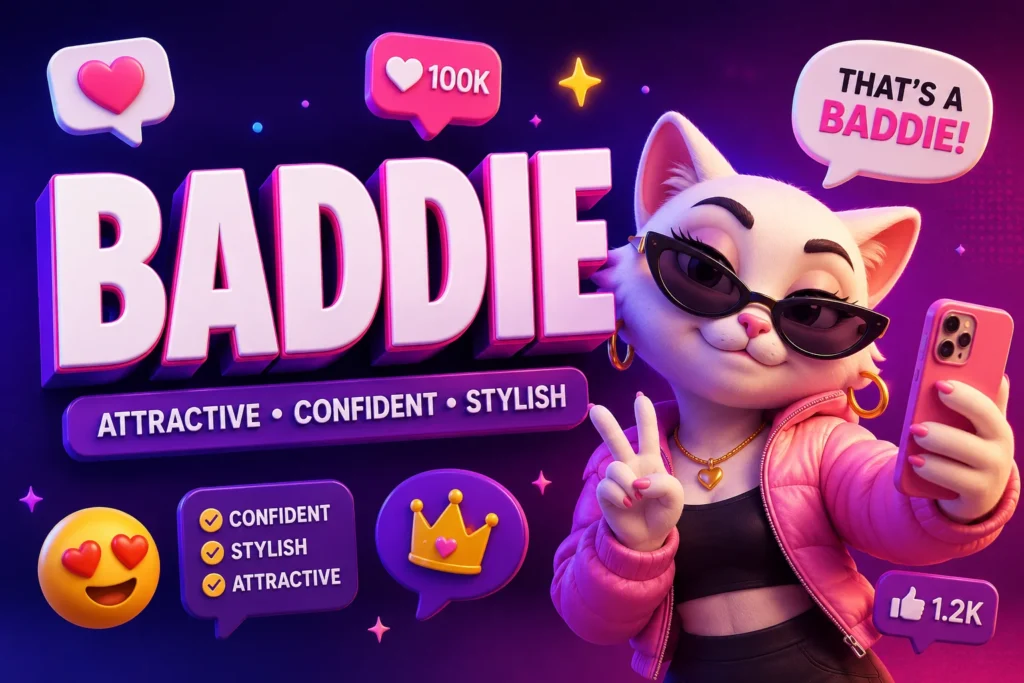
If someone calls a person a baddie, they usually mean they’re very attractive, fashionable, confident, and stylish. On social media, especially TikTok and Instagram, the term often describes someone with a polished appearance, self-confidence, and a trend-conscious aesthetic.
Unlike many internet abbreviations, baddie is not an acronym or abbreviation. It’s simply a slang noun that has evolved into one of the internet’s most recognizable compliments. While it most often refers to women, it can occasionally be used more broadly depending on the context.
In this guide, you’ll learn every real meaning of baddie, where it came from, how people use it on different social platforms, and when it’s appropriate to use.
What Does “Baddie” Mean in Slang?
The primary slang meaning of baddie is:
An attractive, confident, fashionable person with a strong sense of style and self-confidence.
Today, calling someone a baddie is generally intended as a compliment.
Examples include:
- “She’s a total baddie.”
- “That outfit is giving baddie.”
- “You’re looking like a baddie today.”
The compliment isn’t only about physical appearance. It often suggests someone who:
- Dresses well
- Carries themselves confidently
- Has a polished makeup or fashion style
- Appears self-assured
- Keeps up with beauty or fashion trends
Many influencers who fit this style are described as having a “baddie aesthetic.”
Is “Baddie” an Acronym?
No.
Baddie is not an acronym or abbreviation.
It is simply a slang noun that developed from the English adjective bad. In this case, bad doesn’t carry its ordinary negative meaning. Instead, like several other expressions in African American English (AAVE), bad evolved to describe someone impressive, stylish, or exceptionally attractive in certain contexts.
All Real Meanings of “Baddie”
Although the fashionable meaning dominates social media today, baddie has several legitimate meanings depending on the context.
1. Attractive and Stylish Person (Most Common)
This is the meaning most people search for.
A baddie is someone considered:
- attractive
- fashionable
- confident
- photogenic
- trend-conscious
Examples:
- “She looks like a baddie.”
- “That makeup turned you into a baddie.”
- “Her Instagram feed is full of baddie outfits.”
This meaning appears constantly across beauty, fashion, and lifestyle content.
2. Someone With High Self-Confidence
Sometimes appearance isn’t the focus.
People may describe someone as a baddie because they:
- know their worth
- act confidently
- aren’t afraid to express themselves
- project self-assurance
Example:
- “She handled that interview like a baddie.”
Here, the compliment centers more on confidence than appearance.
3. Internet Beauty Aesthetic
On TikTok and Instagram, baddie also refers to a recognizable beauty and fashion style.
This aesthetic often includes:
- coordinated outfits
- polished hairstyles
- carefully applied makeup
- trendy accessories
- confident posing for photos
Examples include:
- “I’m trying the baddie aesthetic.”
- “Here’s my baddie makeup routine.”
- “Summer baddie outfits.”
In this context, baddie describes an entire visual style rather than just a person.
4. Older Meaning: Female Villain or Criminal
Long before today’s compliment became popular, baddie already existed in English.
It could refer to:
- a villain
- a criminal
- an antagonist
For example:
- “The movie’s main baddie escapes.”
This meaning still appears in films, television, comics, and gaming.
Usually, context makes it obvious whether someone means:
- an attractive person
or
- a fictional villain.
A Common Misunderstanding
One common misunderstanding is that people assume baddie means someone who behaves badly or has a rude personality.
That’s usually incorrect.
Modern internet slang focuses much more on:
- appearance
- confidence
- fashion
- attitude in a positive sense
rather than bad behavior.
Another misconception is that baddie always refers only to women.
While it most commonly describes women in social media culture, some people also use it more broadly to compliment anyone with a confident, fashionable appearance. The exact usage depends on the speaker and the community.
Which Apps Use “Baddie”?
The slang appears across several social platforms, though some use it far more frequently than others.
TikTok
TikTok is one of the biggest reasons the word remains popular.
You’ll frequently see:
- #baddie
- baddie transformations
- baddie makeup tutorials
- baddie fashion inspiration
- glow-up videos
Common comments include:
- “She’s literally a baddie.”
- “This outfit screams baddie.”
- “How do I get this baddie look?”
Instagram has been strongly connected with baddie culture for years.
Users commonly post:
- fashion photos
- makeup looks
- mirror selfies
- vacation pictures
- outfit inspiration
Typical comments include:
- “Absolute baddie.”
- “You’re serving baddie.”
- “Certified baddie.”
Snapchat
Because Snapchat revolves around selfies and personal photos, friends sometimes compliment each other using baddie.
Examples:
- “You’re such a baddie.”
- “That filter made you look like a baddie.”
X (Formerly Twitter)
On X, people often use baddie while discussing:
- celebrities
- fashion trends
- reality TV
- viral photos
- internet personalities
It’s also common in humorous posts and memes.
WhatsApp doesn’t have platform-specific slang, but friends often use baddie naturally in private chats and group conversations.
Examples:
- “You looked like a baddie at the party.”
- “Send me your baddie pictures.”
Grammar: How Is “Baddie” Used?
In slang, baddie most commonly functions as a noun.
Examples:
- “She’s a baddie.”
- “He’s dating a baddie.”
- “That influencer is a baddie.”
Sentence Position
It usually appears:
After articles:
- “a baddie”
After linking verbs:
- “She is a baddie.”
As a compliment:
- “You’re a baddie.”
Can It Be a Reply by Itself?
Yes.
Friend posts a selfie.
Comment:
Baddie 🔥
Or:
A: “Rate my outfit.”
B: “Baddie.”
A single word works because the compliment is immediately understood.
Where Did “Baddie” Come From?
The modern slang meaning of baddie is widely traced to African American English (AAVE), where bad and related expressions have long been used in positive ways to describe someone impressive, attractive, or exceptionally stylish. Over time, baddie developed as a noun describing a person who embodies those qualities.
Its exact first origin is unclear. There is no verified record identifying the first individual who coined the slang or the precise year it first appeared.
The word gained much wider popularity through:
- hip-hop culture
- Black popular culture
- beauty influencers
- Twitter (now X)
- YouTube beauty creators
- TikTok
During the 2010s, hashtags, makeup tutorials, and fashion content helped establish the “baddie” aesthetic as its own recognizable online style. By the early 2020s, the term had become mainstream and was widely understood even outside social media communities.
Because the word originated within AAVE before spreading broadly, it’s helpful to recognize those cultural roots when discussing its history.
Four Example Conversations
Funny
A: Why did you spend an hour getting ready?
B: I’m trying to become a certified baddie.
A: Mission accomplished.
B: Finally!
Sarcastic
A: You wore heels just to buy groceries?
B: A baddie never clocks out.
A: Fair enough.
B: Exactly.
Playful
A: New haircut?
B: Yep!
A: You’re looking like a baddie.
B: That’s the goal.
Serious
A: I’ve been working on feeling more confident.
B: It really shows.
A: Thanks.
B: Confidence is what makes someone a real baddie.
More Realistic Chat Examples
1. Friends (TikTok)
Emma: Did you upload your glow-up video?
Sofia: Just now.
Emma: You’re an actual baddie.
Sofia: Stop, you’re making me blush.
2. Sisters
Older Sister: Which outfit should I wear?
Younger Sister: The black one.
Older Sister: Really?
Younger Sister: It gives total baddie vibes—I mean, it makes you look like a baddie.
3. Instagram Comments
Lily: Finally posted my vacation pictures.
Friend: Every photo is gorgeous.
Lily: Thank you!
Friend: Certified baddie.
4. Group Chat
Mia: Should I post this selfie?
Jasmine: Absolutely.
Olivia: You look like a baddie.
Mia: Posting it now.
5. Dating
Chris: I saw your new profile picture.
Taylor: What do you think?
Chris: Honestly, you’re a total baddie.
Taylor: That’s sweet.
6. Snapchat Friends
Olivia: Which selfie should I send?
Maya: The second one.
Olivia: Really?
Maya: Definitely. Total baddie.
7. Family Chat
Cousin: I finally tried a new hairstyle.
Aunt: You look wonderful.
Cousin: Thanks!
Sibling: You’re looking like a baddie.
8. College Friends
Jake: Did you see Ava at the event?
Noah: Yeah.
Jake: She looked amazing.
Noah: Absolute baddie.
9. Fashion Group Chat
Emma: Should I wear sneakers or heels?
Sophie: Heels.
Emma: Why?
Sophie: They complete the baddie look.
10. Workplace Friends
Rachel: I finally updated my LinkedIn photo.
Megan: Professional and stylish.
Rachel: That’s what I wanted.
Megan: Work baddie unlocked.
11. X (Formerly Twitter)
Alex: That celebrity’s outfit is incredible.
Jordan: They’ve been serving looks all year.
Alex: Certified baddie.
Jordan: Couldn’t agree more.
How to Reply to “Baddie”
The best reply depends on whether it’s a compliment from a friend, someone you’re dating, or simply a social media comment.
Funny Reply
- “Don’t gas me up too much.”
- “I practiced this pose for an hour.”
- “It’s the lighting doing all the work.”
- “Finally getting the recognition I deserve.”
Serious Reply
- “Thank you, I really appreciate that.”
- “That’s very kind of you.”
- “Thanks for noticing.”
- “I worked hard on this look.”
Flirty Reply
If the conversation is clearly friendly or romantic:
- “Glad someone noticed.”
- “Maybe you should take me out then.”
- “Careful—you might make me blush.”
- “Guess I have your attention.”
Neutral Reply
- “Thanks!”
- “I appreciate it.”
- “That’s nice of you.”
- “😊”
A simple response is often the most natural, especially in comments or casual chats.
Comparison Table
| Term | Meaning | Tone | Popularity | Confusion Risk |
|---|---|---|---|---|
| Baddie | Attractive, stylish, and confident person | Positive | Very High | Low |
| It Girl | Someone seen as fashionable, influential, and trendy | Positive | High | Medium |
| Slay | To perform exceptionally well or look amazing | Positive | Very High | Low |
| Queen | A compliment for someone admired or respected | Positive | High | Low |
| Fine | Physically attractive person | Positive | Very High | Low |
| Bombshell | Exceptionally attractive person | Positive | Medium | Medium |
| Mess (Opposite) | Someone or something appearing disorganized or poorly put together | Negative | High | Low |
Although these words overlap, baddie emphasizes a combination of style, confidence, and appearance, while terms like fine focus more on physical attractiveness alone.
Who Uses “Baddie”?
Gen Z
Gen Z uses baddie more than any other age group.
You’ll frequently hear it in:
- TikTok videos
- Instagram Reels
- Snapchat conversations
- Fashion content
- Beauty tutorials
- Meme pages
The word has become part of everyday internet vocabulary among many younger users.
Millennials
Many Millennials also use baddie, particularly those active on Instagram, X, and beauty or fashion communities.
The term became especially popular during the 2010s through influencer culture and remains widely recognized today.
Regional Differences
The slang is most closely associated with American English, although it is now understood in many English-speaking countries because of social media.
People in the UK, Canada, Australia, and elsewhere may also use baddie, particularly online, but there is no reliable evidence that the word carries a fundamentally different slang meaning in those regions.
Is “Baddie” Rude or Safe?
Generally, baddie is considered a compliment.
Unlike many appearance-related slang words, it usually expresses admiration rather than criticism.
Is It Offensive?
No.
The word itself is not offensive or insulting.
However, context still matters. If someone is uncomfortable being judged primarily on appearance, repeatedly calling them a baddie may not be appreciated.
Is It Profanity?
No.
There are no swear words or vulgar language involved.
School and Workplace
The term is acceptable in many casual conversations, but it may sound too informal in professional settings.
For example:
Appropriate:
- “You look great today.”
Less appropriate at work:
- “You’re such a baddie.”
Professional compliments generally work better in workplace environments.
Cultural Notes
The modern positive meaning of baddie developed within African American English (AAVE) before becoming mainstream through hip-hop, beauty culture, and social media. Recognizing those origins helps provide accurate context for the word’s history and avoids treating it as something that appeared spontaneously on TikTok.
Why Does “Baddie” Continue to Be Popular?
The word baddie has remained popular because it combines several compliments into one. Instead of saying someone is attractive, fashionable, confident, and stylish separately, one word communicates the whole idea. Social media also reinforced the term through beauty tutorials, outfit inspiration, and “glow-up” content, making it part of a recognizable online aesthetic. Its positive tone and flexibility allow it to work as both a compliment for a person and a description of a fashion style, which helps explain why it has stayed relevant for years.
Frequently Asked Questions
What does “baddie” mean in slang?
In modern slang, a baddie is someone who is attractive, confident, stylish, and fashionable. The term is usually meant as a compliment and is especially common on social media platforms like TikTok and Instagram.
Is “baddie” a compliment?
Yes. In most situations, calling someone a baddie is intended as praise. It suggests admiration for their appearance, confidence, or sense of style rather than criticizing them.
Is “baddie” an acronym?
No. Baddie is not an acronym or abbreviation. It is a slang noun that developed from the word bad, which took on a positive meaning in certain contexts within African American English before becoming widely used online.
Can men be called a “baddie”?
Yes, although the term is most commonly used for women in social media culture. Some people also use it more broadly to compliment anyone with confidence and style, but the exact usage varies by community and context.
Why do people say “baddie” on TikTok?
TikTok creators often use baddie when showing makeup tutorials, outfit ideas, glow-ups, and fashion transformations. The word has become closely associated with confidence and polished aesthetics on the platform.
Is “baddie” rude?
Usually not. It’s generally considered a positive compliment. However, as with any comment about appearance, it’s important to consider whether the person is comfortable receiving it.
Where did the slang “baddie” come from?
The modern slang meaning is widely associated with African American English (AAVE) and later spread through hip-hop culture, beauty communities, and social media. While its cultural roots are well established, the exact first person or moment that coined the term is not definitively documented.
Is “baddie” still popular in 2026?
Yes. Baddie continues to be widely used across TikTok, Instagram, Snapchat, X, and other online communities. It remains one of the most recognizable compliments related to confidence, beauty, and fashion.
Conclusion
The slang word baddie has evolved into one of the internet’s most recognizable compliments. Today, it usually describes someone who is attractive, stylish, confident, and fashionable, rather than someone who behaves badly. Although the word is now common across social media, its modern meaning has roots in African American English (AAVE) before becoming part of mainstream online culture.
Usage Tips
- Use baddie as a compliment for someone’s confidence or style.
- You’ll most often see it on TikTok, Instagram, Snapchat, and X.
- Remember that it describes more than appearance—it often includes confidence and presentation.
- Consider the setting before using casual slang in professional environments.
Common Mistakes
- Mistake: Thinking baddie means someone with a bad personality.
Correct: It usually means someone who is stylish and confident. - Mistake: Assuming it’s an acronym.
Correct: It’s simply slang. - Mistake: Confusing it with the older meaning of “villain.”
Correct: Modern internet slang almost always refers to an attractive or fashionable person unless the context is about fiction. - Mistake: Using it in formal writing or workplace communication.
Correct: It’s best suited to casual conversations and social media.
When to Use It
Use baddie when giving a lighthearted compliment about someone’s style, confidence, or appearance in informal settings. Avoid using it in formal documents, professional communication, or situations where overly personal comments about appearance may be inappropriate.