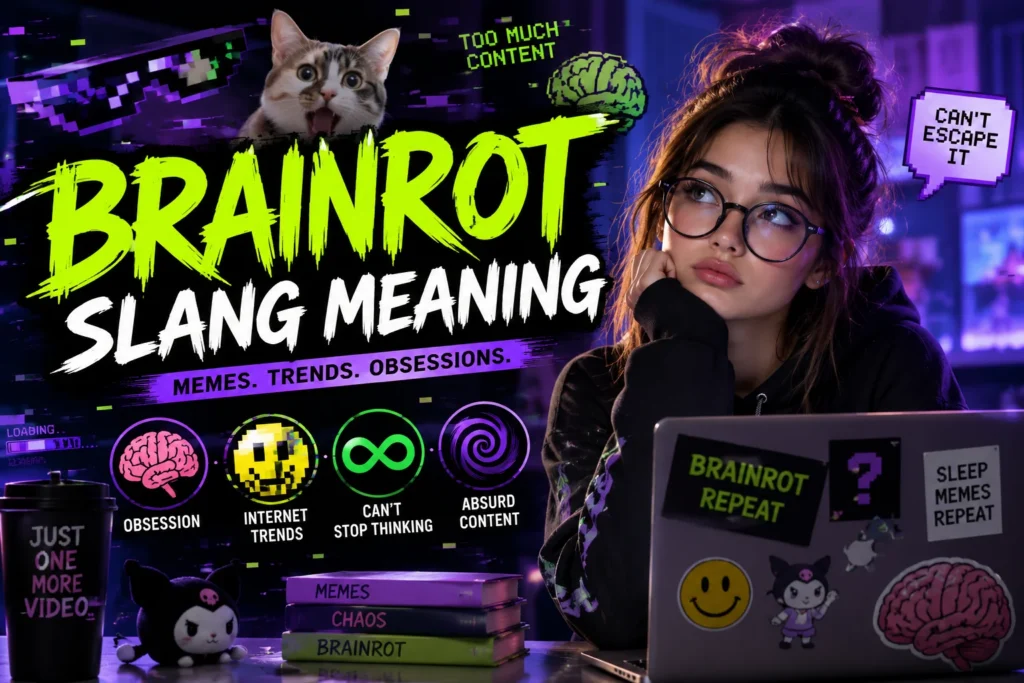
Brainrot in slang describes becoming obsessively fixated on a meme, trend, game, character, song, or topic to the point where it humorously feels like it has “taken over your brain.” It is a slang word—not an acronym—and is usually used jokingly rather than literally.
If you’ve seen comments like “I have brainrot,” “This song gave me brainrot,” or “Brainrot content,” you’re seeing one of the internet’s fastest-growing Gen Z expressions. The term appears across TikTok, Instagram, X, Discord, YouTube, and gaming communities, where it can describe everything from an addictive meme to an inside joke that refuses to leave someone’s mind.
Although the phrase sounds negative, brainrot is usually playful self-deprecating humor, not a medical statement.
What Does Brainrot Mean in Slang?
The most common slang meaning of brainrot is an intense, often humorous obsession with something on the internet.
Someone says they have “brainrot” when they:
- Can’t stop thinking about a meme.
- Keep repeating a viral sound.
- Constantly reference a TV show.
- Watch the same edits over and over.
- Become deeply invested in a game, celebrity, or fictional character.
The word exaggerates the feeling that your brain has been “taken over” by one specific interest.
Example:
“I’ve watched that TikTok edit fifty times. I officially have brainrot.”
Here, the speaker doesn’t literally believe their brain is damaged. They’re joking that the content has become an obsession.
Is Brainrot an Acronym, Abbreviation, or Slang Word?
Brainrot is:
- ❌ Not an acronym
- ❌ Not a texting abbreviation
- ✅ A slang word
- ✅ An internet meme expression
Unlike abbreviations such as “IMO” or “IDK,” brainrot is a compound slang term made from the words brain and rot. Together, they create an exaggerated image of someone’s thoughts being consumed by a single obsession.
The Real Meanings of Brainrot in Slang
1. Being Obsessed With Something Online (Most Common Meaning)
This is the definition most people mean today.
Someone says they have brainrot when they’re unusually attached to:
- a fandom
- a celebrity
- an anime
- a video game
- a TV series
- a meme
- a TikTok trend
- a song
Examples
- “Minecraft brainrot.”
- “Formula 1 brainrot.”
- “Taylor Swift brainrot.”
- “That edit gave me brainrot.”
The phrase usually implies that the obsession is fun rather than unhealthy.
2. Constantly Thinking About One Topic
Brainrot can also describe repeatedly thinking about the same thing throughout the day.
For example:
“I can’t focus because I have Elden Ring brainrot.”
This means the speaker keeps thinking about the game instead of concentrating on other tasks.
3. “Brainrot Content”
People often describe certain videos as brainrot content.
This usually refers to media that is:
- bizarre
- repetitive
- absurd
- chaotic
- strangely entertaining
Examples include:
- surreal memes
- AI-generated videos
- intentionally nonsensical humor
- looping audio
- random internet edits
Despite the name, many viewers watch this content because they find it funny.
4. Ironic Internet Humor
Brainrot has become one of the biggest examples of self-aware internet humor.
Someone might write:
“The internet has completely destroyed my attention span.”
Then immediately follow it with:
“Brainrot.”
The joke exaggerates the effect of constantly consuming memes and short-form videos.
5. Community or Fandom Brainrot
Fans often attach brainrot to a specific interest.
Examples include:
- Pokémon brainrot
- Marvel brainrot
- Anime brainrot
- K-pop brainrot
- Minecraft brainrot
- Formula 1 brainrot
This simply means someone has become deeply immersed in that fandom.
Brainrot on Different Social Media Platforms
The meaning stays similar across platforms, but the way people use it changes.
Brainrot on TikTok
TikTok is where brainrot became mainstream.
You’ll frequently see:
- “TikTok brainrot.”
- “Brainrot compilation.”
- “Brainrot humor.”
- “Brainrot edits.”
Creators often use the term when sharing bizarre or highly addictive videos.
Comments may include:
- “I’ve got brainrot.”
- “This unlocked my brainrot.”
- “Peak brainrot.”
Brainrot on Instagram
Instagram users commonly mention brainrot in:
- meme pages
- Reels
- fandom edits
- fan accounts
- celebrity content
Example:
“This edit gave me brainrot.”
The phrase usually praises content that viewers can’t stop watching.
Brainrot on Snapchat
Brainrot appears in private chats when friends joke about their latest obsession.
Example:
Friend 1: “You’re still quoting that movie?”
Friend 2: “Sorry. Brainrot.”
The tone is almost always playful.
Brainrot on WhatsApp
Brainrot is less common on WhatsApp than on TikTok, but it still appears among younger users discussing:
- memes
- TV shows
- games
- celebrities
For example:
“I’ve got F1 brainrot this weekend.”
Brainrot on X (Formerly Twitter)
X users often describe:
- viral memes
- fandoms
- trending topics
- internet jokes
Comments like:
- “Absolute brainrot.”
- “Certified brainrot.”
- “Internet brainrot.”
are common beneath viral posts.
Why Has Brainrot Become So Popular?
Several internet trends helped brainrot spread so quickly.
Short-Form Video Culture
TikTok, Instagram Reels, and YouTube Shorts encourage repeated viewing of short clips.
When users replay the same audio or meme dozens of times, they jokingly call it brainrot.
Meme Communities
Internet humor increasingly embraces absurdity.
Random jokes, surreal edits, and intentionally confusing videos are often proudly labeled as brainrot.
Fandom Culture
Modern fandoms move incredibly fast.
Fans consume:
- edits
- fan art
- livestreams
- discussions
- theories
When someone spends hours interacting with one fandom, they often joke about having brainrot.
Self-Aware Humor
Unlike older internet slang, brainrot is often used ironically.
People know they’re exaggerating.
That’s part of the joke.
Grammar and Language Role
Part of Speech
Brainrot most commonly functions as a noun.
Examples:
- “I have brainrot.”
- “The brainrot is real.”
It can also act as a descriptive modifier.
Examples:
- “Brainrot humor.”
- “Brainrot memes.”
- “Brainrot content.”
Sentence Position
Brainrot naturally appears:
As the object
- “I caught brainrot.”
As the subject
- “Brainrot has taken over TikTok.”
After linking verbs
- “This is brainrot.”
Before another noun
- “Brainrot videos.”
- “Brainrot edits.”
Can It Replace a Full Sentence?
Sometimes.
Among friends, simply saying:
“Brainrot.”
can communicate:
- “I’m obsessed.”
- “This meme has taken over my mind.”
- “The internet has gone too far.”
The meaning depends on the conversation.
Formal vs Informal Register
| Register | Appropriate? | Notes |
|---|---|---|
| Casual texting | ✅ Yes | Extremely common among Gen Z. |
| Social media | ✅ Yes | One of today’s most recognizable meme terms. |
| Gaming chats | ✅ Yes | Frequently used for fandoms and games. |
| Workplace emails | ❌ No | Too informal. |
| Academic writing | ❌ No | Only appropriate when discussing internet culture. |
Tone and Context Variations
Funny
A: You’ve watched that cat video again?
B: Only twenty times.
A: Serious brainrot.
B: No regrets.
Sarcastic
A: Another five-hour meme compilation?
B: Educational research.
A: Peak brainrot.
B: Absolutely.
Playful
A: You’re still humming that song?
B: It won’t leave my head.
A: You’ve got brainrot.
B: I know, and I’m okay with it.
Serious
A: Why does everyone keep saying brainrot?
B: They’re joking about becoming obsessed with internet content.
A: So it’s not literal?
B: Right. It’s internet slang, not a medical diagnosis.
Real Chat Examples
Example 1 – TikTok Comments
A: I’ve watched this edit ten times.
B: Brainrot unlocked.
A: I can’t stop.
B: Same here.
Example 2 – Friends
A: You’re quoting that anime again.
B: It’s become my personality.
A: Anime brainrot.
B: Guilty.
Example 3 – Gaming Discord
A: Still playing Minecraft?
B: Every single day.
A: Minecraft brainrot.
B: Pretty much.
Example 4 – Instagram Reels
A: I saved every version of that edit.
B: That’s brainrot.
A: They’re all too good.
B: Fair enough.
Example 5 – Group Chat
A: You’ve mentioned Formula 1 in every conversation today.
B: Race weekend does that.
A: F1 brainrot.
B: Absolutely.
Example 6 – YouTube Comments
A: This meme refuses to leave my head.
B: Certified brainrot.
A: I’ve been laughing all day.
B: Same.
Example 7 – College Friends (WhatsApp)
A: You’re still reading theories about that TV show?
B: Every night.
A: You’ve got serious brainrot.
B: The finale raised too many questions.
Example 8 – X (Formerly Twitter)
A: My entire timeline is that meme.
B: Same.
A: Internet brainrot.
B: I can’t escape it.
Example 9 – Siblings
A: Why are you singing that sound again?
B: It randomly plays in my head.
A: TikTok brainrot.
B: Unfortunately.
Example 10 – Gaming Chat
A: Are you buying another skin?
B: It matches my collection.
A: Game brainrot.
B: Worth every coin.
Example 11 – School Friends
A: You drew that character again?
B: They’re my favorite.
A: Character brainrot.
B: I make no apologies.
How to Reply When Someone Says “Brainrot”
The best reply depends on whether the person is joking, teasing, or genuinely describing an obsession.
Funny Reply
“Too late—my brain has already been claimed.”
or
“I’m accepting my brainrot era… temporarily.”
Serious Reply
“Yeah, I’ve been really into it lately.”
or
“I can’t stop thinking about it.”
Flirty Reply
“Maybe you’re the reason I’ve got brainrot.”
(Only appropriate when the conversation is clearly playful and both people are comfortable with that tone.)
Neutral/Unbothered Reply
“Fair enough.”
or
“You’re probably right.”
Comparison Table
| Term | Meaning | Usage Context | Tone | Popularity | Confusion Risk |
|---|---|---|---|---|---|
| Brainrot | Humorous obsession with internet content or a specific interest | Social media, memes, fandoms | Playful / Ironic | Very High | Medium |
| Chronically Online | Spending excessive time on the internet | Meme culture | Humorous | High | Medium |
| Delulu | Delusion used jokingly | TikTok, fandoms | Humorous | Very High | Low |
| Hyperfixation | Intense focus on one interest (used both clinically and casually) | General conversation, online communities | Neutral | High | High |
| Obsessed | Strong interest in someone or something | Everyday conversation | Neutral | Very High | Low |
| Touch Grass (Opposite) | Encouragement to spend less time online | Memes, gaming, social media | Sarcastic | High | Low |
Note: While hyperfixation has a clinical meaning in some contexts (such as discussions about ADHD or autism), many people also use it casually online. Be careful not to assume a medical meaning without context.
Who Uses This Term?
Age Group Breakdown
Teenagers (13–19)
Teenagers are the most frequent users of brainrot. They commonly use it while discussing:
- TikTok trends
- Anime
- Gaming
- K-pop
- Viral memes
- YouTube Shorts
For many teens, the word is simply a humorous way to admit they’re obsessed with something.
Young Adults (20–35)
Young adults use brainrot in fandom communities, gaming groups, Discord servers, and meme pages. They often understand both the original meaning and its ironic use.
Adults Over 35
Older adults are less likely to use the term themselves but may encounter it through younger family members or social media. Without context, the phrase can sound more negative than it is intended to be.
Gen Z vs Millennials
Gen Z
Gen Z has made brainrot one of the defining slang terms of modern internet culture. They use it for:
- memes
- fandoms
- viral sounds
- fictional characters
- internet jokes
Often, the exaggeration is part of the humor.
Millennials
Millennials generally use the term less frequently. When they do, it’s often while discussing internet trends, gaming, or fandom culture rather than everyday conversation.
Regional Usage
United States
Brainrot is widely recognized among Gen Z and younger millennials, particularly on TikTok, YouTube, and gaming platforms.
United Kingdom
The slang appears in similar contexts, especially among users active on meme pages, fandom accounts, and short-form video platforms.
Global
Because TikTok, Instagram, YouTube, and Discord have international audiences, brainrot has spread worldwide. It is most recognizable among English-speaking internet communities but is increasingly understood in multilingual online spaces as well.
Platforms Where It Appears
| Platform | Common Usage |
|---|---|
| TikTok | Viral sounds, edits, memes, fandoms |
| Reels, fan edits, meme pages | |
| Snapchat | Casual conversations between friends |
| Group chats about shared interests | |
| X | Trending memes, fandom discussions, viral posts |
| Discord | Gaming servers, anime communities, fandom chats |
| YouTube | Shorts, comments, reaction videos |
Origin and Internet Culture
The phrase brainrot existed in English long before it became internet slang, where it could literally describe something that supposedly “rots the brain” through excessive consumption. Online communities later adopted the term as an exaggerated joke to describe content that becomes impossible to stop thinking about.
Its modern slang usage gained momentum on platforms like TikTok, X, Tumblr, and Discord, where fandom communities and meme creators jokingly described themselves as having “brainrot” over favorite characters, games, or trends.
By the early 2020s, the term expanded beyond fandom spaces. Users began calling bizarre memes, looping audio, surreal humor, and intentionally chaotic videos brainrot content. Rather than criticizing the content, many people embraced the label as part of internet humor.
Unlike some online slang, brainrot does not originate from AAVE (African American Vernacular English). It developed through internet forums, fandom communities, meme culture, and social media before becoming mainstream.
Today, the phrase has become a cultural shorthand for playful online obsession rather than genuine mental decline.
Is Brainrot Offensive?
Generally, no.
Brainrot is not profanity, a slur, or explicit language. It is usually a humorous exaggeration rather than an insult.
However, context matters.
Does It Contain Explicit Language?
No.
The phrase itself contains no profanity and is appropriate for general audiences.
School and Workplace Appropriateness
Among friends, classmates, and online communities, brainrot is widely understood as harmless slang.
In professional communication, however, the term may sound too informal or confusing to people unfamiliar with internet culture. It is best avoided in formal emails, business presentations, or academic writing unless discussing online language itself.
Cultural Sensitivity
Because the term includes the word “brain,” avoid using it to joke about real neurological conditions or mental health issues. In modern internet slang, brainrot refers to fictional or humorous obsessions—not actual medical conditions.
Real-World Observation
One reason brainrot has become so durable is that it captures a uniquely modern internet experience. Algorithms constantly recommend similar videos, memes, songs, and fan edits, making it easy for users to feel as though one topic has completely taken over their feeds—and their thoughts. Instead of treating that experience seriously, internet users embraced the exaggeration, turning brainrot into a playful badge of fandom, humor, and shared online culture.
Frequently Asked Questions
What does brainrot mean in slang?
Brainrot is internet slang for becoming humorously obsessed with a particular meme, fandom, game, song, character, or trend. People use it to exaggerate how often something occupies their thoughts. It is almost always intended as a joke rather than a literal statement.
Is brainrot a real medical condition?
No. Although the phrase sounds dramatic, the slang meaning is not a medical diagnosis. It is simply a humorous way of saying that someone can’t stop thinking about or consuming a particular type of online content.
Why do people say “I have brainrot”?
People say this when they feel consumed by a specific interest. For example, they may repeatedly watch the same videos, quote the same jokes, or spend hours engaging with one fandom. The expression is intentionally exaggerated for comedic effect.
What is brainrot content?
Brainrot content refers to videos, memes, or internet jokes that are absurd, repetitive, chaotic, or strangely addictive. These posts often spread rapidly because viewers keep sharing and rewatching them. The label is usually affectionate rather than critical.
Is brainrot always negative?
No. Most of the time, people use brainrot positively or humorously to express enthusiasm for something they enjoy. While the wording sounds negative, the intended meaning is usually playful.
Is brainrot popular on TikTok?
Yes. TikTok played a major role in popularizing the term through viral edits, fandom videos, trending audio, and meme compilations. Many users jokingly describe addictive videos as “brainrot.”
Can brainrot refer to books or hobbies?
Yes. Although it often describes internet trends, people also say they have brainrot over novels, sports, musicians, TV series, hobbies, or fictional characters. The key idea is a humorous obsession rather than the specific subject.
Is brainrot still trending?
Yes. Brainrot remains one of the most recognizable Gen Z internet slang terms. While the memes evolve, the phrase continues to appear in comments, captions, and fandom discussions across major social media platforms.
What does “brainrot” mean on TikTok?
On TikTok, brainrot usually means becoming obsessed with a viral sound, meme, creator, trend, or fandom. Users often describe themselves as having brainrot when they repeatedly watch or reference the same content. The term is generally humorous and self-aware.
Why do people call videos “brainrot”?
Videos are called brainrot when they are bizarre, repetitive, or so entertaining that viewers can’t stop watching or thinking about them. The phrase exaggerates their addictive quality without suggesting any real harm.
Conclusion
The brainrot slang meaning has evolved into one of the internet’s most recognizable expressions for humorous obsession. Whether someone can’t stop quoting a meme, replaying a viral sound, or thinking about their favorite game or TV series, saying they have brainrot is a playful way of admitting that one interest has taken over their thoughts.
Like many modern slang terms, context matters. In most conversations, brainrot is a lighthearted joke shared among friends or online communities—not a literal statement about mental health. Understanding that distinction helps you interpret and use the term naturally.
Usage Tips
- Use brainrot in casual conversations about memes, fandoms, games, or trends.
- Remember that the term is usually humorous and self-deprecating.
- Consider your audience—older users may not recognize the slang.
- Use context to clarify what type of “brainrot” you’re referring to (for example, anime, gaming, or music).
Common Mistakes
- Assuming brainrot refers to a real medical condition.
- Using the term in formal or professional communication.
- Thinking it always has a negative meaning.
- Applying it to serious mental health discussions.
When to Use / When to Avoid
Use it when:
- Talking with friends about internet trends.
- Discussing fandoms, memes, games, or viral videos.
- Posting on social media with a playful tone.
- Making lighthearted jokes about your latest obsession.
Avoid it when:
- Writing formal emails or academic papers.
- Discussing genuine neurological or mental health conditions.
- Speaking with audiences unfamiliar with internet slang.
- Using it in contexts where the joke could be misunderstood.