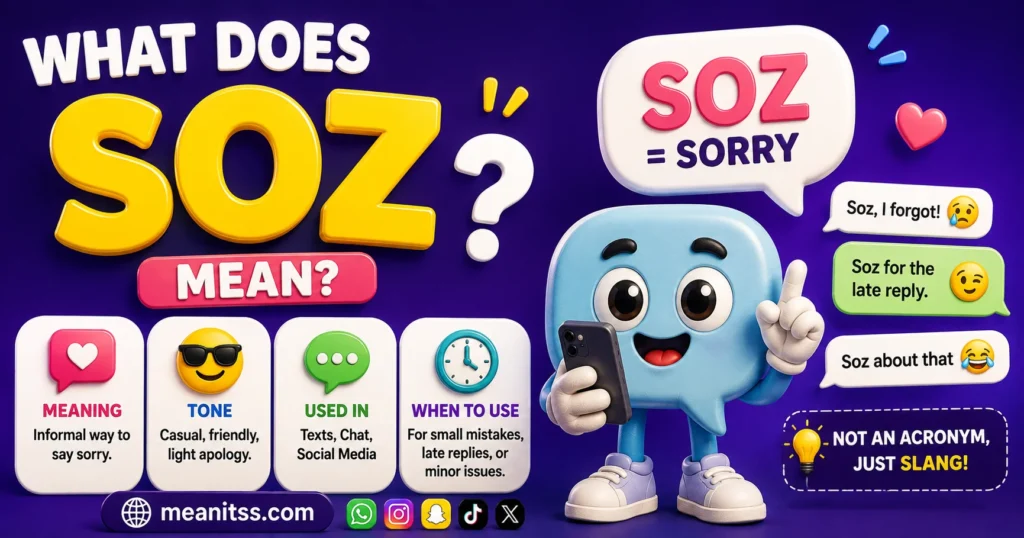
“Soz” means “sorry.” It is an informal British and Australian slang shortening of sorry, commonly used in texts, social media, chats, and other casual communication, especially when the apology is minor or lighthearted.
If someone sends you “soz”, they are generally saying “sorry,” “my bad,” or “I apologize” in a casual way. The exact tone can range from genuinely apologetic to playful, sarcastic, or deliberately unserious depending on the situation.
What Does “Soz” Mean?
Soz = sorry.
It is best described as an informal slang shortening, rather than an acronym. Unlike terms such as “LOL,” the letters in soz do not stand for separate words. It is a shortened, stylized form of sorry. Cambridge classifies it as a UK informal exclamation, particularly used in writing for something that is not very serious or important.
For example:
“Soz, I forgot to text you back.”
Simply means:
“Sorry, I forgot to text you back.”
Another example:
“Soz, I ate the last slice.”
Here, the apology may be partly humorous because the person knows the situation is not particularly serious.
The most common uses of “soz”
You will usually see it when someone is:
- Apologizing for a small mistake
- Explaining a late reply
- Saying they cannot attend something
- Acknowledging a minor inconvenience
- Interrupting someone
- Accidentally doing something
- Using a deliberately casual or humorous apology
Collins lists soz as British and Australian informal English for sorry.
Is “Soz” an Acronym or Abbreviation?
Soz is not an acronym. It is a shortened slang form of the word sorry.
Calling it an “abbreviation” is reasonable in everyday language, and dictionaries describe it as a short or informal form of sorry. The important distinction is that it is not something where each letter represents a different word.
So:
SOZ → sorry
Not:
S = something, O = something, Z = something
The spelling is simply a playful shortening of the original word.
Is “Soz” Always a Genuine Apology?
No. This is one of the most important things to understand about the term.
“Soz” can be sincere, but the spelling itself does not guarantee sincerity.
Compare:
“I’m really sorry. I should have told you earlier.”
with:
“Soz, completely forgot 😂”
The first sounds more serious and deliberate. The second sounds casual and probably relates to a relatively minor mistake.
Cambridge specifically notes that soz is normally used for something not very serious or important, which helps explain why it can sound too casual in a serious situation.
Context matters more than the three letters.
A Common Misunderstanding About “Soz”
A common mistake is assuming that “soz” automatically means the person does not care.
That is too strong.
Sometimes “soz” is simply someone’s normal informal way of saying sorry. Oxford describes it as an informal British expression meaning sorry, particularly in speech, text messages, and social media.
However, if someone uses “soz” after doing something genuinely hurtful, it can feel dismissive because the wording is deliberately casual.
For example:
“Soz I forgot your birthday.”
might be acceptable between close friends who joke around.
But after a serious argument:
“soz lol”
could easily sound sarcastic or insincere.
The relationship, mistake, punctuation, emojis, and surrounding messages all influence how the apology is interpreted.
Where Is “Soz” Used?
There is strong dictionary evidence for soz in text messages, social media, and informal online communication. Oxford explicitly mentions text messages and social media.
Historical reporting also shows the term being used in online communities and platforms such as Facebook, MySpace, and Twitter during the development of internet slang. ABC reported in 2009 that soz was a common online way of saying sorry.
TikTok
“Soz” can occur in casual comments or captions, but there is not strong evidence that it is specifically a TikTok-created slang term. It predates TikTok by decades.
It can be used in casual Instagram messages, comments, and social interactions, but again, it is not an Instagram-specific expression.
Snapchat
It may appear in informal Snapchat conversations, particularly when someone is apologizing for a small mistake or late response. However, soz did not originate on Snapchat.
Its short form makes it suitable for WhatsApp-style messaging, but it is better understood as general informal internet/text slang rather than a WhatsApp-exclusive term.
X
Historical evidence specifically connects soz with older online communication and Twitter-era internet language. ABC’s 2009 reporting mentioned Twitter alongside Facebook and MySpace when discussing online terms entering dictionaries.
Bottom line: soz is a general informal expression found in texting and online communication, not slang belonging exclusively to one platform.
Grammar: How Do You Use “Soz”?
“Soz” functions mainly as an interjection or exclamation.
It can appear at the beginning of a sentence:
“Soz, I forgot.”
It can also stand alone:
“Soz!”
Or appear before an explanation:
“Soz for the delay.”
It can also be placed at the end:
“I missed your call, soz.”
Oxford classifies soz as an exclamation.
Can “soz” be a complete reply?
Yes.
Someone might say:
Person A: “You deleted my photo!”
Person B: “Soz 😭”
That is grammatically informal but perfectly understandable in texting.
Where Did “Soz” Come From?
The history is more interesting than simply saying that it was “invented by Gen Z.”
It predates Gen Z and TikTok.
Wiktionary records soz as a shortening of sorry and cites evidence dating back to 1987. Its etymology describes the form as sorry + -z, part of a British colloquial pattern.
A cited 1987 source by John Silverlight documented soz alongside shortened forms of names such as Kaz, Shaz, Baz, and Waz.
There is also a broader British pattern involving -z endings in informal forms. For example, Wiktionary documents forms such as tomoz from tomorrow and appaz from apparently.
So the safest historical explanation is:
“Soz” developed as a British informal shortening of “sorry,” with documented use dating back to at least 1987. It later became associated with texting and internet communication.
It was not created by TikTok, Snapchat, or modern Gen Z culture.
Four Tone Examples
1. Funny
Alex: “You ate my fries.”
Sam: “Soz 😂”
Alex: “There were literally five left.”
Sam: “Were five left.”
The apology is clearly playful.
2. Sarcastic
Mia: “You spoiled the ending!”
Leo: “Soz.”
Mia: “That sounded incredibly sincere.”
Leo: “I’m working on it.”
Here, soz is intentionally dry.
3. Playful
Ella: “You still haven’t sent me that photo.”
Noah: “Soz 😭 I got distracted.”
Ella: “By what?”
Noah: “A very important video of a dog falling off a sofa.”
4. Serious
Ben: “You said you’d call yesterday.”
Chris: “Soz. You’re right.”
Ben: “I was actually worried.”
Chris: “I’m sorry. I should’ve let you know.”
Notice that the speaker switches from soz to a fuller apology once the situation becomes serious.
Realistic “Soz” Conversations
1. Late reply between friends
Nina: “You disappeared yesterday 😂”
Jess: “Soz, fell asleep at like 8.”
Nina: “Grandma behavior.”
Jess: “Apparently.”
2. Family chat
Mum: “Did you remember to pick up the groceries?”
Tom: “Soz 😭”
Mum: “Tom.”
Tom: “I forgot. Going now.”
3. Group chat
Ryan: “Who changed the group name?”
Maya: “Soz 😂”
Ryan: “Why is it ‘professional potato society’?”
Maya: “It felt appropriate.”
4. Dating
Liam: “You said you’d call me tonight.”
Sophie: “Soz, I got caught up with work.”
Liam: “It’s okay.”
Sophie: “I’ll call after dinner.”
5. Coworker chat
Sam: “Did you send the document?”
Alex: “Soz, attaching it now.”
Sam: “No worries.”
Alex: “Should be there in a minute.”
6. Instagram-style exchange
Friend: “You tagged me in the worst photo 😂”
You: “Soz 😭”
Friend: “Delete it.”
You: “Fine, fine.”
7. Gaming chat
Player 1: “You stole my loot.”
Player 2: “Soz 😂”
Player 1: “Give it back.”
Player 2: “Okay okay.”
8. Canceling plans
Hannah: “Still coming tonight?”
Grace: “Soz, can’t make it.”
Hannah: “Everything okay?”
Grace: “Yeah, just something came up at home.”
9. Accidentally sending the wrong message
Dan: “Was that message meant for me?”
Chris: “SOZ 😭 wrong chat.”
Dan: “What did I just read?”
Chris: “Please forget everything.”
10. Minor interruption
Ava: “I was telling you about the concert…”
Mia: “Soz, continue.”
Ava: “Anyway, as I was saying…”
Mia: “I’m listening.”
11. Playful disagreement
Jake: “You picked the worst movie.”
Ella: “Soz, my taste is elite.”
Jake: “That’s not what elite means.”
Ella: “Agree to disagree.”
12. Online comment
User 1: “You missed my question.”
User 2: “Soz! Didn’t see it.”
User 1: “All good.”
User 2: “I’ll answer it now.”
How to Reply to “Soz”
Your response should depend on what the person is apologizing for.
Funny reply
“Apology accepted, criminal.”
Good for a friend after a tiny mistake.
Serious reply
“Thanks for apologizing. I appreciate that.”
Better when the situation actually matters.
Flirty reply
“You’re forgiven… this time 😉”
This works only when the conversation already has a playful or romantic tone.
Neutral reply
“No worries.”
This is probably the safest response to a minor apology.
If you think they are being dismissive
You can say:
“I know you said soz, but I’m actually a little upset about it.”
That addresses the issue without assuming bad intentions.
Soz vs Similar Expressions
| Term | Meaning | Tone | Popularity | Confusion Risk |
|---|---|---|---|---|
| soz | Sorry | Very informal | Common in UK/Australian informal usage | Low |
| sorry | Apology/regret | Neutral to serious | Very high | Very low |
| my bad | My mistake | Casual | High | Low |
| sry | Sorry | Informal texting | Common online | Low |
| apologies | Expression of regret | More formal | Common | Low |
| sorry, not sorry | Deliberate refusal to genuinely apologize | Sarcastic/playful | Recognizable online | Medium |
| unapologetic | Not sorry | Opposite meaning | Common English | Low |
The closest direct equivalent is simply “sorry.”
Who Uses “Soz”?
The strongest evidence points toward British and Australian English, with online usage extending beyond those regions. Collins explicitly labels the word British and Australian informal, while Cambridge labels it UK informal.
It should not be described as exclusively a Gen Z expression.
The word was documented decades before Gen Z came of age, and historical internet examples show that it was already established in online communication long before TikTok.
Some younger users may encounter it through social media, while older British or Australian users may already recognize it from earlier informal speech or internet culture.
There is not enough reliable evidence to make a factual claim that one gender or specific age group uses it more than another.
Is “Soz” Rude or Safe?
“Soz” is not profanity and is not inherently offensive.
It is generally safe in casual conversation, texts, social media, and conversations with friends.
The main issue is formality and seriousness.
Usually fine for:
- Friends
- Casual texting
- Group chats
- Informal social media
- Minor mistakes
- Lighthearted apologies
Better avoided in:
- Formal business correspondence
- Serious complaints
- Academic writing
- Legal communication
- Major personal apologies
- Situations where you need to demonstrate genuine remorse
For example, if you accidentally miss an important work deadline, “Soz” may sound flippant. A professional message should use something like:
“I’m sorry for the delay. I should have communicated this earlier.”
Why Does “Soz” Work So Well in Conversation?
The appeal of soz comes from its ability to reduce the weight of an apology. It tells the other person, “I recognize the mistake, but this is casual and we’re not treating it like a formal apology.” That makes it useful for everyday social friction: a missed text, a forgotten favor, a minor inconvenience, or a joke that went slightly too far.
Its short spelling also fits naturally into fast digital communication. But because it sounds lighter than sorry, the same feature that makes it friendly can make it inappropriate when the situation requires emotional seriousness.
What About “Soz Not Soz”?
You may also encounter:
“soz not soz”
This plays on the familiar phrase “sorry, not sorry.”
It usually means:
“I’m saying sorry, but I don’t actually regret what I did.”
For example:
“Ate the last cookie. Soz not soz.”
The person is jokingly apologizing while making it clear they would do it again.
This is different from a straightforward “soz”, which can be a genuine apology.
Frequently Asked Questions
What does “soz” mean in texting?
“Soz” means “sorry.” It is an informal shortened form commonly associated with British and Australian English. It is particularly suitable for casual texts and online conversations.
Is “soz” British slang?
Yes. Dictionaries identify soz as British informal slang, and Collins also identifies it as Australian informal usage. It has subsequently appeared in broader internet communication.
Is “soz” rude?
Not automatically. It is simply informal. However, using it for a serious mistake can make the apology sound dismissive or insufficient.
Does “soz” mean “sorry, not sorry”?
No. “Soz” by itself normally means “sorry.” “Soz not soz” is a separate playful expression that indicates the speaker is not genuinely apologetic.
Can I use “soz” with friends?
Yes. It is especially natural in casual conversations with people who understand informal slang. For a minor mistake, “soz” can sound relaxed and friendly.
Is “soz” still used?
Yes, although its popularity varies by community and region. It is a well-established informal expression rather than a newly invented TikTok term. Dictionaries continue to list it, and historical records show use going back at least to 1987.
Does “soz” mean anything besides “sorry”?
For the slang usage relevant to texting and social media, “sorry” is the established meaning. There are unrelated uses of the letter sequence in other contexts, but they are not the meaning people normally intend when they write soz in a casual message.
Is “soz” okay for school or work?
It depends on the situation. It is generally inappropriate for formal writing, assignments, official emails, or serious workplace communication. Use “sorry” or a more complete apology when professionalism matters.
Final Takeaway
“Soz” simply means “sorry.” It is an informal British and Australian shortening that has also spread through internet and texting culture. Reliable sources trace its documented use back to at least 1987, so it is much older than today’s TikTok slang.
The most important thing to remember is tone. “Soz” works well for small mistakes, missed messages, casual apologies, and playful conversations. It can sound dismissive, however, when someone uses it for something genuinely serious.
If you receive “soz” from a friend after a minor mistake, “no worries” is usually enough. If the issue is serious, look beyond the abbreviation and judge the person’s full message and behavior, rather than assuming that the shortened spelling automatically tells you how sincere they are.