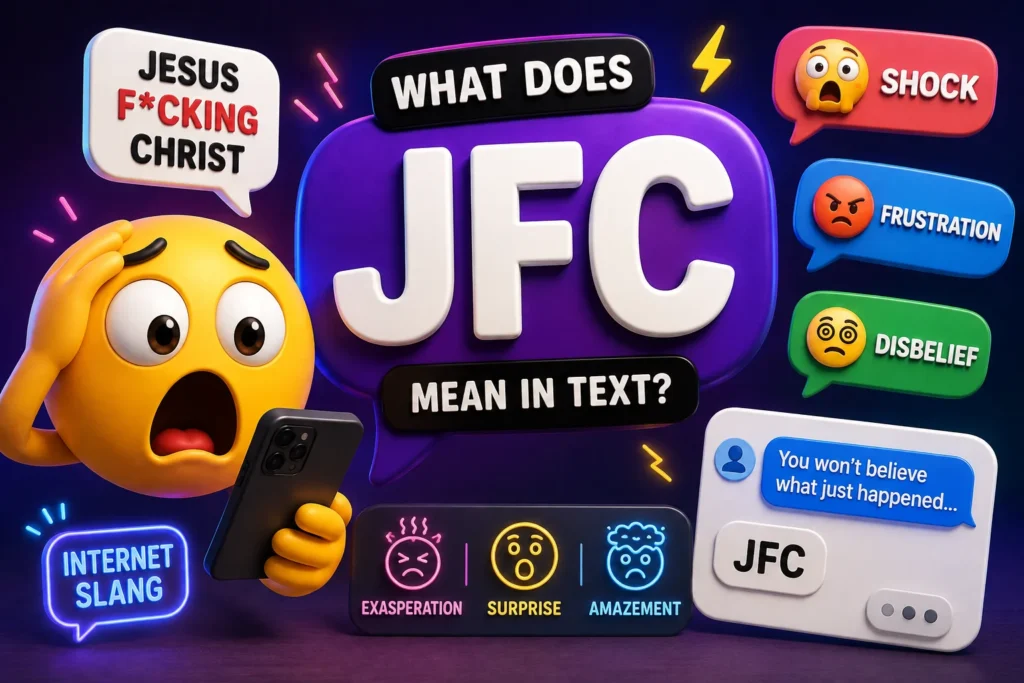
If someone texts “JFC,” they usually mean “Jesus fucking Christ.” It is a vulgar internet initialism used to express strong frustration, shock, disbelief, annoyance, or amazement.
What Does JFC Mean in Text?
JFC is an abbreviation/initialism for “Jesus fucking Christ.” It functions as an emotional exclamation rather than a literal reference to Jesus.
Someone might type:
“JFC, that was expensive.”
Here, the person is not necessarily making a religious statement. They are using JFC to intensify their reaction to the price.
Likewise:
“JFC, you scared me.”
means something closer to “Wow, you really scared me” or “That was extremely startling.”
The exact emotion depends on the surrounding message. JFC can communicate:
- Frustration
- Shock
- Disbelief
- Annoyance
- Exasperation
- Surprise
- Amazement
- Occasionally amused disbelief
Dictionary.com describes JFC as a vulgar slang initialism generally used as an exclamation for exasperation or emotional emphasis in informal digital communication. It also notes that the exact origin of the initialism itself is unclear, although it has appeared in online forums since at least the early 1990s.
Is JFC an acronym or slang?
Technically, JFC is an initialism because its letters are normally pronounced individually: “J-F-C.”
It is also commonly classified as internet slang because of how frequently it functions in informal online communication.
The underlying phrase is profanity, so the abbreviation should not be treated as completely neutral simply because the swear word is hidden behind three letters.
The Main Meanings of JFC
1. Jesus Fucking Christ
This is overwhelmingly the main meaning of JFC in informal texting and online slang.
It is an intensified form of “Jesus Christ!”, which itself can function as an exclamation of surprise, frustration, or disbelief.
For example:
“JFC, why is this computer so slow?”
The speaker is expressing strong irritation.
Another example:
“JFC, you actually won the lottery?”
Here, the reaction is primarily shock or amazement rather than anger.
The important point is that JFC does not automatically mean someone is angry. Context determines the emotion.
2. Rare alternative meanings
JFC can theoretically represent other phrases in specialized contexts. For example, Java Foundation Classes is a technical term associated with Java software development. Some slang-reference sites also record obscure alternative expansions such as “Just For Comedy.”
However, these are not the normal meaning when someone sends JFC in casual texting.
If a friend sends:
“JFC 😂”
you should overwhelmingly interpret it as the slang exclamation rather than a programming term.
Context is what separates the meanings.
A Common Misunderstanding: Does JFC Always Mean Anger?
No.
This is one of the easiest mistakes to make when interpreting JFC.
Because the phrase contains profanity, it can sound aggressive when written out. But JFC can express several different strong emotions.
Compare:
Frustration:
“JFC, this printer is broken again.”
Shock:
“JFC, you paid $900 for that?”
Amazement:
“JFC, that cake is huge.”
Disbelief:
“JFC, he really said that?”
The same three letters can cover very different emotional reactions.
The safest interpretation is usually “That is an extremely strong reaction to what you just said or what just happened.”
How JFC Is Used in Texting
JFC often appears at the beginning of a sentence:
“JFC, what happened here?”
It can also appear by itself:
“JFC.”
When used alone, it acts almost like a complete reaction. The reader has to infer the emotion from the previous message.
For example:
Person A: “I accidentally deleted the entire project.”
Person B: “JFC.”
That one-word response communicates shock, frustration, or disbelief without explicitly explaining the emotion.
It can also appear at the end:
“You actually did that, JFC.”
And sometimes it is paired with other internet expressions:
“JFC 😭”
“JFC lol”
“JFC, seriously?”
The added words or emojis help reveal whether the speaker is angry, amused, shocked, or simply overwhelmed.
Which Apps Is JFC Used On?
JFC is better understood as general internet and texting slang rather than slang belonging exclusively to one social platform.
It is documented in online forums and digital communication, and examples of real-world online use can be found on Reddit and other social platforms. Dictionary.com notes that the initialism has been used in online forums since at least the early 1990s.
Because JFC is simply typed with three letters, there is no special technical feature tying it to one particular app.
TikTok
JFC can appear in informal TikTok-related text, comments, captions, or discussions, but it is not a TikTok-exclusive expression. Search evidence also shows the phrase appearing in text associated with TikTok content.
JFC can be encountered in informal comments, captions, and direct messages, although it is not an Instagram-specific abbreviation.
Snapchat
The abbreviation can function naturally in Snapchat conversations because it is simply an informal text reaction. However, there is no strong evidence that JFC originated on Snapchat or is uniquely associated with the platform.
JFC can be used in ordinary WhatsApp-style conversations, especially among people who already use English internet slang. It should be understood from the surrounding conversation rather than assumed to have a special WhatsApp meaning.
X
JFC also appears in public online discussions, although “JFC” can represent unrelated organizations or names in other contexts. Therefore, the surrounding text matters when interpreting an isolated occurrence.
Bottom line: JFC is best classified as general informal internet/texting slang, not a slang term belonging specifically to TikTok, Snapchat, Instagram, WhatsApp, or X.
Grammar: How Does JFC Work in a Sentence?
JFC is an interjection-like initialism.
It does not normally function as a conventional noun or verb. Instead, it interrupts or introduces a sentence to communicate an emotional reaction.
At the beginning
“JFC, that’s expensive.”
This is probably the most recognizable construction.
As a standalone reaction
“JFC.”
Here it works like an independent exclamation.
In the middle
“That was, JFC, the longest meeting ever.”
This is possible but less natural than placing it at the beginning.
At the end
“You really forgot the tickets, JFC.”
The ending position makes it feel like an emotional afterthought.
Can JFC be a complete reply?
Yes.
If someone sends:
“I just found out the exam is tomorrow.”
A response of:
“JFC.”
can be a complete reply.
The reader understands that the sender is reacting strongly to the news.
Where Did JFC Come From?
The exact origin of the initialism JFC is unclear. There is no reliable evidence establishing a single person, website, or exact date when someone first coined the three-letter form.
Dictionary.com reports that JFC has appeared in online forums since at least the early 1990s, while the phrase “Jesus fucking Christ” itself is considerably older. The underlying profanity has been recorded as an exclamation of frustration, disgust, or anger since at least the 1920s.
The expression developed from the older exclamation “Jesus Christ!”, which has a much longer history as an oath or exclamation. Dictionary.com traces forms of the blasphemous oath involving Jesus Christ back centuries.
So it is more accurate to say:
The phrase is older; the exact history of abbreviating it as JFC is unclear, but the initialism was established in online communication by the early internet era.
There is no solid evidence that JFC originated specifically with Gen Z, TikTok, or modern social media.
4 Tone-Based Conversations
1. Funny
Mia: “I tried cooking and somehow burned water.”
Alex: “JFC 😂 How?”
Mia: “I genuinely don’t know.”
Alex: “Please stay away from the kitchen.”
Here JFC expresses amused disbelief rather than serious anger.
2. Sarcastic
Sam: “I forgot to save the document again.”
Jordan: “JFC, what a shocking development.”
Sam: “I know, completely unexpected.”
Jordan: “Truly a historic moment.”
The sarcasm makes JFC part of a joking complaint.
3. Playful
Ella: “Guess who bought another pair of sneakers?”
Noah: “JFC 😭 You already have twenty.”
Ella: “Twenty-two.”
Noah: “That somehow made it worse.”
Here it is playful exaggeration.
4. Serious
Nina: “The doctor called. They want another test.”
Chris: “JFC. I’m sorry.”
Nina: “I’m trying not to panic.”
Chris: “I’m here if you need anything.”
In this context, JFC communicates emotional shock and concern rather than casual humor.
Realistic Texting Examples
1. Friends
A: “The restaurant charged me for three extra meals.”
B: “JFC, did you check the receipt?”
A: “Yeah. They actually made a mistake.”
B: “I’d definitely call them.”
2. Family
Daughter: “Mom, I accidentally locked my keys in the car.”
Mom: “JFC 😭 Are you okay?”
Daughter: “Yeah, I’m fine.”
Mom: “Call roadside assistance.”
3. Coworkers
Alex: “The client moved the deadline to tomorrow.”
Taylor: “JFC. Seriously?”
Alex: “Yep. Just got the email.”
Taylor: “Okay, let’s divide the work.”
4. Dating
Maya: “He texted me after six months.”
Sara: “JFC, what does he want?”
Maya: “Apparently he ‘misses talking.’”
Sara: “Of course he does.”
5. Group chat
Leo: “Guys, I just saw the final bill.”
Chris: “JFC.”
Nora: “How bad?”
Leo: “Very bad.”
6. Gaming
Player 1: “The boss just one-shot me.”
Player 2: “JFC 😭”
Player 1: “I wasn’t even ready.”
Player 2: “Same thing happened to me.”
7. School
A: “The teacher added another chapter.”
B: “JFC, when are we supposed to read all this?”
A: “Tonight apparently.”
B: “I’m finished.”
8. WhatsApp
Friend 1: “My flight got canceled.”
Friend 2: “JFC. Are you stuck there?”
Friend 1: “Until tomorrow morning.”
Friend 2: “That’s rough.”
9. Social media
A: “Did you see that post?”
B: “JFC, yes.”
A: “I can’t believe they posted that publicly.”
B: “Neither can I.”
10. Surprise
A: “I got the job!”
B: “JFC! You actually got it?”
A: “YES!”
B: “That’s amazing!”
Here JFC communicates excitement and disbelief rather than anger.
11. Everyday annoyance
A: “The internet went down again.”
B: “JFC, again?”
A: “Third time today.”
B: “That’s ridiculous.”
12. Amused disbelief
A: “He brought a suitcase to a one-hour meeting.”
B: “JFC 😂”
A: “I’m not even joking.”
B: “Why does he need luggage?”
How Should You Reply to JFC?
Your response should match the emotion behind it.
Funny reply
“That bad, huh? 😂”
Serious reply
“Yeah, I know. It’s a lot to deal with.”
Flirty reply
A flirty reply can work when the conversation is already playful:
“JFC? I’ll take that as a compliment. 😏”
But don’t assume JFC is flirting by itself. JFC does not inherently have a romantic meaning.
Neutral reply
“What happened?”
This is probably the safest response when you cannot tell whether the sender is angry, shocked, or amused.
JFC vs Similar Expressions
| Term | Meaning | Tone | Popularity | Confusion Risk |
|---|---|---|---|---|
| JFC | Jesus fucking Christ | Strong, vulgar | High in informal online speech | Low |
| OMG | Oh my God | Surprise, shock, excitement | Very high | Low |
| WTF | What the fuck | Confusion, shock, frustration | Very high | Low |
| FFS | For fuck’s sake | Frustration/exasperation | Common online | Medium |
| Jeez | Mild form of “Jesus” | Surprise or annoyance | Common | Low |
| Wow | Surprise or admiration | Neutral to positive | Extremely high | Very low |
| Calm | Opposite-style response to emotional escalation | Neutral | Common | Medium |
The closest comparisons are probably OMG, WTF, and FFS, but they are not interchangeable.
OMG is generally less aggressive and can express excitement.
WTF often focuses on confusion or disbelief.
FFS is more directly associated with frustration.
JFC can cover all of these emotional territories depending on context.
Who Uses JFC?
There is no reliable evidence supporting a strict age, gender, or regional rule for who uses JFC.
It is best understood as informal English internet slang used across different online communities.
Because the abbreviation dates back to early internet communication, it is not accurate to describe it as exclusively Gen Z slang. Dictionary.com notes online-forum usage going back to at least the early 1990s.
You may therefore encounter JFC among older internet users as well as younger people.
Gen Z vs. Millennials
There is no reliable basis for claiming that one generation “owns” JFC.
Younger users may encounter it through social media and messaging, while Millennials and older internet users may have encountered it through forums, chat rooms, gaming communities, blogs, or earlier online communication.
The abbreviation’s history actually makes it a poor example of slang that began exclusively with today’s TikTok culture.
Regional differences
JFC is primarily based on English-language slang and does not have a well-established US-versus-UK meaning difference.
Its exact frequency may vary between communities, but there is no strong evidence that it changes meaning substantially by English-speaking region.
Is JFC Rude or Safe?
JFC contains profanity and can be religiously offensive to some people.
That matters even though the full phrase is abbreviated.
For many users, JFC is simply a strong exclamation. For some religious people, however, using the name of Jesus in a profane expression can be considered disrespectful or blasphemous.
Is it okay with friends?
Usually, if your friends are comfortable with profanity.
Is it appropriate at school?
Generally, it is better to avoid it in formal school communication.
Is it appropriate at work?
Avoid it in professional emails, official messages, customer communication, and formal workplace conversations.
Is it profanity?
Yes. The abbreviation is a shortened form of a phrase containing profanity.
Is it an insult?
Not necessarily.
JFC is often directed at a situation, not a person.
For example:
“JFC, this traffic is awful.”
is different from:
“JFC, you’re an idiot.”
The first expresses frustration. The second combines the exclamation with a direct insult.
Why Does JFC Work So Well in Conversation?
JFC survives because three letters can carry a surprisingly large amount of emotional information. Instead of typing “I am extremely shocked, frustrated, and unable to believe what just happened,” a person can write “JFC” and let the surrounding context do the rest. It is especially useful in fast-moving conversations because it works almost like a written facial expression: short, recognizable, and emotionally intense. Its continued use also makes sense historically because abbreviated internet expressions have long provided a quick way to reproduce the rhythm of spoken reactions in text.
Common Mistakes When Reading JFC
Mistake 1: Assuming the person is furious
JFC can signal surprise, amusement, amazement, or disbelief.
Mistake 2: Treating it as automatically directed at you
Sometimes it is directed at the situation rather than the person receiving the message.
Mistake 3: Assuming it is Gen Z-only slang
The initialism has roots in older internet communication and is not exclusive to modern social media.
Mistake 4: Ignoring the profanity
JFC may look harmless because it is only three letters, but the underlying phrase is vulgar.
Mistake 5: Assuming it has a romantic meaning
JFC itself is not a dating or flirting abbreviation.
Frequently Asked Questions
What does JFC stand for in texting?
JFC usually stands for “Jesus fucking Christ.” It is an informal, vulgar exclamation used to express strong emotion. Depending on context, that emotion can be frustration, shock, disbelief, annoyance, or amazement.
Is JFC a bad word?
JFC contains profanity in its full form, so it is not considered completely clean language. It can also be religiously offensive to some people because it uses Jesus Christ in a profane expression. In casual conversations among people comfortable with swearing, however, it may be used casually.
Does JFC mean angry?
Not necessarily. JFC can communicate anger or frustration, but it can also express surprise, disbelief, excitement, or amused shock. You need to read the surrounding message to determine the intended emotion.
What does JFC mean on social media?
On social media, JFC normally has the same meaning: “Jesus fucking Christ.” It is commonly used as a short emotional reaction to something surprising, frustrating, ridiculous, or shocking. It is not a special technical feature or platform-specific abbreviation.
Is JFC offensive?
It can be. The expression contains profanity and uses a religious name in a profane phrase, so some people may find it offensive. Whether it causes offense depends partly on the audience and their attitudes toward profanity and religious language.
Can JFC be used as a reply by itself?
Yes. Someone can simply respond “JFC” to a surprising or frustrating message. When used alone, it works as an emotional reaction, and the previous message usually supplies the context.
Is JFC the same as WTF?
No, although both are strong internet expressions. WTF literally asks or reacts to something being confusing, strange, or unbelievable, while JFC is more directly an exclamation of shock, frustration, or disbelief. They can sometimes appear in similar situations but carry slightly different wording and tone.
Is JFC appropriate for work?
Usually not in formal workplace communication. Even when coworkers casually use profanity with one another, JFC may be inappropriate in emails, official documents, customer messages, or communication with someone whose preferences are unknown. A cleaner alternative such as “wow,” “seriously?” or “that’s unbelievable” is safer.
Conclusion
JFC in text usually means “Jesus fucking Christ.” It is an informal initialism used to express a strong reaction such as frustration, shock, disbelief, annoyance, or amazement.
The most important thing to remember is that JFC does not automatically mean anger. Look at what came before it, whether there are emojis or extra words, and whether the conversation is serious or joking.
It is also worth remembering that JFC contains profanity and can be offensive to some religious people. Use it mainly in casual conversations where the audience is comfortable with strong language, and avoid it in formal school, workplace, customer-service, or professional settings.
The exact origin of the abbreviation is unclear, but reliable reference material places its online use at least as far back as the early 1990s. The underlying phrase is much older.
Quick usage guide
JFC = strong reaction
JFC 😭 = shocked/amused
JFC, seriously? = frustrated or disbelieving
JFC. = strong reaction with the emotion supplied by context
If you’re unsure how someone intended it, the simplest response is:
“What happened?“