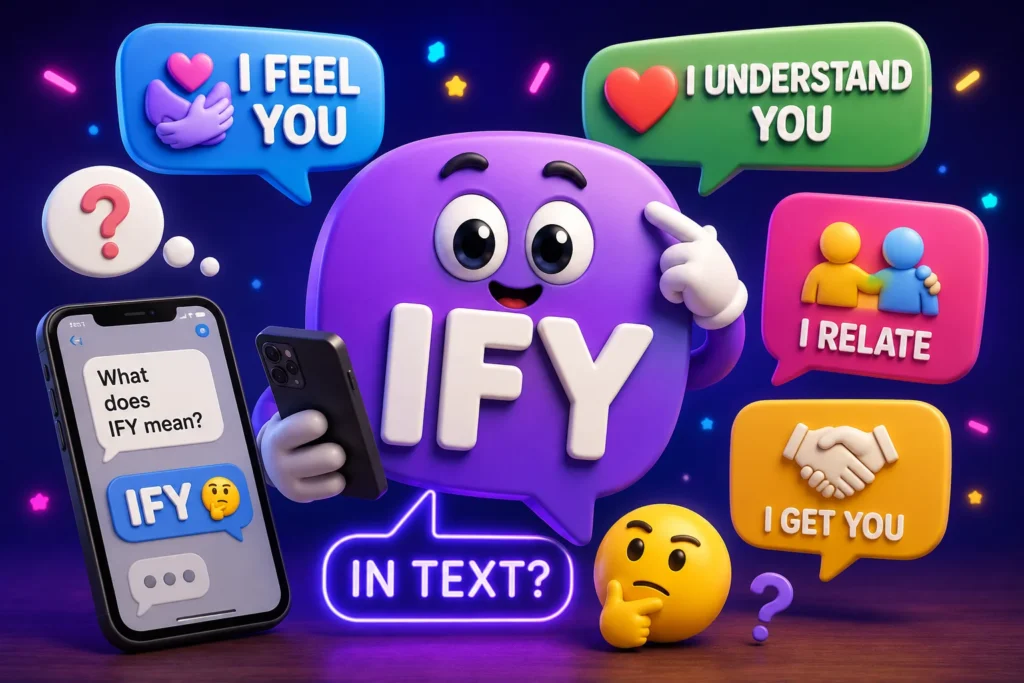
If someone sends you “IFY” in a text, it most commonly means “I Feel You.” It is an informal abbreviation used to show that you understand, relate to, or empathize with what someone has said.
What Does IFY Mean in Text?
IFY is an informal texting abbreviation for “I Feel You.”
When someone replies with “IFY,” they usually mean something close to:
- “I understand you.”
- “I know what you mean.”
- “I can relate.”
- “I understand how you feel.”
- “I’m with you on that.”
The exact shade of meaning depends on the conversation. Someone might use IFY after you complain about a difficult day, describe an awkward situation, share an opinion, or talk about something they have experienced too.
For example:
You: “I’ve been working all day and I’m completely exhausted.”
Friend: “IFY 😭”
Here, “IFY” is essentially saying, “I feel you—I understand how exhausting that is.”
Unlike abbreviations such as LOL or BRB, IFY is not mainly about an action or reaction. It communicates understanding and emotional connection.
Current reference sources consistently identify “I Feel You” as the primary texting meaning. Dictionary.com also lists “I forgive you” as an occasional secondary meaning.
What Does IFY Stand For?
In modern texting slang:
IFY = I Feel You
The phrase “I feel you” is an informal expression meaning that you understand or relate to another person’s thoughts, feelings, or situation.
It does not normally mean physically touching or feeling someone. In this expression, “feel” is being used figuratively to communicate emotional or conversational understanding.
For instance:
“I’m so tired of people canceling plans at the last minute.”
“IFY. It happens to me all the time.”
The second person isn’t necessarily saying they have experienced the exact same situation. They are showing that they understand the frustration.
That distinction matters because IFY can communicate empathy without claiming that two people have identical experiences.
Other Meanings of IFY
Although “I Feel You” is the meaning most strongly associated with texting, IFY can occasionally have other interpretations.
1. I Feel You — Most Common
This is the primary meaning in informal online communication.
It expresses:
- understanding
- agreement
- empathy
- relatability
- emotional support
Example:
“My professor gave us another assignment after saying we were done.”
“IFY 😭”
Meaning:
“I feel you. I understand that frustration.”
2. I Forgive You — Much Rarer
Some references list IFY as an occasional abbreviation for “I Forgive You.” Dictionary.com specifically records this as a secondary use.
However, you should not automatically interpret IFY this way.
Context is important.
For example:
“I’m sorry I forgot your birthday.”
“IFY. It’s okay.”
In that particular conversation, “I forgive you” could make sense, although many readers would still interpret IFY as “I feel you” unless the surrounding conversation clearly establishes the forgiveness meaning.
3. “If You” — A Contextual Reading, Not the Main Slang Meaning
Some online explanations list “if you” as another possible interpretation. However, this is much less established as a standalone texting meaning than “I feel you.”
Usually, “if you” appears as ordinary English inside a sentence rather than as a recognized slang response.
For example:
“IFY want to come, let me know.”
A reader might interpret “IFY” as “if you,” but this is not the standard interpretation of the abbreviation in texting.
So if someone simply messages:
“IFY”
the safest interpretation is “I Feel You,” unless the surrounding context strongly indicates otherwise.
A Common Misunderstanding: IFY vs. IFFY
One of the easiest ways to misunderstand IFY is to confuse it with iffy.
They are not the same.
IFY is generally an abbreviation for “I Feel You.”
Iffy is an ordinary English adjective meaning uncertain, questionable, doubtful, or not particularly reliable.
Compare:
“IFY, that exam was brutal.”
Here, IFY = I Feel You.
But:
“The weather looks iffy.”
Here, iffy means uncertain or questionable.
The spelling matters. IFY is usually written as three letters, while iffy is a normal word.
Is IFY Slang, an Acronym, or an Abbreviation?
IFY is best described as an informal initialism/abbreviation used in digital communication.
People generally pronounce the individual letters rather than treating “IFY” as a normal spoken word.
It belongs to the same broad family of internet shorthand as:
- BRB — be right back
- IDK — I don’t know
- TBH — to be honest
- FR — for real
- NGL — not gonna lie
- IMO — in my opinion
The important difference is that IFY carries an interpersonal message: “I understand where you’re coming from.”
How IFY Is Used in Conversation
IFY normally appears as a response to something another person has said.
It can stand alone:
“IFY 😭”
Or it can be expanded into a longer message:
“IFY, I would be annoyed too.”
It can also be paired with other texting language:
“IFY fr 😭”
Here, fr adds emphasis to the agreement or understanding.
Another example:
“IFY, that sounds rough. Hope things get better.”
In this case, IFY starts the response while the rest of the sentence provides actual emotional support.
IFY Can Mean More Than Simple Agreement
A useful distinction is that IFY isn’t always equivalent to “yes.”
If someone says:
“I hate waking up early.”
and you reply:
“IFY.”
you’re not simply confirming a fact. You’re communicating something closer to:
“I understand that feeling.”
That’s why IFY works especially well after complaints, frustrations, personal stories, or relatable observations.
Which Apps Is IFY Used On?
There is not enough reliable platform-specific usage data to say that IFY belongs exclusively to TikTok, Snapchat, Instagram, WhatsApp, or X.
Current online references describe IFY broadly as an informal internet and texting abbreviation and give examples involving social media and messaging. Some newer pages specifically mention TikTok, Instagram, Snapchat, and WhatsApp, but these claims generally do not provide independent usage statistics.
So the safest conclusion is:
Text messages and private chats
This is the clearest environment for IFY. It works naturally in informal one-to-one conversations and group chats.
TikTok
IFY can appear in comments or replies to relatable content, particularly when someone is agreeing with another person’s experience. However, there is no strong evidence that it is uniquely associated with TikTok.
It can occur in DMs, replies, or comments, but again, IFY is better understood as general internet shorthand rather than Instagram-specific slang.
Snapchat
It can be used in informal Snapchat conversations, although there is no reliable evidence showing that Snapchat is its primary home.
The abbreviation can naturally appear in WhatsApp chats because the platform supports the kind of informal messaging where texting abbreviations are commonly used.
X
IFY can also function in replies or casual posts on X, but it should not be described as an X-specific expression.
Bottom line: IFY is a general informal internet abbreviation, not a slang term belonging exclusively to one app.
Grammar: How Does IFY Work in a Sentence?
Grammatically, IFY isn’t a conventional English noun, verb, or adjective. It is an abbreviation that functions as a conversational response.
It most commonly appears at the beginning of a reply:
“IFY, that sounds awful.”
It can also appear by itself:
“IFY 😭”
Or alongside another phrase:
“IFY, I had the exact same problem.”
Because it is conversational shorthand, punctuation is flexible.
You might see:
“IFY.”
“IFY 😭”
“IFY fr”
“IFY, honestly.”
All of these can communicate roughly the same basic idea.
Can IFY Be a Complete Reply?
Yes.
If a friend sends:
“I can’t believe I have to work tomorrow.”
You can answer:
“IFY 😭”
That is a complete conversational response.
However, IFY alone can sometimes feel too brief, particularly when someone is sharing something serious. In those situations, adding a sentence can make the response feel more sincere:
“IFY. That sounds really stressful. I hope it gets easier.”
Where Did IFY Come From?
This is an area where it is important not to overstate the evidence.
The exact origin date of the abbreviation IFY itself is not clearly documented. Several internet references describe it as developing from the shorthand practices of online chat and text messaging, but they do not provide a definitive first recorded use.
The phrase behind the abbreviation, “I feel you,” has a longer history in informal American English and is strongly associated with slang and hip-hop culture. Sources discussing the expression connect it with African American speech and hip-hop culture, although the precise earliest origin is difficult to establish.
That distinction is important:
The phrase “I feel you” has identifiable cultural and linguistic history; the exact moment someone shortened it to “IFY” is unclear.
It would therefore be inaccurate to claim that one particular person, website, app, or year invented IFY without stronger evidence.
The expression itself means something like “I understand what you’re saying” or “I relate to what you’re experiencing.”
4 Tone Examples: How IFY Changes With Context
Funny
Alex: “I opened the fridge five times hoping new food would appear.”
Maya: “IFY 😭”
Alex: “The fridge has failed me again.”
Maya: “We need a support group.”
Here IFY is playful and relatable.
Sarcastic
Sam: “They said the meeting would only take ten minutes.”
Jordan: “IFY 💀”
Sam: “It lasted two hours.”
Jordan: “Ten minutes in corporate time, apparently.”
IFY reinforces the shared joke.
Playful
Nina: “I said I wasn’t buying anything today.”
Chris: “IFY 😂”
Nina: “Then I saw the sale.”
Chris: “And suddenly the budget disappeared.”
Here IFY means “I completely understand that.”
Serious
Ava: “I’ve been overwhelmed lately and haven’t known how to explain it.”
Lena: “IFY. You don’t have to explain everything at once.”
Ava: “Thanks, I really needed that.”
Lena: “I’m here if you want to talk.”
In serious conversations, IFY works best when it is followed by genuine support.
12 More Realistic IFY Texting Examples
1. Between Friends
Friend 1: “I studied all night and still forgot everything.”
Friend 2: “IFY 😭”
Friend 1: “My brain just clocked out.”
Friend 2: “Same honestly.”
2. Family Chat
Sister: “Mom asked me to fix the Wi-Fi again.”
Brother: “IFY 😂”
Sister: “Apparently I am now the family IT department.”
Brother: “Congratulations on the promotion.”
3. Dating
Her: “I get nervous before every first date.”
Him: “IFY. I do too.”
Her: “Okay, so I’m not the only one.”
Him: “Definitely not.”
4. Relationship Conversation
Partner 1: “I just need some quiet time after work.”
Partner 2: “IFY. Take whatever time you need.”
Partner 1: “Thank you for understanding.”
Partner 2: “Of course.”
5. School Group Chat
Student: “Why is every assignment due on the same day?”
Classmate: “IFY 😭”
Student: “I can’t keep doing this.”
Classmate: “The syllabus is fighting us.”
6. Work Chat
Coworker: “That deadline is way tighter than I expected.”
Coworker 2: “IFY.”
Coworker: “I’ll try to finish my section tonight.”
Coworker 2: “Let me know if you need help.”
7. Instagram Comment
Person 1: “When you finally sit down and remember you forgot something.”
Person 2: “IFY 😂”
Person 3: “Every single time.”
8. TikTok Comment
Person 1: “POV: you say you’re going to sleep early.”
Person 2: “IFY 😭”
Person 3: “And suddenly it’s 3 a.m.”
9. Snapchat
Friend: “I accidentally sent that message to the wrong person.”
Friend 2: “IFY 💀”
Friend: “I wanted the ground to swallow me.”
Friend 2: “That is actually painful.”
10. WhatsApp Group
Friend 1: “Nobody warned me traffic would be this bad.”
Friend 2: “IFY.”
Friend 3: “We’ve been sitting here forever.”
Friend 1: “At least we’re suffering together.”
11. Supporting Someone
Friend: “I’ve been having a rough week.”
You: “IFY. I’m sorry you’re dealing with that.”
Friend: “I appreciate you.”
You: “Anytime.”
12. Shared Opinion
Friend 1: “That movie was way too long.”
Friend 2: “IFY 😂”
Friend 1: “The ending could’ve happened an hour earlier.”
Friend 2: “Exactly.”
How to Reply When Someone Says “IFY”
Your response should depend on what the other person was talking about.
Funny Reply
“Finally, someone understands my suffering 😂”
Good when the original conversation is lighthearted.
Serious Reply
“Thanks for understanding. It’s been a difficult week.”
This works when IFY is being used as emotional support.
Flirty Reply
If you’re already flirting, you could say:
“Glad you feel me 😉”
This only works when the relationship and conversation are already clearly playful. Otherwise, it can sound awkward because “feel me” can have other interpretations.
Neutral Reply
“Exactly, you get it.”
This is simple and keeps the conversation moving.
IFY vs. Similar Texting Expressions
| Term | Meaning | Tone | Popularity | Confusion Risk |
|---|---|---|---|---|
| IFY | I Feel You | Empathetic, casual | Moderate | Medium |
| I get you | I understand you | Casual, supportive | High | Low |
| FR | For real | Agreeing, emphatic | Very high | Low |
| Same | I have the same feeling/experience | Casual, relatable | Very high | Low |
| I hear you | I understand/acknowledge your point | Supportive | High | Low |
| I forgive you | I accept your apology | Serious/relational | Common phrase, rare as IFY | High |
| IDK | I don’t know | Uncertain | Very high | Low |
The closest alternatives are “I get you,” “I hear you,” and “same.” However, they are not perfectly interchangeable.
“Same” emphasizes shared experience.
“I hear you” emphasizes acknowledgment.
“IFY” tends to combine understanding, relatability, and empathy.
Who Uses IFY?
There is not enough reliable demographic research to claim that IFY belongs exclusively to Gen Z, teenagers, or any particular gender.
It appears in informal internet communication and can be understood by people familiar with texting shorthand. Current references describe it as an internet/texting abbreviation rather than a term restricted to one age group.
You may therefore encounter it among younger social-media users as well as older people who regularly use online abbreviations.
There is also no strong evidence that IFY has a distinct meaning in American English versus British English. The expression “I feel you” has broader English-language circulation, but the abbreviation itself is best treated as informal internet shorthand rather than a regional dialect marker.
Is IFY Rude or Safe?
IFY is generally harmless and non-offensive when it means “I Feel You.”
It is not profanity, and there is nothing inherently insulting about the abbreviation.
However, appropriateness depends on the setting.
With Friends
Completely natural.
“IFY 😭”
In a Casual Group Chat
Fine if everyone understands texting shorthand.
At School
It may be acceptable in informal student-to-student messaging, but avoid it in formal assignments.
At Work
Use caution. A coworker may understand it, but “I understand” or “I see what you mean” is clearer in professional communication.
In a Formal Email
Avoid IFY.
Instead of:
“IFY, thanks.”
write:
“I understand, and thank you for explaining.”
A Small Cultural Note About “I Feel You”
The phrase “I feel you” has a history connected to informal American speech, African American language varieties, and hip-hop culture. Because of that history, it is better to describe its development accurately rather than pretending it appeared randomly as a modern TikTok invention.
At the same time, the exact linguistic path from the spoken expression “I feel you” to the three-letter abbreviation IFY is not firmly established in the available evidence.
So claims such as “IFY was invented on TikTok” or “Gen Z created IFY” should be treated skeptically.
Why Does IFY Work So Well in Conversation?
IFY is effective because it compresses a surprisingly nuanced response into three letters. Instead of simply agreeing, the sender signals that they understand the speaker’s perspective or emotional situation. That makes it especially useful after complaints, relatable observations, and personal stories. Its strength is not that it says something complicated; it is that it quickly tells another person, “I get where you’re coming from.” That emotional acknowledgment is what gives the abbreviation staying power.
IFY vs. “I Feel You” vs. “I Feel For You”
These expressions look almost identical, but their conversational roles can differ.
I feel you usually means:
“I understand or relate to you.”
I feel for you more strongly suggests:
“I sympathize with you.”
For example:
“I feel you. Mondays are exhausting.”
This communicates shared understanding.
But:
“I feel for you. That sounds really difficult.”
This can sound more sympathetic and compassionate.
IFY follows the first expression, “I feel you.”
When Should You Use IFY?
IFY works particularly well when:
- a friend is complaining about something relatable
- someone shares a frustrating experience
- you agree with someone’s personal observation
- you want to show quick emotional support
- you’re responding casually in a chat
- you’re replying to a relatable social-media post
It works less well when:
- the situation requires a detailed response
- you’re writing professionally
- someone is sharing a serious crisis
- the other person may not understand texting abbreviations
- you’re communicating with someone who expects formal language
The biggest practical rule is simple:
Use IFY as an acknowledgment, not as a substitute for genuine support when the situation requires more.
FAQ About IFY
What does IFY mean in texting?
IFY most commonly means “I Feel You.” It is used to express understanding, empathy, agreement, or relatability. In many conversations, it means something like “I get what you mean” or “I understand how you feel.”
Is IFY a slang word?
IFY is better described as an informal texting abbreviation or initialism rather than a conventional slang word. It comes from the phrase “I feel you,” which is itself an informal expression. The abbreviation is primarily associated with casual digital communication.
What does IFY mean from a girl or guy?
There is no special gender-specific meaning for IFY. Whether a man, woman, or anyone else uses it, the ordinary meaning is still “I Feel You.” Claims that IFY has a different meaning based on the sender’s gender are not supported by reliable evidence.
Is IFY the same as “same”?
Not exactly. Both can communicate that you relate to something, but “same” more directly emphasizes that you have the same experience or feeling. IFY emphasizes understanding or empathy toward what the other person is saying.
Does IFY mean “I forgive you”?
It can, but this meaning is much rarer. Dictionary.com lists “I forgive you” as an occasional use of IFY. You should only interpret it that way when the surrounding conversation clearly involves an apology or forgiveness.
Is IFY rude?
No. IFY is not inherently rude, offensive, or profane. However, replying with only “IFY” to someone describing a serious personal problem could feel too brief or dismissive, so adding a more thoughtful response can be better.
Can I use IFY at work?
You can, but it is usually better to use clearer language in professional communication. “I understand,” “I see what you mean,” or “I understand your concern” sounds more professional and leaves less room for confusion.
Is IFY used on TikTok?
It can appear in TikTok comments and other social-media conversations, particularly around relatable content. However, available evidence does not establish TikTok as the exclusive or primary platform for IFY, so it is more accurate to call it general internet/texting shorthand.
Final Takeaway
IFY usually means “I Feel You” in text and online conversations. It is a short, informal way to say that you understand, relate to, or empathize with what someone is saying.
The most important distinction is context. If someone says:
“IFY 😭”
after describing a frustrating experience, they almost certainly mean:
“I feel you—I understand.”
A much rarer interpretation is “I Forgive You,” and that only makes sense when the conversation is about an apology or forgiveness.
Don’t confuse IFY with iffy, which is a completely different English word meaning uncertain or questionable.
And while the phrase “I feel you” has a longer history connected to informal American speech and hip-hop/African American linguistic culture, the exact origin of the abbreviation IFY itself remains unclear. It is safest to describe IFY as informal internet shorthand rather than claiming a specific inventor or platform created it.
If you’re texting friends, replying to relatable posts, or participating in casual group chats, IFY is a compact way to show that you understand where someone is coming from. In formal school or workplace communication, simply write “I understand” instead.