
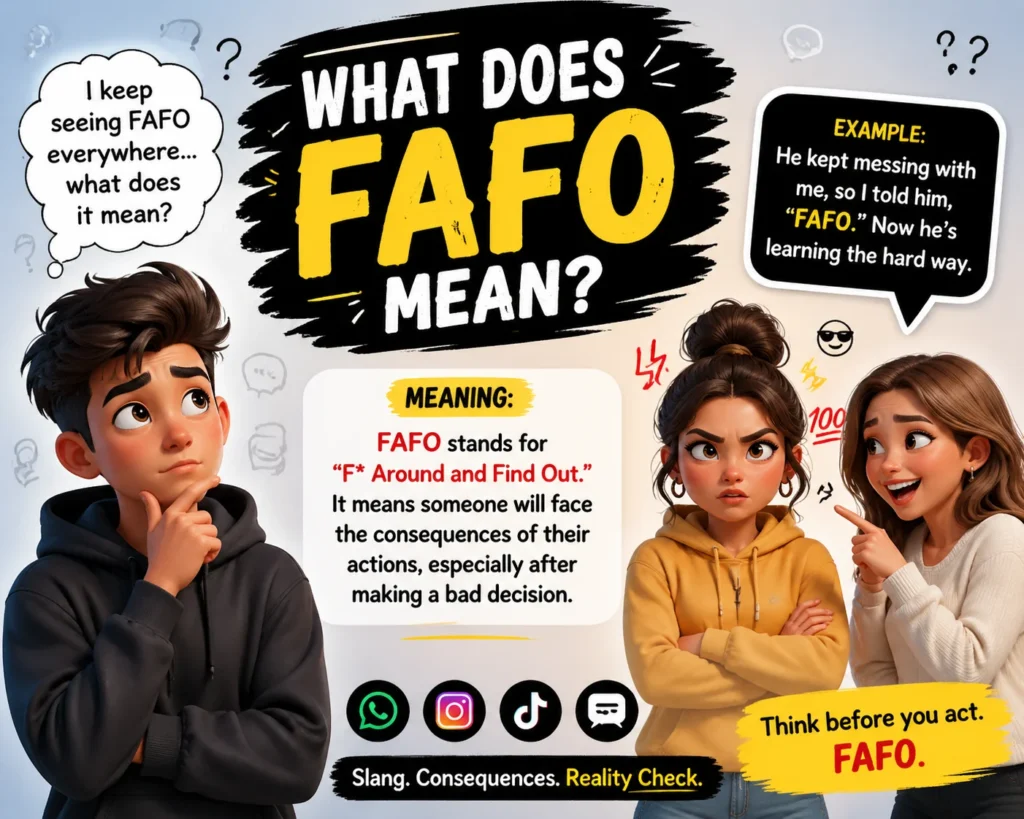
If you’ve been scrolling through social media, reading memes, or engaging in modern online conversations, you’ve likely encountered the acronym “FAFO.” But what does it really mean, and why has it taken the internet by storm? In this article, we’ll break down the meaning of “FAFO,” its origins, emotional significance, and how it’s used across different platforms. Whether you’ve seen it in TikTok comments, Instagram DMs, or even WhatsApp chats, you’ll have a clearer understanding by the end. Let’s dive in!
“FAFO” is a slang term that’s become a staple in online communication. It stands for “F*** Around and Find Out.” Simply put, it’s a phrase used to warn someone about the consequences of their actions. When you “FAFO,” you’re essentially testing the limits or pushing boundaries — and finding out the consequences in the process.
Why is this phrase so popular? It resonates with the culture of boldness and spontaneity. It’s a phrase that captures the essence of modern communication—quick, direct, and often with a hint of humor or defiance. Whether in a playful context or a more serious warning, “FAFO” captures a wide array of emotions, and people use it to either encourage or caution others.
Let’s explore this phrase further and unpack its deeper meanings and uses in various settings.
FAFO – Quick Meaning
- Definition: “FAFO” stands for “F*** Around and Find Out,” a phrase that highlights the idea of testing limits and learning the consequences of those actions.
- Context: It’s a warning or statement about the potential repercussions of one’s behavior or decisions.
- Common Usage:
- “If you keep messing with me, you’re about to FAFO.”
- “He tried to act tough, and now he’s finding out the hard way—FAFO.”
Quick Examples
- Person A: “What happens if I try to argue with her?”
- Person B: “You’re about to FAFO. She doesn’t take any nonsense.”
- Person A: “Should I mess with that guy? He’s always talking trash.”
- Person B: “FAFO if you want, but don’t say I didn’t warn you.”
Origin & Background
The phrase “FAFO” is rooted in internet culture, where shorthand and clever phrases often go viral. It’s not just an abbreviation — it’s a sentiment that aligns with a more rebellious, defiant attitude in social interactions. It encourages taking risks, sometimes without considering the consequences.
The phrase likely emerged from the internet meme culture, where phrases like “YOLO” (You Only Live Once) and “FOMO” (Fear of Missing Out) have made waves. However, unlike YOLO, which encourages living life to the fullest, “FAFO” is often used in a more cautionary or sarcastic manner.
Over time, it spread across social media platforms like Twitter, TikTok, and Instagram, with people using it to comment on anything from political statements to personal challenges. It’s a shorthand for saying, “Be careful what you do because there are consequences,” or, conversely, “If you’re going to act tough, be ready to face the music.”
Real-Life Conversations
WhatsApp Chat
- Person A: “I’m thinking of texting my ex.”
- Person B: “FAFO, but don’t blame me when things get messy.”
Instagram DM
- Person A: “Do you think I can handle this situation?”
- Person B: “You’ll FAFO. But, hey, go ahead if you’re feeling lucky.”
TikTok Comment
- Person A: “Should I start a fight with this guy?”
- Person B: “FAFO, but it’s not going to end well.”
Text Message
- Person A: “Should I send this risky text?”
- Person B: “FAFO, just know that you’re about to stir things up.”
These conversations show how FAFO can be used in a variety of ways, from friendly advice to a warning shot.
Emotional & Psychological Meaning
“FAFO” is not just a phrase — it taps into our natural instinct to test boundaries. It’s an emotional expression of confidence, risk-taking, and often, rebellion. People who use it are either encouraging others to step out of their comfort zones or warning them to be prepared for consequences.
The underlying emotion behind “FAFO” is often a blend of defiance and empowerment. It’s a statement that speaks to the consequences of one’s actions, revealing something about modern communication: it’s blunt, immediate, and sometimes brash.
For example, think about a time when you were considering doing something a bit risky — maybe skipping work or taking an unplanned trip. The phrase “FAFO” encapsulates that moment of making the decision to push the limits. It’s a reminder that while you can take risks, you also have to face what comes with them.
Usage in Different Contexts
Social Media
On platforms like Twitter or TikTok, “FAFO” is often used in reaction to someone’s bold or controversial post. It’s a way of saying, “If you’re going to make a statement or take action, be ready for the fallout.”
Friends & Relationships
In personal conversations, the phrase is usually used to joke around or give advice in a lighthearted way. It could be used when a friend is about to confront a difficult situation or test their limits.
Work / Professional Settings
Though it’s mostly casual, some people use “FAFO” in work environments, especially when discussing risky business decisions or bold strategies. However, this can be inappropriate in formal contexts, where professional language is more suitable.
Casual vs. Serious Tone
“FAFO” can be casual and playful, or it can carry a serious, warning tone. The emotional weight depends on the context and relationship between the people involved.
When NOT to Use It
- In Formal Settings: Using “FAFO” in professional emails or meetings can undermine your credibility and is inappropriate in most corporate environments.
- Cultural Sensitivity: In some cultures, the language used in “FAFO” might be seen as disrespectful or offensive. Always be mindful of your audience.
- Avoid in Serious Conversations: If you’re offering emotional support or having a deep discussion, “FAFO” might come off as dismissive or overly casual.
Common Misunderstandings
One common misunderstanding is the tone in which “FAFO” is used. Some might think it’s always a harsh or aggressive remark, but in many cases, it’s used jokingly or as a lighthearted warning. People may also misinterpret it as a threat when it’s not meant that way at all.
Another point of confusion is whether “FAFO” is literal or figurative. While it literally refers to testing boundaries and finding out the consequences, in social media contexts, it’s often a playful or sarcastic comment rather than an actual warning.
Comparison Table
| Expression | Meaning | Usage |
|---|---|---|
| FAFO | F*** Around and Find Out | Casual, warning, testing boundaries |
| YOLO | You Only Live Once | Encouraging boldness, risk-taking |
| FOMO | Fear of Missing Out | Regret or desire not to miss an opportunity |
| TBH | To Be Honest | Openness, honesty |
Key Insight: “FAFO” is more about consequences than the action itself, whereas phrases like “YOLO” focus more on the adventurous side.
Variations / Types
- FAFO and Find Out – A shortened version of the phrase.
- FAF – Sometimes used as shorthand for “FAFO.”
- Mess Around and Find Out – A milder version.
- Risk and Find Out – Used when someone is taking calculated risks.
- Test It and Find Out – Used when someone is probing boundaries.
- Push the Limit – Focuses more on personal challenges.
- Dare and Find Out – Focuses on challenges that might lead to failure.
- Go for It – More positive but similar in spirit.
- Walk the Line – Implies walking a fine line between risk and caution.
- Try Your Luck – A more casual variation.
How to Respond When Someone Uses It
- Casual Replies: “Guess I’ll FAFO then!”
- Funny Replies: “I’m already prepared for the fallout, haha!”
- Mature Replies: “I’m weighing the risks, but I know what I’m doing.”
- Respectful Replies: “I hear you — but I’ll decide what happens next.”
Regional & Cultural Usage
Western Culture
In Western countries, particularly the U.S., “FAFO” is widely used among Gen Z and Millennials. It’s casual, often humorous, and sometimes used to defuse tension in a conversation.
Asian Culture
In some Asian cultures, the use of strong language like “FAFO” can be seen as disrespectful. However, in internet culture, it might still be used among younger generations as a rebellious or empowering phrase.
Middle Eastern Culture
In the Middle East, where there is often a higher emphasis on respect and formality in communication, “FAFO” might be considered inappropriate in most settings. However, it could be used in more casual online conversations.
Global Internet Usage
Globally, the internet has allowed “FAFO” to transcend cultural boundaries. While its usage varies, it’s popular among younger people who engage in online communities and social media platforms.
Generational Differences
Gen Z tends to use “FAFO” more often than Millennials, especially in informal and internet-based settings.
Is It Safe for Kids?
“FAFO” contains explicit language and references, so it’s not appropriate for children. While teenagers may come across the term online, parents should be aware of its meaning and usage in order to guide their children in understanding when and how to use such phrases appropriately.
FAQs
- What is the full form of FAFO?
“FAFO” stands for “F*** Around and Find Out.” - Can I use FAFO in professional settings?
No, it’s best avoided in formal or professional environments. - Is FAFO always used negatively?
Not always; it can be used humorously or as a lighthearted warning. - Where did FAFO come from?
It originated in internet meme culture and became popular through social media. - Is FAFO offensive?
It can be, depending on the context and audience.
Conclusion
“FAFO” is more than just a phrase; it’s a reflection of the boldness and spontaneity that dominate modern communication. Whether you’re using it to warn a friend, joke with someone, or express your own daring nature, it encapsulates the thrill of taking risks and finding out what happens next. Just remember to use it in the right context, and always be aware of your audience.