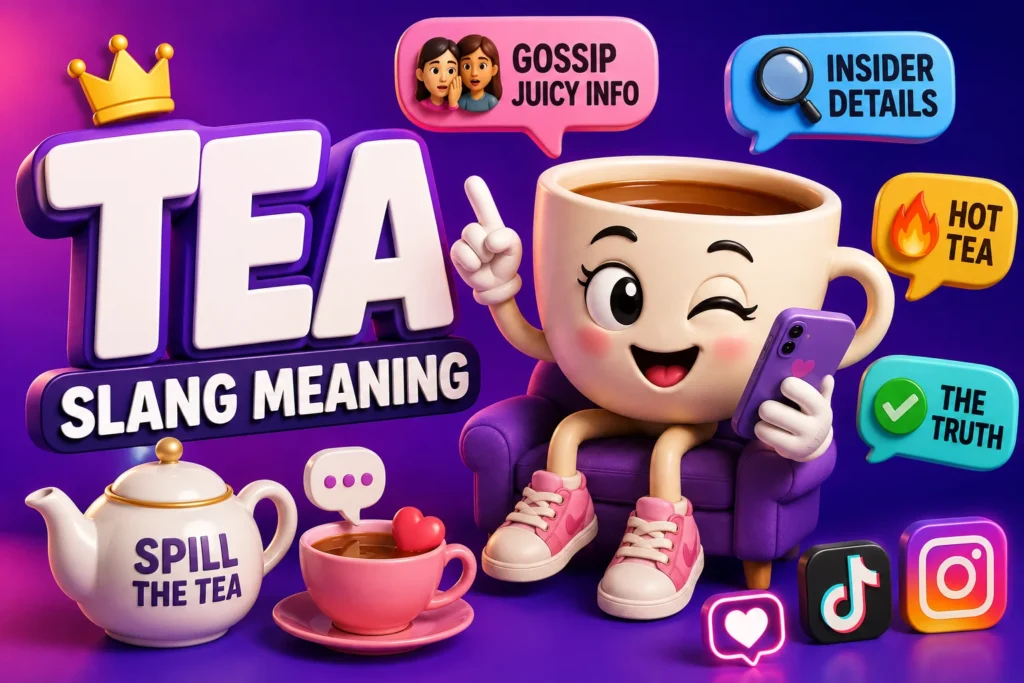
If someone says “That’s the tea” or “Spill the tea,” they’re talking about gossip, juicy news, insider information, or the truth about a situation. In modern internet slang, tea is slang, not an acronym or abbreviation, and it’s one of the most recognizable expressions across social media.
Although many people associate it with TikTok, the term actually predates the platform. It originated in Black drag culture, where “T” (or “tea”) referred to “truth,” before spreading into LGBTQ+ communities and eventually mainstream internet culture through television, memes, and social media.
This guide explains what tea really means, where it came from, when to use it, and why it remains one of the internet’s favorite slang words.
What Does Tea Mean in Slang?
The most common slang meaning of tea is:
Interesting gossip, truthful information, or behind-the-scenes details that people are eager to hear or share.
Unlike ordinary gossip, tea often implies that the information is real or comes from someone with inside knowledge.
Examples:
- “What’s the tea?”
- “Give me the tea.”
- “She spilled all the tea.”
- “That’s some hot tea.”
In everyday conversation, the word usually carries a playful tone rather than a malicious one.
Is Tea an Acronym?
No.
Unlike terms such as GOAT, LOL, or IMO, tea is not an acronym.
It is simply a slang noun.
Historically, however, many linguists and dictionaries trace it back to the spoken letter “T,” meaning “truth,” used in Black drag culture during the late 20th century. Over time, speakers naturally expanded T into tea, making expressions like “spill the tea” feel more intuitive because tea is something that can literally be spilled.
All Real Meanings of “Tea”
Although gossip is the meaning most people search for today, tea has a few legitimate slang uses depending on context.
1. Gossip or Insider Information (Most Common)
This is by far the dominant meaning online.
Examples:
- “Tell me the tea.”
- “I heard some tea today.”
- “Spill the tea.”
Here, tea means:
- gossip
- drama
- insider news
- secrets
- truthful details
2. Truth
Earlier uses emphasized truth more than gossip.
Someone might say:
“That’s the tea.”
Meaning:
“That’s the truth.”
Today, this meaning still exists, but it usually overlaps with gossip.
3. “Hot Tea”
Adding hot means the information is especially dramatic or surprising.
Example:
“I’ve got hot tea about what happened after the concert.”
The adjective makes the gossip sound even more exciting.
4. “Weak Tea”
Another genuine expression is weak tea.
It means:
- disappointing gossip
- uninteresting information
- incomplete details
- something less dramatic than expected
Example:
“That’s weak tea. I expected something bigger.”
This usage also traces back to drag culture and later became common among fans of reality TV and online commentary.
A Common Misunderstanding
Many people think tea simply means gossip.
That’s only partly true.
Originally, tea referred to truth or someone’s personal business, and only later became closely associated with gossip. Because many juicy truths become gossip, the meanings naturally merged over time.
Another misconception is that “spill the tea” came from the Boston Tea Party or from literally spilling a drink. There is no evidence for that. Language historians instead point to Black drag culture, where “spill the T” evolved into “spill the tea.”
Which Apps Use “Tea”?
Unlike some slang that’s tied to a single platform, tea appears almost everywhere online.
TikTok
Very common.
People use it in:
- celebrity gossip
- storytime videos
- relationship drama
- creator controversies
Examples:
- “Storytime… here’s the tea.”
- “Spilling the tea.”
Common in:
- comment sections
- memes
- influencer pages
- celebrity accounts
Example:
“Girl, give us the tea.”
Snapchat
Friends often use it privately.
Examples:
- “Any tea from school?”
- “What’s today’s tea?”
Common in casual group chats.
Example:
“I’ve got tea about yesterday.”
X (formerly Twitter)
Frequently appears during:
- celebrity news
- entertainment discussions
- viral arguments
- sports rumors
The phrase is especially popular when breaking news spreads quickly.
Grammar: How Does “Tea” Work?
Unlike many internet abbreviations, tea behaves like an ordinary noun.
Part of Speech
Primarily:
Noun
Examples:
- “The tea is wild.”
- “I’ve got tea.”
Common Verb Phrase
Although tea itself isn’t a verb, it appears in the fixed phrase:
spill the tea
Example:
“Spill the tea already.”
Can Tea Be a Complete Reply?
Yes.
Examples:
Friend:
“Guess who got back together?”
Reply:
“Tea?”
or
“Spill.”
Both are natural in text conversations.
Where Did Tea Come From?
The history of tea is much richer than many articles explain.
Most language experts trace the slang to Black drag culture in the United States, where “T” meant “truth.” Early documented uses appear in connection with drag performer Lady Chablis, whose language helped introduce the term to a broader audience through the 1994 book Midnight in the Garden of Good and Evil.
Over time:
- T (truth) became tea
- “Spill the T” became “spill the tea”
- LGBTQ+ communities spread the phrase
- RuPaul’s Drag Race helped introduce it to mainstream audiences
- Twitter, Tumblr, YouTube, and later TikTok turned it into global internet slang.
Unlike many viral slang words that disappear after a year or two, tea has remained popular because it fills a conversational need: it’s a quick, playful way to ask for interesting details without sounding overly serious.
Tea vs Similar Slang
One reason people confuse tea is that several internet slang terms overlap.
| Term | Meaning | Same as Tea? |
|---|---|---|
| Tea | Gossip or truthful insider information | — |
| Spill the tea | Share gossip | Very similar |
| Spill the beans | Reveal a secret | Similar but older idiom |
| Drama | Conflict between people | Related but broader |
| Receipts | Proof or evidence | Often supports the tea |
| Rumor | Unverified information | Not necessarily tea |
A Useful Difference Most Articles Miss
One subtle distinction that often goes unexplained is the relationship between tea and receipts.
People frequently say:
“I have the tea.”
This means they have the story.
But when they say:
“I have receipts.”
They mean they have screenshots, messages, photos, or evidence that proves the story.
On social media, tea often starts the conversation, while receipts determine whether others believe it.
Example Conversations
1. Funny
Alex: I heard you have tea.
Sam: I do.
Alex: Then pour the whole kettle.
Sam: Grab a chair.
2. Sarcastic
Taylor: I’ve got tea.
Jordan: Is it actually interesting this time?
Taylor: Fine… it’s lukewarm tea.
Jordan: I knew it.
3. Playful
Emma: Guess who texted me?
Lily: Spill the tea!
Emma: You’ll never guess.
Lily: I’m listening.
4. Serious
Chris: Before rumors spread, here’s the tea.
Morgan: I’d rather hear the truth directly.
Chris: That’s exactly why I’m telling you.
Morgan: Thanks for being honest.
More Real-Life Conversation Examples
Friends (TikTok)
Friend 1: Your story says you have tea.
Friend 2: Wait until tonight.
Friend 1: I can’t wait that long.
Instagram Comments
Follower: We need the tea.
Creator: Tomorrow’s video explains everything.
Snapchat
Emma: Any tea from class today?
Noah: Plenty.
Emma: Send it.
Family Group Chat
Sister: Did Mom tell you?
Brother: No.
Sister: I’ve got some tea.
Dating
Alex: So… how was your date?
Taylor: Oh, I’ve got tea.
Alex: I’m calling you now.
Office Chat
Coworker: Did the meeting go well?
Coworker 2: Let’s just say there’s tea.
Coworker: Tell me after work.
Group Chat
Jake: Why is everyone online?
Chris: Someone dropped major tea.
College Friends
Student: Did you hear what happened after class?
Friend: No.
Student: I’ve got the tea.
X (formerly Twitter)
User 1: The tea is getting hotter every hour.
User 2: Waiting for receipts before believing it.
Reality TV Fans
Fan 1: Did you watch last night’s episode?
Fan 2: Yes!
Fan 1: The reunion spilled all the tea.
Celebrity Discussion
Friend: Is that rumor true?
Friend 2: Nobody knows yet.
Friend: Then it isn’t tea yet.
Discord Server
User: Any updates?
Moderator: No confirmed tea yet.
How to Reply When Someone Says “Tea”
Funny
“Pour me a cup.”
Serious
“Go ahead—I’m listening.”
Flirty
“Only if we spill it over coffee.”
Neutral
“What’s going on?”
Comparison Table
| Term | Meaning | Tone | Popularity | Confusion Risk |
|---|---|---|---|---|
| Tea | Gossip or truthful insider information | Playful | Very High | Low |
| Spill the Tea | Share gossip or details | Playful | Very High | Low |
| Receipts | Proof supporting a claim | Serious | High | Medium |
| Drama | Conflict or controversy | Emotional | Very High | Medium |
| Spill the Beans | Reveal a secret | Casual | High | Low |
| Lore | Background story or history | Humorous | Growing | Medium |
| Keep It Quiet (opposite) | Don’t share the information | Neutral | Medium | Low |
Who Uses “Tea”?
Tea has become mainstream, but different groups often use it in different ways.
Gen Z
Gen Z uses tea daily on:
- TikTok
- Snapchat
- Discord
- X
It’s especially common in conversations about influencers, dating stories, celebrity drama, and viral trends.
Millennials
Many Millennials adopted the term through:
- Twitter (now X)
- Tumblr
- YouTube
- Reality TV
- RuPaul’s Drag Race
They often use it alongside expressions like “spill the beans” or “receipts.”
Regional Differences
There is no strong evidence that “tea” belongs to one English-speaking country today.
It is widely recognized in:
- United States
- Canada
- United Kingdom
- Australia
- New Zealand
Because of social media, the slang has spread internationally and is understood by many English speakers regardless of location.
Is Tea Offensive?
Generally, no.
Tea itself is:
- ✅ Not profanity
- ✅ Not a slur
- ✅ Usually safe for school
- ✅ Acceptable in casual workplaces
- ✅ Family-friendly in most situations
However, the content of the tea may not be appropriate.
For example:
- Sharing private information without permission can be hurtful.
- Spreading false rumors is unethical.
- Gossip about coworkers or classmates can create unnecessary conflict.
The word is harmless—the way it’s used matters.
Why “Tea” Has Stayed Popular
Unlike many slang words that fade after a single trend, tea survives because it solves a real conversational need. It instantly tells listeners that what’s coming is interesting, surprising, or revealing. The word is short, memorable, and easy to combine with other expressions like “hot tea,” “spill the tea,” and “the tea is…” It also works across text messages, videos, podcasts, memes, and face-to-face conversations, making it one of the most versatile pieces of internet slang.
A Practical Tip: When Not to Call Something “Tea”
One detail many articles overlook is that not every rumor is automatically “tea.”
Good internet etiquette is to distinguish between:
- Tea – Information someone believes to be true or firsthand.
- Rumor – Something unverified.
- Opinion – A personal viewpoint.
- Receipts – Evidence supporting the claim.
Using these terms accurately helps avoid spreading misinformation, especially on social media where stories can travel quickly.
FAQ
What does “spill the tea” mean?
It means to share gossip, insider information, or the truth about a situation. Today, it’s one of the most common internet expressions for revealing interesting details. The phrase is usually playful rather than hostile.
Why is gossip called tea?
Most language experts trace it to Black drag culture, where “T” meant “truth.” Over time, speakers expanded “T” into “tea,” leading to the now-famous phrase “spill the tea.” The expression later became popular through LGBTQ+ culture, television, and social media.
Is tea always gossip?
No. While gossip is the most common meaning, tea can also refer to truthful information or inside knowledge. Depending on context, it may simply mean “Here’s what really happened.”
What’s the difference between tea and drama?
Tea refers to the information itself, while drama refers to the conflict or situation. You can have tea about drama, but the two words aren’t interchangeable.
Can I use tea in a professional workplace?
Usually, it’s better not to. Although the word isn’t offensive, it’s informal slang. In professional settings, phrases like “updates,” “information,” or “details” are generally more appropriate.
Is “tea” still popular in 2026?
Yes. While new slang appears every year, tea remains widely understood across TikTok, Instagram, X, YouTube, and messaging apps. Its long history and flexibility have helped it outlast many short-lived internet trends.
What’s the difference between “tea” and “receipts”?
Tea is the story or information someone is sharing. Receipts are the screenshots, messages, photos, or other evidence that support the story. On social media, people often ask for receipts before believing the tea.
Conclusion
Tea is slang for gossip, truthful insider information, or interesting personal news, and it remains one of the internet’s most recognizable expressions. Although many people first encountered it through TikTok or reality TV, its roots go back much further to Black drag culture, where “T” represented truth before evolving into today’s familiar phrase, “spill the tea.”
When you use the term, remember that tea doesn’t automatically mean rumor—it often suggests that the information is genuine or comes from someone close to the situation. Whether you’re chatting with friends, commenting on social media, or watching a creator’s latest storytime, understanding the difference between tea, rumors, drama, and receipts will help you use the slang naturally and accurately.