
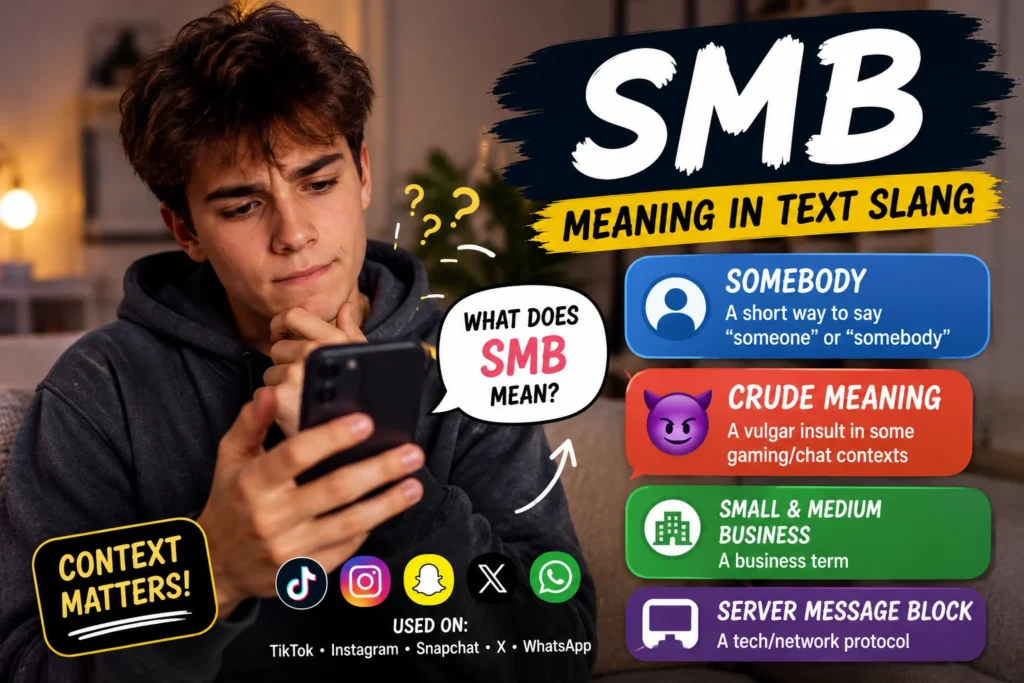
“SMB” in text slang most commonly means “somebody” — shorthand used when typing fast in casual texts, comments, and captions. It also has a cruder meaning in some gaming and chat contexts, plus unrelated meanings in business and tech. People search this because the same three letters point to very different things depending on where they appear.
The confusion is real. “SMB” isn’t a word on its own, so depending on the platform and the people involved, it could be an innocent shorthand for “somebody,” a crude insult meaning “Suck My B*lls“, or a business/tech term unrelated to texting. This article breaks down each meaning clearly, in the order people actually encounter them.
What Does “SMB” Actually Mean?
The Most Common Meaning: “Somebody”
In everyday texting and on social platforms, “SMB” most commonly shortens “somebody.” It refers to an unnamed or unspecified person quickly, without typing the full word. A caption like “smb come get their mans” or “smb explain this to me” uses SMB this way — a fast, casual substitute for “somebody” or “someone.”
It is an abbreviation, not a true acronym, since it doesn’t spell out something pronounceable from initials the way acronyms like “NASA” do — it’s “somebody” with the vowels dropped, similar to how “message” becomes “msg.”
A Cruder, Less Common Meaning
Separately, “SMB” has an older, cruder meaning ““Suck My B*lls”. A vulgar insult or expression of frustration.” in some gaming and chat communities: a vulgar insult. This usage predates the “somebody” trend and tends to show up in aggressive, confrontational contexts like gaming chat rather than everyday captions. Context is what separates the two — a friendly “smb help me” is not the crude meaning, while a hostile one-word “smb” fired off during an argument likely is.
Unrelated Business and Tech Meanings
Outside of texting slang, “SMB” has two well-established, unrelated meanings. In business, it stands for “Small and Medium-sized Business,” a standard term in corporate discussions. In IT, it stands for “Server Message Block,” a protocol for sharing files and printers across a network. Neither has anything to do with the texting usage, but this explains why “SMB meaning” searches sometimes surface business or tech results.
Platform Breakdown: How “SMB” Appears
TikTok
TikTok is where the “somebody” meaning is most visible, showing up constantly in comments and captions — “smb tell him,” “smb explain this trend” — as a fast way to call out to an unspecified person in the comments.
On Instagram, “SMB” appears in comments and captions the same way it does on TikTok, usually as “somebody,” especially under relatable or reaction-style posts.
Snapchat
In Snapchat chats, “SMB” is typically used one-on-one or in group chats as “somebody,” often in a quick message like “smb text me back.”
X (formerly Twitter)
On X, “SMB” appears in both the “somebody” sense and, less often, the cruder confrontational sense, since X’s reply culture includes both casual commentary and heated exchanges.
“SMB” shows up far less often on WhatsApp, since that platform skews toward longer, personal messaging. When it does appear, it’s almost always the “somebody” meaning.
Tone Variations: How “SMB” Changes With Context
Funny
A: smb come get their man, he’s out here dancing on the table B: LMAOO which one is he A: the one in the striped shirt B: oh no I know exactly who you mean
Sarcastic
A: smb please explain why I’m the only one who studied for this test B: because we had faith in you obviously A: faith doesn’t pass exams B: neither does complaining about it now
Playful
A: smb tell me if this outfit works for tonight B: it’s giving main character energy, wear it A: okay good because I already put it on B: confidence was the plan all along then
Serious
A: smb needs to check on her, she hasn’t answered anyone all day B: I’ll call her right now A: let me know what she says B: okay, calling now, I’ll update you in a few minutes
Real Chat Examples
Friends and Classmates
A: smb explain this math homework to me B: which question are you stuck on A: literally all of them B: okay send me a photo of the page
A: smb tell the group chat we’re not doing the project tonight B: I’ll say it, don’t worry A: thank you, everyone listens to you more than me B: that’s just because I go first
Dating and Relationships
A: smb needs to tell him his profile picture is from 2016 B: I am NOT the one telling him that A: someone has to B: let it be someone braver than me
A: smb come hang out, I’m bored out of my mind B: what time were you thinking A: anytime after 6 B: I’m in, I’ll bring snacks
Work and School Group Chats
A: smb needs to send the notes from today’s lecture B: I have them, uploading now A: you’re a lifesaver honestly B: don’t worry about it, we all need each other for this class
A: smb forgot to lock the register again B: was it during the morning shift A: yeah, I just caught it now B: okay I’ll flag it to the manager so it doesn’t happen again
Gaming and Group Chats
A: smb needs to carry this round, I’m getting cooked B: switch to support, I’ll cover you A: okay switching now B: better, stay behind me
A: smb keeps disconnecting the call, is it just me B: no it’s happening on my end too A: must be the server then B: yeah let’s just restart the app
Public Comments
A: [comment] smb tell this man his mic is still on B: [reply] LOL he has no idea A: [reply] someone in his chat needs to say something fast B: [reply] too late, everyone already heard it
A: [comment] smb needs to explain why this song is stuck in my head B: [reply] it’s the beat drop, it gets everyone A: [reply] I’ve had it on repeat all day B: [reply] same, no shame in that
Grammar & Language Role
Part of Speech
“SMB” functions as a pronoun substitute, standing in for the indefinite pronoun “somebody” — referring to an unspecified person.
Sentence Position
It typically sits at the start of a sentence as the subject — “smb tell him” mirrors “somebody tell him.” It can also appear mid-sentence in the object position, as in “ask smb else.”
Can It Replace a Full Sentence?
Not usually. Unlike reaction words that stand alone as a full message, “SMB” needs the rest of the sentence around it — it replaces one word, not an entire thought.
Formal vs. Informal Register
Strictly informal. It belongs in texts, captions, and comments, never professional writing, where “somebody” should be spelled out in full.
How to Reply to “SMB”
Funny Reply
“smb = me, I volunteer as tribute”
Serious Reply
“I can help with that — what do you need?”
Flirty Reply
“smb? could be me if you’re asking nicely”
Neutral/Unbothered Reply
“I got it, one sec”
Comparison Table
SMB vs. Related and Confused Terms
| Term | Meaning | Usage Context | Tone | Popularity | Confusion Risk |
|---|---|---|---|---|---|
| SMB | “Somebody,” or a cruder insult in some contexts | Captions, comments, group chats | Casual or, rarely, hostile | High | High (multiple unrelated meanings) |
| SMH | “Shaking my head,” expressing disapproval | Texts, comments | Disappointed/annoyed | Very high | Low |
| SMTH | “Something” | Texts, captions | Neutral/casual | High | Medium (visually similar to SMB) |
| IDK | “I don’t know” | Texts, group chats | Neutral | Very high | Low |
| SM | “So much” or “social media,” depending on context | Texts, bios | Neutral/casual | High | Medium (context-dependent) |
| Nobody | The direct opposite of “somebody” | Everyday speech and text | Neutral | Very high | Low |
Who Uses This Term
Age Group Breakdown
The “somebody” meaning is used mostly by teens and users in their twenties active on TikTok, Instagram, and Snapchat, where fast, caption-style typing is the norm.
Gen Z vs. Millennials
Gen Z is far more likely to use “SMB” as “somebody” in captions and comments, fitting the abbreviated, scroll-speed style of TikTok culture. Millennials are more likely to type “somebody” in full or use SMB in its business sense, since that meaning is more established in the professional contexts Millennials frequently work in.
Regional Usage
The “somebody” texting usage is tied to English-language internet culture broadly, with heavy visibility in the U.S. thanks to TikTok’s comment culture, and it has spread anywhere English-language social media use is high, including the UK. The business and tech meanings are used globally wherever English is the working language of commerce or IT.
Platforms and Which Meaning Appears Where
The “somebody” meaning dominates TikTok, Instagram, and Snapchat. The cruder meaning is more likely to surface in gaming chats and heated exchanges on X. The business and tech meanings appear almost exclusively outside casual texting, in professional writing and IT documentation.
Origin & Internet Culture
The Verified Origin
The “somebody” usage began appearing on TikTok around 2020, largely in comments and captions, and became widely mainstream by around 2023. It follows a common texting pattern: dropping vowels from a word to type it faster, the same logic behind “msg” for “message” or “bc” for “because.”
Cultural Roots
There’s no single, verified cultural origin tied to a specific community for the “somebody” meaning — it reads as a product of fast-paced, comment-based platforms rather than a term with documented roots in a particular dialect. The cruder meaning is older and tied more to competitive gaming and chat culture, where blunt insults are common shorthand.
TikTok and Meme Culture’s Role
TikTok’s comment section is built around short, punchy replies aimed at calling out an unnamed person in a video’s audience — “smb tell him” works as a quick tag toward whoever might know the person being discussed. That format rewarded the shortest possible version of “somebody,” and “SMB” became the standard.
How It Evolved
What started as a simple vowel-dropped abbreviation gradually became recognizable enough that people use it without thinking twice — the same way “smh” or “idk” stopped needing explanation. Its meaning hasn’t shifted since it took hold; it has just become more widely understood over time.
Safety & Appropriateness
Is It Rude or Offensive?
In its “somebody” meaning, “SMB” is not rude — it’s a neutral, everyday shorthand. In its cruder meaning, it functions as an insult and comes across as confrontational.
Is It Profanity or Explicit Language?
The “somebody” meaning contains no profanity. The cruder meaning is vulgar in nature, though it’s implied through abbreviation rather than spelled out.
School and Workplace Appropriateness
As “somebody,” it’s fine for school and casual workplace chat. The cruder meaning is not appropriate in either setting and carries real risk of being misread as an insult.
Cultural Sensitivity Notes
There are no significant cultural sensitivity concerns tied to this term beyond the context-dependent risk of using the cruder meaning without realizing how it could be read.
Real-World Observation
What makes “SMB” durable is how invisible it’s become as an abbreviation. Nobody consciously registers that they’ve dropped two vowels from “somebody” — it’s simply how the word gets typed now in caption culture, the same way “tho” replaced “though” without anyone deciding to make the switch. Its real function is efficiency in address: it lets someone call out to an unspecified person in a comment section or group chat without slowing down to type a full word, which matters where reply speed and brevity carry social value. The one thing keeping it from being completely frictionless is the crude alternate meaning sitting quietly underneath it — a reminder that even the most innocent-looking abbreviations can carry more than one conversation’s worth of history.
FAQ
General Questions
What does “SMB” mean in text?
In texting, “SMB” most commonly means “somebody,” a fast way to refer to an unnamed person, as in “smb tell him.” It’s an abbreviation, not a true acronym, formed by dropping vowels from the full word.
Is “SMB” always a nice word?
No. While the dominant meaning is neutral “somebody,” SMB also has a cruder, confrontational meaning in some gaming and chat contexts, so tone and context matter.
Does “SMB” mean something different in business?
Yes — in business, “SMB” stands for “Small and Medium-sized Business,” a completely unrelated professional term.
Is “SMB” the same as “Server Message Block”?
Only in IT and networking contexts. “Server Message Block” is a technical file-sharing protocol, unrelated to how “SMB” is used in texts or captions.
Where did the “somebody” meaning of SMB come from?
It started appearing on TikTok around 2020 as a fast, vowel-dropped way to type “somebody” in comments and captions, becoming widely recognized by around 2023.
Is “SMB” offensive or inappropriate to use at school or work?
As “somebody,” it’s harmless and fine for school or casual workplace chat. The cruder meaning is not appropriate in either setting and can easily be misread as hostile.
Why do people type “SMB” instead of “somebody”?
Because it’s faster to type and matches the caption-and-comment style common on TikTok and Instagram, where short, quick replies are the norm.
Is “SMB” more of a Gen Z term or a Millennial term?
Gen Z is more likely to use “SMB” as “somebody” in casual captions, while Millennials are more likely to encounter it in its business sense or spell “somebody” out in full.
Conclusion
Summary
“SMB” most commonly means “somebody” in texting and social media slang, used as a fast way to refer to an unspecified person in comments, captions, and group chats. It also has a cruder, more confrontational meaning in some gaming and chat contexts, plus entirely unrelated meanings in business (“Small and Medium-sized Business”) and tech (“Server Message Block”).
Usage Tips
- Use it at the start of a sentence, the same way you’d use “somebody.”
- Rely on context and tone to figure out which meaning is intended if it’s unclear.
- Keep it to casual texts, captions, and comments, never formal writing.
- Remember the business and tech meanings exist if you see it outside a casual chat context.
Common Mistakes
- Assuming “SMB” only has one meaning across every platform and context.
- Using it in a professional email where “somebody” should be spelled out.
- Mistaking the neutral “somebody” meaning for the cruder one, or vice versa.
- Confusing the texting slang with the unrelated business or tech acronym.
When to Use It vs. When to Avoid It
Use it in casual texts, comments, and captions when referring to an unspecified person. Avoid it in formal writing, professional communication, or any message where the cruder meaning could be misread as an insult.