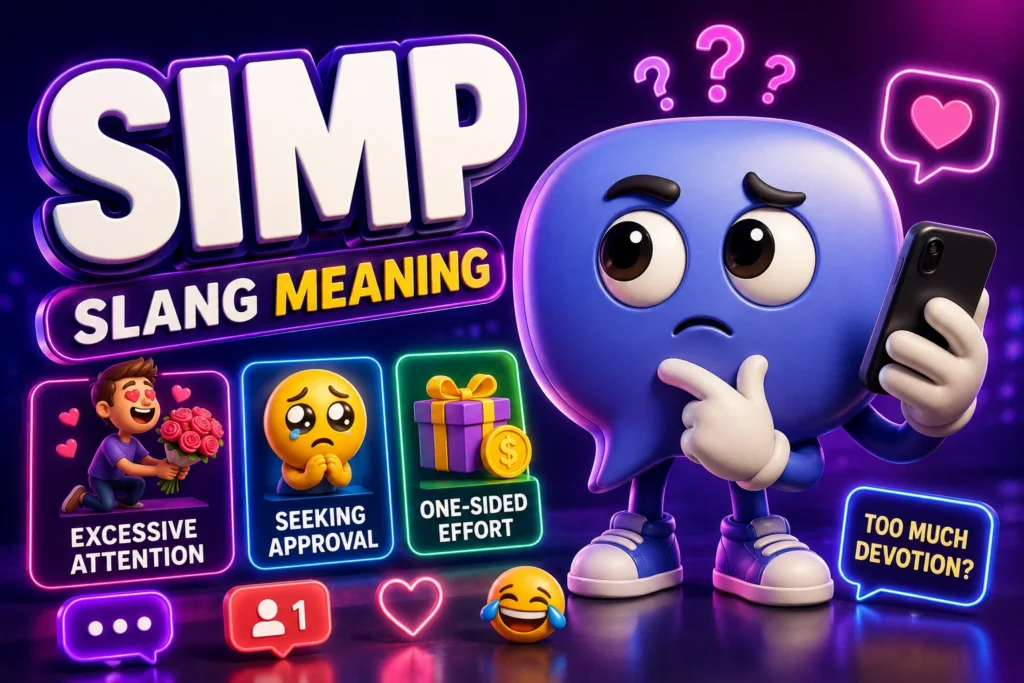
If someone calls a person a simp, they usually mean that the person is showing excessive admiration, attention, or devotion toward someone—often a romantic interest—without receiving the same level of interest in return. Today, the term is commonly used both seriously and jokingly across social media.
Unlike many internet abbreviations, simp is not an acronym. Although fake expansions circulate online, they are myths. The word is simply a slang term with documented use dating back decades before it became a viral TikTok expression.
In this guide, you’ll learn the real meaning of simp, where it came from, how it’s used today, and when it’s meant as a joke versus an insult.
What Does “Simp” Mean in Slang?
The most common meaning of simp is:
Someone who goes overboard trying to impress, please, or gain the affection of another person, usually when that attention isn’t equally returned.
The word often suggests that someone is sacrificing too much time, money, effort, or self-respect because they like someone.
Examples:
- “He’s simping again.”
- “Don’t be such a simp.”
- “She posted one selfie and now everyone is simping.”
However, context matters. Friends often use the word playfully, while strangers may intend it as criticism.
Is “Simp” an Acronym?
No.
Simp is not an acronym or abbreviation.
You may see people online claim it stands for phrases like:
- “Suckers Idolizing Mediocre P****”
- Other invented expansions
These are false backronyms that appeared long after the slang became popular.
The real word simp has existed independently for decades and originally developed as a shortened form of simpleton, meaning a foolish or gullible person.
All Real Meanings of “Simp”
Although the core idea remains similar, simp has several real meanings depending on context.
1. Someone Who Shows Excessive Romantic Devotion (Most Common)
This is the meaning most people recognize today.
A simp is someone who:
- constantly seeks another person’s approval
- gives expensive gifts hoping for affection
- always agrees with someone they like
- ignores poor treatment because of a crush
Example:
“He’s simping over someone who barely knows he exists.”
The implication is that the effort isn’t balanced or appreciated.
2. Someone Who Overly Praises a Celebrity or Influencer
Online, simp isn’t limited to dating.
People also say someone is simping for:
- streamers
- YouTubers
- musicians
- athletes
- fictional characters
- influencers
Example:
“You’re simping for your favorite actor again.”
This usually means showing excessive admiration.
3. Playful Friend-to-Friend Joke
Many friends now use simp without any negative intent.
Example:
A: You bought your girlfriend flowers?
B: Yeah.
A: Simp.
Everyone laughs.
In conversations like this, the speaker often isn’t criticizing kindness—they’re teasing a friend.
4. Meme Slang
Modern meme culture uses simp in exaggerated ways.
Examples:
- “Certified simp.”
- “Simp detected.”
- “Professional simp.”
- “Maximum simping.”
These expressions are often humorous rather than serious.
A Common Misunderstanding
One of the biggest misunderstandings is that being kind automatically makes someone a simp.
That’s not what the slang originally meant.
Being respectful, buying gifts, supporting a partner, or showing affection does not automatically make someone a simp. The slang generally implies excessive, one-sided devotion or seeking approval without healthy boundaries.
Another misunderstanding is that simp only applies to men.
Not true.
Although the word has often been directed at men in online culture, people now use it for any gender. Someone might jokingly say a woman is “simping” over a celebrity, fictional character, or romantic interest.
Which Apps Use “Simp”?
TikTok
TikTok played a major role in making simp mainstream.
You’ll commonly see:
- dating advice
- relationship memes
- comedy skits
- reaction videos
- gaming clips
Popular captions include:
- “Simp behavior.”
- “Caught simping.”
- “Stop simping.”
Instagram users often write:
- “Everyone is simping in the comments.”
- “Simp alert.”
- “Certified simp.”
The slang appears frequently under celebrity photos and influencer posts.
X (Formerly Twitter)
On X, simp appears in:
- memes
- sports discussions
- entertainment posts
- gaming communities
- celebrity conversations
Example:
“Half the replies are just people simping.”
YouTube
The word regularly appears in:
- livestreams
- gaming content
- podcasts
- reaction videos
- comedy channels
Many creators jokingly call themselves “simps” for their favorite games, TV shows, or celebrities.
Snapchat
Among friends, Snapchat users may say:
- “You’re simping 😂”
- “Major simp.”
- “Quit simping.”
These messages are usually playful.
People sometimes use simp in private chats when teasing friends about crushes or relationships.
It’s much less common in formal conversations or workplace group chats.
Grammar: How Is “Simp” Used?
The slang is surprisingly flexible.
As a Noun
This is the most common use.
Examples:
- “He’s a simp.”
- “She’s such a simp.”
- “Don’t be a simp.”
As a Verb
The verb simp or simping is extremely common.
Examples:
- “He’s simping.”
- “Stop simping.”
- “Quit simping over celebrities.”
As an Adjective (Informal)
Sometimes people use it like an adjective.
Example:
- “That’s simp behavior.”
Although technically simp remains a noun, this usage has become common online.
Sentence Position
Beginning:
- “Simp detected.”
Middle:
- “He’s acting like a simp.”
End:
- “That’s such a simp.”
Can It Be a Whole Reply?
Yes.
Example:
A: I drove three hours just to deliver coffee.
B: Simp.
The single-word reply communicates the joke immediately.
Where Did “Simp” Come From?
The history of simp is much older than TikTok.
The word developed as a shortened form of simpleton, meaning a foolish or gullible person. Documented uses of simp date back to the early 20th century, and by the 1960s, it had begun appearing as slang in American English. During the 1980s and 1990s, the term became more widely recognized through hip-hop culture, where it described someone who appeared overly submissive or excessively devoted in romantic situations.
The modern internet meaning took shape years later. Around 2019 and 2020, TikTok, Twitch, Reddit, YouTube, and X helped transform simp into one of the internet’s biggest slang words. Livestreams, gaming communities, reaction videos, and meme pages popularized phrases like “simping,” “simp behavior,” and “simp detected.”
Today, the word is used far more broadly than before. It can describe someone showing excessive admiration toward a crush, a celebrity, a fictional character, or even a favorite sports team. While its tone ranges from playful teasing to genuine criticism, its modern popularity is largely driven by meme culture rather than its older historical meanings.
Four Example Conversations
Funny
A: You bought her coffee, flowers, and dessert?
B: She had a rough day.
A: Simp.
B: Proudly.
Sarcastic
A: He liked every single photo she posted.
B: Every one?
A: Every one.
B: That’s elite-level simping.
Playful
A: You watched her livestream again?
B: Maybe.
A: Simp alert.
B: I’ll accept that.
Serious
A: Do you think I’m trying too hard?
B: Maybe a little.
A: I don’t want to lose myself.
B: Healthy relationships should go both ways.
More Realistic Chat Examples
1. Friends (TikTok)
Emma: You commented first again?
Olivia: So?
Emma: Simp.
Olivia: I prefer “supportive.”
2. Gaming Friends
Alex: You bought every skin because your favorite streamer recommended them?
Jordan: Maybe.
Alex: That’s simping.
Jordan: No regrets.
3. Dating
Chris: I surprised them with dinner.
Taylor: That’s sweet.
Chris: My friends called me a simp.
Taylor: Being thoughtful isn’t simping.
4. Group Chat
Jake: He’s defending his favorite singer again.
Ryan: Every single day.
Jake: Biggest simp I’ve ever seen.
Ryan: Facts.
5. Instagram Comments
Liam: Look at these replies.
Friend: Everyone’s simping.
Liam: Thousands of comments already.
Friend: Internet being the internet.
6. Snapchat Friends
Mia: You replied to her story in five seconds?
Noah: Timing matters.
Mia: Simp.
Noah: Speed is a skill.
7. Siblings
Brother: You’re watching that actor’s interviews again?
Sister: They’re interesting.
Brother: You’re simping.
Sister: I call it appreciation.
8. Coworkers
Mark: You volunteered to cover their shift again?
Sarah: They needed help.
Mark: Careful, people might call you a simp.
Sarah: Helping someone isn’t the same thing.
9. Dating
Emma: He drove two hours just to see me.
Friend: That’s sweet.
Emma: My cousin called him a simp.
Friend: Kindness and simping aren’t always the same thing.
10. Family Group Chat
Dad: Who keeps defending that TV character?
Son: Me.
Dad: You’re a simp for that show.
Son: Absolutely.
11. X (Formerly Twitter)
User 1: Bought another jersey from my favorite player.
User 2: Certified simp.
User 1: I’ll proudly wear that title.
How to Reply to “Simp”
Whether someone means it as a joke or criticism will shape your response.
Funny Reply
- “I’m just committed.”
- “Someone has to support them.”
- “Certified simp with premium membership.”
- “I’ll frame that compliment.”
Serious Reply
- “There’s a difference between kindness and simping.”
- “I’m just treating people respectfully.”
- “Healthy relationships require effort from both sides.”
- “I don’t think caring about someone is a bad thing.”
Flirty Reply
If you’re talking to someone you like:
- “Only for you.”
- “Maybe you’re worth simping for.”
- “Guess you caught me.”
- “Don’t expose me like that.”
Neutral Reply
- “Maybe.”
- “That’s your opinion.”
- “I don’t see it that way.”
- “Fair enough.”
Comparison Table
| Term | Meaning | Tone | Popularity | Confusion Risk |
|---|---|---|---|---|
| Simp | Someone showing excessive admiration or devotion | Humorous / Critical | Very High | Low |
| White Knight | Defending someone mainly to gain approval | Critical | High | Medium |
| Fanboy/Fangirl | Extremely enthusiastic supporter | Playful | High | Low |
| Stan | Dedicated fan who strongly supports someone | Positive / Playful | Very High | Medium |
| Thirsty | Desperate for romantic or sexual attention | Humorous | High | Medium |
| Respectful Partner (Often Confused) | Someone who treats a partner kindly and equally | Positive | High | High |
| Independent (Opposite) | Someone who maintains healthy boundaries and doesn’t seek excessive approval | Neutral | Medium | Low |
One reason simp causes confusion is that people sometimes use it for anyone who is affectionate or thoughtful. Traditionally, however, the term implies excessive or one-sided devotion, not simply being kind.
Who Uses “Simp”?
Gen Z
Gen Z helped turn simp into one of the defining internet slang terms of the late 2010s and early 2020s. It’s common in memes, gaming communities, dating discussions, and reaction videos.
Gen Alpha
Gen Alpha continues using simp, often alongside newer internet slang like rizz, gyatt, sigma, looksmaxxing, and Fanum tax.
Millennials
Many Millennials understand the word because of its widespread use on social media. Some also remember earlier versions of the slang from music and internet forums.
Regional Differences
The slang is most common in the United States, but it is widely recognized throughout Canada, the United Kingdom, Australia, New Zealand, and other English-speaking countries because of social media.
There is no strong evidence that the meaning changes significantly between regions. The tone may vary, but the core definition remains consistent.
Is “Simp” Rude or Safe?
Is It Profanity?
No.
The word itself is not profanity.
Is It Offensive?
It can be.
Among friends, simp is often harmless teasing. However, when directed at someone to mock their relationships or emotions, it can be insulting.
Is It Appropriate for School?
Generally yes.
The word isn’t considered vulgar, although teachers may discourage slang in classroom discussions.
Is It Appropriate for Work?
Usually not.
Professional settings rarely benefit from internet slang, and calling a coworker a simp may sound disrespectful or unprofessional.
Cultural Notes
Modern simp became popular through internet culture, gaming communities, and livestreams. While it has appeared in hip-hop over the years, today’s usage extends well beyond any one community. It is best understood as mainstream online slang rather than a term limited to a single platform or group.
Why Does “Simp” Continue to Stick Around?
The word simp survives because it captures a familiar social dynamic in one short, memorable label. People have always noticed situations where someone seems to be trying too hard to impress a crush, celebrity, or influencer. Internet culture amplified that observation into a joke that is instantly recognizable across platforms. At the same time, discussions about what actually counts as simping have kept the word relevant. Some people use it playfully, while others argue it is overused or unfairly applied to ordinary kindness. That ongoing debate has helped the slang remain part of online conversations long after many viral expressions faded away.
Frequently Asked Questions
What does “simp” mean in slang?
A simp is someone who shows excessive admiration, attention, or devotion toward another person—often a romantic interest—without receiving the same level of interest in return. Today, the word is frequently used jokingly among friends as well as seriously online.
Is “simp” an acronym?
No. Simp is not an acronym or abbreviation. Claims that it stands for phrases like “Suckers Idolizing Mediocre P****” are false backronyms that appeared after the slang became popular.
Can girls be called a simp?
Yes. Although the term was often directed at men when it became popular online, people now use simp for any gender. Someone can be described as simping for a crush, celebrity, influencer, or fictional character regardless of gender.
Is being nice the same as simping?
No. Being respectful, supportive, or caring does not automatically make someone a simp. The slang usually implies excessive, one-sided behavior or sacrificing healthy boundaries to gain someone’s approval.
Is “simp” an insult?
Sometimes. Among friends, it’s often playful teasing. In other situations, it can be used as a criticism or insult, depending on the speaker’s intent and the context.
Is “simp” still popular in 2026?
Yes. While it is no longer the newest internet slang, simp remains widely understood and continues to appear on TikTok, Instagram, YouTube, Twitch, X, Reddit, and in everyday online conversations.
What’s the difference between “simp” and “stan”?
A stan is a devoted fan of a celebrity, creator, or brand, usually without a romantic implication. A simp generally describes someone showing excessive admiration or devotion, often toward a person they are romantically interested in or hoping to impress.
Can “simp” be used as a verb?
Yes. People commonly use the verb simp and the present participle simping. Examples include “Stop simping,” “He’s simping again,” or “They’re simping over that celebrity.”
Conclusion
The slang term simp has evolved from an older word meaning a foolish person into one of the internet’s most recognizable expressions. Today, it usually describes someone who appears overly devoted to another person, especially when the attention or affection isn’t equally returned.
At the same time, context matters. Friends often use simp as lighthearted teasing, while others use it more critically. It’s also important not to confuse genuine kindness with simping—healthy relationships involve mutual respect, not one-sided sacrifice.
Usage Tips
- Use simp in casual conversations or online discussions.
- Remember that it’s slang, not an acronym.
- Consider the tone before using it, since some people may take it as an insult.
- Avoid assuming that every thoughtful or affectionate action counts as simping.
Common Mistakes
- Mistake: Thinking simp is an acronym.
Correct: It is simply a slang word. - Mistake: Calling every kind partner a simp.
Correct: The slang refers to excessive or one-sided devotion, not ordinary kindness. - Mistake: Believing only men can be simps.
Correct: The term can be applied to people of any gender. - Mistake: Using it in formal settings.
Correct: It is best suited to casual conversations and online culture.