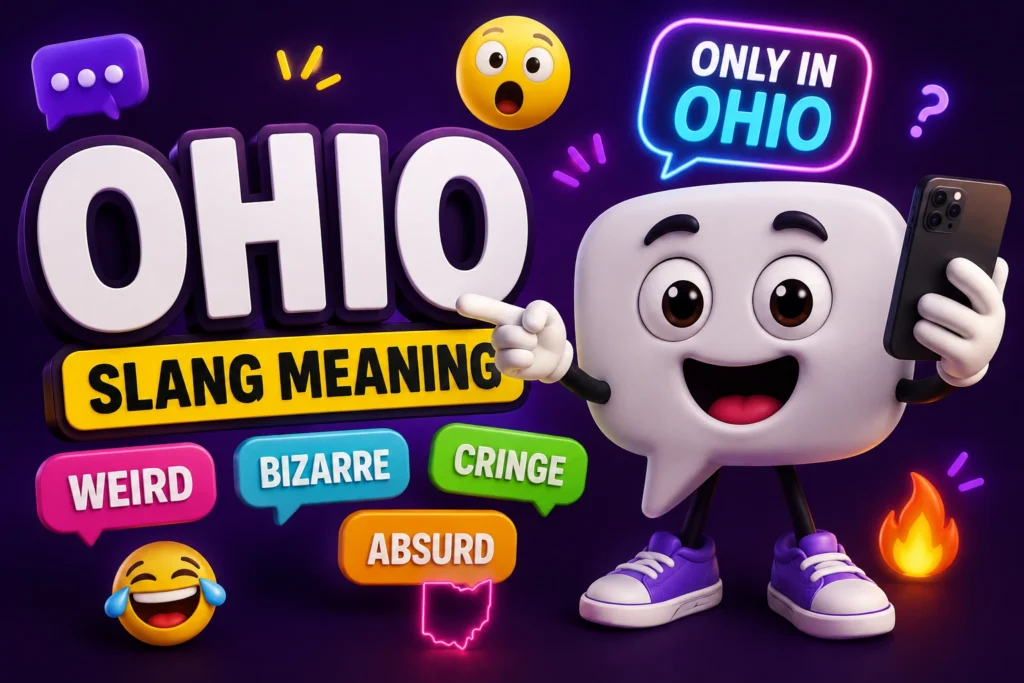
Ohio is internet slang used to describe something weird, absurd, awkward, cringe, or bizarre. Despite being the name of a U.S. state, in modern meme culture calling something “Ohio” usually means it’s so strange that it feels like it belongs in an imaginary world where anything can happen. The slang grew out of the viral “Only in Ohio” meme rather than from any real characteristic of the state.
Today, you’ll often see people comment simply “Ohio”, “so Ohio”, or “Only in Ohio” under unusual videos and photos. The word has also become part of Gen Alpha “brain rot” humor alongside terms like rizz, skibidi, and gyatt.
Is “Ohio” an acronym?
No.
Ohio is not an acronym or abbreviation. It’s simply the name of the U.S. state that evolved into internet slang through memes.
All Real Meanings of “Ohio”
1. Weird, bizarre, or surreal (most common)
This is the meaning almost everyone intends today.
If someone calls a video, person, object, or situation “Ohio,” they’re joking that it’s incredibly strange or chaotic.
Examples:
- “That AI video is so Ohio.”
- “Bro has Ohio cooking skills.”
- “This entire comment section is Ohio.”
The tone is almost always humorous rather than literal.
2. Cringe or awkward
Some people also use “Ohio” for something embarrassing or socially awkward.
Example:
“That pickup line was Ohio.”
Here it means “cringe” rather than simply weird.
3. Random “brain rot” filler
Among Gen Alpha, “Ohio” is sometimes inserted into intentionally nonsensical phrases.
Examples include:
- Ohio rizz
- Ohio sigma
- Ohio gyatt
- Skibidi Ohio
In these cases, the word often isn’t meant to have a precise definition. Instead, it contributes to absurd humor.
A Common Misunderstanding
Many people think internet slang is making fun of actual Ohio.
That’s only partly true.
The meme isn’t based on evidence that Ohio is stranger than other places. Instead, internet users repeatedly joked that every impossible or ridiculous event happened “only in Ohio.” Over time, the joke became so popular that Ohio itself became shorthand for weirdness, even when the content has nothing to do with the real state.
Which Apps Use “Ohio”?
TikTok
TikTok helped make the slang explode.
You’ll frequently find:
- “Only in Ohio”
- “Ohio final boss”
- “Ohio rizz”
Most are meme edits, AI videos, or intentionally bizarre clips.
Instagram Reels and meme pages commonly use “Ohio” in captions describing surreal or cursed content.
X (formerly Twitter)
On X, people often comment:
- “Ohio”
- “That’s so Ohio.”
It’s used as a quick reaction rather than a detailed explanation.
Snapchat
Some younger users include the term in chats and Stories, especially when referencing viral memes or brain-rot humor.
It’s less common than on public social media but still appears in conversations between friends who follow internet memes.
Grammar
“Ohio” is unusually flexible.
Adjective
Most common.
- “That’s Ohio.”
- “That outfit is Ohio.”
Noun (rare)
Sometimes people jokingly refer to something as “an Ohio.”
Example:
- “This video is an absolute Ohio.”
This isn’t standard English but appears in memes.
Standalone reply
Yes.
Someone sends an unbelievably strange video.
Reply:
Ohio.
That single word communicates:
- weird
- absurd
- impossible
- chaotic
depending on context.
Where Did It Come From?
The slang traces back to internet memes from the late 2010s, especially “Only in Ohio.” Those memes paired bizarre photos or videos with captions claiming they happened in Ohio—even when they clearly didn’t.
The joke snowballed across Reddit, Twitter, TikTok, Instagram, and meme pages. By 2022–2023, younger users had shortened the joke so that simply saying “Ohio” meant “weird” or “cringe.”
There is no reliable evidence that this slang comes from AAVE.
Instead, it developed primarily from internet meme culture and later became part of Gen Alpha “brain rot” vocabulary.
Example Conversations
Funny
A: Why is that chicken riding a skateboard?
B: Ohio.
A: Fair enough.
Sarcastic
A: My Wi-Fi disconnected during the meeting.
B: Ohio internet.
A: Honestly, yes.
Playful
A: I accidentally wore two different shoes.
B: That’s so Ohio.
A: I noticed halfway through work.
Serious
A: Did you actually mean that?
B: No, I was just saying “Ohio” because the situation looked ridiculous.
A: Got it.
More Realistic Chat Examples
Friends (TikTok)
Alex: Watch this cat open the refrigerator.
Ben: Ohio.
Alex: Exactly what I thought.
Family
Mom: Why are you laughing?
Son: Someone edited a fish driving a bus.
Mom: That’s impossible.
Son: Exactly. Ohio.
Coworkers
Chris: The printer made 400 blank pages.
Jordan: That’s incredibly Ohio.
Chris: I don’t even know how.
Dating
Taylor: I accidentally waved back at someone who wasn’t waving.
Jamie: Tiny bit Ohio.
Taylor: Thanks for the support.
Gaming
Player 1: That boss teleported through the wall.
Player 2: Ohio mechanics.
Player 1: Definitely a bug.
Group Chat
Emma: Look at this AI-generated giraffe.
Liam: Ohio.
Noah: Peak Ohio.
Snapchat
Friend: My filter turned me into a potato.
You: Ohio moment.
Friend: Literally.
User 1: This edit makes no sense.
User 2: That’s why it’s funny.
User 1: Ohio content.
School
Student: The classroom projector started speaking.
Friend: Ohio school.
Student: I wish I were joking.
Cousins
Cousin: Grandpa accidentally FaceTimed the TV.
You: Ohio technology.
Cousin: He somehow answered himself.
Discord
User A: That mod banned the bot.
User B: Ohio moderation.
User A: Pretty much.
How to Reply
Funny
- “Average Ohio experience.”
- “Can’t even argue with that.”
Serious
- “Yeah, that really was strange.”
- “That explains it.”
Flirty
If the conversation is playful:
- “If that’s Ohio, then I’m moving there with you.”
Neutral
- “True.”
- “Fair.”
- “Makes sense.”
Comparison Table
| Term | Meaning | Tone | Popularity | Confusion Risk |
|---|---|---|---|---|
| Ohio | Weird, bizarre, cringe | Humorous | Very High | Low |
| Cringe | Embarrassing | Negative | Very High | Low |
| Sus | Suspicious | Casual | Very High | Low |
| Skibidi | Brain-rot meme word with changing context | Absurd | Very High | High |
| Rizz | Charisma or flirting ability | Positive | Very High | Low |
| Cursed | Unsettlingly weird | Humorous | High | Medium |
| Normal (opposite) | Ordinary, expected | Neutral | Universal | Very Low |
Who Uses “Ohio”?
The slang is most common among:
- Gen Alpha
- Younger Gen Z
- Meme communities
- TikTok users
- Discord users
- Gaming communities
Older Millennials and Gen X often encounter it because younger relatives or social media introduce the meme.
Outside the U.S., people who consume English-language memes also recognize the slang, even if they’ve never been to Ohio.
Is It Rude or Safe?
Generally, yes.
- Not profanity.
- Safe for school conversations in most situations.
- Safe for workplaces if casual humor is appropriate.
However:
Calling a person “Ohio” may sound insulting if you’re implying they’re weird or embarrassing.
Also remember that the slang isn’t intended as a serious statement about people from the actual state of Ohio.
Why Has “Ohio” Stayed Popular?
Unlike many internet slang terms, “Ohio” is intentionally flexible. It can react to almost any bizarre situation without needing a detailed explanation. That simplicity made it ideal for short-form videos, meme captions, and comment sections. As Gen Alpha embraced increasingly absurd “brain rot” humor, the word evolved from a specific meme into a general symbol for surreal internet comedy rather than a literal reference to geography.
Frequently Asked Questions
What does “Ohio” mean in Gen Alpha slang?
It usually means something is weird, absurd, cringe, or chaotic. It’s a humorous label rather than a literal reference to the U.S. state. The meaning comes from internet memes, especially “Only in Ohio,” where impossible events were jokingly said to happen there. Today it’s one of the best-known pieces of Gen Alpha internet slang.
Why do people say “Only in Ohio”?
The phrase began as a meme caption attached to bizarre images and videos. The joke suggested that impossible events were somehow normal in Ohio. Eventually, the phrase became so widespread that people shortened it to simply saying “Ohio.”
Is “Ohio” actually insulting?
Usually not. Most people use it jokingly about situations rather than individuals. If directed at a person, though, it can imply they’re acting strangely or awkwardly, so context matters.
Does “Ohio” have anything to do with the real state?
Not really. While the meme uses the state’s name, the slang is based on internet humor rather than factual claims about Ohio. The joke became detached from reality as it spread online.
Can adults use “Ohio”?
Yes, but younger internet users may recognize it as Gen Alpha or Gen Z meme slang. Using it ironically is common, while overusing it can sound outdated as internet trends change quickly.
Is “Ohio” still popular?
Yes, although its peak popularity has passed in some online communities. It still appears in memes, comment sections, and “brain rot” jokes, often alongside words like rizz, sigma, and skibidi.
Why is “Ohio” often paired with “rizz”?
The pairing is mostly comedic. “Ohio rizz” exaggerates the idea that someone’s flirting skills are bizarre or awkward. In many memes, combining unrelated slang words is part of the joke rather than a phrase with a fixed definition.
Conclusion
“Ohio” has evolved from the name of a U.S. state into one of the internet’s most recognizable meme slang terms. In most contexts, it means weird, absurd, awkward, or cringe, and it traces back to the viral “Only in Ohio” meme rather than any real stereotype about the state.
Usage Tips
- Use it to react to bizarre or surreal content.
- It’s best suited for casual conversations and memes.
- Understand that it’s ironic, not literal.
- Keep the audience in mind—some people won’t recognize the meme.
Common Mistakes
- Thinking it’s an acronym.
- Assuming it insults everyone from Ohio.
- Using it in formal writing.
- Believing it has a single fixed definition in every meme.
When to Use It
Use “Ohio” in casual chats, memes, gaming, or social media when something feels hilariously strange.
When to Avoid It
Avoid it in professional communication, academic writing, or with audiences unfamiliar with internet meme culture.