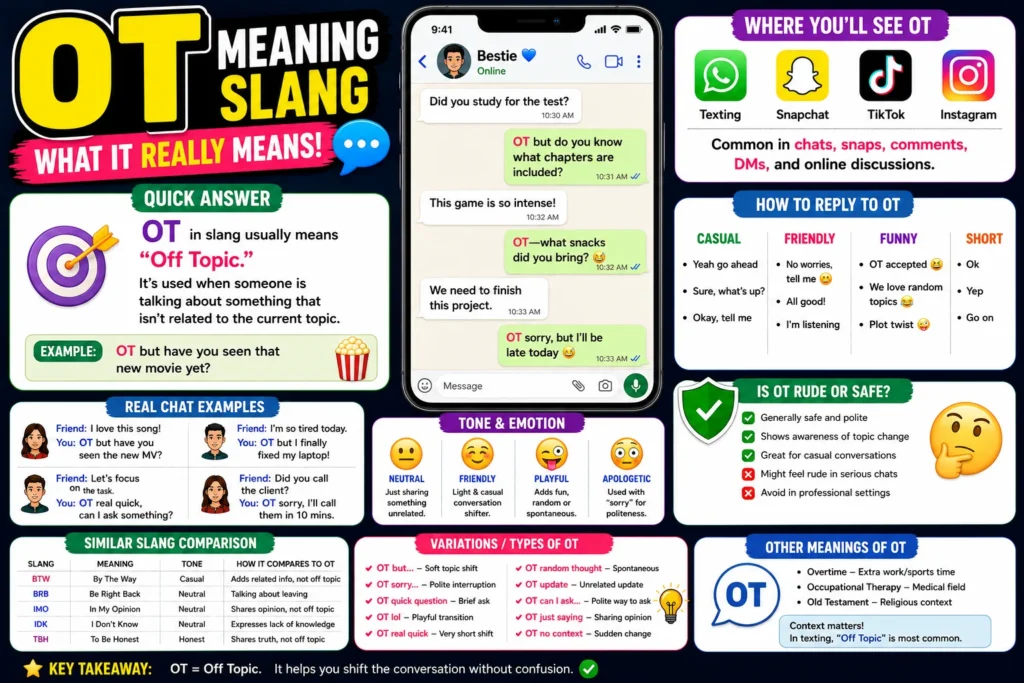
The meaning of “OT” in slang most commonly is “Off Topic.”
People use it when a message or comment doesn’t relate to the current conversation.
In some contexts, OT can also mean “Overtime” (especially in sports or work chats), but in casual texting, “Off Topic” is the primary meaning.
Example:
“OT but have you seen that new movie yet?”
OT Meaning in Text
In everyday texting, OT (Off Topic) is used to signal that you’re about to say something unrelated to the current conversation.
It’s like a quick heads-up so the other person doesn’t get confused.
You’ll often see it in group chats, online discussions, or fast-moving conversations where people jump between topics.
When people use OT:
- Changing the subject suddenly
- Adding a random thought
- Acknowledging they’re off track
- Keeping conversations organized
Natural examples:
- “OT but I just ordered pizza 😅”
- “OT—did you finish the assignment?”
- “Sorry OT, but your outfit today was 🔥”
It’s casual, quick, and widely understood online.
Real Chat Examples (How It Actually Looks)
Here’s how the meaning of OT slang shows up in real conversations:
Conversation 1
Friend: Did you study for the test?
You: OT but do you know what chapters are included?
Conversation 2
Friend: This game is so intense
You: OT—what snacks did you bring? 😂
Conversation 3
Friend: We need to finish this project
You: OT sorry, but I’ll be late today
Conversation 4
Friend: I love this show
You: OT but the actor reminds me of someone lol
These feel natural because OT smoothly shifts the topic without awkwardness.
Emotional Meaning & Tone
“OT” is mostly neutral, but tone depends on how you use it.
What it usually expresses:
- Awareness (you know you’re off topic)
- Casualness
- Slight interruption
- Spontaneity
Tone breakdown:
- Friendly: “OT but you look great today 😄”
- Neutral: “OT—meeting moved to 3pm”
- Slightly rude (rare): “OT, that doesn’t matter”
👉 The key is delivery. Add “sorry” or an emoji to keep it friendly.
OT Meaning from a Girl / Guy
From a Girl:
Often feels more polite or soft, especially when paired with “sorry” or emojis.
Example:
“OT sorry but can I ask you something?”
From a Guy:
Usually more direct and casual, sometimes without extra softening words.
Example:
“OT—did you send that file?”
👉 Same meaning, just a slight difference in tone and delivery.
How to Reply to OT
If someone uses “OT,” they’re just shifting the topic—so respond naturally.
Casual Replies:
- “Yeah go ahead”
- “Haha that’s random but okay”
- “Sure, what’s up?”
Friendly Replies:
- “No worries, tell me 😊”
- “All good, I’m listening”
- “Haha I like random topics”
Funny Replies:
- “OT accepted 😂”
- “We love a random moment”
- “Plot twist conversation lol”
Short Responses:
- “Ok”
- “Yep”
- “Go on”
- “Shoot”
Keep it relaxed—no need to overthink it.
Is OT Rude or Safe to Use?
OT is completely safe to use.
It’s actually polite in many cases because it shows you’re aware you’re changing the topic.
When it works best:
- Group chats
- Casual conversations
- Online discussions
When to be careful:
- Serious or emotional conversations
- Professional settings (use full phrases instead)
Example:
- Good: “OT but quick question…”
- Not ideal: “OT” during a serious discussion
Where You’ll See OT
Texting:
Very common in casual chats and group messages.
Snapchat:
Used in quick replies or when switching topics mid-conversation.
TikTok:
Appears in comments when someone brings up something unrelated.
Instagram:
Seen in DMs or comment threads, especially in longer discussions.
👉 Basically, anywhere conversations move fast.
Similar Slang Comparison
| Slang | Meaning | Tone | Use Case |
|---|---|---|---|
| OT | Off Topic | Neutral | Changing subject |
| BTW | By The Way | Casual | Adding side info |
| BRB | Be Right Back | Neutral | Leaving briefly |
| IDC | I Don’t Care | Dismissive | Showing indifference |
| IMO | In My Opinion | Neutral | Sharing thoughts |
👉 Key Insight:
OT is more intentional than “BTW.”
BTW adds something related, while OT clearly signals a shift away from the topic.
Variations / Types of OT
Here are common ways people use OT:
- OT but… – Softens the topic change
- OT sorry… – Polite interruption
- OT quick question – Signals urgency
- OT lol – Light, playful shift
- OT real quick – Brief interruption
- OT random thought – Casual, spontaneous
- OT question – Direct and simple
- OT can I ask… – Polite lead-in
- OT just saying – Adds opinion
- OT update – Sharing unrelated info
Each version keeps the same meaning but changes tone slightly.
Common Mistakes & Misunderstandings
1. Thinking OT Has Only One Meaning
While “Off Topic” is most common, it can also mean “Overtime” in sports or work chats.
2. Using It in Serious Conversations
It may seem dismissive if someone is discussing something important.
3. Overusing It
Too much “OT” can make conversations feel scattered.
4. Tone Misreading
Without context, it might feel abrupt or random.
Other Meanings of OT
Besides slang, “OT” can also mean:
- Overtime (sports, work hours)
- Occupational Therapy (medical field)
- Old Testament (religious context)
👉 But in texting and online slang, “Off Topic” is the default meaning.
FAQ
What does OT mean in Snapchat?
It means “Off Topic,” used when switching to something unrelated in chat.
What does OT mean from a girl?
Same meaning—usually softer or more polite in tone.
Is OT slang rude?
No, it’s generally polite. It only feels rude in serious conversations.
What does OT mean in texting?
It means “Off Topic,” signaling a shift in conversation.
Can OT mean something else?
Yes, it can mean “Overtime,” but that depends on context.
When should I use OT?
Use it when changing topics casually in chats or online discussions.
Conclusion
Now you know the real meaning of OT slang—it’s a simple, useful way to switch topics without confusing anyone.
It keeps conversations smooth, especially in fast chats where ideas jump around quickly.
Use it naturally, add a little tone with emojis if needed, and it’ll feel completely effortless in your everyday messaging.