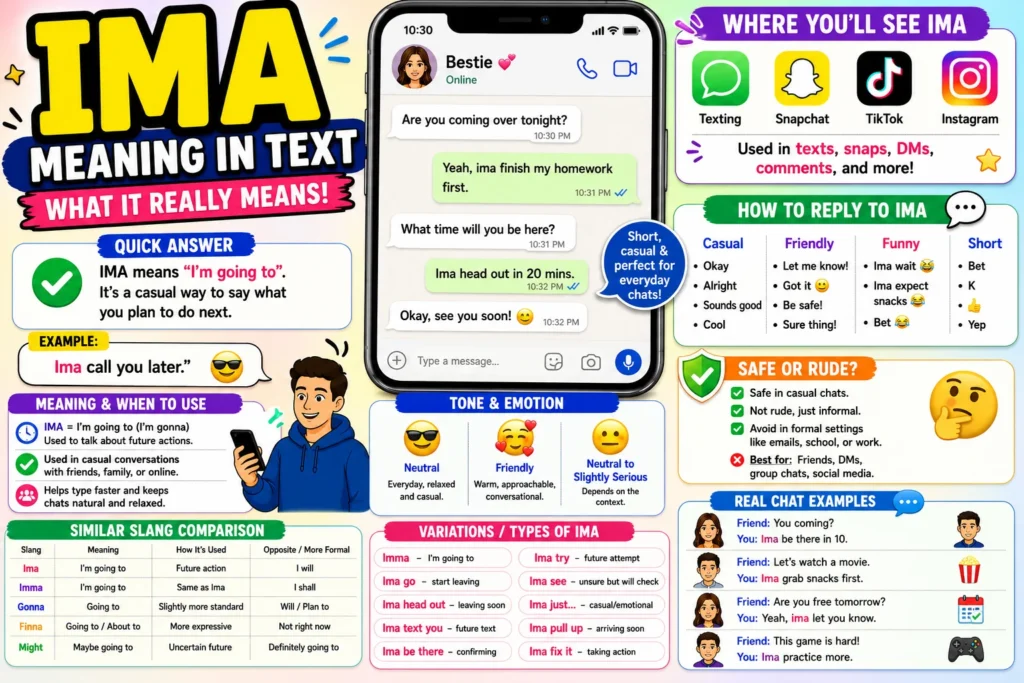
“IMA” means “I’m going to” in texting and online slang. It’s a casual, shortened way to say what you’re about to do.
Sometimes, it can also mean “I’m gonna” (same idea, just even more informal).
People use it to type faster and sound more relaxed in chats.
Example:
“Ima call you later.”
IMA Meaning in Text
In everyday texting, IMA is all about future action—something you’re about to do right now or very soon.
It’s basically a shortcut for:
- I am going to
- I’m gonna
You’ll usually see it in casual conversations where speed matters more than perfect grammar.
It’s super common in:
- Text messages
- Social media comments
- DMs and group chats
Why people use it:
- Faster typing
- Feels natural and conversational
- Matches how we actually speak
Examples:
- “Ima grab some food real quick.”
- “Ima text you when I get there.”
- “Ima start that show tonight.”
Real Chat Examples
Here’s how IMA actually shows up in real conversations:
Conversation 1 (WhatsApp):
Friend: You coming out tonight?
You: Yeah, ima finish my homework first.
Conversation 2 (Snapchat):
Friend: Where you at?
You: Ima head there in 10 mins.
Conversation 3 (Instagram DM):
Friend: Did you watch it yet?
You: Not yet, ima watch it later.
Conversation 4 (Group Chat):
Friend: Who’s bringing snacks?
You: Ima bring chips and drinks.
Emotional Meaning & Tone
IMA usually feels relaxed and casual.
It doesn’t carry strong emotion by itself—it depends on the sentence.
Tone breakdown:
- Friendly: “Ima call you later 😊”
- Neutral: “Ima do it tomorrow.”
- Slightly dismissive (rare): “Ima handle it.” (can sound short if context is tense)
Overall, it’s safe, informal, and everyday slang.
IMA Meaning From a Girl / Guy
From a Girl:
When a girl uses “ima,” it usually sounds:
- Chill and natural
- Friendly or conversational
- Sometimes slightly playful
Example:
“Ima text you when I’m free.”
From a Guy:
From a guy, it typically feels:
- Straightforward
- Casual and relaxed
- Action-focused
Example:
“Ima pull up in 5.”
👉 There’s no major difference—it’s more about personality than gender.
How to Reply to IMA
When someone uses “ima,” you don’t need anything complicated. Just match the vibe.
Casual Replies:
- “Cool 👍”
- “Alright”
- “Sounds good”
Friendly Replies:
- “Okay, let me know!”
- “Got it 😊”
- “Be safe!”
Funny Replies:
- “Ima wait then 😂”
- “Ima expect snacks 👀”
- “Ima judge your choice lol”
Short Responses:
- “Bet”
- “K”
- “👍”
Is IMA Rude or Safe to Use?
IMA is completely safe to use.
It’s not rude at all—but it is informal.
Use it when:
- Chatting with friends
- Messaging casually
- Posting online
Avoid it when:
- Writing emails
- Talking to teachers or bosses
- Professional settings
👉 Think of it like saying “gonna”—fine socially, not for formal situations.
Where You’ll See IMA
Texting:
Very common in everyday conversations.
Snapchat:
Used in quick replies and streak chats.
TikTok:
Seen in captions or comments.
Example: “Ima try this trend.”
Instagram:
Used in DMs and comment sections.
👉 Basically, anywhere people type fast and casually.
Similar Slang Comparison
| Slang | Meaning | How It Compares |
|---|---|---|
| Ima | I’m going to | Main slang, casual |
| Gonna | Going to | Slightly more standard |
| Finna | About to | More expressive, trending |
| Imma | I’m going to | Same as “ima,” just different spelling |
| I will | Formal future tense | Opposite tone (formal) |
| I might | Uncertain future | Less definite than “ima” |
👉 Key Insight:
“Ima” feels quick and certain—you’re not just thinking about doing something, you’ve basically decided already.
Variations / Types of IMA
Here are common ways people use or tweak it:
- Imma – Same meaning, more phonetic spelling
- Ima go – Starting an action
- Ima head out – Leaving soon
- Ima text you – Future communication
- Ima be there – Confirming plans
- Ima try – Showing intention
- Ima see – Slight uncertainty
- Ima just… – Casual or emotional tone
- Ima pull up – Arriving soon
- Ima fix it – Taking responsibility
Common Mistakes & Misunderstandings
1. Using It in Formal Situations
Wrong: “Ima submit the report tomorrow.”
Better: “I will submit the report tomorrow.”
2. Confusing It With “I’m”
“IMA” always implies future action—not present.
3. Overusing It
Using it in every sentence can sound repetitive.
4. Tone Misreading
Short messages like “ima do it” can feel dry if there’s no emoji or context.
Other Meanings of IMA
While slang-wise it means “I’m going to,” IMA can mean other things in different contexts, like:
- Organizations or abbreviations (rare in casual chat)
- Names or acronyms in specific industries
👉 But in texting, 99% of the time it means “I’m going to.”
FAQ
What does IMA mean in Snapchat?
It means “I’m going to,” usually describing what someone is about to do.
What does IMA mean from a girl?
Same meaning—“I’m going to.” Tone may feel more friendly or conversational.
Is IMA rude?
No, it’s not rude. It’s just informal.
Is IMA the same as Imma?
Yes, both mean the same thing. “Imma” is just a different spelling.
Can I use IMA in school or work?
It’s better to avoid it in formal communication.
Does IMA mean something different on TikTok?
No, it keeps the same meaning—“I’m going to.”
What does IMA mean in text?
IMA means “I’m going to.” It’s a casual way to say what you plan to do next.
What does IMA mean on Snapchat?
On Snapchat, IMA is used the same way—usually to quickly say what you’re about to do.
What does IMA mean from a girl?
It still means “I’m going to,” but the tone may feel more friendly or conversational depending on context.
Is IMA slang or proper English?
IMA is slang. It’s not considered proper English and shouldn’t be used in formal writing.
Is IMA the same as Imma?
Yes, both mean “I’m going to.” “Imma” is just a more phonetic spelling.
When should you not use IMA?
Avoid using it in professional settings like emails, school assignments, or formal conversations.
Does IMA mean something different on TikTok or Instagram?
No, the meaning stays the same—it still means “I’m going to.”
Conclusion
“IMA” is one of those slang terms that feels natural once you start using it. It’s quick, casual, and perfect for everyday conversations.
As long as you keep it in informal settings, you’ll sound relaxed and up-to-date without overthinking it.