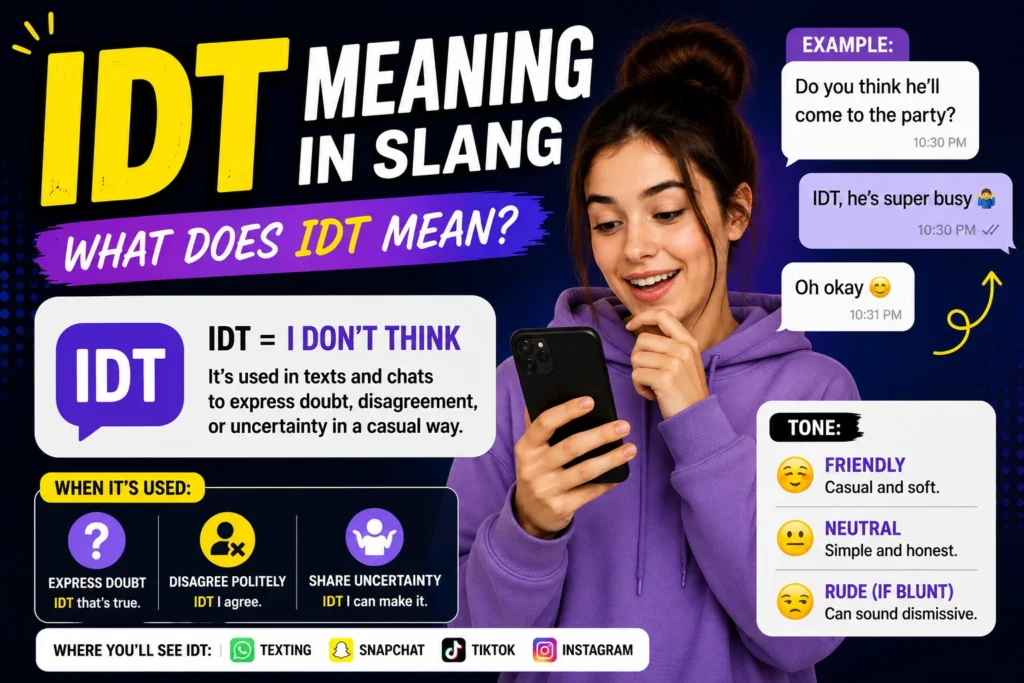
“IDT” in slang usually means “I Don’t Think.” It’s commonly used in texting to express doubt, disagreement, or uncertainty.
Sometimes, it can also imply a soft or polite “no” depending on the context.
In everyday chats, people use it to avoid sounding too direct while still sharing their opinion.
Example:
“I DT he’s coming tonight.”
IDT Meaning in Text
“IDT” is an abbreviation/initialism, not a true acronym — it’s read letter-by-letter (“eye-dee-tee”), not pronounced as a word the way acronyms like “NASA” are.
“IDT” stands for “I Don’t Think,” and you’ll mostly see it in casual texting or online conversations.
It’s a quick way to respond when you’re unsure about something or when you disagree—but don’t want to sound harsh.
People use it because it feels softer than saying “no” or “you’re wrong.”
When it’s used:
- To express doubt
- To disagree politely
- To avoid sounding too blunt
Examples:
- “IDT that’s a good idea.”
- “IDT she meant it like that.”
- “IDT I can make it tonight.”
Real Chat Examples
Conversation 1:
Friend: You coming to the party later?
You: IDT, I’ve got too much work.
Conversation 2:
Friend: He likes you, trust me
You: IDT lol, he barely talks to me
Conversation 3:
Friend: That movie was amazing
You: IDT it was that great tbh
Conversation 4:
Friend: Think they’ll cancel school tomorrow?
You: IDT, the weather isn’t that bad
Conversation 5 (Sibling, iMessage):
You: is mom still mad about the car thing
Sibling: IDT, she seemed fine at dinner
You: good, I was scared to go home
Sibling: you’re safe lol
Conversation 6 (Coworker, Slack):
Coworker: will the client sign off by Friday?
You: IDT, they’ve been slow on every round so far
Coworker: okay, I’ll push the timeline back a bit
You: probably safer, yeah
Conversation 7 (Group chat, Snapchat):
Friend 1: are we still doing the trip next month?
You: IDT tbh, nobody’s confirmed flights yet
Friend 2: yeah same energy from me
Friend 1: okay let’s revisit this weekend
Conversation 8 (Dating, texting):
Date: do you think he still likes his ex?
You: idt, he never brings her up anymore
Date: good, was just checking
You: you have nothing to worry about
Conversation 9 (TikTok comment reply):
Commenter: is this actually true or just a theory
You: idt it’s confirmed anywhere tbh
Commenter: yeah that’s what I figured
You: worth fact-checking before sharing it
Conversation 10 (Parent/teen texting):
Parent: will you be home for dinner?
You: idt, practice is running late again
Parent: okay, I’ll save you a plate
You: thank you 🙏
Emotional Meaning & Tone
“IDT” is interesting because it’s not just about what you say—it’s about how you say it.
Friendly Tone
When used with emojis or “lol,” it feels light and casual.
Example: “IDT 😂”
Neutral Tone
Simple and straightforward without emotion.
Example: “IDT that’s true.”
Slightly Rude Tone
If used bluntly, it can come off dismissive.
Example: “IDT you know what you’re talking about.”
Sarcastic Tone
Used when the doubt is exaggerated for comedic effect rather than genuine uncertainty.
Example: “IDT that’s ever gonna happen 💀”
It really depends on context and how well you know the person.
IDT Meaning from a Girl / Guy
From a Girl
When a girl uses “IDT,” it often sounds softer or more indirect.
It can mean she disagrees but doesn’t want to sound too harsh.
Example: “IDT that’s a good idea” → polite disagreement
From a Guy
Guys tend to use it more directly.
It may come across as straightforward or even slightly blunt.
Example: “IDT that’s happening” → firm opinion
These are general conversational patterns some users notice, not a rule — plenty of people don’t follow this pattern at all, and tone depends far more on the individual and the relationship than on gender.
How to Reply to IDT
Casual Replies
- “Yeah, maybe you’re right”
- “Fair enough”
Friendly Replies
- “Haha okay, we’ll see”
- “No worries, I get it”
Funny Replies
- “IDT you’re ready for this convo 😄”
- “IDT… but what if I am?”
Short Responses
- “Got it”
- “Alright”
- “Cool”
Serious Replies
- “Okay, what makes you doubt it?”
- “Got it, let’s figure out a backup plan then”
Is IDT Rude or Safe to Use?
School and Workplace Appropriateness
“IDT” is fine for casual peer messaging but should be avoided in formal emails, professional Slack/Teams messages, or academic writing — spell out “I don’t think” in those contexts instead.
Cultural Sensitivity Notes
There are no significant cultural sensitivity concerns tied to this term — it’s a neutral, tone-dependent abbreviation with no offensive or exclusionary history.
Short answer: It’s generally safe—but context matters.
“IDT” is not inherently rude. It’s actually a softer way of disagreeing.
However, tone can shift depending on:
- How direct your message is
- Whether you add emojis or soften it
- Your relationship with the person
Safe: “IDT I can make it, sorry!”
Rude: “IDT that makes any sense.”
Where You’ll See IDT
Texting
Most common place—quick, casual replies.
Snapchat
Used in chats or captions when reacting to something.
TikTok
Appears in comments when people disagree or doubt a claim.
Used in DMs or comment sections for opinions.
Used less often than in Snapchat or TikTok, since WhatsApp skews toward longer personal messages — but still appears in quick replies between people who already know each other.
X (formerly Twitter)
Shows up in reply threads when someone is expressing doubt about a claim or news post, functioning as a quick, public hedge rather than a private message.
Similar Slang Comparison
| Slang | Meaning | Tone |
|---|---|---|
| IDT | I don’t think | Soft disagreement |
| IMO | In my opinion | Neutral |
| TBH | To be honest | Honest/blunt |
| IDC | I don’t care | Dismissive |
| NGL | Not gonna lie | Casual honesty |
| YK | You know | Conversational |
👉 Key Insight
“IDT” sits in a sweet spot—it’s less harsh than “no” but still clear enough to express doubt. That’s why it’s so popular in everyday chats.
Variations / Types of IDT
IDT
Basic form—simple disagreement or doubt.
IDT lol
Adds humor or lightness.
IDT 😂
Clearly joking or playful tone.
IDT tbh
More honest or direct.
IDT tho
Adds emphasis or contrast.
IDT so
Softens the statement further.
IDT anymore
Used when something used to be true but isn’t now.
IDT rn
Means “I don’t think right now.”
IDT yet
Implies possibility in the future.
IDT at all
Stronger disagreement.
Common Mistakes & Misunderstandings
Tone Confusion
People may think you’re being rude when you’re just being honest.
Wrong Usage
Using it in formal settings (emails, work chats) can feel too casual.
Overuse
If you say “IDT” too often, it can make you sound negative or dismissive.
Other Meanings of IDT
Outside of casual texting, “IDT” has a couple of other documented meanings. In gaming and Discord chat, it’s sometimes used to mean “I Didn’t Try” — typically said after a loss, half as an excuse and half as a joke. Separately, IDT is also the name of a real company, Integrated Device Technology, Inc., a semiconductor manufacturer — unrelated to the texting slang. If you see “IDT” outside of a casual chat, context will usually make clear which meaning is intended.
While “I Don’t Think” is the most common slang meaning, “IDT” can also stand for other things in different contexts—but those are rarely used in texting.
In casual conversations, it almost always means the slang version.
Origin & History of IDT
Abbreviations like “IDT” trace back to the early SMS era, when text messages were capped at 160 characters and phones relied on slow T9 predictive typing. Users developed shorthand to fit more meaning into fewer keystrokes, and hedging phrases like “I don’t think” — already common in spoken English — were natural candidates for shortening.
Unlike trend-based slang that fades after a viral moment, “IDT” has stuck around because it mirrors a genuinely common way people soften opinions in everyday speech, not just text.
FAQ
What does IDT mean in Snapchat?
It means “I Don’t Think,” usually used to express doubt or disagreement in chats.
What does IDT mean from a girl?
It usually sounds softer—like a polite or indirect way of disagreeing.
What does IDT mean from a guy?
It can be more direct and straightforward, depending on tone.
Is IDT rude?
Not usually. It depends on how you phrase the sentence and context.
Can IDT be used in serious conversations?
Yes, but it may sound too casual. Better to use full phrases in formal situations.
Is IDT the same as “no”?
Not exactly. It’s softer and less direct than saying “no.”
Does IDT mean “I Didn’t Try”?
Occasionally, but only in specific contexts — mainly gaming and Discord chat, where someone might type it after losing a match. Outside of gaming, this meaning is rare. In everyday texting, Snapchat, or Instagram DMs, “IDT” means “I don’t think” more than 90% of the time. If the context involves a game or competitive loss, “I Didn’t Try” is worth considering.
Is IDT the same as IDK?
No — they express different things. “IDK” means “I don’t know,” signaling a lack of information, while “IDT” means “I don’t think,” signaling doubt or a leaning opinion. You’d use “IDK” if you genuinely have no idea, and “IDT” if you have a hunch but aren’t fully certain.
Quick recap:
If it’s a gaming context, double-check whether “I Didn’t Try” fits better than “I don’t think.”
Use IDT for casual doubt or soft disagreement, not formal writing.
Add “lol,” “tbh,” or an emoji to soften a blunt-sounding IDT.
Don’t assume gendered usage patterns apply to everyone.
“IDT” is one of those small slang terms that does a lot of work. It helps you disagree, express doubt, or share your opinion—without sounding too harsh.
Once you understand the tone behind it, you can use it naturally in conversations and avoid misunderstandings.
Use it casually, keep it friendly, and you’ll sound like you’ve been texting this way forever.