
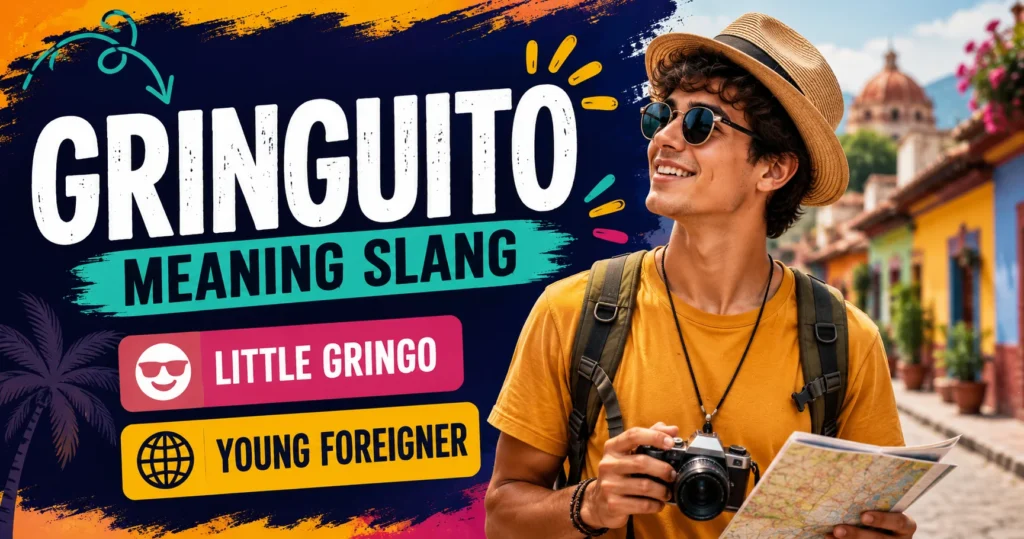
Gringuito is a Spanish slang word meaning “little gringo” or “young foreigner.” It’s usually used playfully or affectionately toward a non-Latin American person, but its tone can range from friendly to mildly teasing depending on the speaker, country, and situation.
What Does Gringuito Mean in Slang?
If you’ve seen gringuito on TikTok, Instagram, or in a Spanish conversation, it most often refers to:
- A young foreigner, especially someone from the United States or another English-speaking country.
- A tourist who stands out because they’re clearly not local.
- A foreign friend in an affectionate or teasing way.
- Someone viewed as inexperienced with local customs or language.
The exact meaning depends almost entirely on context, relationship, and tone.
Unlike many internet abbreviations, gringuito is an actual Spanish word, not an acronym.
Is Gringuito an Acronym, Abbreviation, or Slang Word?
Gringuito is a slang noun and a diminutive form of the Spanish word “gringo.”
It is formed by adding the Spanish diminutive suffix “-ito” to gringo.
- Gringo → foreigner (commonly referring to an American or English-speaking foreigner in many Latin American countries)
- Gringuito → little gringo, young gringo, or dear gringo
In Spanish, diminutives often make words sound:
- More affectionate
- More playful
- Less harsh
- Sometimes slightly humorous
However, a diminutive doesn’t automatically make a word kind. Like many slang terms, the speaker’s intent determines whether it sounds friendly, teasing, or mildly insulting.
The Primary Meaning: “Little Gringo”
The most common meaning of gringuito is simply:
A small, young, or affectionately described gringo.
This doesn’t necessarily refer to someone’s physical size.
Instead, it may describe:
- a young traveler
- a foreign exchange student
- someone’s foreign boyfriend or girlfriend
- a tourist learning Spanish
- an American child visiting Latin America
Example
A: ¿Quién es ese gringuito?
B: Es un estudiante de intercambio.
Translation:
A: Who’s that little foreign guy?
B: He’s an exchange student.
Here, the word simply identifies someone as a foreign visitor.
Does Gringuito Always Refer to Americans?
Not always.
Although gringo often refers to people from the United States, usage varies across Spanish-speaking countries.
Depending on the region, gringuito may describe:
- Americans
- Canadians
- British travelers
- Australians
- Europeans who clearly appear foreign
- Any English-speaking tourist
Some countries use gringo almost exclusively for Americans, while others apply it more broadly to foreigners. Because meanings differ regionally, it’s best to avoid assuming everyone uses the term in exactly the same way.
Can Gringuito Be Positive or Negative?
Yes.
The word itself isn’t automatically offensive.
Instead, its tone depends on:
- facial expression
- relationship
- context
- body language
- intention
Friendly
Ese gringuito habla muy bien español.
Translation:
That foreign guy speaks Spanish really well.
This is often genuine praise.
Playful
Mira al gringuito intentando bailar salsa.
Translation:
Look at the little foreigner trying to dance salsa.
Friends might say this jokingly without intending offense.
Mildly Teasing
Someone might jokingly call a tourist gringuito because they’re obviously unfamiliar with local customs.
The teasing is usually lighthearted rather than hostile.
Negative
If spoken with contempt or sarcasm, gringuito can become dismissive or insulting.
Like many labels, the tone—not the word alone—determines whether it’s offensive.
Why Do People Search for “Gringuito Meaning Slang”?
Many English speakers encounter gringuito for the first time:
- while traveling
- watching TikTok videos
- reading Instagram comments
- listening to Spanish music
- watching Latin American YouTube creators
- chatting with Spanish-speaking friends
Because automatic translators often return “little gringo,” people wonder whether it’s:
- an insult
- a compliment
- a nickname
- a joke
The answer is usually:
It depends on the relationship and context.
Other Genuine Uses of Gringuito
A Friendly Nickname
Some Spanish speakers affectionately call a close foreign friend gringuito.
Example:
¡Hola, gringuito! ¿Cómo estás?
This resembles calling someone:
- buddy
- amigo
- little dude
The familiarity changes how the word feels.
Referring to a Tourist
Locals sometimes use gringuito when talking about visitors.
Example:
El gringuito preguntó dónde estaba la playa.
Translation:
The tourist asked where the beach was.
Here, the term is descriptive rather than emotional.
Talking About Children
Because the -ito ending naturally suggests smallness or affection, adults may use gringuito for children visiting from another country.
Example:
Ese gringuito es muy educado.
Translation:
That little foreign boy is very polite.
This usage is generally neutral or affectionate.
How Gringuito Is Used on Different Platforms
Gringuito on TikTok
TikTok has introduced many users to the word through:
- travel videos
- language-learning content
- Latin American creators
- cultural humor
Creators sometimes jokingly refer to tourists as gringuitos, especially when reacting to visitors trying local foods, customs, or dances.
In these videos, the tone is usually playful rather than insulting.
Gringuito on Instagram
Instagram captions and comments often use gringuito when discussing:
- travel photos
- international relationships
- vacation memories
- cultural experiences
Example:
Mi gringuito favorito ❤️
Translation:
My favorite little gringo.
In this context, the nickname is affectionate.
Gringuito on WhatsApp
On WhatsApp, the word appears mainly in personal conversations between friends or family members.
Someone might say:
El gringuito ya llegó.
Translation:
The foreign guy has arrived.
Whether it sounds friendly or teasing depends on the relationship between the speakers.
Gringuito on X (formerly Twitter)
On X, gringuito occasionally appears in discussions about:
- travel
- football (soccer)
- language learning
- cultural observations
- current events involving foreigners
Because posts on X lack facial expressions or vocal tone, readers sometimes misinterpret whether the word is meant humorously or critically.
Tone & Context Variations
Funny
A: Did you try spicy salsa?
B: The waiter called me “gringuito” afterward.
A: That’s because you nearly drank the hot sauce!
B: I learned my lesson.
Sarcastic
A: You said you were basically a local after one vacation.
B: Then someone called me “gringuito.”
A: Reality hit fast.
B: Apparently so.
Playful
A: Everyone keeps calling me gringuito.
B: That’s because you’re trying so hard to roll your R’s.
A: I’m improving!
B: Keep practicing.
Serious
A: Someone called me gringuito today. Should I be offended?
B: Not necessarily. Listen to the tone and consider who said it.
A: So context matters?
B: Exactly.
Real Chat Examples
1. Travel
A: Everyone kept calling me gringuito.
B: Were they smiling?
A: Yes.
B: Then it was probably friendly.
2. Restaurant
A: The waiter laughed and said, “Gracias, gringuito.”
B: Did it sound rude?
A: Not at all.
B: Then it was likely playful.
3. Language Class
A: My teacher jokingly called me gringuito.
B: That’s a good sign.
A: Really?
B: It usually means they’re comfortable joking with you.
4. Instagram
A: Why did someone comment “gringuito”?
B: They probably noticed you’re traveling abroad.
A: Makes sense.
B: It’s common in travel posts.
5. Friends
A: My friend’s family calls me gringuito.
B: Do they treat you warmly?
A: Absolutely.
B: Then it’s almost certainly affectionate.
6. Vacation
A: I finally ordered food in Spanish.
B: Nice!
A: They still called me gringuito.
B: Your accent probably gave you away.
7. TikTok Comment
A: Someone replied, “Nice try, gringuito 😂.”
B: They were probably joking about your pronunciation.
A: I figured as much.
B: That’s common in language-learning videos.
8. Exchange Student
A: My host family calls me gringuito every day.
B: Do they smile when they say it?
A: Always.
B: Then it’s most likely a nickname.
9. Soccer Match
A: The locals kept calling me gringuito during the game.
B: Were they laughing with you?
A: Yeah, everyone was friendly.
B: Sounds like harmless teasing.
10. WhatsApp Group
A: Who’s the new gringuito in the group?
B: He’s an exchange student from Canada.
A: Welcome!
B: He’s learning Spanish quickly.
11. Coffee Shop
A: The barista remembered me and said, “Hola, gringuito!”
B: That’s a good sign.
A: I guess I’m becoming a regular.
B: Exactly.
Grammar & Language Role
Part of Speech
Gringuito is a noun. It refers to a person and functions much like words such as tourist, friend, or neighbor.
Examples:
- Ese gringuito habla español muy bien.
- El gringuito volvió este verano.
Sentence Position
Beginning
Gringuito, ven acá.
(Used as a nickname when addressing someone.)
Middle
Ese gringuito siempre prueba la comida local.
End
Conocimos a un gringuito.
Can It Replace a Full Sentence?
No.
Unlike abbreviations such as LOL or IG, gringuito is a noun and cannot stand alone as a complete response in a conversation.
Formal vs Informal Register
| Usage | Register |
|---|---|
| Gringuito | Informal |
| Gringo | Informal |
| Foreigner | Neutral |
| International visitor | Formal |
| Tourist | Neutral |
Because it is slang, gringuito is generally unsuitable for formal reports, academic writing, or official communication.
How to Reply if Someone Calls You “Gringuito”
Funny Reply
Guilty! I’m still working on my Spanish. 😄
Serious Reply
What do you mean by gringuito?
This is a polite way to clarify the speaker’s intention if you’re unsure about the tone.
Flirty Reply
(Only if appropriate and the situation is clearly playful.)
Maybe—but this gringuito bought you coffee. 😉
Neutral Reply
Haha, I’m still learning.
or
Fair enough.
Comparison Table
| Term | Meaning | Usage Context | Tone | Popularity | Confusion Risk |
|---|---|---|---|---|---|
| Gringuito | Little gringo / young foreigner | Casual Spanish conversations | Playful to neutral | Medium | Medium |
| Gringo | Foreigner (often American) | Everyday Spanish slang | Neutral to varied | Very High | Medium |
| Extranjero | Foreigner | Formal and neutral Spanish | Neutral | High | Low |
| Turista | Tourist | Travel context | Neutral | High | Very Low |
| Local (opposite) | Resident of the area | Everyday conversation | Neutral | High | Very Low |
Who Uses This Term?
Age Group Breakdown
- Teens (13–18): Occasionally use it in social media jokes, memes, and travel content.
- Young adults (18–35): Common among travelers, exchange students, bilingual communities, and online creators.
- Adults (35+): Frequently use it in everyday spoken Spanish, especially when referring to foreign visitors.
Gen Z vs Millennials
Gen Z
Gen Z is more likely to encounter gringuito through:
- TikTok travel videos
- Instagram Reels
- language-learning creators
- meme content
- international friendships
Millennials
Millennials are more likely to hear or use the term while:
- traveling
- living abroad
- working internationally
- communicating with Spanish-speaking friends or colleagues
Regional Usage
The word appears across many Spanish-speaking countries, but its meaning and emotional tone vary.
Generally:
- It commonly refers to a foreigner, often from the United States or another English-speaking country.
- In some places, it may be used more broadly for non-local visitors.
- Whether it feels affectionate, humorous, neutral, or mildly critical depends on local usage and the relationship between the speakers.
Because regional differences exist, it’s best not to assume the word carries the same meaning everywhere.
Platform Usage
| Platform | Typical Usage |
|---|---|
| TikTok | Travel videos, language learning, cultural humor |
| Travel captions, comments, international relationships | |
| Personal chats among friends and family | |
| X (formerly Twitter) | Cultural discussions, travel, sports, and current events |
The term is not commonly used on Snapchat as a recurring piece of internet slang, so it is generally omitted from Snapchat-specific discussions.
Origin & Internet Culture
Gringuito comes from the Spanish word gringo, combined with the diminutive suffix -ito.
The suffix -ito is widely used in Spanish to indicate:
- small size
- affection
- familiarity
- endearment
- playful emphasis
As a result, gringuito often softens the tone of gringo, though it does not automatically make the word positive.
The exact origin of gringo itself has been debated for many years, and several popular stories circulate online. However, many of these stories—such as claims that it originated from the phrase “Green, go home!”—lack historical evidence. Linguists generally agree that the precise origin remains uncertain, while the word has been documented in Spanish for centuries with meanings that evolved over time.
In modern internet culture, gringuito appears mainly in:
- travel vlogs
- language-learning videos
- cultural exchange content
- humorous posts about tourists adapting to life abroad
It is not associated with AAVE and does not originate from internet slang. Instead, it is a traditional Spanish word that has become more visible online through global social media.
Safety & Appropriateness
Is Gringuito Offensive?
Not inherently.
Most uses are:
- affectionate
- playful
- descriptive
- mildly teasing
However, like many labels, it can become offensive if used with obvious hostility or prejudice.
Does It Contain Profanity?
No.
The word contains no profanity or explicit language.
Is It Appropriate for School or Work?
It depends.
In casual conversation, the word is generally acceptable.
In professional or formal settings, it is usually better to use neutral terms such as:
- foreign visitor
- international student
- tourist
- traveler
Cultural Sensitivity
Because the word refers to nationality or foreign identity, avoid assuming that everyone will interpret it the same way. If you are speaking with someone you do not know well, a neutral description is often the safer choice.
Real-World Observation
One reason gringuito continues to appear in both real life and online conversations is that it reflects cultural interaction rather than internet trends alone. Travelers, exchange students, and bilingual communities often encounter the term while navigating new cultures, and many describe hearing it with a smile or laugh rather than hostility. Like many nicknames, its meaning is shaped less by the dictionary definition and more by the relationship between the people involved.
Frequently Asked Questions
What does gringuito mean in slang?
In slang, gringuito usually means “little gringo” or “young foreigner.” It often refers to an American or another English-speaking visitor, though the exact meaning varies by region and context.
Is gringuito an insult?
Not necessarily. In many conversations, it is used playfully or affectionately. However, like many descriptive labels, it can sound insulting if spoken with obvious sarcasm or hostility.
Is gringuito the same as gringo?
Not exactly. Gringuito is the diminutive form of gringo. The -ito ending often adds a sense of affection, familiarity, or playfulness, although context still matters.
Does gringuito only refer to Americans?
No. While it often refers to Americans in many regions, some Spanish speakers use it more broadly for foreigners or English-speaking visitors from countries such as Canada, the United Kingdom, or Australia.
Why do people call tourists gringuito?
Locals may use the term when a visitor clearly appears unfamiliar with the language or local customs. In many cases, it’s intended as a lighthearted nickname rather than a criticism.
Is gringuito common on TikTok?
Yes, it occasionally appears in travel videos, language-learning content, and cultural humor. It is usually used jokingly when creators discuss tourists or life abroad.
Can I call myself gringuito?
Yes. Many travelers and language learners jokingly refer to themselves as gringuito in social media posts or videos. Self-use is often humorous and shows awareness of being an outsider.
Should I be offended if someone says gringuito?
Not automatically. Consider the speaker’s tone, facial expression, and relationship with you. In many everyday interactions, the term is meant as a friendly or playful nickname rather than an insult.
Conclusion
If you’re wondering about the gringuito meaning in slang, it generally refers to a “little gringo” or young foreigner, often someone from the United States or another English-speaking country. The word is a traditional Spanish slang term—not an acronym—and its tone depends heavily on context. In many real-life conversations and online interactions, it’s used as an affectionate or humorous nickname, though it can sound dismissive if spoken with negative intent.
Usage Tips
- Use gringuito only in casual conversations where the tone is clearly friendly.
- Pay attention to the speaker’s intent before assuming it’s an insult.
- Remember that meanings can vary across Spanish-speaking regions.
- When in doubt, ask politely what the speaker means.
Common Mistakes
- Assuming gringuito is always offensive.
- Believing it only refers to Americans.
- Thinking it’s an internet acronym or abbreviation.
- Ignoring the importance of context and tone.
When to Use
- Casual conversations with Spanish-speaking friends.
- Travel and cultural discussions.
- Language-learning contexts.
- Humorous or affectionate nicknames where appropriate.
When to Avoid
- Formal business or academic settings.
- Conversations where nationality-based labels could be misunderstood.
- Situations where the speaker’s intent is unclear.