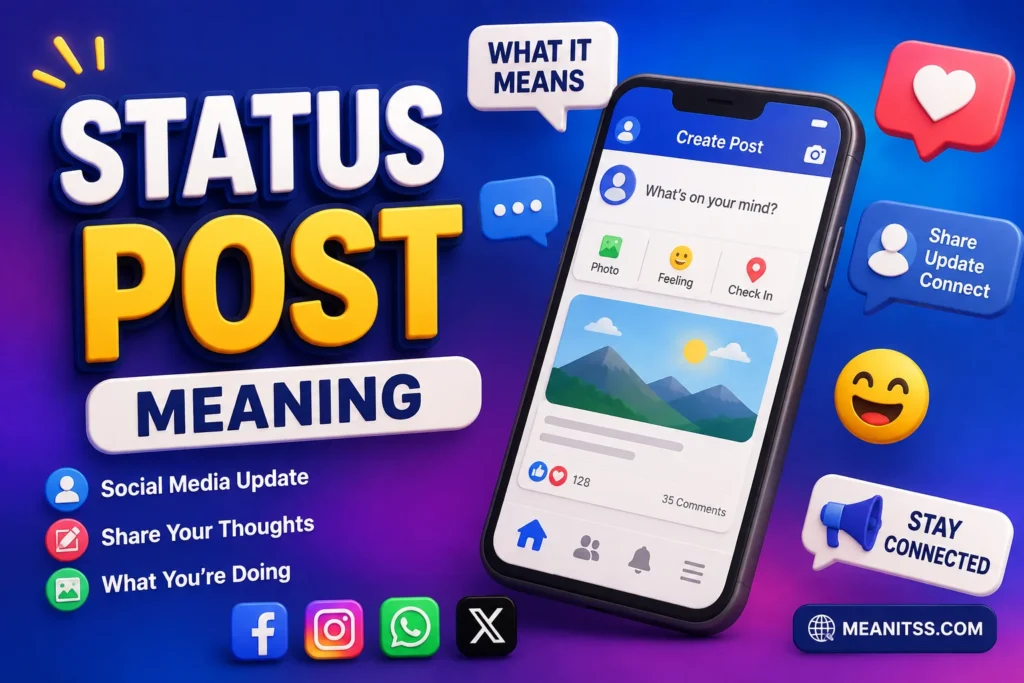
If you’re wondering about the status post meaning, it usually refers to a social media update that tells others what you’re doing, thinking, feeling, or experiencing. Today, the phrase is most closely associated with Facebook-style updates, although similar features exist across several platforms.
Unlike many internet slang terms, status post is not slang, an acronym, or an abbreviation. It’s a standard internet communication term that became popular as social media evolved.
What Does “Status Post” Mean?
A status post is a message, photo, video, or combination of content that updates other people about your current situation, opinion, activity, or mood.
Examples include:
- “Finally finished my exams!”
- “Vacation starts tomorrow.”
- “Feeling grateful today.”
- “Just adopted a puppy.”
Originally, the word status referred to a person’s current condition or state, while post means publishing something online. Together, the phrase describes an online update shared with others.
All Real Meanings of “Status Post”
1. Social Media Update (Most Common)
This is the meaning almost everyone intends.
A status post tells friends or followers:
- what you’re doing
- what you’re thinking
- how you’re feeling
- important life events
- announcements
Example:
“She posted a status about graduating college.”
2. General Online Update
Outside Facebook, people sometimes use status post more loosely to describe any update published online.
Examples:
- community forum announcements
- LinkedIn updates
- public profile updates
- community pages
Although people often shorten this to simply post, both expressions can refer to the same idea depending on context.
3. Messaging App Statuses
Some messaging apps use “status” differently.
For example:
- WhatsApp Status
- Telegram Stories (formerly Status-like features in some contexts)
Here, a status is usually temporary media rather than a permanent profile update.
Because platforms use different names, “status post” isn’t always the official term even though many users understand what it means.
A Common Misunderstanding
Many people think status and post are identical.
They aren’t always.
A status traditionally means an update about your current situation.
A post can be:
- a meme
- a photo
- a video
- an article
- a poll
- a shared link
- an advertisement
- or a status update
In other words:
Every status is generally a post.
But not every post is a status.
Modern platforms increasingly use post as the broader term.
Which Apps Use the Term?
This is where “status” became famous.
Originally Facebook asked:
“What’s on your mind?”
Typing an answer created a status update.
Even today many users still say:
“I posted a status.”
Instagram rarely uses the word status officially.
Instead people usually say:
- post
- story
- reel
Some users casually call a photo upload a status, but post is the standard term.
WhatsApp officially has Status.
However:
A WhatsApp Status disappears after 24 hours.
It’s different from a normal feed post.
Snapchat
Snapchat mainly revolves around:
- Stories
- Snaps
People don’t usually call them status posts.
TikTok
TikTok centers around videos.
Users almost always say:
- post
- upload
- video
The phrase status post isn’t common TikTok terminology.
X (formerly Twitter)
People usually say:
- post
- tweet (older terminology)
Calling a tweet a “status post” is uncommon today.
Grammar
“Status post” is a noun phrase.
Examples:
- “That status post went viral.”
- “Her status post received 5,000 likes.”
- “Delete your status post.”
It can function as:
Subject
“My status post got shared.”
Object
“I deleted the status post.”
After a preposition
“People commented on the status post.”
Unlike “OK” or “LOL,” status post is not normally used as a standalone reply.
You wouldn’t answer someone with:
“Status post.”
Instead you’d say:
“I’ll make a status post.”
Where Did “Status Post” Come From?
The phrase developed naturally as social networking websites became mainstream.
The word status comes from the Latin status, meaning condition or standing, long before the internet existed.
The internet meaning of post evolved from online forums and bulletin boards, where publishing a message was called “posting.” Later, social media adopted the same terminology for sharing text, photos, and videos.
When Facebook introduced status updates in the mid-2000s, many users naturally combined the ideas into the phrase status post. It became widely understood even though modern platforms increasingly prefer simply saying “post.”
There is no evidence that the phrase comes from AAVE or any specific slang community. It developed through mainstream internet and social media usage.
Four Short Conversations
Funny
Alex: Did you see my status post?
Jordan: The one about burning toast?
Alex: It already has 300 laughing emojis.
Jordan: Your cooking career is officially over.
Sarcastic
Emma: Nice status post.
Ryan: You mean the one nobody liked?
Emma: Even your mom ignored it.
Ryan: Brutal.
Playful
Mia: Should I post this selfie?
Zoe: Absolutely.
Mia: New status post coming!
Zoe: I’ll be the first to like it.
Serious
Dad: I saw your status post.
Son: Yeah, I wanted everyone to know.
Dad: Thanks for keeping the family updated.
Son: I appreciate everyone checking in.
Real-Life Examples Most Articles Skip
Many articles define “status post” but don’t explain why people still use the phrase even though platforms have changed.
Three useful observations:
1. Older Users Say “Status”
People who joined Facebook in the late 2000s often continue saying:
“I posted a status.”
Younger users are more likely to say:
“I made a post.”
Neither is incorrect.
2. The Meaning Depends on Platform Design
On Facebook, a status often emphasizes personal updates.
On Instagram, the same content is usually called a post.
On WhatsApp, Status is an official feature with temporary visibility.
Understanding the platform helps avoid confusion.
3. “Status” Implies Personal Context
Compare these:
- “I posted a recipe.”
- “I posted a status.”
The second naturally suggests you’re sharing something about yourself, while the first could simply share information.
Realistic Example Conversations
1. Friends (Facebook)
Liam: I saw your status post about the concert.
Noah: It was amazing!
Liam: The photos looked incredible.
Noah: You should come next time.
2. Family (WhatsApp)
Mom: Your status made me smile.
Daughter: Thanks! It was such a fun day.
Mom: You looked so happy.
Daughter: I definitely was.
3. Coworkers (LinkedIn)
Sarah: Nice status post about your promotion.
James: Thank you! It was a big milestone.
Sarah: Well deserved.
James: I appreciate that.
4. Group Chat
Jake: Did everyone see Mia’s latest status post?
Emma: Yes, the vacation pictures were beautiful.
Chris: Now I want a holiday too.
Mia: Come with me next time!
5. Dating
Alex: Your status post caught my attention.
Taylor: Which one?
Alex: The coffee shop photo.
Taylor: Glad someone noticed.
6. Community Group
Admin: Please read today’s status post before asking questions.
Member: Thanks for the reminder.
Admin: It includes all the event details.
Member: I’ll check it now.
7. School Friends
Emma: Your graduation status post got so many likes.
Olivia: I wasn’t expecting that.
Emma: Everyone is proud of you.
Olivia: Thanks so much.
8. Small Business
Customer: I saw your status post about the weekend sale.
Owner: Yes, it starts tomorrow.
Customer: I’ll stop by.
Owner: Looking forward to seeing you.
9. Gaming Community
Player 1: Did you read the guild’s status post?
Player 2: Yes, the tournament starts Friday.
Player 1: Time to practice.
Player 2: Definitely.
10. Neighborhood Group
Neighbor: I noticed your status post about the lost dog.
Owner: Thankfully, someone found him.
Neighbor: That’s wonderful news.
Owner: We were so relieved.
11. Travel Update
Friend: Your airport status post surprised me.
Traveler: Last-minute trip!
Friend: Safe travels.
Traveler: Thanks!
12. Charity Event
Volunteer: Your status post helped spread the word.
Organizer: That’s great to hear.
Volunteer: We had a bigger turnout.
Organizer: Every share helped.
How to Reply to a Status Post
There isn’t one “correct” reply. Your response depends on the type of update.
Funny Reply
- “Now that’s a plot twist 😂”
- “You really had to post that?”
- “This made my day.”
Serious Reply
- “Congratulations! You earned it.”
- “I’m sorry you’re going through this.”
- “Wishing you all the best.”
Flirty Reply (When Appropriate)
- “Looking great as always.”
- “You somehow make every post interesting.”
- “Guess I’ll have to comment more often.”
Neutral Reply
- “Thanks for sharing.”
- “Nice update.”
- “Glad things are going well.”
- “Hope everything works out.”
Comparison Table
| Term | Meaning | Tone | Popularity | Confusion Risk |
|---|---|---|---|---|
| Status Post | A personal update shared online | Neutral | High | Low |
| Post | Any content published online | Neutral | Very High | Low |
| Story | Temporary content that disappears after a set time | Casual | Very High | Medium |
| Reel | Short-form vertical video | Casual | Very High | Low |
| Tweet/Post (X) | A message published on X | Neutral | High | Low |
| Timeline Update | Content added to a profile or timeline | Neutral | Medium | Medium |
| Private Message (Opposite) | Sent directly to one person instead of publicly | Neutral | Very High | Low |
Who Uses the Term?
Teenagers
Many teenagers understand the phrase, but they are more likely to say post, story, or upload depending on the platform.
Gen Z
Gen Z generally uses platform-specific words such as Reel, Story, Snap, or simply post. “Status post” is understood but isn’t their default wording.
Millennials
Millennials are the group most likely to use “status post,” especially if they began using Facebook during its early years.
Older Adults
Many older social media users still refer to Facebook updates as status posts because that’s the terminology they first learned.
Regional Differences
There is no strong evidence that “status post” has a uniquely American, British, Australian, or Canadian meaning. English-speaking users generally understand the phrase in the same way.
Is “Status Post” Rude or Safe?
The phrase itself is completely neutral.
- ✅ Not profanity
- ✅ Not offensive
- ✅ Safe for school
- ✅ Appropriate in workplaces
- ✅ Suitable for family conversations
Whether a status post is appropriate depends entirely on what the post contains, not on the phrase “status post” itself.
Why Does This Phrase Still Matter?
One reason “status post” has survived while many internet terms have faded is that it describes a familiar online behavior rather than a passing trend. Even as platforms change—from Facebook to Instagram, LinkedIn, or WhatsApp—people continue sharing updates about their lives. The wording may shift toward simply saying “post,” but many users still recognize “status post” instantly because it emphasizes a personal update rather than just any piece of content. Its longevity comes from describing a communication habit that remains central to social media.
Frequently Asked Questions
What does status post mean?
A status post is an online update that shares your current thoughts, activities, feelings, or news with others. The term became especially popular through Facebook but is still widely understood across social media.
Is a status post the same as a regular post?
Not exactly. Every status post is a type of post, but not every post is a status update. A status usually focuses on the person sharing it, while a post can also be a meme, video, advertisement, or article.
Is “status post” slang?
No. It is a standard internet communication term rather than slang, an acronym, or an abbreviation.
Which app is most associated with status posts?
Facebook is the platform most closely associated with the phrase because its early interface centered around users publishing status updates.
Is WhatsApp Status the same as a status post?
They are related but not identical. WhatsApp Status is an official feature that displays temporary updates for 24 hours, whereas “status post” is a broader phrase that can refer to personal updates on different platforms.
Can businesses make status posts?
Yes. Businesses often share announcements, promotions, holiday hours, product launches, or company news as status updates on social media.
Should I say “status” or “post”?
Both are correct, but “post” is now more common across most social media platforms. “Status” is still widely understood, particularly by long-time Facebook users.
Why do some people still call it a status?
Many users adopted the term during Facebook’s early years and continue using it out of habit, even though modern platforms often prefer the broader word “post.”
Conclusion
A status post is simply a personal update shared online. It isn’t slang, an acronym, or a trendy internet phrase—it is a long-standing social media term that became popular through Facebook and continues to be understood today. While newer platforms often use words like post, story, or reel, the idea remains the same: sharing information about yourself or something important with your audience.
If you’re talking about Facebook or a general personal update, status post is perfectly natural. If you’re referring to Instagram, TikTok, or X, using the platform’s preferred terminology—such as post, story, or video—will usually sound more current.