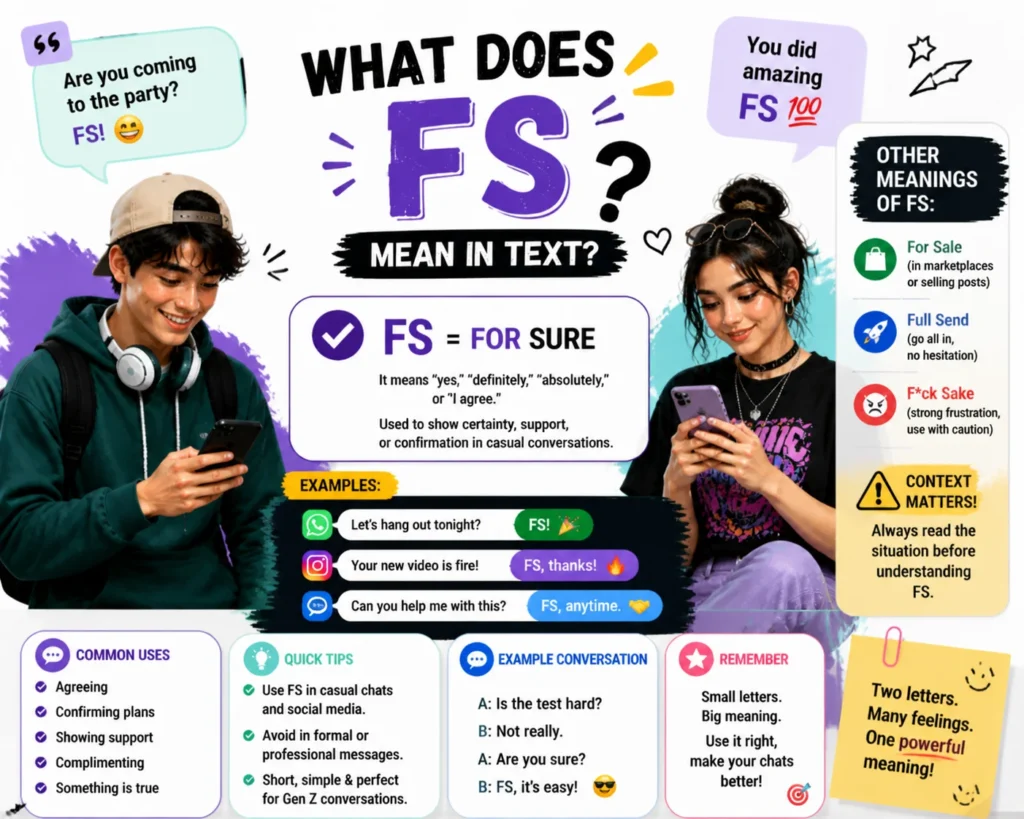
FS usually means “for sure” in texting, which means yes, definitely, absolutely, or I agree. It is a casual slang abbreviation people use when they want to sound confident, friendly, and quick.
FS mean in slang is most commonly “for sure.” People use it in texts, comments, DMs, and casual chats to show agreement, certainty, support, or confirmation. In other contexts, FS can also mean for sale, full send, or a stronger frustration phrase, so context matters. Recent slang guides also describe “for sure” as the main texting meaning, while noting other context-based uses like “for sale” and “full send.”
People search for fs mean because two small letters can feel confusing. Someone may send “fs” after a plan, under a TikTok video, in a marketplace post, or during an emotional conversation.
The good news is simple: in normal texting, FS is usually positive or neutral. It often means the person agrees with you, believes you, or wants to confirm something without typing a full sentence.
FS Mean – Quick Meaning
In everyday slang, FS means “for sure.”
It is used like:
- Yes
- Definitely
- Absolutely
- I agree
- That is true
- No doubt
- I’m certain
Examples:
“Are you coming tonight?”
“FS.”
“That song is amazing.”
“FS, I’ve had it on repeat.”
“You really think I can do it?”
“FS. You’ve got this.”
In casual chats, FS feels short but supportive. It can sound relaxed, confident, and friendly.
However, the meaning changes with context. On Facebook Marketplace, FS may mean for sale. In extreme sports or hype culture, it may mean full send, meaning to go all in. Some online guides also mention stronger or adult uses, so the safest rule is to read the conversation before assuming.
Origin & Background
FS comes from the phrase “for sure.”
People have said “for sure” in spoken English for many years. It became a natural way to say “yes,” “definitely,” or “I agree.” As texting became faster, people shortened common phrases into abbreviations.
That is how “for sure” became FS.
This happened because online communication rewards speed. In a chat, people do not always want to type long replies. A short “fs” can do the job in two letters.
Social media also helped the term spread. TikTok comments, Instagram DMs, Snapchat messages, Discord chats, and WhatsApp groups all encourage short, quick reactions.
Instead of writing:
“Yes, I completely agree with you.”
People write:
“FS.”
The meaning evolved from simple agreement into something more flexible. Today, FS can show confidence, emotional support, excitement, loyalty, or reassurance.
For example, “You’re talented fs” feels more personal than a plain “yes.” It sounds like the person is strongly confirming what they believe.
That is why FS works so well in modern slang. It is short, but it still carries feeling.
Real-Life Conversations
Person A:
Do you think I should apply for that job? I feel underqualified.
Person B:
FS. You have more experience than you realize.
Person A:
I needed to hear that.
Person B:
Send the application. Don’t overthink it.
Instagram DMs
Person A:
I almost didn’t post this picture.
Person B:
You look beautiful fs.
Person A:
Really? I was nervous about it.
Person B:
Yes, it looks natural. Keep it up.
TikTok Comments
Person A:
This is the most relatable video I’ve seen all week.
Person B:
FS. Especially the part about pretending to be fine.
Person A:
That part hit too hard.
Person B:
Same. People joke, but it’s real.
Text Messages
Person A:
Are we still meeting at 7?
Person B:
FS, I’m leaving in 10.
Person A:
Perfect. I’ll grab us a table.
Person B:
Bet, see you soon.
Emotional & Psychological Meaning
FS may look casual, but it often carries emotional weight.
When someone says “fs,” they are not always just agreeing. Sometimes they are reassuring you. Sometimes they are validating your feelings. Sometimes they are saying, “I’m with you.”
That is why FS can feel comforting in the right moment.
If someone says, “You matter fs,” the abbreviation does not weaken the message. In some conversations, it can make the message feel more natural and less dramatic.
People use FS because modern communication often balances emotion with casualness. Many people, especially younger users, want to express care without sounding too intense.
FS helps them do that.
It says:
“I mean it.”
“I agree.”
“I support you.”
“I’m not just saying this.”
Here is a personal-style scenario.
Imagine a student tells a friend, “I feel like everyone is ahead of me.” The friend replies, “You’re doing better than you think fs.” That tiny phrase can feel grounding. It gives reassurance without turning the conversation into a lecture.
In that way, FS shows how digital language has changed. People now use small slang terms to carry real emotional meaning.
Usage in Different Contexts
Social Media
On social media, FS usually means agreement or strong approval.
Examples:
“This outfit is clean fs.”
“That ending was emotional fs.”
“She deserves more followers fs.”
In comments, FS often works like a public stamp of agreement. It tells others, “I feel the same way.”
Friends & Relationships
Among friends, FS is casual and natural.
It can confirm plans:
“Lunch tomorrow?”
“FS.”
It can show loyalty:
“You still got my back?”
“FS.”
It can also support someone emotionally:
“You think I’ll be okay?”
“FS. One bad week doesn’t define you.”
In relationships, FS may sound affectionate when used with warmth. For example, “I miss you fs” feels honest but still casual.
Work / Professional Settings
FS is not ideal for formal work communication.
In a professional email, write:
“That works for me.”
“Absolutely.”
“I agree.”
“Confirmed.”
However, FS may be acceptable in casual workplace chats if the team culture is relaxed.
Example:
“Can you review this before lunch?”
“FS, I’ll check it now.”
Still, be careful with managers, clients, teachers, or formal teams. Clear language is safer.
Casual vs Serious Tone
FS fits casual tone best.
It works well for jokes, plans, compliments, quick support, and social media reactions.
In serious conversations, it depends on the relationship. With a close friend, “I understand fs” may feel caring. With someone upset or grieving, it may sound too brief.
The stronger the emotion, the more careful your response should be.
When NOT to Use It
Do not use FS when the conversation needs formality, clarity, or emotional depth.
Avoid FS in:
- Job applications
- Business emails
- Academic writing
- Legal communication
- Customer service replies
- Serious apologies
- Sensitive family discussions
- Messages to elders who may not know slang
Also avoid FS when it could be confused with for sale.
For example, if someone posts:
“Laptop FS”
They likely mean the laptop is for sale, not “for sure.” Slang references commonly list “for sale” as another meaning in marketplace contexts.
Cultural sensitivity matters too. Some people may see short replies as lazy or rude. In cultures where respectful wording is important, a full sentence may be better.
Instead of:
“FS.”
Write:
“Yes, that sounds good.”
“I completely agree.”
“Of course, I understand.”
Common Misunderstandings
The biggest misunderstanding is thinking FS has only one meaning.
In texting, it usually means for sure. But in selling groups, FS means for sale. In online hype culture, FS can connect to full send. In some frustrated conversations, it may stand for a stronger phrase that is not suitable for polite settings.
Tone is another common issue.
A simple “fs” can sound supportive, bored, confident, or dismissive depending on the situation.
Example:
Person A: “I had a really hard day.”
Person B: “fs.”
That may feel cold.
But:
Person A: “This song is underrated.”
Person B: “FS.”
That feels natural.
Literal vs figurative meaning can also confuse people.
When someone says, “That movie was good fs,” they do not mean “for sure” as a separate idea. They mean, “That movie was definitely good.”
So FS often works as an intensifier. It strengthens the sentence.
Comparison Table
| Term | Meaning | Similar, Opposite, or Related | Example |
|---|---|---|---|
| FS | For sure | Main slang meaning | “I’ll be there fs.” |
| FR | For real | Similar slang | “That was deep fr.” |
| Bet | Okay / agreed | Similar slang | “Bet, see you soon.” |
| No doubt | Definitely | Similar expression | “You can win, no doubt.” |
| Facts | True / I agree | Similar slang | “Facts, that needed to be said.” |
| Nah | No | Opposite meaning | “Nah, I’m not going.” |
| Maybe | Uncertain | Opposite tone | “Maybe, I’ll see.” |
| For sale | Available to buy | Context-based FS meaning | “Phone FS.” |
| Full send | Go all in | Related hype slang | “We’re doing it full send.” |
| Confirmed | Officially agreed | Formal alternative | “Meeting confirmed.” |
Key Insight:
FS is simple, but context decides everything. In a friendly text, it usually means “for sure.” In a marketplace post, it may mean “for sale.” In emotional conversations, its tone depends on how close the people are.
Variations / Types
1. FS = For Sure
The most common slang meaning.
It means yes, definitely, or I agree.
2. fs
The lowercase version.
It feels more casual, relaxed, and Gen Z-style.
3. FS!
A more excited version.
The exclamation mark adds energy or enthusiasm.
4. FS Bro
A friendly version among close friends.
It adds warmth, support, or casual loyalty.
5. FS Girl
A casual supportive phrase.
It is often used to agree with or encourage someone.
6. FS = For Sale
A marketplace meaning.
It means an item is available to buy.
7. FS = Full Send
A hype-based meaning.
It means going all in without hesitation.
8. FS as Reassurance
Used to comfort someone.
For example, “You’ll be okay fs.”
9. FS as Agreement
Used when you strongly agree.
For example, “That teacher explains well fs.”
10. FS as Emphasis
Used to strengthen a statement.
For example, “This place is expensive fs.”
How to Respond When Someone Uses It
Casual Replies
“Exactly.”
“Yeah, I agree.”
“Same here.”
“True.”
“Bet.”
Funny Replies
“FS certified.”
“Finally, someone gets it.”
“That’s the most fs thing ever.”
“Agreed with my whole soul.”
Mature Replies
“I appreciate you saying that.”
“That means a lot.”
“I agree with you.”
“Yes, that makes sense.”
Respectful Replies
“Thank you, I understand.”
“I appreciate your support.”
“Yes, I agree.”
“That works for me.”
If someone uses FS to confirm plans, you can reply with:
“Perfect.”
“See you then.”
“Sounds good.”
“Great, I’ll be there.”
If someone uses FS as emotional support, you can say:
“Thank you, I needed that.”
“I appreciate you.”
“That helped more than you know.”
Regional & Cultural Usage
Western Culture
In Western online spaces, FS is commonly used among younger people in texting, TikTok comments, Snapchat, Discord, and casual group chats.
It usually means “for sure” and often sounds confident or affirming.
For example:
“That’s the best album this year fs.”
Asian Culture
In many Asian countries, English slang mixes with local languages in daily chat.
Users may write:
“FS yaar.”
“FS bro.”
“FS, this is true.”
In South Asian texting, people often combine English abbreviations with Urdu, Hindi, Punjabi, or other local languages. The meaning usually stays casual and friendly.
Middle Eastern Culture
In Middle Eastern digital spaces, FS may be understood among English-speaking youth, especially on Instagram, TikTok, gaming platforms, and international chats.
However, people may prefer clearer language in family, religious, academic, or formal conversations.
Because respect and tone matter strongly in many settings, “for sure” or “yes, definitely” may feel more appropriate than FS.
Global Internet Usage
Globally, FS is part of fast internet language.
It works because it is short, easy to type, and emotionally flexible.
Still, not every user will understand it. Some may read FS as a technical acronym, a marketplace label, or something else.
That is why context is the real key.
Generational Differences
Gen Z uses FS naturally in short, casual messages.
Millennials may understand it, but many still prefer “for sure” written fully.
Older generations may not recognize it at all. They may ask what it means or misread it as a typo.
So, use FS when you know your audience understands slang.
Is It Safe for Kids?
FS is generally safe for kids when it means for sure.
It is a simple agreement phrase and is not harmful by itself. However, kids should know that FS can have other meanings in different online spaces, including marketplace, adult, or frustrated contexts.
For younger users, the safest explanation is:
“FS usually means for sure, but always check the conversation.”
Parents should also teach kids not to copy every abbreviation without understanding where it appears and who is using it.
FAQs
What does FS mean in text?
FS usually means for sure in text. It shows agreement, certainty, or confirmation.
What does FS mean on Snapchat?
On Snapchat, FS usually means for sure. It is often used to confirm plans or agree with someone.
What does FS mean on TikTok?
On TikTok, FS often means for sure. People use it in comments to strongly agree with a video or opinion.
Is FS rude?
FS is not usually rude. However, it can feel too short or dismissive in serious conversations.
What does FS mean on Facebook Marketplace?
On Facebook Marketplace or selling posts, FS usually means for sale.
Can FS mean full send?
Yes, FS can mean full send in hype, sports, or adventure-related contexts. It means going all in.
Is FS formal?
No, FS is informal slang. Use “for sure,” “confirmed,” or “I agree” in professional settings.
What is the difference between FS and FR?
FS means for sure, while FR means for real. Both can show agreement, but FR often confirms honesty or truth.
Can I reply FS to a compliment?
Yes. If someone says, “You did great,” you might say, “Thanks, fs,” but a warmer reply like “Thank you, I appreciate it” is better.
Why do people use FS instead of for sure?
People use FS because it is faster, casual, and common in online conversations.
Conclusion
Now you know what fs mean in slang: most of the time, it means for sure.
It is a quick way to say yes, definitely, I agree, or I believe that. It can make a message feel confident, relaxed, and friendly.
But like most slang, FS depends on context. In a normal text, it usually means agreement. In a selling post, it may mean for sale. In a hype-based conversation, it may mean full send.
The best approach is simple: look at the conversation, the platform, and the relationship.
Use FS with friends, comments, DMs, and casual chats. Avoid it when the situation needs professionalism, sensitivity, or clear emotional care.
Small slang can say a lot. FS is proof that even two letters can carry confidence, support, and connection when used the right way.