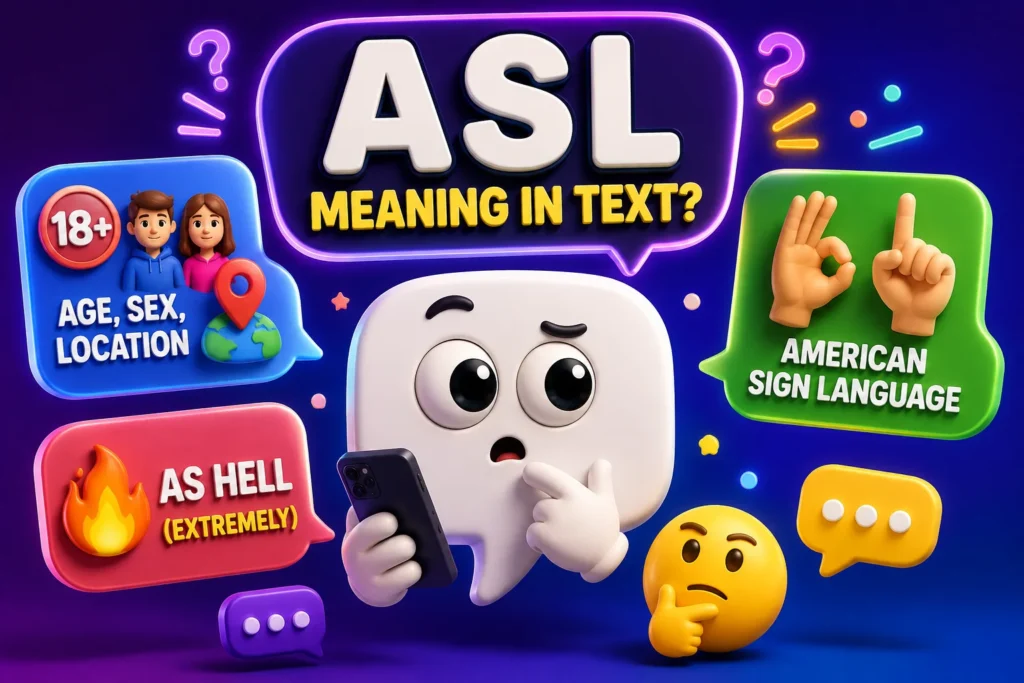
ASL in texting can mean “age, sex, location,” “as hell,” or “American Sign Language,” depending on context. In modern social-media slang, lowercase asl often means “as hell,” while the older chat abbreviation ASL meant “age, sex, location.”
That makes ASL unusually confusing because the same three letters can point to completely different ideas. Someone writing “I’m tired asl” is probably emphasizing “tired as hell,” while someone asking “ASL?” may be using the older “age, sex, location” expression. If the conversation is about signing or Deaf culture, ASL almost certainly means American Sign Language.
What Does ASL Mean in Texting?
There are three major meanings worth knowing:
- asl = as hell — a modern internet-slang abbreviation used for emphasis.
- ASL = age, sex, location — an older internet-chat abbreviation asking for basic personal information.
- ASL = American Sign Language — the name of a complete natural language used primarily by many Deaf and hard-of-hearing people in the United States and parts of Canada.
The first meaning is particularly important if you’re reading TikTok comments or current social-media conversations. Dictionary.com now lists both “age, sex, location” and “as hell” as internet uses of asl.
The most important clue: look at the sentence
Consider these examples:
- “That movie was good asl.” → good as hell
- “I’m hungry asl.” → hungry as hell
- “ASL?” → probably age, sex, location
- “Do you know ASL?” → probably American Sign Language
- “She teaches ASL.” → American Sign Language
So you shouldn’t automatically expand every occurrence of ASL the same way.
ASL as “As Hell”
The lowercase form asl is increasingly used online as a shortened version of “as hell.” It works as an intensifier, meaning it makes an adjective or description stronger.
For example:
“That test was hard asl.”
means:
“That test was hard as hell.”
Likewise:
- “I’m tired asl.” = I’m extremely tired.
- “That food was good asl.” = That food was extremely good.
- “He’s funny asl.” = He’s extremely funny.
- “It’s cold asl outside.” = It’s extremely cold outside.
This use is especially associated with Gen Z internet culture and social media. Sources tracking internet slang identify TikTok as a major place where the newer meaning became widely visible, although it isn’t exclusive to TikTok.
Why does “asl” mean “as hell” when there is no H?
That’s part of what makes the slang unusual.
It is not a conventional first-letter abbreviation such as LOL (“laughing out loud”). Instead, asl represents the sound and compressed form of “as hell” as it is spoken quickly. Slang.net describes the newer usage as a social-media shortening of “as hell.”
The spelling isn’t perfectly logical, which is one reason older internet users sometimes find the newer usage confusing.
ASL as “Age, Sex, Location”
Before the newer “as hell” meaning became popular, ASL was strongly associated with “age, sex, location.”
It was commonly used in internet chat rooms and instant messaging, particularly during the early era of online social interaction. Someone might simply type:
“ASL?”
The expected response could contain three pieces of information, such as:
“18 / female / Texas.”
The abbreviation became a recognizable part of early online chat culture. Historical accounts describe A/S/L as a common introductory question in chat rooms, especially when strangers were meeting online.
This meaning still exists, but it can feel dated depending on the community and platform.
A safety point about the old meaning
The older “age, sex, location” usage deserves more caution than a typical slang abbreviation because it asks for personal information.
If a stranger online asks for your age, sex, and location, you do not have to provide those details. This is particularly important for younger users because seemingly casual questions can reveal information that should remain private.
CyberDefinitions also notes the privacy concerns associated with sharing this type of information with unknown people online.
ASL as American Sign Language
There is another completely legitimate meaning: American Sign Language.
In this context, ASL is not slang. It is a complete natural language with its own linguistic structure and grammar. The U.S. National Institute on Deafness and Other Communication Disorders explains that ASL is distinct from English and has its own grammatical properties.
For example:
“I’m learning ASL.”
Here, the meaning is clearly American Sign Language, not “as hell.”
Likewise:
“Do you know ASL?”
usually asks whether someone knows American Sign Language.
It is worth being precise here: ASL is not simply “English translated into hand movements.” It is a language in its own right, with its own grammar and structure.
Where Did ASL Come From?
The three meanings have different histories, so there isn’t one single origin story for “ASL.”
The history of “age, sex, location”
The age/sex/location abbreviation grew out of early internet chat culture. It was used as a quick way for strangers to exchange basic information when entering online conversations.
It became particularly recognizable in chat rooms and instant messaging during the late 1990s and early 2000s. A 2001 Pew Research report on teenagers and internet use found that A/S/L was among the common questions encountered in chat rooms.
The history of “as hell”
The precise origin of asl = as hell is less certain.
There is evidence of the newer usage online by at least 2018, and it became much more visible on social media during the early 2020s. Know Your Meme documents a June 2018 post as an early known example connecting “asl” with “as hell,” while later TikTok usage helped spread the meaning.
That does not establish one individual as the inventor of the slang. The exact moment when people collectively began using it cannot be established with confidence.
The history of American Sign Language
ASL has a much older and different history.
Its development in the United States dates to the early 19th century. It emerged through interaction between local signed languages and French Sign Language, particularly around the school established in Hartford, Connecticut, in 1817. Laurent Clerc and Thomas Hopkins Gallaudet played important roles in that early educational history.
The exact origins are more complicated than a simple “one person invented ASL” story. Modern ASL developed over time from multiple influences and became a distinct language.
Is ASL an Acronym or an Abbreviation?
It depends on which meaning you mean.
ASL = American Sign Language is an initialism/acronym-like abbreviation formed from the initial letters of the phrase.
ASL = age, sex, location is generally described as an internet abbreviation or initialism.
asl = as hell is best understood as an internet slang abbreviation or initialism.
In everyday conversation, people often simply call all three “texting abbreviations,” even though their linguistic histories are different.
Which Apps Is ASL Used On?
The newer asl = as hell usage is well documented on TikTok and other social-media platforms, including X/Twitter. Dictionary.com says the lowercase slang form is not exclusive to TikTok, and slang references also document its use across social media.
TikTok
TikTok is one of the clearest places to encounter asl = as hell.
Examples include:
- “cute asl”
- “tired asl”
- “funny asl”
- “that was scary asl”
The platform helped make the newer meaning much more recognizable to younger internet users.
X
The newer usage also appears on X, while the older “age, sex, location” meaning has a much longer history across internet chat and messaging.
Instagram, Snapchat, and WhatsApp
The abbreviation can occur in private messages or social posts on many services, but the available evidence is not strong enough to claim that any one of these platforms is uniquely responsible for the meaning. It is safer to describe asl as broader internet/text slang rather than attach the newer definition exclusively to one app.
Grammar: How Is “asl” Used?
When asl means “as hell,” it normally functions as an intensifier.
It usually follows an adjective or adverb:
- “happy asl”
- “busy asl”
- “cold asl”
- “fast asl”
- “expensive asl”
It does not normally function as a standalone response in this meaning.
For example:
“How was the concert?”
“Asl.”
That doesn’t naturally communicate “as hell.”
By contrast:
“That concert was loud asl.”
works because asl intensifies “loud.”
When ASL means age, sex, location, it can stand alone as a question:
“ASL?”
When it means American Sign Language, it behaves like the name of a language:
“I’m studying ASL.”
4 Tone-Based Conversations
Funny
Mia: How was your first day at the gym?
Leo: Humbling asl.
Mia: That bad?
Leo: My legs filed a resignation letter.
Sarcastic
Alex: This assignment is easy asl.
Jordan: Great. You can finish mine too.
Alex: Absolutely not.
Jordan: So “easy” was doing some heavy lifting there.
Playful
Sam: Your new haircut looks good asl.
Nina: Finally, someone noticed.
Sam: I noticed immediately.
Nina: Took you long enough 😂
Serious
Chris: You okay?
Taylor: I’m tired asl, honestly.
Chris: Want to talk about it?
Taylor: Yeah. I could use someone to listen.
12 More Realistic Text Examples
1. Friends
A: Bro, that game was stressful asl.
B: I almost threw my controller.
A: Same.
B: We need better teammates.
2. Dating
A: You looked good asl tonight.
B: Oh really? 👀
A: Really.
B: I’ll remember that.
3. Family
Mom: How was the trip?
Daughter: Fun asl.
Mom: Glad you enjoyed it.
Daughter: I’m exhausted now though.
4. Coworkers
A: Today was busy asl.
B: Tell me about it.
A: I haven’t even had lunch.
B: Go eat before you answer another email.
5. Group chat
A: That ending was crazy asl.
B: NO SPOILERS.
C: Too late 😭
D: I just opened the chat.
6. TikTok comment
A: This dog is cute asl.
B: Literally 😭
A: The little face gets me every time.
B: Same.
7. X
A: It is cold asl today.
B: You’re not wrong.
A: Summer betrayed us.
B: Apparently.
8. Old-school chat meaning
A: ASL?
B: 20 / male / London.
A: Nice, I’m 21 / female / Manchester.
Here, ASL means age, sex, location, not “as hell.”
9. American Sign Language
A: Do you know ASL?
B: A little. I’m taking a beginner class.
A: That’s cool.
B: I’m still learning the basics.
10. Misunderstanding
A: That restaurant was expensive asl.
B: Wait, why are you asking my age?
A: 😂 I’m saying it was expensive as hell.
B: Ohhh. Different ASL.
11. Casual complaint
A: I’m hungry asl.
B: You literally ate an hour ago.
A: That was an appetizer.
B: You had three burgers.
12. Compliment
A: Your presentation was good asl.
B: Thanks! I was nervous.
A: You couldn’t tell.
B: That’s a relief.
How Should You Reply to “asl”?
Your response depends entirely on the meaning.
Funny reply
If someone says:
“I’m tired asl.”
You could answer:
“Same. My bed has been calling my name for hours.”
Serious reply
If someone says:
“I’m stressed asl.”
A better response is:
“What’s going on? Do you want to talk about it?”
Flirty reply
If someone says:
“You look good asl.”
You might respond:
“Keep talking like that and I might start believing you 😉.”
Neutral reply
If someone writes:
“That movie was boring asl.”
You can simply say:
“Yeah, I thought it was pretty slow too.”
If someone sends “ASL?” as a standalone message, don’t assume they mean “as hell.” They may be asking for age, sex, and location.
ASL vs Similar Texting Terms
| Term | Meaning | Tone | Popularity | Confusion Risk |
|---|---|---|---|---|
| asl | As hell | Casual, emphatic | High online | High |
| ASL | Age, sex, location | Casual, old-school chat | Lower than before | High |
| ASL | American Sign Language | Neutral/informational | Very established | High |
| asf | As fuck | Casual, emphatic | High | Medium |
| af | As fuck | Casual, emphatic | Very high | Low |
| fr | For real | Casual/agreement | Very high | Low |
| literally | Exact or emphatic expression | Neutral/casual | Very high | Low |
| barely | Hardly; only just | Neutral | Common | Low |
One important distinction is that af and asf are more transparent abbreviations of “as fuck,” while asl is less obvious because the letters do not directly correspond to “as hell.” That is part of the reason people sometimes need to look up its newer meaning.
Who Uses “asl”?
The answer depends on the meaning.
The “age, sex, location” usage is strongly associated with older internet chat culture, particularly the era of chat rooms and instant messaging. It is still understandable to people familiar with that culture but may feel dated to many younger users.
The “as hell” usage is strongly associated with contemporary social-media slang and is especially visible in Gen Z-oriented online spaces.
There is no reliable basis for saying that one gender universally uses asl more than another, so gender-based usage claims should be avoided.
There is also no solid evidence that the slang meaning belongs exclusively to one U.S. region. It is better understood as internet-mediated language that can spread across geographic boundaries.
Is ASL Rude or Safe?
The abbreviation itself is not inherently offensive.
However, the meaning “as hell” contains the word “hell,” so it is informal and mildly profane depending on the standards of the audience. It is generally more appropriate for casual conversation than formal writing.
For school assignments, professional emails, applications, or workplace documents, write the full phrase or choose a neutral intensifier instead.
The older “age, sex, location” meaning deserves a different kind of caution. It isn’t offensive, but sharing personal information with strangers online can create privacy and safety risks.
And when discussing American Sign Language, use the term respectfully. ASL is a real language and an important part of Deaf communities and culture, not simply internet shorthand.
A Useful Way to Decode ASL
The most practical trick is to examine what comes before it.
If you see:
“cute asl”
the answer is almost certainly “cute as hell.”
If you see:
“ASL?”
the older “age, sex, location” interpretation becomes much more plausible.
If you see:
“I’m learning ASL.”
the meaning is clearly American Sign Language.
Capitalization can provide a clue, but it isn’t a perfect rule. People frequently ignore capitalization when texting, so context is more reliable than uppercase versus lowercase alone.
Why Does “asl” Work So Well in Conversation?
The newer asl survives because texting rewards compression, but it also adds a particular internet tone. Saying “funny” and saying “funny asl” don’t feel exactly the same: the latter is more emphatic and conversational. Its unusual spelling also makes it recognizable as online language rather than formal writing. At the same time, the older meaning remains memorable because ASL was once such a familiar chat-room question. The result is a rare abbreviation whose meaning is heavily determined by the surrounding sentence and by the generation or online community using it.
Frequently Asked Questions
What does ASL mean in texting?
In current internet slang, lowercase asl often means “as hell,” functioning as an intensifier. Historically, ASL commonly meant “age, sex, location.” It can also mean American Sign Language, so context is essential.
What does “asl” mean on TikTok?
On TikTok, asl often means “as hell.” For example, “tired asl” means “tired as hell.” The usage became especially visible in TikTok and other social-media communities during the early 2020s.
Does ASL still mean age, sex, location?
Yes, but the usage is much more associated with older internet chat culture than with current mainstream social media. Someone typing “ASL?” as a standalone question may still mean age, sex, and location. However, you should not assume that’s the meaning when ASL appears inside a sentence such as “funny asl.”
What does “cute asl” mean?
“Cute asl” means “cute as hell.” It is a casual way to strongly emphasize that someone or something is cute. The expression is informal and commonly associated with social-media slang.
Does ASL mean American Sign Language?
Yes. ASL is the standard abbreviation for American Sign Language, a complete natural language with its own grammar and linguistic structure. It is not merely a shortened way of saying “sign language.”
Is “asl” a Gen Z word?
The “as hell” use is strongly associated with contemporary Gen Z internet culture and social media. However, ASL itself is much older because “age, sex, location” was widely used in earlier online chat. So the letters aren’t inherently a Gen Z invention.
Is ASL appropriate for school or work?
The abbreviation is usually too informal for formal school or workplace writing when it means “as hell.” Use standard language instead. American Sign Language is, of course, perfectly appropriate to discuss in academic or professional contexts.
Is ASL safe for kids?
The “as hell” meaning is generally ordinary internet slang, although it is informal. The bigger safety issue is the older “age, sex, location” meaning because it can encourage someone to disclose personal information to strangers. Children and teens should avoid sharing identifying details with unknown people online.
Conclusion
ASL has three important meanings in texting and online communication: “as hell,” “age, sex, location,” and “American Sign Language.” The lowercase asl inside a phrase such as “happy asl” usually means “as hell,” while a standalone “ASL?” may refer to the older age/sex/location question.
The safest way to decode it is to read the surrounding sentence rather than relying only on capitalization. If it intensifies an adjective, think “as hell.” If someone asks “ASL?”, consider the older chat meaning. If the conversation concerns Deaf culture, signing, interpreters, or learning a language, ASL means American Sign Language.
And if a stranger asks you for your age, sex, and location, remember that you never need to provide personal information simply because an abbreviation makes the question sound casual.