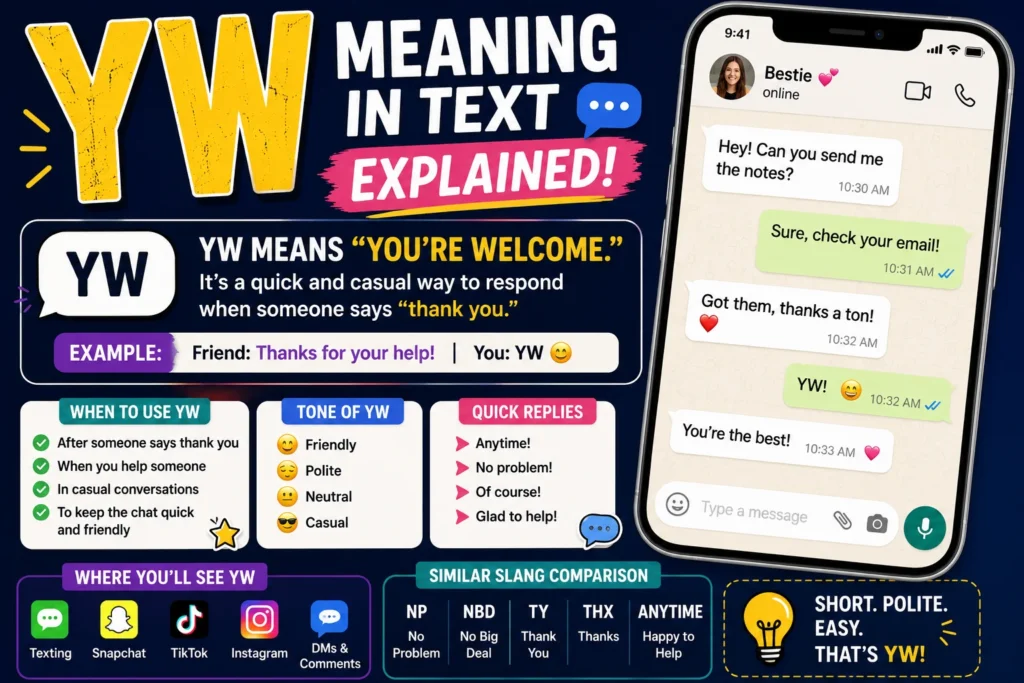
“YW” means “you’re welcome.” It’s commonly used in texting and social media as a quick, polite response after someone says “thank you.”
In some rare cases, it can also mean “yeah, whatever,” but that depends heavily on tone and context.
In everyday chats, it’s simply a fast, friendly way to acknowledge appreciation without typing the full phrase.
Example:
“Thanks for helping me!” → “YW 😊”
YW Meaning in Text
In texting, YW = “you’re welcome.” It’s one of those shorthand replies people use when they want to keep things quick and casual.
You’ll see it after:
- Someone thanks you
- You help someone out
- You give advice or share something useful
It’s especially popular because it saves time and still feels polite.
Examples:
- “Thanks for sending the notes!” → “YW!”
- “Appreciate it!” → “yw no problem”
- “Thanks for the ride” → “yw anytime!”
Notice how it’s often lowercase too—that’s how casual it is.
Real Chat Examples (Relatable Conversations)
Chat 1 (WhatsApp)
Friend: “Thanks for reminding me about the meeting!”
You: “YW! I almost forgot too 😅”
Chat 2 (Snapchat)
Friend: “Appreciate you helping me with homework”
You: “yw 🙌”
Chat 3 (Instagram DM)
Friend: “Thanks for tagging me in that post!”
You: “YW haha it was so you”
Chat 4 (iMessage)
Friend: “Thanks for picking up my order!”
You: “yw no worries 👍”
Emotional Meaning & Tone
“YW” is usually polite, relaxed, and friendly—but tone can shift depending on how it’s used.
👍 Friendly Tone
- “yw 😊”
- “YW!! anytime!”
Feels warm and genuine.
😐 Neutral Tone
- “yw”
- “YW.”
Just polite, nothing extra.
⚠️ Slightly Dismissive (Rare)
- “yeah, yw I guess”
- “yw…”
If paired with sarcasm or dry replies, it might feel uninterested.
👉 Tone depends more on punctuation, emojis, and context than the letters themselves.
YW Meaning From a Girl / Guy
From a Girl
When a girl uses “yw,” it’s typically:
- Friendly and polite
- Casual and easygoing
- Sometimes paired with emojis to soften tone
Example: “yw 💕” → warm and kind
From a Guy
From a guy, “yw” is usually:
- Straightforward and brief
- Neutral or friendly
- Less likely to include emojis
Example: “yw” → simple acknowledgment
👉 Overall, the meaning doesn’t change much—just the style and tone.
How to Reply to YW
Even though “yw” ends the thank-you exchange, you can still respond if you want to keep the conversation going.
Casual Replies
- “Of course!”
- “Anytime!”
- “Appreciate it”
Friendly Replies
- “You’re the best!”
- “Thanks again 😊”
- “I owe you one”
Funny Replies
- “I’ll remember this favor 😄”
- “Adding it to your good karma points”
- “Legend behavior”
Short Responses
- “👍”
- “🙌”
- “😊”
Is YW Rude or Safe to Use?
YW is completely safe and polite in most situations.
But context matters:
✅ Safe When:
- Talking to friends
- Casual texting
- Social media replies
⚠️ Be Careful When:
- Messaging your boss or teacher
- Responding in formal emails
- Talking in serious situations
In those cases, typing “you’re welcome” fully sounds more professional.
Where You’ll See YW
Texting
Most common place—quick replies in everyday chats.
Snapchat
Used in streaks or quick thank-you responses.
TikTok
Appears in comments or replies to appreciation.
Seen in DMs and comment sections.
👉 Basically, anywhere people want to save time but stay polite.
Similar Slang Comparison
| Slang | Meaning | Tone |
|---|---|---|
| YW | You’re welcome | Neutral/friendly |
| NP | No problem | Casual, relaxed |
| NBD | No big deal | Very laid-back |
| Anytime | Happy to help | Friendly |
| Sure | Polite but brief | Neutral |
| TY | Thank you | Opposite expression |
| Thx | Thanks | Casual gratitude |
👉 Key Insight:
“YW” is more neutral than “no problem” and more casual than “you’re welcome.” It sits right in the middle—quick, polite, and widely accepted.
Variations / Types of YW
Here are common variations you’ll see:
- yw – Lowercase, super casual
- YW! – Slightly more enthusiastic
- yw 😊 – Friendly and warm
- YW no problem – Extra reassurance
- yw anytime – Open and helpful tone
- yw haha – Light and playful
- YW 👍 – Simple acknowledgment
- yw!! – Excited or cheerful
- yw ofc – “Of course,” more emphasis
- yw np – Combo with “no problem”
Common Mistakes & Misunderstandings
1. Tone Confusion
A plain “yw” might feel cold if someone expected more warmth.
👉 Fix: Add an emoji or extra word if needed.
2. Using It in Formal Situations
Replying “yw” in professional emails can feel too casual.
👉 Use full “you’re welcome” instead.
3. Overuse
Using “yw” in every reply can feel repetitive or robotic.
👉 Mix it up with:
- “anytime”
- “no worries”
- “glad to help”
Other Meanings of YW
While rare, “YW” can sometimes mean:
- “Yeah, whatever” → sarcastic or dismissive tone
- Initials (names/brands) → context-specific
👉 But in 99% of cases, it simply means “you’re welcome.”
FAQ
What does YW mean in Snapchat?
It means “you’re welcome,” usually as a quick reply after someone says thanks.
What does YW mean from a girl?
It typically means a friendly or polite “you’re welcome,” often with emojis for warmth.
Is YW rude?
No, it’s not rude. It’s casual. It can feel blunt only if used without tone or context.
Can YW mean something else?
Yes, sometimes “yeah, whatever,” but that’s rare and depends on tone.
Should I use YW in professional messages?
Not really. It’s better to write “you’re welcome” fully in formal situations.
Is YW the same as “no problem”?
Not exactly. Both are polite, but “no problem” feels more relaxed and conversational.
Why do people use YW instead of typing it out?
Mostly for speed and convenience—it’s quicker while still being polite.
Conclusion
“YW” is one of the simplest and most useful pieces of texting slang out there. It keeps conversations flowing without overthinking your reply.
Use it in casual chats, add a little personality when needed, and switch to the full phrase in formal settings. Once you get used to it, it’ll feel completely natural.