
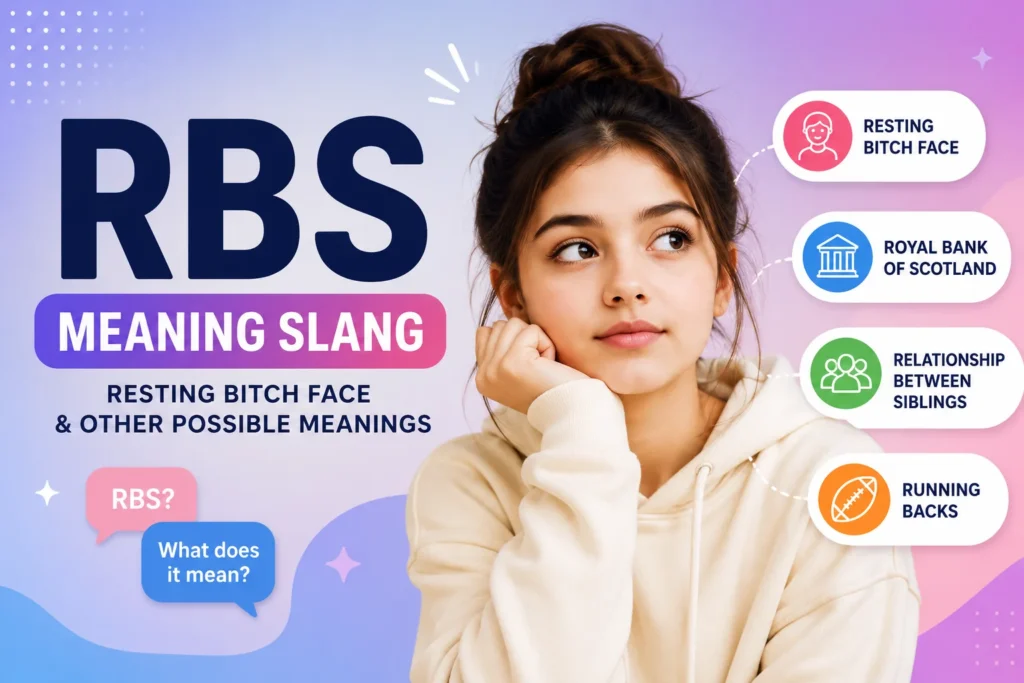
RBF stands for “Resting Bitch Face.” It describes a neutral, relaxed facial expression that unintentionally looks annoyed, angry, or unimpressed even when the person feels completely calm.
People search this term because they’ve either been told their face “looks mad” when they’re not, or they’ve seen RBF used as a caption on a photo, meme, or comment and want to know if it’s an insult, a joke, or just a description. The confusion usually isn’t about the letters themselves — it’s about whether calling someone RBF is meant to be mean or affectionate.
Meaning & Explanation
The Primary (and Only Widely Used) Meaning
RBF has one dominant, well-established meaning: Resting Bitch Face — a face that looks serious, irritated, or unfriendly by default, with no connection to the person’s actual mood. It’s used to describe both other people (“she has such an RBF”) and oneself (“sorry, this is just my RBF, I’m not mad”).
Is It an Acronym, Abbreviation, or Slang Word?
RBF is an initialism: each letter represents one word in the phrase “Resting Bitch Face,” and it’s read letter by letter rather than pronounced as a word. It functions as internet and everyday slang, but it started as a genuine descriptive phrase before being shortened for faster typing.
Platform Breakdown
RBF is almost always tied to a photo or video, so it shows up on visual-first platforms far more than text-only ones. It’s not typically used on WhatsApp, since it depends on an accompanying image, which is less central to how WhatsApp conversations are structured.
RBF on TikTok
RBF appears constantly in video captions and comment sections, often on “why does my face look like this in every photo” style videos, or in duet/stitch jokes about someone’s neutral expression.
RBF on Instagram
On Instagram, RBF shows up mostly in photo captions and comment replies, frequently self-applied by the poster as a joke about their own candid or “off-guard” photos.
RBF on Snapchat
RBF is used in quick captions or chat replies reacting to an unflattering or serious-looking snap, usually followed by a laughing emoji to clarify it’s a joke.
RBF on X (Twitter)
On X, RBF turns up in quote posts, threads, and replies, often attached to celebrity photos or memes where someone’s neutral expression is being joked about publicly.
Tone & Context Variations
Funny
A: why do you look so mad in this photo B: I wasn’t mad, I was just standing there A: classic RBF B: I can’t control my own face apparently
Sarcastic
A: smile more, you look upset B: this is my face at rest, I’m not upset A: sure, “resting” B: it’s called RBF, look it up
Playful
A: be honest, do I have RBF B: babe you invented RBF A: rude but accurate B: it’s a whole personality at this point
Serious
A: people keep telling me I look unapproachable at work B: it might just be your neutral expression, not your attitude A: I know, but it’s starting to affect how coworkers treat me B: maybe mention it’s RBF so they stop reading into it
Real Chat Examples
A: your yearbook photo is scary lol B: thanks, that’s just my RBF A: you look like you’re about to fail someone B: I was thinking about lunch actually
TikTok comment
A: Why does she look so unbothered in every video
B: that’s just RBF, she’s actually really sweet
A: okay good because I was scared to comment
B: everyone says that at first lol
A: can we talk about the meeting notes
B: sure, go ahead
A: you looked annoyed the whole time, is everything okay
B: oh no, that’s just my resting face, I was fully engaged
A: new profile picture?
B: yeah, do I look mad in it
A: kind of, ngl
B: ugh RBF strikes again
sibling text
A: Mom thinks you’re mad at her from your photo
B: tell her it’s just RBF, I love her
A: I tried, she doesn’t believe me
B: send her a smiling one instead
A: your dating profile pic looks intense
B: I know, people keep swiping left probably
A: try smiling in at least one
B: fair, my RBF isn’t doing me any favors there
X reply
A: This actress always looks so unimpressed on camera
B: pretty sure that’s just RBF, not attitude
A: true, she seems really nice in interviews
B: exactly, faces lie sometimes
A: are you upset with me
B: no, why?
A: you’ve had that face on all day
B: that’s literally just my face, I promise I’m fine
A: first day at the new job go okay?
B: yeah but someone asked if I was mad at them within an hour
A: classic RBF welcome
B: I need a sign that says “this is just my face”
A: you should smile in group photos more
B: I do smile, this is what my smile looks like apparently
A: oh no
B: yeah, RBF doesn’t fully go away even when I try
Snapchat caption
A: why do I look like this B: RBF supremacy A: I was literally just thinking about tacos B: your face didn’t get the memo
Grammar & Language Role
Part of speech:
Functions as a noun phrase, referring to a type of facial expression (“she has RBF”) or used adjectivally in casual speech (“that’s such an RBF photo”).
Sentence position:
Typically appears mid-sentence as the subject or object of the sentence, rather than standing alone as a full reply the way some acronyms do.
Can it replace a full sentence?
Rarely on its own — it usually needs a supporting sentence around it (e.g., “it’s just my RBF” rather than a standalone “RBF” reply).
Register:
Informal, though, because “bitch” is embedded in the full phrase, it sits closer to casual conversational slang than to something appropriate in formal or professional writing.
How to Reply to RBF
Funny reply:
“It’s not RBF, it’s my ‘don’t talk to me before coffee’ face.”
Serious reply:
“I get that a lot — my face just doesn’t reflect my mood, I promise I’m not upset.”
Flirty reply:
“Good thing I like a little intensity 😏”
Neutral/unbothered reply:
“Yeah, that’s just how my face sits, no big deal.”
Comparison Table
| Term | Meaning | Usage Context | Tone | Popularity | Confusion Risk |
|---|---|---|---|---|---|
| RBF | Resting Bitch Face | Describing a neutral, serious-looking expression | Joking or descriptive | Very High | Medium (can read as insult) |
| RAF | Resting Angry Face / Resting A**hole Face (male equivalent) | Same concept, applied to men | Joking | Low–Moderate | Medium |
| Poker Face | Deliberately hiding emotion | Card games, negotiations, intentional control | Neutral | High | Low |
| Deadpan | Expressionless delivery, often for comedic effect | Comedy, dry humor | Neutral to funny | Moderate | Low |
| BRF | Bitchy Resting Face (earlier variant of RBF) | Same as RBF, older phrasing | Joking | Low | Medium |
| Smiley / Approachable | Naturally warm, open expression | Opposite of RBF | Positive | High | Low |
Who Uses This Term
Age Group Breakdown
RBF is used across a wide age range, but it’s most active among teens through mid-30s, since it originated and spread through social media and meme culture rather than older, offline slang traditions.
Gen Z vs. Millennials
Millennials were present for the term’s actual rise to mainstream popularity in 2013, and often use it with that pop-culture context in mind. Gen Z picked it up later through memes and TikTok and tends to use it more casually and self-referentially, often applying it to selfies or profile pictures as a running joke rather than a cultural reference point.
Regional Usage
RBF is used throughout the US and UK with the same meaning, and it appears in both the Cambridge Dictionary and general internet slang references, reflecting how firmly it has entered everyday English. Its use has spread globally wherever English-language social media and memes circulate, though it remains most concentrated in English-speaking online spaces.
Platforms
The term appears across TikTok, Instagram, Snapchat, and X, almost always tied to a photo, video, or visual reference, since RBF describes an expression rather than a spoken or written statement.
Origin & Internet Culture
RBF traces back further than most people assume. According to a 2013 New York Times year-end roundup of newly popular words, the underlying phrase had been in casual use for at least a decade before it went viral. The term’s mainstream breakout moment came on May 22, 2013, when the comedy group Broken People uploaded a mock public service announcement to Funny or Die titled “Bitchy Resting Face,” featuring comedian Milana Vayntrub, which framed the expression as a “condition” people unfairly suffered from. Around the same time, comedian Nicole Arbour’s video on the topic helped push RBF further into pop culture conversation. From there, the acronym spread quickly through Twitter, lifestyle publications like Cosmopolitan and Elle, and eventually into academic and scientific discussion — a 2016 study even measured “underlying emotion” in RBF-associated faces using facial-analysis software. What started as a stand-up-style joke about being misunderstood became a widely recognized shorthand that people now use both to describe others and, just as often, to good-naturedly explain their own expression.
Safety & Appropriateness
RBF contains the word “b*tch” spelled out in its full form, which makes it mildly profane even though the acronym itself (R-B-F) is rarely spelled out loud. It’s generally considered casual and joking rather than genuinely offensive, especially when self-applied, but calling someone else’s face RBF without knowing them well can come across as rude or presumptuous. It’s not appropriate for formal workplace communication or professional writing, though it’s common enough in casual office banter between coworkers who know each other well. There are no significant cultural sensitivity concerns tied to RBF, but because the full phrase includes gendered language historically applied more often to women, some people prefer softer alternatives like “resting face” or “neutral face” in mixed or unfamiliar company.
Real-World Observation
What keeps RBF in circulation more than a decade after it went viral is that it solves a genuinely awkward social problem: how do you explain that your face doesn’t match your mood without sounding defensive? Before the term existed, people either had to over-explain (“no really, I’m fine, I just look like this”) or just accept being misread. RBF gives people a shared, slightly self-deprecating shorthand that diffuses the moment instead of escalating it — saying “sorry, that’s just my RBF” reads as a joke rather than an excuse. It’s also one of the rare pieces of internet slang that jumped from meme culture into actual scientific research, which is part of why it has stuck around instead of fading out like most viral 2013-era phrases. The term endures because it names something real that predates the internet entirely — it just finally gave people a fast, funny way to talk about it.
FAQ
What does RBF mean in slang?
Quick answer: A neutral face that looks angrier than it is. RBF stands for “Resting Bitch Face,” a term describing a neutral facial expression that unintentionally looks angry, annoyed, or unfriendly. It’s used both to describe other people’s default expressions and, very commonly, as a lighthearted way for someone to explain their own face doesn’t reflect their actual mood.
Is RBF an insult?
Quick answer: Usually a joke, not a real insult. It can be, depending on who says it and how, but in most modern usage it’s meant as a joking observation rather than a genuine insult. Self-applying the term (“it’s just my RBF”) is almost always harmless, while pointing it out about a stranger can come across as rude.
Where did the term RBF come from?
Quick answer: A viral 2013 comedy video. The underlying phrase existed informally for years before a 2013 Funny or Die video titled “Bitchy Resting Face” pushed it into mainstream pop culture. From there it spread rapidly through social media, lifestyle magazines, and eventually academic research on facial perception.
Is RBF only used to describe women?
No, but it started out that way. Historically, RBF has been applied more often to women, and a less common male-focused version, sometimes called RAF, exists as a parallel term. However, RBF is increasingly used for anyone, regardless of gender, whose neutral expression reads as more serious or intense than intended.
Can you actually have RBF, or is it just a joke?
Quick answer: It’s mostly a joke, but there’s some real science behind it. While RBF started as internet humor, researchers have studied the phenomenon and found that neutral faces described as having RBF do show slightly more “trace” emotion — like contempt — than typical neutral expressions, according to facial-analysis research covered by CNN in 2016. So it has some basis in observable facial expression, even though the term itself remains casual slang.
Is it appropriate to call a coworker RBF?
No, keep it out of work conversations. Generally, no — it’s too informal and mildly profane for most workplace conversations, even if meant as a joke. It’s better suited to casual conversations with friends or close colleagues who clearly won’t take it the wrong way.
What’s the difference between RBF and just looking serious?
Quick answer: RBF is unintentional; looking serious can be a choice. RBF specifically refers to a face that looks serious, annoyed, or unapproachable at rest, without any conscious effort or actual negative emotion behind it. “Looking serious” can be intentional or situational, while RBF describes a person’s default, unintentional expression.
Is RBF still used in 2026?
Yes, it’s still widely used. Yes, RBF remains a widely recognized and commonly used term, especially in photo captions, memes, and casual conversation on TikTok, Instagram, and X. It hasn’t faded the way many 2013-era slang terms have, largely because it describes something people continue to relate to.
Conclusion
RBF stands for “Resting Bitch Face,” a neutral expression that unintentionally reads as annoyed or unfriendly, and it remains one of the most durable pieces of internet slang from the early 2010s because it names a real, relatable experience.
Usage tips:
- Use it self-referentially when your candid photos or default expression get misread.
- Add a laughing emoji or light tone when applying it to someone else, so it clearly reads as a joke.
- Save it for casual conversations rather than professional or formal writing.
- Pair it with reassurance (“I’m not actually mad”) when explaining your own expression to someone new.
Common mistakes:
- Assuming it’s always an insult when it’s usually meant lightly or self-deprecatingly.
- Using it about someone you don’t know well, which can come across as presumptuous.
- Treating RBF as a reflection of someone’s actual personality or mood.
- Using it in formal workplace emails or professional settings where it reads as unpolished.
When to use it:
In casual conversations, captions, or jokes among friends, or to explain your own resting expression.
When to avoid it:
In professional settings, with people you don’t know well, or as a genuine criticism rather than a lighthearted observation.