
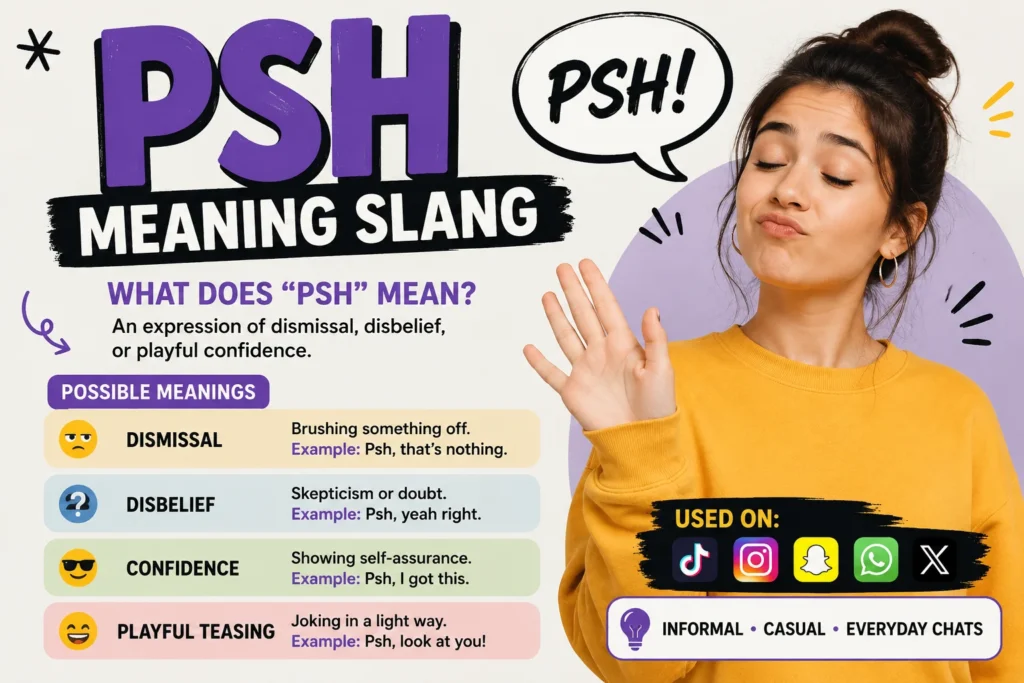
If you’ve searched “psh meaning slang,” the most common meaning is an expression of dismissal, disbelief, or mild annoyance—similar to saying “yeah, right,” “whatever,” or making a scoffing sound. People often search this term because its meaning changes depending on the conversation, tone, and platform, making it easy to misunderstand.
What Does “Psh” Mean in Slang?
The slang term “psh” is not an acronym. It isn’t short for multiple words. Instead, it’s an onomatopoeic slang expression, meaning it imitates a sound people make when reacting with skepticism, dismissal, or playful disbelief.
Unlike abbreviations such as “LOL” or “BRB,” “psh” represents an attitude rather than a phrase. In text conversations, it helps convey tone that might otherwise be difficult to express through plain words.
The meaning usually depends on context, but the most common interpretations include:
- Dismissing an idea as unimportant.
- Showing disbelief or skepticism.
- Playfully pretending something isn’t impressive.
- Expressing confidence, as if something is easy.
- Light teasing between friends.
For example:
A: I bet you can’t finish that game on hard mode.
B: Psh, watch me.
Here, “psh” communicates confidence mixed with playful dismissal.
Is “Psh” an Acronym, Abbreviation, or Slang Word?
Many people assume “psh” stands for something, but that’s incorrect.
| Type | Is “Psh” One? | Explanation |
|---|---|---|
| Acronym | No | It does not represent multiple words. |
| Abbreviation | No | It isn’t a shortened version of another word. |
| Slang word | Yes | It’s an informal conversational expression. |
| Sound expression | Yes | It imitates a scoffing or dismissive sound. |
Because it represents a vocal reaction rather than a sentence, you’ll often see it written differently depending on emphasis:
- psh
- Psh
- Pssh
- Pshh
- Psshh
These spelling variations usually indicate stronger emotion rather than different meanings.
The Most Common Meanings of “Psh”
1. Dismissal
This is the meaning people encounter most often.
Someone says “psh” to brush off an idea, opinion, or criticism.
Example:
A: You’re probably going to lose.
B: Psh. We’ll see.
The speaker isn’t necessarily angry—they’re dismissing the comment.
2. Disbelief
Sometimes “psh” expresses doubt that something is true.
Example:
A: He says he met that celebrity.
B: Psh, I don’t believe that.
Here it functions almost like saying “Yeah, right.”
3. Playful Confidence
Friends often use “psh” before making a confident statement.
Example:
A: Think you can solve it?
B: Psh, give me five minutes.
The tone is lighthearted rather than arrogant.
4. Friendly Teasing
Among close friends, “psh” can soften playful banter.
Example:
A: You’re getting old.
B: Psh, I’m still faster than you.
The intent is humor, not insult.
What Does “Psh” Mean on Different Social Platforms?
Although the meaning stays broadly similar, the way people use “psh” varies slightly across social media.
TikTok
On TikTok, “psh” commonly appears in comments, captions, and reply videos when creators jokingly dismiss something or react sarcastically.
Examples include:
- “Psh… that’s way too easy.”
- “Psh, who believed that?”
It’s frequently paired with humorous videos or exaggerated confidence.
Instagram users often include “psh” in comments between friends.
Typical examples include:
- “Psh, stop being so dramatic.”
- “Psh, you already knew.”
It usually signals playful teasing rather than genuine criticism.
Snapchat
Because Snapchat conversations are casual and fast-moving, “psh” often replaces facial expressions or vocal reactions.
Someone might reply:
“Psh 😂”
This combines dismissal with humor, making the message feel less serious.
On WhatsApp, “psh” is mostly used in conversations between friends or family members.
For example:
A: You never text first.
B: Psh, I texted yesterday.
The tone depends heavily on the relationship.
X (formerly Twitter)
On X, “psh” often appears in replies expressing skepticism or disagreement.
Examples include:
- “Psh, that’s not how it happened.”
- “Psh, nice try.”
Because posts are short, “psh” efficiently communicates attitude without a long explanation.
Grammar and Language Role
What Part of Speech Is “Psh”?
“Psh” functions primarily as an interjection.
Interjections express emotion or reaction rather than describing actions or objects.
Examples include:
- Wow!
- Ugh.
- Hmm.
- Psh.
Like these expressions, “psh” stands independently and doesn’t require grammatical agreement with the rest of the sentence.
Where Does It Usually Appear?
Most commonly, “psh” appears:
- At the beginning of a sentence.
- Before a response.
- By itself.
- Before a contrasting opinion.
Examples:
- Psh, that’s easy.
- Psh… no chance.
- Psh!
- Psh, you wish.
Can It Replace a Full Sentence?
Yes.
Because it expresses a complete emotional reaction, “psh” can stand alone.
For example:
A: You’re scared.
B: Psh.
The listener immediately understands the speaker is dismissing the accusation.
Formal or Informal?
“Psh” is highly informal.
It’s suitable for:
- Text messages
- Social media
- Group chats
- Casual conversations
- Friendly online gaming chats
It’s generally inappropriate for:
- Business emails
- Academic writing
- Professional reports
- Workplace presentations
- Formal customer communication
Where Did “Psh” Come From?
Unlike many internet slang terms, “psh” did not originate online.
Instead, it represents the written version of a dismissive scoffing sound that English speakers have used in speech for decades. Writers eventually began spelling this sound as “psh” (along with variants like “pshh” or “psssh”) to capture the same vocal reaction in text.
As texting, instant messaging, and social media became more common in the late 1990s and early 2000s, expressions like “psh,” “ugh,” “meh,” and “hmm” became popular because they helped people communicate tone without hearing someone’s voice.
Rather than replacing words, “psh” fills a conversational gap. It lets the reader imagine the speaker’s reaction before reading the rest of the message.
“Psh” in Internet Culture
Modern internet culture has helped “psh” remain relevant because short reaction words work well in fast-moving conversations.
Instead of typing a long response, someone might simply write:
“Psh.”
That single word can communicate disbelief, playful confidence, or light sarcasm depending on the conversation.
On short-form video platforms, creators often use on-screen text like:
“Psh… watch this.”
The expression builds anticipation before a surprising result or humorous twist. In memes and reaction posts, “psh” frequently appears alongside eye-roll emojis, laughing emojis, or exaggerated facial expressions to emphasize a dismissive attitude.
Importantly, “psh” is not tied to one specific online community or generation. Its continued popularity comes from how naturally it mirrors spoken conversation rather than from a single viral trend.
Tone Variations of “Psh”
Funny
A: I accidentally ate your fries.
B: Psh, “accidentally”? You finished the whole box.
A: I was hungry!
B: That’s the funniest excuse I’ve heard today.
Sarcastic
A: I’m never late.
B: Psh, you were late yesterday too.
A: That doesn’t count.
B: Convenient explanation.
Playful
A: Think you can beat me?
B: Psh, prepare to lose.
A: Big talk.
B: You’ll see soon enough.
Serious
A: Everyone says the rumor is true.
B: Psh, don’t believe everything you hear online.
A: Fair point.
B: Always check reliable sources first.
Real Chat Examples
Example 1 – Friends Planning a Game Night
A: You’re definitely losing tonight.
B: Psh, I’ve been practicing all week.
A: We’ll find out soon.
B: Can’t wait.
Example 2 – Siblings
A: Mom said you’re her favorite.
B: Psh, nice try.
A: Worth a shot.
B: Not convincing.
Example 3 – Snapchat Conversation
A: You forgot my birthday.
B: Psh, I was planning a surprise.
A: Really?
B: Check your mailbox tomorrow.
Example 4 – TikTok Comments
A: Nobody can cook this recipe perfectly.
B: Psh, challenge accepted.
A: Post the results.
B: Deal.
Example 5 – WhatsApp Group Chat
A: We should cancel the trip because it might rain.
B: Psh, we’ll bring umbrellas.
A: Fair enough.
B: Adventure doesn’t stop for a little rain.
Example 6 – X Reply
A: That movie is the worst film ever made.
B: Psh, you’ve clearly never seen some real disasters.
A: Give me recommendations.
B: Maybe another day!
Real Chat Examples (Continued)
Example 7 – College Classmates
A: You studied only one hour for the exam?
B: Psh, I reviewed the important chapters.
A: I hope that’s enough.
B: We’ll find out tomorrow.
Example 8 – Instagram Comments
A: You edited this photo too much.
B: Psh, it’s just better lighting.
A: That’s your story?
B: I’m sticking to it.
Example 9 – Coworkers (Casual Team Chat)
A: That report looks difficult.
B: Psh, we’ve handled tougher projects.
A: Good point.
B: Let’s finish it together.
Example 10 – Parent and Teenager
A: You can’t stay up all night gaming.
B: Psh, I wasn’t planning to.
A: I’m serious.
B: Okay, I’ll log off soon.
Example 11 – Friends Watching Sports
A: Our team has no chance of winning.
B: Psh, the game’s only halfway over.
A: You’re staying optimistic.
B: Until the final whistle.
How to Reply When Someone Says “Psh”
Your response should match the tone of the conversation rather than the word itself.
Funny Reply
- “Confidence level: 100%.”
- “We’ll see about that.”
- “I’ll remember you said that.”
Serious Reply
- “Let’s look at the facts first.”
- “I understand why you think that.”
- “That’s one way to see it.”
Flirty Reply
If the conversation is already playful:
- “Confident, aren’t you?”
- “I like the attitude.”
- “Trying to impress me?”
Avoid using flirty responses in professional or unfamiliar conversations.
Neutral or Unbothered Reply
- “Okay.”
- “Fair enough.”
- “If you say so.”
- “Let’s move on.”
Comparison Table
| Term | Meaning | Usage Context | Tone | Popularity | Confusion Risk |
|---|---|---|---|---|---|
| Psh | Dismissal, disbelief, playful confidence | Texts, social media, casual speech | Playful, sarcastic | High | Low |
| Meh | Indifference or lack of enthusiasm | Reviews, chats, comments | Neutral | High | Low |
| Ugh | Frustration or annoyance | Everyday conversations | Negative | Very High | Low |
| Yeah, right | Strong disbelief or sarcasm | Spoken and written conversations | Sarcastic | High | Medium |
| Whatever | Dismissal or unwillingness to argue | Casual disagreements | Dismissive | Very High | Medium |
| Absolutely (opposite) | Complete agreement or confidence | Formal and informal settings | Positive | Very High | Low |
Who Uses “Psh”?
Age Group Breakdown
While anyone can use “psh,” it appears most often among teenagers and younger adults who regularly communicate through text messages and social media.
- 13–18: Frequently used in playful banter, gaming chats, and social apps.
- 18–30: Common in messaging, memes, and casual workplace conversations.
- 30+: More common in speech than typed messages, though still recognizable.
Gen Z vs. Millennials
Gen Z
- More likely to pair “psh” with emojis, GIFs, or memes.
- Often uses it ironically or humorously.
- May combine it with reaction images or short-form video captions.
Millennials
- Tend to use “psh” similarly to spoken conversation.
- Often type it in text messages or Facebook Messenger chats.
- Less likely to exaggerate the spelling.
Regional Usage
United States
“Psh” is widely recognized in American English as a written version of a dismissive sound.
United Kingdom
It is understood by many internet users but appears less frequently than in American online conversations.
Global English
Because social media spreads informal English expressions quickly, “psh” is familiar to many English speakers worldwide, especially those active on international platforms. However, its frequency varies by community and language.
Platform Summary
| Platform | Common Usage |
|---|---|
| TikTok | Reaction captions, humorous confidence, sarcasm |
| Friendly teasing in comments and captions | |
| Snapchat | Casual conversations between friends |
| Informal chats with family and friends | |
| X | Skeptical or sarcastic replies to posts |
Safety and Appropriateness
Is “Psh” Rude?
Not inherently.
Most people view it as mildly dismissive rather than offensive. Whether it feels rude depends almost entirely on the relationship and the situation.
Among close friends, it usually comes across as playful. In a serious disagreement, however, it can sound disrespectful because it suggests you’re brushing off someone else’s opinion.
Is It Profanity?
No.
“Psh” contains no profanity or explicit language. It is generally considered a clean slang expression suitable for most audiences.
Is It Appropriate for School or Work?
In casual conversations with classmates or colleagues, it may be acceptable if your relationship is informal.
However, avoid using it in:
- Professional emails
- Academic papers
- Job interviews
- Customer service communication
- Formal presentations
Replacing respectful language with “psh” in these situations may appear unprofessional.
Cultural Sensitivity
Unlike some internet slang terms that originate within specific communities or dialects, “psh” is best understood as a written representation of a dismissive vocal sound. There is no well-documented evidence linking it to a single cultural or linguistic community. Using it casually does not generally raise cultural sensitivity concerns, though respectful communication is always important.
Real-World Observation
One reason “psh” has remained popular despite decades of changing internet slang is its flexibility. It communicates emotion instantly without requiring a complete sentence, making conversations feel closer to spoken language. In real chats, people rarely stop to define “psh” because the surrounding context usually reveals whether it means playful confidence, disbelief, or gentle dismissal. That adaptability has helped the expression survive multiple generations of online communication, from early instant messaging to today’s short-form videos and group chats.
Frequently Asked Questions
What does “psh” mean in texting?
In texting, “psh” usually expresses dismissal, disbelief, or playful confidence. It’s similar to saying “yeah, right,” “whatever,” or making a scoffing sound aloud. The exact meaning depends on the conversation and the relationship between the people chatting.
Is “psh” positive or negative?
It can be either. Between friends, it often sounds humorous or playful. During disagreements, however, it may seem dismissive or slightly rude because it downplays what another person has said.
Is “psh” an acronym?
No. “Psh” is not an acronym or abbreviation. It is an onomatopoeic slang expression that represents a vocal reaction rather than a shortened phrase.
Why do people type “psh”?
People use “psh” to communicate tone quickly in digital conversations. Since text messages don’t include facial expressions or vocal cues, expressions like “psh” help readers understand whether someone is joking, skeptical, or confidently brushing something aside.
What emoji goes well with “psh”?
Many people pair “psh” with expressive emojis such as 😂, 🙄, 😏, or 😅 depending on the intended tone. The emoji changes how readers interpret the message, making it feel more humorous, sarcastic, or playful.
Can “psh” be used in professional conversations?
Generally, no. Because it is informal slang, it doesn’t fit most workplace communication. It’s better suited to conversations with friends or informal online interactions.
Is “psh” still popular?
Yes. Although newer slang appears regularly, “psh” remains recognizable because it reflects a natural spoken reaction. Its simplicity has allowed it to stay relevant across different generations of internet users.
What does “psh” mean from a girl?
The meaning doesn’t change based on gender. It usually expresses playful dismissal, skepticism, or confidence. The surrounding conversation provides the real clue to the intended tone.
What does “psh” mean from a guy?
Again, the meaning depends on context rather than the speaker’s gender. A guy might use “psh” to joke with friends, dismiss a claim, or show confidence before making a statement.
Is “psh” sarcastic?
Often, yes. “Psh” frequently introduces sarcastic responses, especially when someone doubts or mocks a statement. However, it can also be completely playful without any negative intent.
What’s the difference between “psh” and “meh”?
“Psh” reacts to something by dismissing or doubting it, while “meh” expresses indifference or lack of enthusiasm. Although both are informal expressions, they communicate different emotions.
Conclusion
The slang term “psh” is a simple but expressive way to show dismissal, disbelief, playful confidence, or light teasing. Rather than being an acronym, it’s a written version of a natural vocal reaction that has become part of online conversations across texting apps and social media. Understanding the context is the key to interpreting its meaning correctly.
Usage Tips
- Use “psh” in casual conversations with friends or family.
- Pay attention to context before interpreting its tone.
- Pair it with emojis carefully if you want to make the tone clearer.
- Keep it out of formal or professional writing.
Common Mistakes
- Assuming “psh” is an acronym.
- Using it in business or academic communication.
- Interpreting every use as rude or sarcastic.
- Ignoring the surrounding conversation when deciding what it means.
When to Use It
Use “psh” when you want to express playful disbelief, confidence, or lighthearted dismissal in informal conversations.
When to Avoid It
Avoid using “psh” in professional settings, serious discussions, or situations where a dismissive tone could be misunderstood.